

TL;DR:
- Implementing systematic quality risk management and hazard analysis reduces formulation risks from ideation to manufacturing.
- Strategies like allergen control, scalable design, and supply chain resilience are essential for successful product launches and long-term success.
Launching a new product in the consumer goods space is equal parts science and strategy. You can invest months in R&D, nail your ingredient ratios, and still watch a launch collapse because of an allergen label gap, a supplier swap, or a batch that performs differently at manufacturing scale than it did in your lab. Formulation risk is not a side concern, it is the central challenge that separates brands that scale confidently from those that scramble to fix problems after products hit shelves. This article walks through six proven, actionable strategies to systematically reduce formulation risk from ideation through production.
Table of Contents
- Apply structured quality risk management (QRM))
- Leverage hazard analysis for targeted controls
- Strengthen allergen and labeling risk controls
- Design for scalability and distribution resilience
- Run effective risk-based experiments and scale-up logic
- Plan for resilience with alternate ingredients and sources
- What most formulation risk guides miss: The edge cases and scale-up traps
- Streamline your risk reduction with FormlyPro
- Frequently asked questions
Key Takeaways
| Point | Details |
|---|---|
| Prioritize structured QRM | Systematic risk management drives quality and compliance from concept to launch. |
| Apply targeted hazard controls | Refine risk controls using severity and likelihood to focus efforts efficiently. |
| Validate allergen and labeling procedures | Comprehensive ingredient and label review minimizes compliance gaps. |
| Build resilience at scale | Test and qualify alternate ingredients and processes for supply chain reliability. |
| Embrace empirical, risk-based scaling | Critical process parameter screening enables safe, confident market translation. |
Apply structured quality risk management (QRM)
Every successful risk reduction effort starts with a formal framework. Quality risk management, or QRM, is a systematic process for assessment, control, communication, and review of risks to product quality across the entire product lifecycle. What makes QRM genuinely powerful is its principle of proportionality: the depth of your documentation and the rigor of your controls should match the actual level of risk involved. You do not need a 40-page risk report for a low-risk color reformulation, but you absolutely need one for a product targeting sensitive populations.
Integrating QRM into your formulation workflow from the very beginning creates a traceable path between every scientific decision you make and the compliance outcome it produces. This matters enormously during audits, reformulations, or supplier changes.
Here is what a working QRM framework should address at each stage:
- Identify risks during raw material selection, before a single gram is weighed
- Analyze likelihood and severity using real data, not assumptions
- Evaluate which risks require active controls versus which can be monitored passively
- Document and communicate decisions to both your formulation and regulatory teams
- Review and update your risk profile whenever an ingredient, supplier, or process changes
Understanding formulation compliance for cosmetics or product compliance for launches becomes significantly easier when you have a QRM framework already encoding those requirements into your workflow.
Pro Tip: Build your QRM checklist before you finalize your ingredient list. Retroactive risk documentation is always more expensive and less accurate than prospective planning.
With a systematic QRM framework in place, the next step is to address specific hazards inherent to your formulation.
Leverage hazard analysis for targeted controls
QRM gives you the overarching structure. Hazard analysis sharpens the focus. By evaluating severity and likelihood of each potential failure point, you can allocate your resources to the controls that actually matter, rather than spreading effort equally across every theoretical risk.
Think of it like a HACCP (Hazard Analysis and Critical Control Points) approach applied to your formulation pipeline. In food and CPG (consumer packaged goods) development, this means identifying the points in your process where a hazard can be introduced, controlled, or eliminated, and then applying only the most relevant interventions at those critical junctures.
Here is how to run a targeted hazard analysis for a formulation project:
- List every input material and the known hazards associated with each, including chemical, microbiological, and allergen hazards
- Score each hazard on a simple severity scale (1 to 5) and a likelihood scale (1 to 5), then multiply to get a risk priority number
- Set control thresholds for any risk priority number above your acceptable limit, ensuring controls are specific and measurable
- Link each control to a compliance requirement, so your scientific decisions translate directly into traceable regulatory outputs
- Assign ownership for each control so accountability is clear across your formulation and quality teams
"A formulation that passes hazard analysis without clearly linked compliance outputs is only half-finished. The scientific and the regulatory cannot live in separate documents."
Staying on top of your regulatory compliance checklist is far more manageable when hazard analysis is built into your formulation process rather than bolted on afterward.
Pro Tip: Do not treat your hazard analysis as a one-time document. Revisit it every time you change an ingredient, a supplier, or a manufacturing step. A static hazard log creates a false sense of security.
Strengthen allergen and labeling risk controls
Allergen risk is one of the most underestimated formulation challenges, particularly for brands working with complex or multi-ingredient formulations. The FDA's food labeling inspection guidance specifically instructs investigators to review formulations and raw material labels for major allergens, and to document corrective actions when labels fail allergen declaration requirements. That is not a recommendation. That is a standard the agency actively enforces.
The problem is that allergen exposure is rarely obvious. It hides in incidental additives like flavorings, spices, and colorants, in processing aids that do not appear on a finished label, and in cross-contact scenarios at co-manufacturers. Brands that only check their primary ingredient list for allergens are leaving significant risk on the table.
To operationalize allergen risk reduction, focus on these controls:
- Raw material review: Every incoming ingredient, including multicomponent ones, must include an allergen declaration from your supplier
- Finished product label verification: Cross-check your finished label against your full formulation, not just your top-line ingredient list
- Supplier documentation audits: Request updated specs at least annually, or whenever a supplier changes their formulation or sourcing
- Cross-contact assessment: Evaluate shared production lines and equipment at your co-manufacturer or contract packager
The table below illustrates common allergen risk sources and the relevant control for each:
| Risk source | Common category | Recommended control |
|---|---|---|
| Multicomponent flavors | Incidental additives | Supplier allergen declaration per component |
| Shared processing equipment | Cross-contact | Written cross-contact policy from manufacturer |
| Spice blends | Complex raw materials | Full ingredient breakdown from supplier |
| Colorants (natural) | Incidental additives | Verify carrier and processing agents |
| Contract packaging materials | Environmental | Allergen cleaning validation records |
Understanding compliance for food and supplements requires treating allergen management as both a formulation problem and a supplier documentation problem simultaneously.
Design for scalability and distribution resilience
A formulation that works beautifully in your lab is not automatically a formulation that works at 10,000-unit production runs. Scaling introduces variability in mixing energy, temperature, processing time, packaging interactions, and raw material lot consistency. All of these variables affect product performance and stability in ways that controlled lab conditions simply cannot predict.

The goal is to design scalability targets into your development process from the start, rather than discovering compatibility issues during your first production run.
| Development stage | Key scalability risk | Mitigation approach |
|---|---|---|
| Lab formulation | Ingredient interaction under heat/shear | Pilot batch testing at varied process parameters |
| Pilot to production | Mixing uniformity at scale | Equipment-matched process parameter mapping |
| Packaging selection | Material-formula interaction | Real-use compatibility and migration testing |
| Distribution testing | Temperature and humidity exposure | Accelerated shelf-life studies pre-launch |
| Consumer use | Open-container preservation | Challenge testing under real-use conditions |
Preservation is a particularly common failure point. An antimicrobial system that meets your lab's challenge test may not perform adequately once a consumer opens the product and uses it over six months in a humid bathroom. Real-use scenario testing is not optional for serious risk reduction.
If you are developing brand formulations for health and beauty or managing ingredient sourcing and compliance, understanding how distribution conditions interact with your formula is a non-negotiable part of launch preparation.
Pro Tip: Test your formulation in its actual primary packaging under worst-case distribution conditions before you finalize your stability claims. You will catch packaging-formula interactions that accelerated lab testing alone will miss.
Run effective risk-based experiments and scale-up logic
Empirical, knowledge-driven screening of critical process parameters is one of the most effective tools for reducing development risk when translating formulations to industrial scale. Rather than making assumptions about how a process will behave at higher volumes, you systematically vary one factor at a time to isolate its effect on product quality.
This approach, often framed within Quality by Design (QbD) principles in pharmaceutical and nutraceutical development, identifies which process variables are truly critical versus which are incidental. Knowing your critical process parameters allows you to set tighter controls exactly where they matter and avoid over-engineering parameters that have little real impact on output quality.
A practical scale-up experiment sequence looks like this:
- Define your target product profile including specific quality attributes you cannot compromise on
- Map potential process parameters across mixing speed, temperature, processing time, and ingredient addition sequence
- Run single-factor experiments at bench scale to measure each parameter's impact on your target quality attributes
- Identify your critical process parameters and build allowable ranges for each into your manufacturing instructions
- Validate at pilot scale before full production, specifically testing the boundary conditions of your critical parameter ranges
Key stat: Research in pharmaceutical QbD scale-up demonstrates that structured, risk-based identification of critical process parameters significantly reduces batch failure rates during technology transfer compared to empirical scale-up without parameter mapping.
Using formulation analytics for faster R&D helps you move through this experimental phase faster by connecting your data points into a coherent picture of formulation performance rather than working from disconnected batch reports.
Plan for resilience with alternate ingredients and sources
Even a perfectly designed formulation becomes vulnerable when a key ingredient is suddenly unavailable. Supply chain disruptions, regional regulatory restrictions, and single-source supplier failures are not hypothetical risks, they are documented realities that brands in every category have faced over the past several years.
Industry note: Brands that had pre-qualified alternate ingredients and supplier pathways recovered from COVID-era supply disruptions significantly faster than those that scrambled to find substitutes only after their primary source failed.
A formulation that qualifies alternate ingredients and tests substitution pathways during development is a formulation built for market longevity. This includes your preservative system, your functional actives, and even your excipients (inactive carriers or fillers) if they come from single or restricted sources.
Resilience planning should include:
- Identify single-source dependencies in your current formulation before launch, not after a supply disruption
- Qualify at least one alternate supplier for each critical ingredient, with full documentation and compatibility testing
- Run side-by-side comparative testing to confirm the alternate ingredient produces equivalent product quality
- Track regional regulatory restrictions for ingredients that are approved in your primary market but restricted elsewhere if you have global ambitions
- Document substitution pathways formally, so your quality team can act quickly during disruptions without improvising
Your backup ingredient sourcing strategy and your quality compliance checklist should reference each other directly. A substitution that passes your quality check but fails a compliance requirement is not a viable backup.
What most formulation risk guides miss: The edge cases and scale-up traps
Most formulation risk guides focus on the obvious: check your allergen labels, run stability testing, document your suppliers. That is necessary advice, but it misses the cases that actually cause costly recalls and compliance failures.
The first overlooked area is allergen risk in multicomponent ingredients. Allergen exposure often hides in incidental additives like flavors, spices, and colorants, ingredients that appear as a single line on your raw material spec but may contain multiple sub-ingredients, each with its own allergen profile. A brand that only reviews its top-level ingredient list for allergens and relies on a single "allergen-free" declaration from a flavor supplier without verifying the full component breakdown is carrying hidden risk that no finished-product label review will catch.
The second trap is scaling with assumptions intact. Generic formulation changes made without explicitly testing the conditions that differ between lab and production, batch size, equipment type, mixing dynamics, and raw material lot variation, can surface catastrophic failures only after you have committed to full production. We have seen brands validate a preservation system at lab scale, scale up to 5,000 units without repeating the challenge test in actual manufacturing conditions, and then fail a third-party safety audit because the industrial mixer changed the emulsion structure in ways that compromised antimicrobial distribution.
The uncomfortable truth is that most formulation risk failures are failures of assumption testing, not failures of formulation science. The brand had good science. They just never tested what happened when their carefully controlled assumptions changed.
Formulation transparency is becoming a consumer expectation and a regulatory focus simultaneously. Brands that build their risk management practices around full-stack visibility, from raw materials through finished product labeling, will be significantly better positioned when regulators and consumers both start asking harder questions.
Streamline your risk reduction with FormlyPro
Applying all six of these strategies manually across a formulation pipeline requires significant coordination between your R&D, quality, compliance, and sourcing teams. Mistakes happen when these functions work in silos, and the cost of those mistakes at launch is nearly always higher than the cost of fixing them in development.
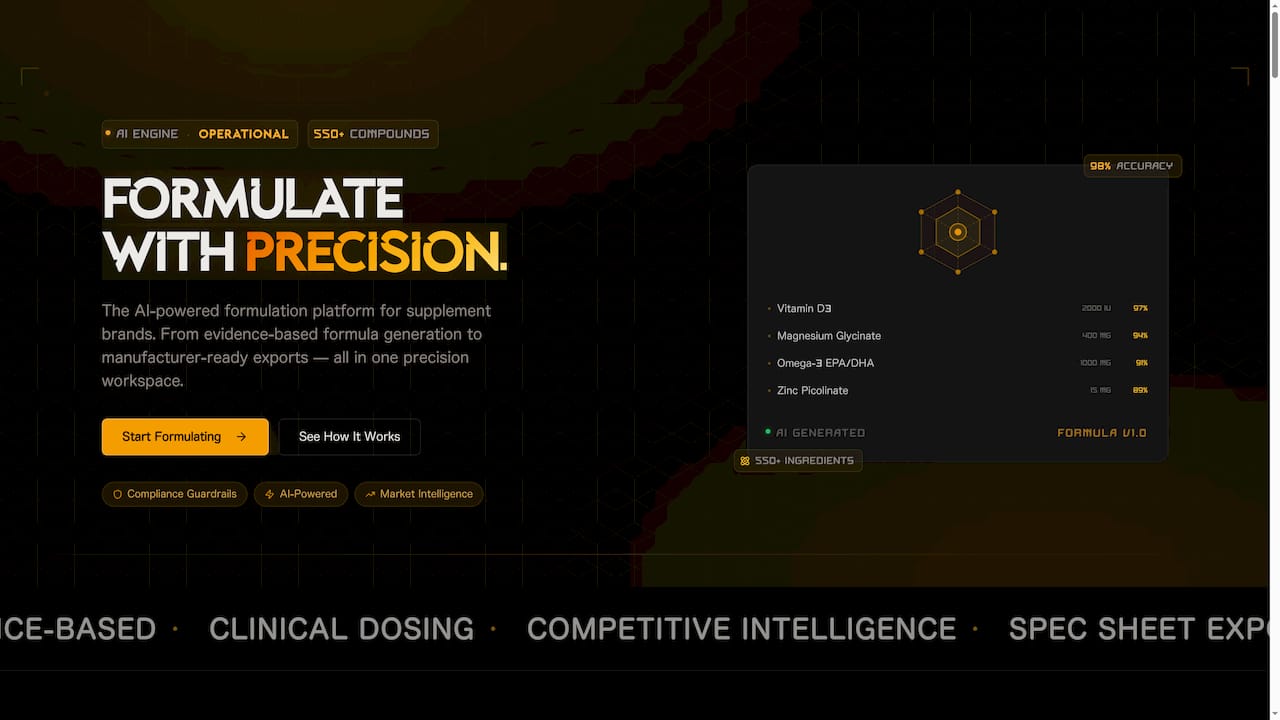
FormlyPro is built specifically for brand owners and product developers who need a structured, integrated system for formulation risk reduction. The FormlyPro platform supports you from ideation through production with an 8-phase development plan, built-in market and competitive analytics, compliance guidance tailored to your product category, supplier qualification tracking, and an AI-powered packaging mockup designer. Whether you are launching your first SKU or scaling an existing line, FormlyPro gives your team the infrastructure to manage risk systematically rather than reactively. Explore how the platform can become your formulation risk management backbone.
Frequently asked questions
What is the most effective way to reduce formulation risks?
A structured QRM process is the most effective approach, allowing systematic identification, analysis, and control of risks across the product lifecycle with proportional documentation effort matched to actual risk level.
How can brands manage allergen risks in complex formulations?
Brands should review all ingredients, including multicomponent and incidental additives, and ensure supplier documentation and finished-product labeling are both verified and compliant. FDA inspection guidance specifically targets formulation and raw material allergen review, not just finished-label checks.
Why is supply chain resilience important for formulation risk?
Supply disruptions can make even well-tested formulations vulnerable when a key ingredient becomes unavailable. Qualifying alternate ingredients and testing substitution pathways in advance is the most reliable way to minimize this exposure.
What's the best way to ensure scale-up success from lab to market?
Risk-based, knowledge-driven screening of critical process parameters is the key to successful industrial translation, ensuring you know exactly which variables control product quality before you commit to full-scale production.
How does formulation risk management impact regulatory compliance?
Risk management systems tie your scientific formulation decisions directly to compliance outcomes. Combining structured QRM with hazard analysis ensures reformulation outputs are traceable to compliance records, making audits faster and fewer surprises possible.