

TL;DR:
- Proper regulatory understanding and compliance integration are crucial for market success and cost savings.
- Choosing private label allows faster, lower-cost market entry, with options to move to custom formulation later.
- Rigorous stability testing and natural ingredient oversight prevent costly reformulations and ensure product quality.
Launching a health and beauty product without a solid formulation and compliance strategy is one of the most expensive mistakes a brand can make. Many new brands struggle with unstable formulations and costly relaunches due to missed regulatory steps, and the consequences range from product recalls to complete reformulation cycles that eat months of runway. This guide walks you through every critical stage, from regulatory mapping and formulation strategy to stability testing and launch optimization, so you can build a product that holds up in the market and on the shelf.
Table of Contents
- Understand regulatory frameworks and compliance essentials
- Choose your formulation strategy: Private label vs custom development
- Master the step-by-step formulation process
- Troubleshoot and optimize for market-ready performance
- Expert perspective: Why great formulations start with compliance and analytics
- Ready to build your next market-winning formula?
- Frequently asked questions
Key Takeaways
| Point | Details |
|---|---|
| Start with compliance | Understanding regulatory demands saves time and prevents costly reformulation. |
| Choose the right strategy | Private label suits fast launches, while custom formulations offer control and uniqueness. |
| Prioritize stability early | Stability testing and analytics should guide all R&D efforts to ensure market readiness. |
| Leverage the right partners | GMP-certified labs with integrated compliance services help ensure efficient, trouble-free launches. |
Understand regulatory frameworks and compliance essentials
Success in the health and beauty market starts with understanding your regulatory landscape. Most brands underestimate how dramatically the rules differ between regions, and that gap is where expensive mistakes happen.
The two most important frameworks you need to know are EU Regulation 1223/2009 and the US FDA's Modernization of Cosmetics Regulation Act (MoCRA). The EU vs US compliance gap is significant: the EU requires pre-market approval, a Cosmetic Product Safety Report (CPSR), a Product Information File (PIF), and bans over 1,600 substances, while the US operates on a post-market model with facility registration, safety substantiation, and roughly 11 banned substances under MoCRA as of 2026.
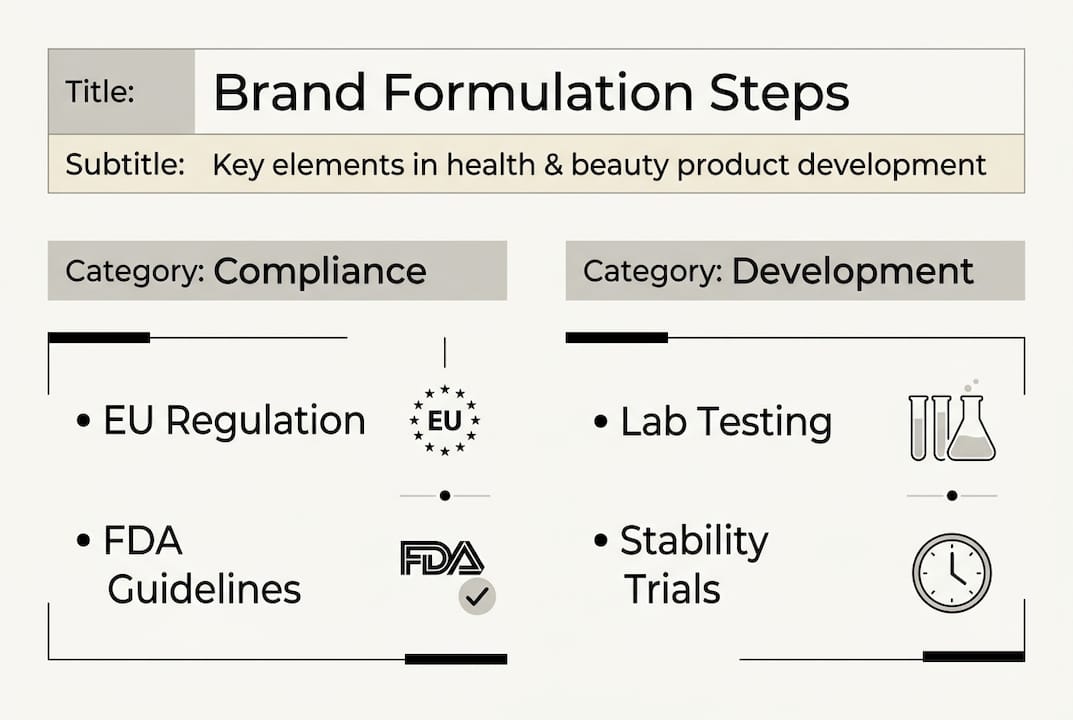
This is not just a paperwork difference. It changes when you need to act, what documentation you build, and which ingredients you can even consider.
| Requirement | EU (Reg 1223/2009) | US (MoCRA 2026) |
|---|---|---|
| Approval model | Pre-market | Post-market |
| Banned substances | 1,600+ | ~11 |
| Key documents | CPSR, PIF | Safety substantiation |
| Facility registration | Required | Required |
| Responsible person | Mandatory (EU-based) | Brand/manufacturer |
Here is what this means practically for your brand:
- If you plan to sell in the EU, your safety assessor must be qualified and your PIF must be complete before launch.
- If you are US-focused, your facility registration and safety records must be in place and accessible for FDA review.
- If you want to launch in both markets, you need to design your formulation to meet the stricter EU banned list from day one.
"Getting your compliance architecture right before you finalize any formula is not caution, it is competitive strategy. Brands that build compliance into R&D from the start consistently reach market faster."
Pro Tip: When designing for cross-market launch, always formulate against the EU banned substance list first. This automatically satisfies US requirements and eliminates the need for costly reformulation later. You can explore formulation compliance essentials and use a structured regulatory checklist to stay on track with compliance standards in 2026.
Choose your formulation strategy: Private label vs custom development
With the regulatory landscape mapped out, the next decision is whether to choose private label or custom formulation for your product vision. This choice affects your timeline, budget, and how much control you have over your brand's point of difference.
Private label means working with a manufacturer's existing, pre-tested formula and applying your branding to it. Custom formulation means developing a unique formula from scratch, tailored to your specific ingredient story, performance targets, and brand identity.

The cost and timeline differences are real. Private label vs custom development shows private label typically takes 4 to 8 weeks with low minimum order quantities, while custom formulation adds 20 to 40 percent to development costs, requires minimum order quantities of 3,000 to 5,000 units, and adds $500 to $8,000 in additional testing fees.
| Factor | Private label | Custom formulation |
|---|---|---|
| Development time | 4 to 8 weeks | 3 to 9 months |
| Cost premium | Base cost | 20 to 40% higher |
| MOQ | 1,000 to 5,000 units | 3,000 to 5,000 units |
| Formula ownership | Shared | Exclusive |
| Flexibility | Low | High |
To decide which path fits your business stage, work through these steps:
- Define your budget ceiling for product development and testing.
- Assess your timeline. Do you have a hard launch date or investor milestone?
- Identify your brand's core differentiator. Is it the formula itself or the positioning?
- Evaluate your manufacturing relationships. Do you have access to GMP lab partnerships that support custom work?
- Decide whether you need formula exclusivity to protect your competitive position.
Starting with private label is often the smarter strategic move, especially for first launches. It lets you validate your market positioning, build sales data, and generate cash flow before committing to the higher investment of custom development. Use formulation analytics to identify what is actually working in your category before you invest in a fully custom formula.
Pro Tip: Build your private label contract to include a transition clause. This lets you move to a custom formula with the same manufacturer once you hit a volume threshold, reducing downtime and protecting your customer relationships. Review market-ready steps to plan this transition strategically.
Master the step-by-step formulation process
Once you have chosen your formulation approach, it is time to turn your idea into a real, compliant, and stable product. Here is how the process unfolds in the lab and beyond.
Partnering with GMP-certified labs for integrated R&D, regulatory, and manufacturing support is one of the most effective ways to avoid reformulations and cut time-to-market. The structure of the process matters as much as the chemistry.
- Concept and brief: Define your product type, target consumer, key claims, and performance benchmarks.
- Ingredient research: Screen ingredients against your target market's banned lists and identify actives that support your claims.
- Bench development: Create initial prototypes at lab scale, testing for texture, pH, and basic compatibility.
- Stability and safety testing: Run accelerated and real-time stability studies before scaling.
- Scale-up trials: Move from bench to pilot batch, checking for consistency and process stability.
- Documentation: Build your PIF or safety substantiation file in parallel with development, not after.
Here is a breakdown of the key tests and what they reveal:
| Test type | What it reveals |
|---|---|
| Centrifugation | Emulsion stability and phase separation risk |
| pH monitoring | Formula drift and preservation effectiveness |
| Oxidation testing | Shelf life of oils and actives |
| Microbiology (challenge test) | Preservative efficacy and contamination risk |
| Viscosity measurement | Texture consistency across batches |
| Accelerated stability (40°C/75% RH) | Predicted shelf life under stress conditions |
Common failures in real-world formulation research show that most reformulation cycles happen because stability testing was delayed or skipped at the bench stage. Catching a phase separation issue at bench scale costs hours. Catching it after a full production run costs thousands.
Pro Tip: Run your stability testing in parallel with bench development, not sequentially. Placing samples under stress conditions from week one gives you data while you are still refining the formula, so you can boost product performance and course-correct before you commit to a final version. See research-backed formulation examples for real category benchmarks.
Troubleshoot and optimize for market-ready performance
Even the best-designed formulations encounter challenges in stability and market performance. Here is how to catch and correct them before launch.
The most common failure points are not exotic. They are predictable, and that means they are preventable. Emulgels and emulsions are particularly prone to phase separation within 60 to 90 days, while pH drift, color change, and microbial failures show up frequently, especially in formulas built around natural ingredients.
Natural ingredients introduce specific risks that synthetic formulas do not face at the same level. Plant-derived oils oxidize. Botanical extracts can feed microbial growth. Preservative systems that work in conventional formulas may not provide adequate coverage in high-water-activity natural products.
Here is a practical checklist for optimizing formula stability before launch:
- Select a preservative system validated for your specific pH range and water activity.
- Run a preservative efficacy test (PET) as a non-negotiable step, not an optional one.
- Monitor color, odor, and viscosity at 1-month, 3-month, and 6-month intervals.
- Test packaging compatibility. Some packaging materials interact with formula components and accelerate degradation.
- Conduct freeze-thaw cycling to simulate real-world shipping and storage conditions.
- Document every deviation from your target specification with a root cause analysis.
"Formulas using natural preservative alternatives showed a 35% higher rate of microbial challenge test failures compared to conventional systems, underscoring the need for rigorous PET protocols in natural beauty formulations."
Packaging is part of the stability equation too. Review packaging tips for stability to understand how material choices affect shelf life and compliance labeling.
Pro Tip: Stress-test your formula by exposing samples to temperature cycling (4°C to 45°C), UV light exposure, and high humidity simultaneously. Real-world performance rarely matches ideal lab conditions, and this approach surfaces failure modes that standard accelerated testing misses.
Expert perspective: Why great formulations start with compliance and analytics
After reviewing the essential steps and common pitfalls, here is what separates consistent brand leaders from the rest.
Most brands treat compliance and analytics as finishing steps. They build the formula, then check whether it passes. That sequence is backwards, and it is why so many brands face expensive late-stage reformulations or launch delays.
The brands that consistently reach market faster and with fewer setbacks are the ones that run regulatory review and formulation analytics from day one of R&D, not after the formula is finalized. They use competitor ingredient data to identify what is already working in the market. They map their formula against banned substance lists before they order raw materials. They treat stability testing and compliance analytics as inputs to the formulation process, not outputs.
This is not just about risk management. It is about speed. When your regulatory documentation builds in parallel with your lab work, you shave weeks off your timeline. When your analytics flag a trending active ingredient early, you get to market before the competition does. The brands winning in health and beauty right now are not the ones with the biggest budgets. They are the ones with the tightest integration between science, data, and compliance.
Ready to build your next market-winning formula?
You now have a clear roadmap: regulatory frameworks, formulation strategy, step-by-step lab process, and stability optimization. The next step is putting it into action with the right infrastructure behind you.
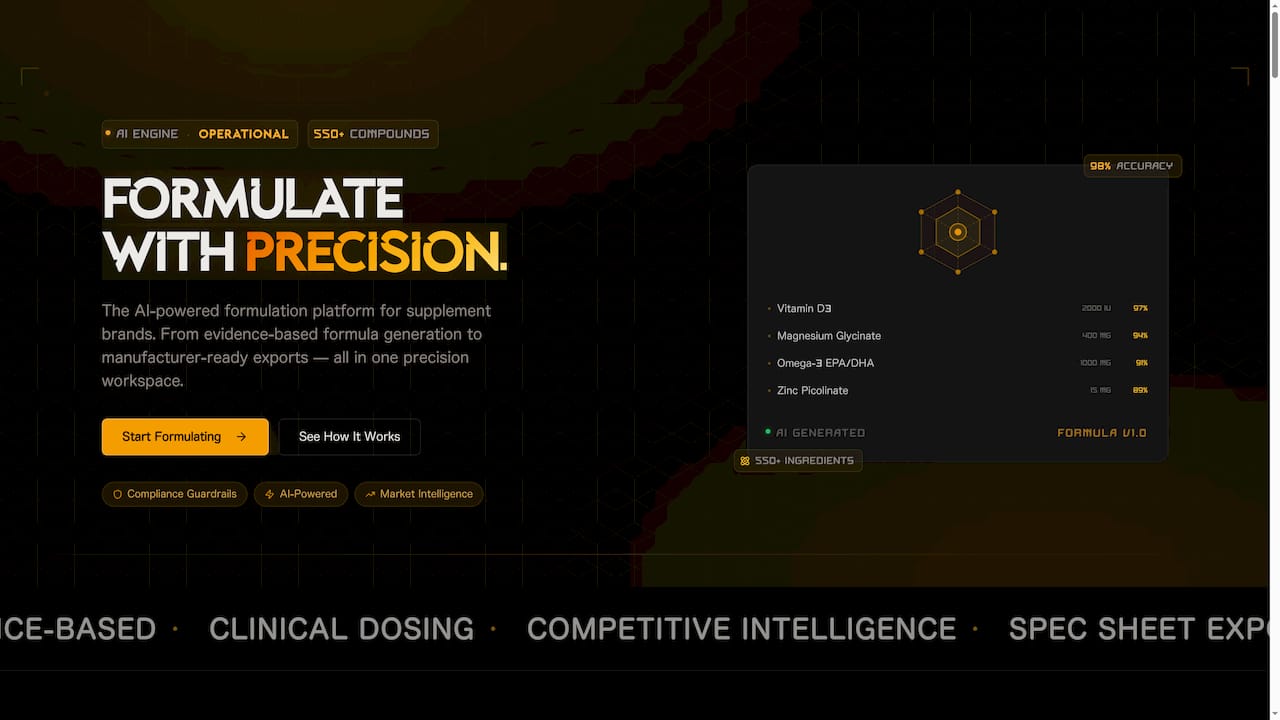
FormlyPro is built specifically for health and beauty brands that want to move from idea to market-ready product without the guesswork. The platform combines an 8-phase product development plan, real-time compliance guidance, competitor formulation analytics, and an AI-powered packaging mockup designer in one workflow. Whether you are validating a private label concept or scaling a custom formula, FormlyPro gives your team the research, compliance, and production tools to launch with confidence. Explore the platform and see how it fits your next product launch.
Frequently asked questions
What are the first compliance steps for a new health and beauty brand formulation?
Start by identifying all regulatory frameworks for your target market and review banned ingredient lists and required documentation before beginning formulation. The EU requires over 1,600 banned substances to be screened, while the US operates under MoCRA with approximately 11 banned substances.
Should I choose private label or custom formulation for my first launch?
Most startups benefit from private label to minimize cost and development time, then progress to custom formulations for brand differentiation. Private label is faster and cheaper while custom offers full formula control at a higher cost and longer lead time.
How do I ensure formulation stability with natural ingredients?
Use robust preservative systems, perform stability and centrifugation testing, and monitor for changes in color and pH over 60 to 90 days. Natural ingredients are less stable and require careful testing for separation and microbial growth.
What lab partnerships are critical for health and beauty brands?
Partner with GMP-certified labs that offer integrated R&D, compliance, and manufacturing to streamline product development. GMP-certified labs can cut time-to-market and help avoid costly reformulations.