

TL;DR:
- Small oversights like allergen mislabeling or outdated ingredients can lead to costly recalls and fines.
- Building compliance into every product development stage and maintaining thorough documentation helps brands stay audit-ready.
- Using dedicated tools and regular reviews ensures ongoing adherence to evolving regulations and upcoming labeling requirements.
One missed allergen declaration. One outdated ingredient order. One label placed on the wrong panel. Any of these small oversights can trigger a product recall, a regulatory fine, or a delayed launch that costs your brand months of momentum. Label mistakes are a leading cause of costly enforcement actions in the beauty, health, and food markets. This guide gives you a practical, step-by-step compliance checklist built specifically for brands in these industries. Whether you are formulating a new supplement, launching a skincare line, or bringing a food product to retail shelves, the steps below will help you stay compliant, market-ready, and ahead of the next regulatory update.
Table of Contents
- Establishing your compliance foundation
- Core checklist for food, beauty, and health products
- Labeling essentials: Best practices and upcoming changes
- Monitoring, documentation, and ongoing compliance
- The real-world compliance edge: Beyond the checklist
- Streamline compliance with the right tools
- Frequently asked questions
Key Takeaways
| Point | Details |
|---|---|
| Start with fundamentals | Set up proper documentation and assign clear compliance responsibilities early. |
| Master key checklist items | Focus on ingredient, allergen, and usage disclosures for all products. |
| Prepare for labeling changes | Stay alert to evolving requirements like the 2026 front-of-pack update. |
| No shortcuts on monitoring | Routine audits and up-to-date records keep your brand ready for any rule change. |
Establishing your compliance foundation
Compliance is not something you bolt on at the end of product development. The brands that avoid costly setbacks build their regulatory process into every stage, from the first ingredient decision to the final label proof. Before you launch anything, you need a solid foundation in place.
Here is how to build it:
-
Create a master documentation file. Every product needs a dedicated record that includes the full formulation, supplier certificates of analysis, safety assessments, and any testing results. FDA regulations require up-to-date documentation covering product identity, net quantity, and ingredient disclosures. If an inspector asks for your records, you should be able to pull them within minutes, not days.
-
Audit your labeling structure. Your label must clearly state the product's legal identity (what it actually is), the net quantity (weight, volume, or count), and a properly formatted ingredient list. For food and supplement brands, this means listing ingredients in descending order by weight. For cosmetics, the INCI (International Nomenclature of Cosmetic Ingredients) naming convention applies.
-
Assign a compliance owner. Someone on your team needs to own regulatory monitoring. The FDA issues updates, guidance documents, and proposed rules throughout the year. If no one is tracking these changes, you will find out about them the hard way. This does not have to be a full-time role, but it does need to be a named responsibility.
-
Check your exemption eligibility. Small businesses and low-volume producers may qualify for certain labeling exemptions under FDA rules. These exemptions can reduce your compliance burden significantly, but you still need documentation proving you qualify. Review the eligibility criteria carefully and keep those records on file.
-
Build a pre-launch compliance review into your timeline. Schedule a formal review of all labeling and documentation at least four weeks before your target launch date. This gives you time to correct issues without scrambling.
Pro Tip: Use a shared digital folder structure that mirrors your compliance checklist. When every document has a designated home, audits become routine instead of stressful.
Core checklist for food, beauty, and health products
With your foundation in place, here is the detailed checklist every compliant product needs. Requirements vary by category, but these core elements apply across food, beauty, and health products.
Universal label requirements:
- Legal product identity (common or usual name)
- Net quantity of contents (weight, measure, or count)
- Name and address of the manufacturer, packer, or distributor
- Complete ingredient list in the correct format
- Required warnings and directions for safe use
Allergen declarations for food and supplements:
Food products must list ingredients in descending order by weight and clearly identify any of the 9 major allergens: milk, eggs, fish, shellfish, tree nuts, peanuts, wheat, soybeans, and sesame. Sesame was added as the ninth major allergen under FASTER Act rules, which took effect in 2023. Many brands are still catching up on this one.
Industry-specific requirements by category:
| Category | Key requirement | Regulatory body |
|---|---|---|
| Food | Nutrition Facts panel, allergen labeling | FDA |
| Dietary supplements | Supplement Facts panel, structure/function claim disclaimers | FDA |
| OTC drugs | Drug Facts panel, active ingredient listing | FDA |
| Cosmetics | INCI ingredient listing, no drug claims | FDA |
| Functional beverages | Both Nutrition Facts and any health claim substantiation | FDA / FTC |
Health claims: Know the rules before you write copy.
This is where many brands get into trouble. There is a significant legal difference between a qualified health claim (which requires FDA authorization), a structure/function claim (which requires a disclaimer), and a disease claim (which is not allowed on food or supplements without drug approval). Using the wrong language on your label or website can reclassify your product as an unapproved drug. That is a serious enforcement risk.
For beauty brands, the line between a cosmetic and a drug is drawn by what your product claims to do. If your moisturizer claims to "reduce wrinkles by stimulating collagen production," you may have just turned it into an unapproved drug in the FDA's view.

Pro Tip: Run every marketing claim through a simple test: does this claim describe a physiological change in the body? If yes, you need to verify whether it crosses into drug claim territory before it goes on your label or your website.
Labeling essentials: Best practices and upcoming changes
Labeling is where compliance becomes visible to consumers and regulators alike. Getting it right means more than following today's rules. It means preparing for what is coming.
Nutrition Facts panel: What must be included.
For food and supplement brands, the Nutrition Facts (or Supplement Facts) panel is non-negotiable. Required elements include serving size, servings per container, calories, and percent daily values (%DV) for nutrients like fat, sodium, carbohydrates, protein, and key vitamins and minerals. The 2016 FDA update, which was fully enforced by 2021, introduced changes to how added sugars and vitamin D are reported. If your labels still reflect the old format, they are out of compliance.
PDP vs. information panel: Placement matters.
The Principal Display Panel (PDP) is the main face of your product, the part a consumer sees first on the shelf. The statement of identity and net quantity must appear here. Supporting information like the ingredient list, allergen statement, and manufacturer address goes on the information panel (the side or back label). Mixing these up is a surprisingly common mistake that can trigger a warning letter.
Upcoming changes you need to prepare for now.
"The FDA's proposed front-of-pack labeling for saturated fat, sodium, and added sugars is expected to come into effect as early as 2026."
This proposal would require a standardized, easy-to-read icon on the front of food packages indicating whether a product is high in these three nutrients. If finalized, it will affect packaging design, printing costs, and how you position products with higher sodium or fat content. Start modeling what this looks like on your current packaging now, before it becomes mandatory.
Visual clarity and legal fine print.
Font size minimums exist for a reason. The FDA specifies minimum type sizes for different label elements based on the size of your package. Tiny, hard-to-read ingredient lists are not just a consumer experience problem. They are a compliance problem. Make sure your designer understands these requirements before finalizing artwork.
Pro Tip: Build a label compliance checklist into your packaging approval workflow. Every label proof should be signed off against the checklist before it goes to print.
Monitoring, documentation, and ongoing compliance
Getting compliant is a milestone. Staying compliant is the ongoing work. Regulations change, product formulations evolve, and new guidance documents get issued. Here is how to keep your compliance status current.
Build a compliance calendar.
- Set annual review dates. At minimum, review all product labels and documentation once per year against current FDA requirements. Staying compliant means regularly checking your records against updated rules, especially as new enforcement deadlines approach.
- Track proposed rules. Subscribe to FDA email alerts or assign someone to review the Federal Register for proposed rules relevant to your category. Proposed rules often have a 12 to 24 month runway before enforcement, which gives you time to adapt.
- Document every formulation change. Any time an ingredient is swapped, a supplier changes, or a concentration is adjusted, that change needs to be logged and the label reviewed for accuracy. A formulation change that seems minor can affect allergen status, nutrient content, or claim validity.
- Conduct internal mock audits. Once or twice a year, walk through your product files as if you were an FDA inspector. Check that every document is current, every label matches the approved formulation, and every health claim has supporting substantiation on file.
Common audit pitfalls to avoid:
- Missing or outdated certificates of analysis from suppliers
- Labels that reference an old formulation after an ingredient change
- Health claims on your website that are not reflected in your label documentation
- No written procedure for handling consumer complaints or adverse event reports
- Supplement brands missing the required disclaimer: "This statement has not been evaluated by the Food and Drug Administration."
Training your team.
Compliance knowledge cannot live in one person's head. Cross-train at least two people on your core compliance requirements. Document your internal procedures so that if your compliance lead leaves, the knowledge stays with the company.
The real-world compliance edge: Beyond the checklist
Here is something most compliance guides will not tell you: the checklist is the floor, not the ceiling. Brands that treat compliance as a box-ticking exercise are always one regulatory update away from a scramble. The brands that consistently stay ahead treat compliance as a living part of their operations, not a one-time project.
The most damaging mistakes we see are not from brands that ignored the rules entirely. They come from brands that got complacent after a successful launch, or that misread a gray area and assumed they were fine. Ingredient substitutions that seem trivial can shift allergen status. A new marketing claim added to a product page without legal review can reclassify the product. These are not theoretical risks. They are the kinds of issues that generate warning letters and recalls.
The brands that thrive build compliance into their product development rhythm. Every formulation decision, every label update, every new claim gets reviewed against current requirements before it goes live. That discipline is what separates brands that scale cleanly from those that hit expensive walls.
Streamline compliance with the right tools
Manual checklists are a strong starting point, but they have limits when you are managing multiple SKUs, tracking regulatory updates across categories, and preparing for upcoming rule changes like the 2026 front-of-pack proposals.
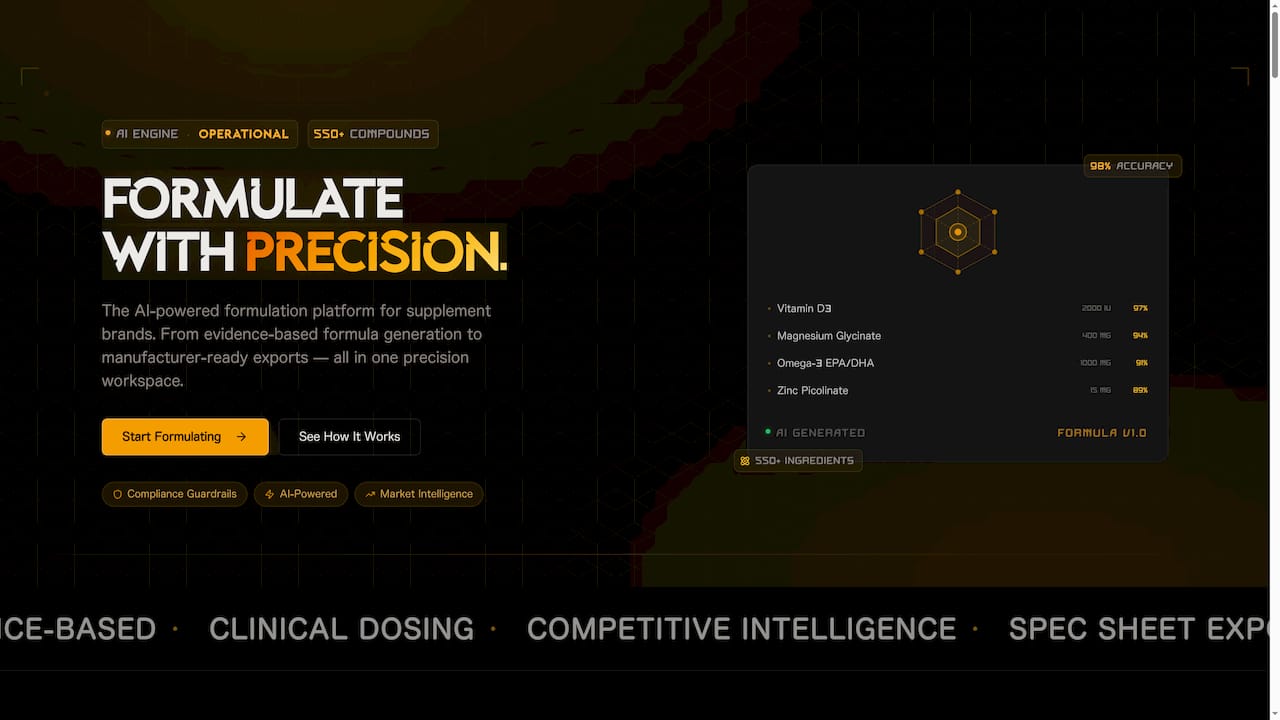
FormlyPro is built for exactly this challenge. The platform guides beauty, health, and food brands through every compliance requirement, from formulation documentation to label review, within an 8-phase product development framework. You get built-in market research, competitor analysis, and an AI-powered packaging mockup designer, all in one place. Instead of managing compliance in spreadsheets, you can track, update, and verify your regulatory status as your product evolves. If you are serious about launching clean and scaling fast, FormlyPro gives you the infrastructure to do it.
Frequently asked questions
What documents should I keep for regulatory compliance?
Keep detailed product formulations, supplier records, ingredient lists, and all past label versions for easy reference during audits. Documentation covers formulations, ingredients, and safety records as a core compliance requirement.
When do the new FDA front-of-pack labeling rules take effect?
The proposed front-of-pack rules covering saturated fat, sodium, and added sugars could be enforced as early as 2026, so brands should start preparing their packaging now.
How can small businesses apply for compliance exemptions?
Small or low-volume food producers should review FDA exemption eligibility criteria carefully and keep supporting records on file to demonstrate they qualify.
What are the biggest compliance pitfalls for new brands?
Missed allergen listings and outdated ingredient order mistakes are among the most common triggers for recalls and regulatory fines for new product launches.