

TL;DR:
- A rigorous formulation checklist focuses on documentation, process control, validation, traceability, and regulatory compliance.
- Checklist requirements differ between cosmetics and food, emphasizing claims substantiation for cosmetics and hazard analysis for food.
- Maintaining an evolving, well-documented, and validated checklist is essential for regulatory success and market readiness.
A single missed step in your formulation workflow can trigger a regulatory hold, a costly recall, or a product launch that never recovers. Scientists and formulators in cosmetics and food know this pressure intimately. The gap between a compliant, market-ready product and an expensive failure often comes down to one thing: the rigor of your checklist. This article lays out a field-tested, sequential formulation checklist built for regulated industries, compares cosmetics and food requirements side by side, and shows you exactly where most teams lose control of their process.
Table of Contents
- Key criteria for a robust formulation checklist
- Step-by-step: The essential scientist's formulation checklist
- Comparing checklists: Cosmetics vs. food industry needs
- Documentation, validation, and compliance: The scientist's backbone
- Why most formulation checklists fail and how to fix yours
- Supercharge your formulation workflow with FormlyPro
- Frequently asked questions
Key Takeaways
| Point | Details |
|---|---|
| Follow regulated criteria | A successful formulation checklist must align with industry regulations and quality standards. |
| Document every step | Meticulous documentation ensures audit-readiness and traceability for both food and cosmetics. |
| Customize for your field | While core steps are similar, tailor your checklist to specific challenges in food or cosmetics. |
| Build feedback loops | Continuously update your checklist based on real-world results and team input. |
| Leverage digital tools | Platforms like FormlyPro simplify checklist management, validation, and compliance. |
Key criteria for a robust formulation checklist
A formulation checklist is only as strong as the criteria it's built on. Vague or incomplete criteria produce checklists that look thorough but collapse under audit pressure. The foundation must cover five non-negotiable pillars: documentation, process control, validation, traceability, and regulatory fit.
Documentation means capturing every decision, change, and test result from first concept through scale-up. Process control means defining acceptable ranges for critical parameters like pH, viscosity, and temperature, and flagging deviations immediately. Validation confirms that your product does what you claim it does, under real-world conditions. Traceability links every ingredient batch to every finished lot. Regulatory fit means your checklist reflects the specific rules governing your product category, whether that's FDA cosmetics GMP or SQF food manufacturing standards.
The FDA GMP guidelines for cosmetics cover facilities, ingredient testing, and production and lab controls as baseline requirements. These aren't suggestions. They define the minimum standard your checklist must reflect. Similarly, SQF food manufacturing checklists enforce hazard analysis, prerequisite programs, and traceability as core requirements.
Tailoring your checklist to your specific sector matters more than most teams realize. A cosmetics checklist built on food GMP logic will miss critical steps around claims substantiation and preservation efficacy. A food checklist borrowed for a supplement will skip allergen controls that regulators will catch immediately. Understanding formulation compliance requirements for your category is the starting point, not an afterthought.
Key criteria your checklist must include:
- Product brief and claims definition with supporting evidence
- Ingredient screening for safety, regulatory status, and compatibility
- Process parameters with defined acceptable ranges and deviation protocols
- Stability and preservation testing protocols tied to claims
- Labeling review against applicable regulations
- Batch documentation and traceability from raw material to finished product
- CAPA (Corrective and Preventive Action) records for any deviations
Using a regulatory compliance checklist as a living document, not a static form, is what separates teams that pass audits from teams that scramble before them.
Pro Tip: Assign a version number and review date to every checklist. When regulations update, your checklist should update within 30 days. Treat it like a controlled document, because regulators do.
Step-by-step: The essential scientist's formulation checklist
With the criteria defined, here's the actionable checklist leading from initial concept to finished, compliant product. Each stage builds on the last. Skipping or rushing any step creates compounding risk downstream.
- Define the product brief. Specify the target consumer, intended claims, regulatory category, and budget constraints. Every formulation decision flows from this document. Ambiguity here creates rework at every later stage.
- Conduct ingredient screening. Verify each ingredient's regulatory status in your target markets, check for known incompatibilities, and confirm supplier specifications and certificates of analysis. Don't assume prior approvals transfer across categories.
- Develop the prototype. Record every batch variation, including pH, viscosity, appearance, and odor. Capture the exact process parameters used. This is your baseline for all future comparisons.
- Run stability testing. Test under real-time and accelerated conditions. For cosmetics, this includes freeze-thaw cycling and high-temperature storage. For food products, water activity and microbial challenge testing are non-negotiable.
- Validate preservation efficacy. For cosmetics, run a challenge test (USP 51 or equivalent). For food, validate against your HACCP critical limits.
- Complete scale-up validation. Confirm that bench-scale parameters hold at pilot and commercial scale. Document every deviation and the corrective action taken.
- Conduct GMP compliance review. Cross-reference your formulation and process against applicable GMP requirements. The FDA GMP inspection checklist is a practical reference for cosmetics teams.
- Review labeling. Confirm ingredient declarations, claims, warnings, and net quantity statements against current regulations.
- Establish traceability. Link every raw material lot to the corresponding batch production record.
- Implement post-market surveillance. Set up a system to capture consumer complaints, adverse events, and field returns. This feeds directly back into your CAPA process.
"The best formulation teams treat their checklist as a feedback engine, not a sign-off sheet. Every post-launch data point is an opportunity to improve the next product cycle."
For a structured approach to building step-by-step market-ready formulations, the sequence above applies across both cosmetics and food categories. Teams working through brand formulation steps for the first time will find that stages 1 through 3 consume more time than expected, mostly because brief definition is underestimated.
Pro Tip: Every change to a formula, even a minor supplier switch, requires a documented change control record. Auditors specifically look for undocumented changes as evidence of process weakness.
Comparing checklists: Cosmetics vs. food industry needs
Following a universal checklist is the goal, but sector requirements shape key steps. Both industries share a core framework, but the specific controls, regulatory references, and risk priorities diverge significantly.
| Checklist area | Cosmetics | Food manufacturing |
|---|---|---|
| Ingredient vetting | Safety, INCI compliance, EU/FDA status | GRAS status, allergen declaration, supplier approval |
| Stability testing | Accelerated, real-time, freeze-thaw | Shelf-life, water activity, microbial challenge |
| Hazard analysis | Safety assessment (EU Regulation 1223/2009) | HACCP critical control points |
| Allergen management | Limited (fragrance allergens) | Mandatory declaration, cross-contact controls |
| Claims substantiation | Clinical or in-vitro evidence required | Nutrient content, health claims (FDA/EFSA) |
| Traceability | Batch records, ingredient lots | Full supply chain, farm to fork |
| Post-market monitoring | Adverse event reporting | Recall protocols, FSMA requirements |
| Training records | GMP-based competency | SQF prerequisite programs, food safety culture |
SQF food manufacturing standards place heavy emphasis on HACCP, prerequisite programs, and documented training as foundational requirements. Cosmetics checklists, by contrast, weight claims substantiation and preservation efficacy more heavily.
Key differences worth noting:
- Allergen controls are a legal mandate in food, not just a best practice
- HACCP is a regulatory requirement for food but a voluntary best practice for most cosmetics
- Claims evidence in cosmetics requires consumer perception studies or clinical data; food claims require nutrient analysis and regulatory pre-approval in many markets
- Post-market surveillance in food is driven by FSMA recall requirements; in cosmetics it's driven by adverse event reporting obligations
For real-world formulation examples across both sectors, the structural differences become very clear at the hazard analysis and claims stages. Understanding food compliance importance is especially critical for teams crossing over from cosmetics into functional food or supplement development. You can also reference the full food manufacturing checklist directly from SQF for a complete sector-specific reference.
Documentation, validation, and compliance: The scientist's backbone
Whether food or cosmetics, your checklist must ensure compliance through airtight records and ongoing validation. Documentation is not a bureaucratic burden. It is your primary defense in any regulatory inspection, recall event, or legal challenge.

The documentation trail must run from R&D through commercial scale-up without gaps. Every ingredient specification, batch production record, in-process test result, and CAPA must be captured, version-controlled, and retrievable. The FDA GMP framework is explicit: incomplete or missing records are treated as evidence of non-compliance, regardless of whether the product itself is safe.
Required record types for a compliant formulation program:
| Record type | Purpose | Retention requirement |
|---|---|---|
| Ingredient specifications | Verify supplier quality and regulatory status | Life of product + 1 year |
| Batch production records | Link process to finished product | 2 years minimum (FDA) |
| Stability test reports | Support shelf-life and claims | Life of product |
| Preservation efficacy data | Demonstrate microbiological safety | Life of product |
| CAPA records | Document deviations and corrective actions | 3 years minimum |
| Training records | Demonstrate personnel competency | Duration of employment + 2 years |
Validation goes beyond documentation. It means generating objective evidence that your process consistently produces a product meeting all defined specifications and claims. A formula that performs in the lab but fails at scale is not validated. A claim that isn't backed by a controlled test is a liability.
Key statistic: Studies on FDA warning letters and recall data consistently show that the majority of enforcement actions cite inadequate records or missing validation data as primary findings, not product safety failures. The product was often fine. The paperwork wasn't.
For a practical walkthrough of building these systems, the compliance guide covers the core documentation architecture for both food and cosmetics teams.
Why most formulation checklists fail and how to fix yours
Here's the uncomfortable reality: most formulation checklists fail not because they're missing steps, but because they're treated as one-time artifacts. Teams build a checklist for a product launch, check every box, file it away, and never look at it again. The checklist becomes a compliance prop rather than a working tool.
The second failure mode is excessive rigidity. Checklists designed to cover every possible scenario become so long and complex that scientists start skipping sections under time pressure. A 47-item checklist that nobody uses is worse than a focused 15-item checklist that gets completed every time.
The fix is building feedback loops directly into your checklist process. After every product launch, schedule a structured review with your cross-functional team, including R&D, regulatory, quality, and marketing. Ask what the checklist caught, what it missed, and what slowed you down. Update the document. Version it. Repeat.
Teams that focus on optimizing product development treat their checklist as a living system, not a static form. The best checklists evolve with every product cycle, incorporating real field data and post-market findings.
Pro Tip: Schedule a quarterly checklist review with your quality and regulatory leads. Even a 30-minute session will surface outdated requirements and process gaps before they become audit findings.
Supercharge your formulation workflow with FormlyPro
Putting a rigorous checklist into practice requires more than a spreadsheet. It requires a system that connects your formulation data, compliance requirements, and market intelligence in one place.
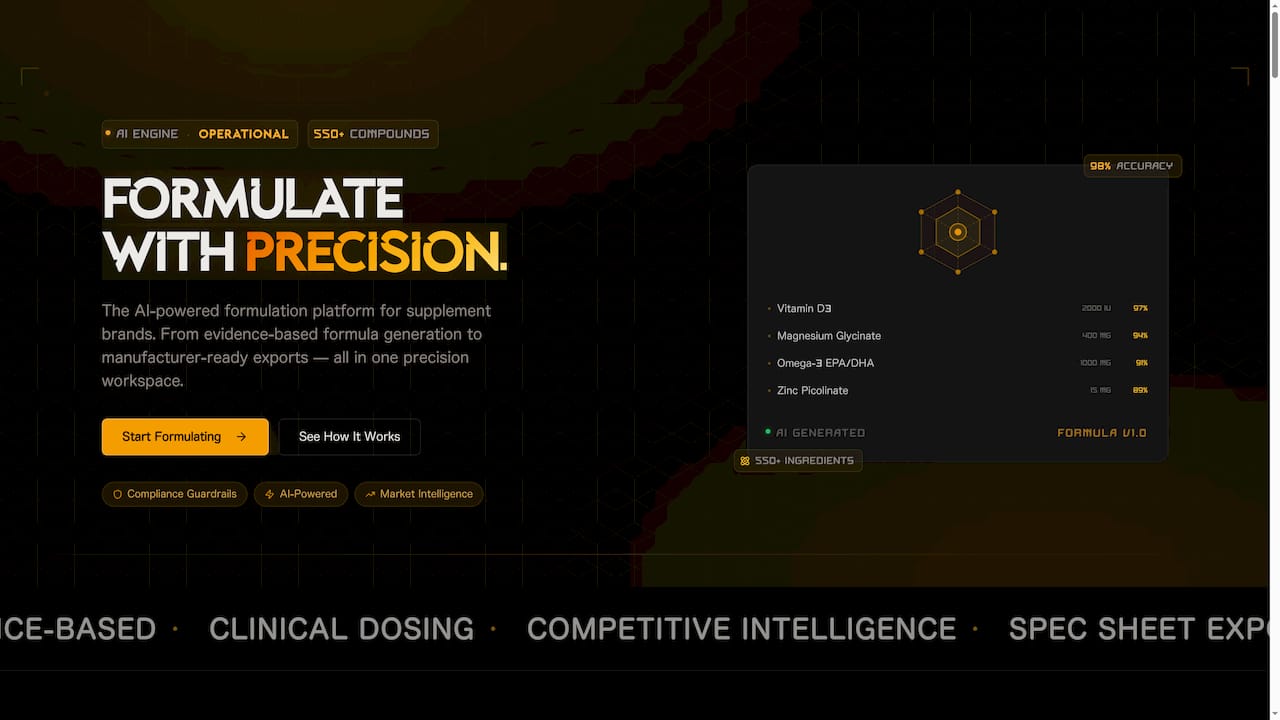
The FormlyPro platform is built for exactly this workflow. From product brief to post-market monitoring, FormlyPro guides you through an 8-phase development process with built-in compliance checks, competitor analysis, and documentation tools. The AI-powered packaging mockup designer and integrated market research mean your checklist doesn't just keep you compliant. It keeps you competitive. If you're ready to move from manual checklists to a structured, audit-ready workflow, FormlyPro is where that starts.
Frequently asked questions
What are the top five steps in a formulation checklist for scientists?
Define the product brief, select proven ingredients, develop a prototype, validate compliance and stability, then ensure accurate documentation and post-launch monitoring. The FDA GMP checklist outlines these as foundational requirements for cosmetics teams.
How are food and cosmetics formulation checklists different?
Food checklists focus on HACCP and allergen controls, while cosmetics stress product claims, preservation, and labeling. SQF food standards require prerequisite programs and food safety culture documentation that have no direct cosmetics equivalent.
Why is documentation so important in formulation checklists?
Documentation is your primary defense during audits, recalls, and regulatory inspections. The FDA GMP framework treats missing or incomplete records as direct evidence of non-compliance, independent of product quality.
What is the role of validation in a formulation checklist?
Validation confirms the product consistently meets all claims, safety standards, and regulatory requirements before market release. It bridges the gap between lab performance and commercial-scale reliability.