

TL;DR:
- Product recalls often stem from poor compliance integration throughout development rather than lack of care.
- Embedding compliance in every phase of product development enhances market access, safety, and brand trust.
- Using a structured approach with proper frameworks, methodologies, and documentation enables proactive regulation management and competitive advantage.
Product recalls don't happen because teams didn't care. They happen because compliance was treated as a final checkpoint rather than a built-in discipline. 83% of FDA device recalls in 2024 involved design and manufacturing nonconformities, which means the problem started long before any submission crossed a regulator's desk. For product developers and brand managers in regulated industries, compliance is not a formality. It is the architecture that determines whether your product reaches market, stays on shelves, and earns lasting consumer trust. This guide gives you a clear, practical framework to build compliance into every phase of development.
Table of Contents
- What is compliance in product development?
- Core compliance frameworks and standards
- Methodologies for compliant product development
- Practical steps: embedding compliance from planning through launch
- Why strategic compliance pays off: what most guides don't tell you
- Make compliance your competitive advantage with FormlyPro
- Frequently asked questions
Key Takeaways
| Point | Details |
|---|---|
| Compliance is strategic | Proactive compliance unlocks market growth, protects your brand, and enables innovation. |
| Choose the right framework | Match compliance standards like FDA or ISO to your product's risk category and market. |
| Methodology matters | Hybrid development approaches with good tools provide both speed and audit-ready documentation. |
| Stepwise integration is best | Weave compliance into every development phase, from planning to post-launch monitoring. |
What is compliance in product development?
Compliance means your product meets every applicable law, regulation, and industry standard throughout its entire development lifecycle. Not just at launch. Not just during audits. At every phase, from initial concept through post-market monitoring.
For regulated industries like food, supplements, medical devices, and cosmetics, why compliance matters goes far beyond avoiding fines. Non-compliance can pull your product from shelves, trigger costly recalls, and permanently damage the brand equity you worked years to build. The financial and reputational consequences are not theoretical. They are routine for teams that underestimate what compliance actually demands.
Compliance spans five core dimensions:
- Regulatory approval: Meeting the legal requirements to sell in your target market
- Consumer safety: Ensuring your product performs as intended without causing harm
- Documentation integrity: Maintaining records that prove every decision was deliberate and traceable
- Cross-functional alignment: Involving legal, quality, R&D, and operations from day one
- Post-market vigilance: Monitoring performance and responding to issues after launch
The biggest myth in product development is that compliance is a paperwork exercise you hand off to a quality team at the end. It is not. It is a cross-functional discipline that shapes how you design, test, and document your product at every stage.
Statistic callout: Teams that follow a structured regulatory compliance checklist from the planning phase are significantly less likely to face audit penalties or market withdrawal.
FDA-compliant product development follows a 5-phase roadmap covering assessment, strategy, integration, documentation, and monitoring. Understanding that roadmap early is what separates brands that scale from brands that stall in remediation. Compliance is not a cost of doing business. It is the mechanism through which your business earns the right to operate.
Core compliance frameworks and standards
Not all compliance frameworks are created equal, and selecting the wrong one for your product category is a costly mistake. The framework you choose should match your product's risk class, intended market, and regulatory environment.
Here is a comparison of the most widely used frameworks in regulated product development:
| Framework | Scope | Key documentation | Best for |
|---|---|---|---|
| FDA 21 CFR | US market approval | Design history file, DHF, DMR | Devices, supplements, food |
| ISO 13485:2016 | Medical device quality systems | Design controls, CAPA records | Medical devices globally |
| ISO 9001:2015 | General quality management | Process documentation, audits | Broad manufacturing sectors |
| GMP (cGMP) | Manufacturing processes | Batch records, SOPs | Pharma, supplements, food |
| ISO 22000 | Food safety management | Hazard analysis, control plans | Food and beverage brands |
ISO 13485:2016 Clause 7.3 outlines design and development controls that require planning, design reviews, verification, validation, and a formal process for managing design changes. For medical device teams, this clause alone defines much of your compliance workload.
How do you decide which framework applies? Follow this process:
- Identify your product category and its risk classification
- Determine your primary market and its governing regulatory body
- Map secondary markets and any mutual recognition agreements
- Assess your current quality system against the framework's requirements
- Engage a regulatory specialist to validate your framework selection before committing resources
For supplement brands specifically, certifications and testing requirements vary by ingredient type, claim category, and distribution channel. A framework that works for a device brand will not automatically translate to a supplement workflow.
Pro Tip: Do not default to the most rigorous framework just to appear thorough. Align your selection with your product's actual risk class. Over-engineering compliance for a low-risk product wastes resources. Under-engineering it for a high-risk product creates liability.
The ISO certification impact on audit outcomes and retailer acceptance is measurable. Certified brands move through procurement and distribution partnerships faster because third-party validation reduces perceived risk for buyers.
Methodologies for compliant product development
How your team manages the development process has a direct effect on compliance outcomes. Three primary methodologies dominate regulated product development, and each carries distinct advantages and risks.
Waterfall is a sequential, phase-gated approach. Every stage must be completed and documented before the next begins. This creates high traceability and a clean audit trail, which is exactly what regulators want to see. It works best for hardware-heavy products, high-risk medical devices, and any product where design changes mid-development are extremely costly. The downside is rigidity. If market requirements shift, adapting is slow.

Agile breaks development into iterative sprints, allowing teams to test, learn, and adjust quickly. For software-based products and lower-risk categories, this speeds innovation. The compliance risk is documentation lag. Teams move fast and forget to record decisions, which creates gaps that become serious problems during audits.
Hybrid combines both. You maintain the documentation discipline of Waterfall while using Agile sprints for specific workstreams like formulation testing or UX development. This is increasingly the preferred approach for market-ready formulations in complex regulated categories.
| Methodology | Best for | Compliance strength | Key risk |
|---|---|---|---|
| Waterfall | Hardware, high-risk devices | High traceability | Slow to adapt |
| Agile | Software, low-risk products | Speed to market | Documentation gaps |
| Hybrid | Mixed systems, supplements | Balanced audit readiness | Requires discipline |
In regulated industries, Waterfall suits hardware and high-risk devices for structured documentation, Agile works for software and low-risk products with embedded traceability, and Hybrid addresses mixed systems.
"The methodology you choose doesn't just affect speed. It determines whether your compliance records will hold up under scrutiny."
Electronic Quality Management System tools, known as eQMS platforms, support traceability and documentation across all three methodologies. If your team is running Agile sprints, an eQMS enforces the documentation habits that prevent compliance failures. Understanding lab product certifications is also essential when your methodology involves iterative prototype testing, since each test cycle may trigger new documentation requirements.
Practical steps: embedding compliance from planning through launch
Knowing the frameworks and methodologies is necessary. Executing them without gaps is where most teams struggle. Here is a stepwise approach to embedding compliance from day one.
- Conduct a compliance assessment. Before any design work begins, map your product against applicable regulations, identify gaps in your current quality system, and define your documentation requirements.
- Map all regulatory requirements. Build a requirements traceability matrix that links every product specification to a regulatory obligation. This becomes your audit backbone.
- Integrate controls into design. Do not add controls after the design is finished. Build verification checkpoints, failure mode analysis, and design reviews into the development schedule.
- Develop documentation in real time. Every decision, change, and test result should be recorded as it happens. Retroactive documentation is a red flag in any audit.
- Perform structured verifications and validations. Verification confirms your product was built correctly. Validation confirms it performs correctly in real-world conditions. Both are required.
- Prepare regulatory submissions. Compile your design history file, test reports, and labeling documentation well ahead of submission deadlines.
- Establish post-market monitoring. Build a system to track complaints, adverse events, and field performance. Regulators expect this infrastructure to be active, not theoretical.
The most common pitfalls are documentation gaps, inadequate staff training on compliance procedures, and failure to track design changes formally. Each one is preventable with the right systems in place.
Rigorous documentation reduces audit penalties by up to 41%, which makes a strong case for treating your document management system as a core business asset, not an administrative burden.
Pro Tip: Bring your compliance lead into the planning meeting, not the review meeting. Teams that involve compliance expertise at ideation spend far less time in remediation later.
Your compliance checklist should be a living document that evolves with your product and your market. Static checklists become obsolete. Dynamic ones keep your team audit-ready at every stage. A structured drug screening workflow approach, for example, shows how systematic process design prevents gaps that create liability.
Why strategic compliance pays off: what most guides don't tell you
Most compliance guides stop at the mechanics. Here is what they leave out.
Teams that treat compliance as a cost center consistently underinvest in it until a recall or enforcement action forces their hand. By that point, the remediation cost dwarfs what proactive compliance would have required. The math is not complicated. The behavior is.
The brands that win in regulated markets are not the ones with the most sophisticated formulations. They are the ones whose compliance infrastructure lets them move faster, enter new markets with less friction, and build retailer and consumer trust that compounds over time. Compliance done right is a market access accelerator, not a brake.
The uncomfortable truth is that most teams know this and still delay. Compliance feels abstract until it isn't. A warning letter, a shelf pull, or a failed audit makes it very concrete very quickly. The deeper compliance steps that separate proactive brands from reactive ones are not technically complex. They require organizational commitment and the right systems.
When compliance is embedded early, it becomes a filter that improves product quality, sharpens positioning, and reduces the cost of every subsequent development cycle. That is not bureaucracy. That is competitive advantage.
Make compliance your competitive advantage with FormlyPro
Building a compliance-first product development process is significantly easier when your platform is designed for it from the ground up.
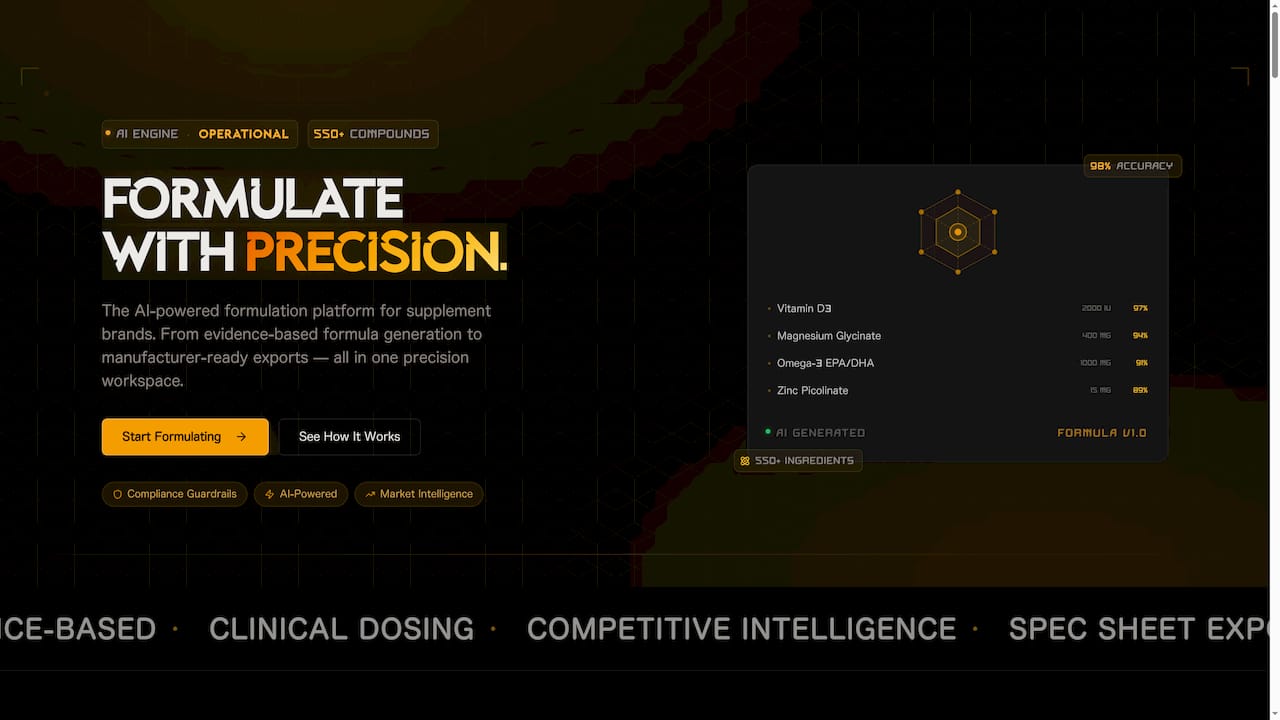
FormlyPro gives regulated brands a purpose-built environment to manage formulations, compliance guidance, market research, and competitor analysis in one place. The 8-phase development plan walks your team from ideation through production, with compliance checkpoints built into every stage, not bolted on at the end. You also get AI-powered packaging design and custom mockup tools so your brand presentation matches your compliance rigor. If you are ready to move from reactive compliance to a system that gives you a real market edge, explore how the market-ready formulations guide and FormlyPro's platform work together to get your product launch-ready.
Frequently asked questions
What is the difference between regulatory compliance and quality assurance?
Regulatory compliance ensures your product meets legal and industry rules set by external bodies, while quality assurance focuses on internal standards and consistent product performance. ISO 13485 Clause 7.3 makes clear that both must work together in regulated product development.
Which compliance framework should I use for a new supplement product?
For US distribution, FDA regulations and cGMP requirements apply. For broader international markets, FDA's 5-phase roadmap combined with ISO 9001 or ISO 22000 provides a strong foundation. Always verify local market requirements before finalizing your framework.
Does Agile product development risk compliance failures?
Agile can create compliance gaps if documentation is not maintained in real time. Embedded traceability and eQMS tools make Agile workable in regulated environments without sacrificing audit readiness.
How can we reduce the risk of product recalls?
Verification at every design stage, formal change control, and thorough documentation are your best defenses. Rigorous documentation reduces audit penalties by up to 41% and significantly lowers recall risk across regulated product categories.