

TL;DR:
- Common formulation mistakes include incorrect ingredient ratios, regulatory oversights, and poor documentation.
- Catching errors early in development reduces costly recalls, rework, and compliance issues.
- Using structured processes, digital tools, and cross-team communication enhances formulation success.
Launching a food or beverage product means walking a tightrope between innovation and compliance, and one misstep in the formulation stage can cost your brand months of rework, a failed regulatory submission, or a product recall. The gap between a promising concept and a market-ready SKU is wider than most teams expect, and the mistakes that widen it are rarely exotic. They are repeatable, predictable, and preventable. This article maps the most damaging formulation pitfalls, compares their downstream impact across development stages, and gives you actionable strategies to keep your next launch on track.
Table of Contents
- Identifying the criteria for a successful formulation
- Top 7 formulation pitfalls in food and beverage development
- Comparison: Impact of pitfalls across product stages
- How to prevent and address formulation mistakes
- What most guides miss about formulation pitfalls
- Take the next step: Optimize your formulations
- Frequently asked questions
Key Takeaways
| Point | Details |
|---|---|
| Criteria guide success | Starting with well-defined criteria keeps formulation projects focused and compliant. |
| Main pitfalls identified | Issues like wrong ingredient ratios and poor documentation account for most failures. |
| Impact varies by stage | Mistakes at early stages escalate costs and cause launch delays. |
| Prevention is proactive | Regular checklists, analytics, and team communication are critical for prevention. |
| Digital tools provide edge | Platforms streamline processes and reduce errors, leading to faster, more reliable outcomes. |
Identifying the criteria for a successful formulation
To prevent the most costly missteps, start with a clear set of formulation criteria. Without a defined evaluation framework, teams end up making judgment calls under pressure, and that is when errors slip through.
A strong formulation meets five non-negotiable criteria:
- Product safety: Every ingredient must be safe at the intended use level, with toxicological data on file and verified supplier documentation.
- Regulatory compliance: The formula must satisfy labeling laws, permitted ingredient lists, and category-specific standards in every target market.
- Sensory quality: Taste, texture, color, and aroma must meet consumer expectations and stay consistent across production batches.
- Cost viability: The bill of materials must work within margin targets, accounting for ingredient price volatility and minimum order quantities.
- Shelf life: The product must remain stable, safe, and on-spec throughout its stated shelf life under realistic storage conditions.
These five pillars are not independent. A change to reduce cost can shift the sensory profile. A regulatory update can force an ingredient swap that destabilizes shelf life. Understanding these interactions is what separates experienced formulators from teams that are constantly chasing problems. As part of any structured approach, market-ready formulation steps should include checkpoints against all five criteria at every development gate.
Guidelines and checklists help minimize errors during the formulation stage, and the teams that use them consistently reach production faster with fewer reformulations.
Pro Tip: Bring your regulatory compliance lead into the formulation process at the concept stage, not after prototyping. Early involvement prevents the costly cycle of reformulating to fix compliance gaps that could have been avoided from day one.
Top 7 formulation pitfalls in food and beverage development
With the evaluation framework in mind, examine the pitfalls that commonly undermine successful products. Common development errors include misunderstanding ingredient interactions and overlooking regulatory changes, both of which are more frequent than most brand managers expect.
-
Incorrect ingredient ratios. The most widespread and damaging mistake. A ratio error in an emulsifier system can split a sauce. Too little preservative can create a microbial safety risk. Too much of a functional ingredient can push a product over a regulatory threshold. These errors often start small but compound through scale-up.
-
Ignoring regulatory updates. Food and beverage regulations change. Acceptable daily intake limits shift, novel ingredient approvals get revised, and labeling requirements are updated. Teams that rely on regulatory knowledge from a previous product cycle risk launching out of compliance.
-
Neglecting allergen control. Allergen cross-contact during formulation and production is one of the leading causes of recalls globally. The issue is not always an undeclared ingredient. It can be a shared processing aid, a reformulated supplier ingredient, or a packaging error. Every ingredient change should trigger an allergen review.
-
Inadequate sample testing. Skipping or rushing stability testing, sensory panels, and challenge testing (to verify microbial safety under stress conditions) is a fast track to post-launch problems. Products that were never tested under realistic distribution conditions frequently fail on shelf before they fail in the lab.
-
Poor shelf-life planning. Shelf life is not just a number on a label. It requires real-time and accelerated stability data, packaging compatibility testing, and an understanding of how transit and retail conditions affect product integrity. Underestimating degradation rates leads to products that arrive compromised or return high consumer complaint rates.
-
Underestimating sensory factors. A formula that passes safety and compliance checks but fails a consumer taste panel is still a failed product. Texture changes on freeze-thaw cycles, color shifts during processing, and off-notes from ingredient interactions are all sensory pitfalls that require deliberate testing protocols, not just informal tasting sessions.
-
Improper documentation. Formula records, batch logs, and specification sheets that are incomplete, inconsistent, or stored across disconnected systems create regulatory risk and slow every subsequent decision. When an auditor or retailer requests documentation, gaps become expensive.
"Every one of these pitfalls has a paper trail. The teams that avoid expensive reformulations are not the ones with the most talented formulators. They are the ones with the most disciplined documentation and review processes."
You can see how these mistakes play out in practice by reviewing formulation examples for food products across multiple categories.
Pro Tip: Build a "change control" protocol into your formulation workflow. Every ingredient substitution, supplier switch, or process parameter adjustment should require a documented review against all seven pitfall categories before it is approved.
Comparison: Impact of pitfalls across product stages
Recognizing these mistakes, it helps to see their effect side-by-side during development. The cost of a mistake is not fixed. It scales dramatically depending on when it surfaces. Avoiding pitfalls can drastically reduce delays and compliance risks, particularly when issues are caught before manufacturing commitments are made.
| Pitfall | Concept stage impact | Prototype stage impact | Pre-launch impact | Post-launch impact |
|---|---|---|---|---|
| Incorrect ingredient ratios | Low cost to fix | Moderate rework | Significant delay | Recall risk, high cost |
| Regulatory non-compliance | Easy to adjust | Moderate rework | Submission failure | Market withdrawal |
| Allergen control gaps | Manageable | Moderate rework | Production halt | Recall, liability |
| Inadequate sample testing | Not yet relevant | Caught early | Delayed launch | Safety incident |
| Poor shelf-life planning | Low cost to fix | Data gap identified | Label error risk | Returns, complaints |
| Sensory failures | Low cost to fix | Reformulation needed | Consumer panel failure | Poor sales, delisting |
| Documentation gaps | Minimal impact | Slows reviews | Audit exposure | Regulatory action |
The pattern is consistent: mistakes caught at the concept or early prototype stage cost time and minor resources. The same mistake surfacing post-launch can cost six figures in recall logistics, regulatory response, and brand reputation damage.

A useful benchmark from product performance in formulation research: products that undergo formal stage-gate reviews with defined formulation criteria are significantly less likely to require major reformulation after their initial prototype. The investment in structured reviews at each stage pays back many times over in avoided rework and accelerated timelines.
Statistic callout: Teams that implement structured formulation analytics and stage-gate reviews report up to 50% faster R&D cycles compared to teams relying on ad hoc processes. That speed advantage compounds across your entire portfolio.
How to prevent and address formulation mistakes
To move from awareness to action, explore proven prevention and correction tactics. Following structured processes and using analytics are proven ways to minimize risk, and the teams that do this consistently outperform those that rely on individual expertise alone.
Here are the core prevention strategies that high-performing product development teams use:
- Regular checklist reviews: Formulation checklists should be living documents, updated whenever a regulatory change, a supplier issue, or a post-launch failure teaches you something new. Static checklists from three product cycles ago are not protection, they are a false sense of security.
- Digital formulation tools: Platforms that centralize formula records, ingredient data, regulatory flags, and batch documentation eliminate the information silos that let errors hide. When every team member works from the same data source, discrepancies surface early.
- Routine compliance audits: Schedule quarterly reviews of your formulas against current regulations in all target markets. Ingredient status changes, permitted use levels shift, and labeling requirements evolve. Proactive audits cost far less than reactive reformulations.
- Continuous team education: Regulatory and formulation science knowledge has a shelf life. Ensure your R&D and quality teams have access to ongoing training, including category-specific updates from regulatory bodies and industry associations.
- Iterative feedback loops: Build formal feedback mechanisms between your R&D, quality, regulatory, and marketing teams. The formulator who does not know that a retailer requires a specific clean-label certification cannot design for it.
The following table shows how different prevention strategies map to the pitfall categories they are most effective against:
| Prevention strategy | Most effective against |
|---|---|
| Formulation checklists | Ratio errors, documentation gaps |
| Digital formulation platforms | Documentation, allergen control, compliance |
| Compliance audits | Regulatory updates, labeling errors |
| Sensory testing protocols | Sensory failures, shelf-life planning |
| Team cross-training | Allergen control, documentation, communication |
For teams building or rebuilding their formulation workflow, the step-by-step formulation process provides a structured starting point, and pairing it with a clear compliance in product development framework closes the gap between technical quality and regulatory readiness.
Pro Tip: After any product recall, compliance failure, or major reformulation, run a structured post-mortem that traces the error back to its root cause in your process, not just the formulation itself. Most formulation mistakes are actually process failures wearing a technical disguise.
What most guides miss about formulation pitfalls
Most articles on formulation mistakes hand you a checklist and call it done. That approach treats pitfalls as isolated technical errors rather than signals of something deeper in your process. After working with brands across multiple food and beverage categories, the pattern is clear: the teams with the fewest formulation failures are not the ones with the longest checklists. They are the ones where information moves freely and problems get surfaced early, before they become expensive.
The real issue is usually a communication breakdown, not a knowledge gap. A formulator who does not know that the marketing team has committed to a "no artificial preservatives" positioning cannot make the right shelf-life decisions. A quality manager who is not included in supplier switch conversations cannot flag allergen risks before they reach production. These are not technical failures. They are organizational ones.
The conventional wisdom is to add more reviews, more sign-offs, more documentation requirements. Sometimes that helps. But more often, it creates bottlenecks that push teams to treat compliance steps as boxes to check rather than genuine risk management. The better solution is to build a culture where raising a formulation concern is fast, normal, and rewarded, not a bureaucratic event that delays the timeline.
Boosting product performance over the long term requires treating every pitfall as a diagnostic opportunity. When a stability issue surfaces at the prototype stage, the question should not just be "how do we fix this formula?" It should also be "why did our process not catch this earlier, and what does that tell us about our stage-gate reviews?"
The brands that build this mindset into their development culture stop repeating the same classes of mistakes. The ones that treat pitfalls as one-off technical problems keep cycling through them, product after product.
Take the next step: Optimize your formulations
Avoiding formulation pitfalls is not just about having the right knowledge. It requires the right infrastructure to put that knowledge into practice, consistently, across every product in your portfolio.
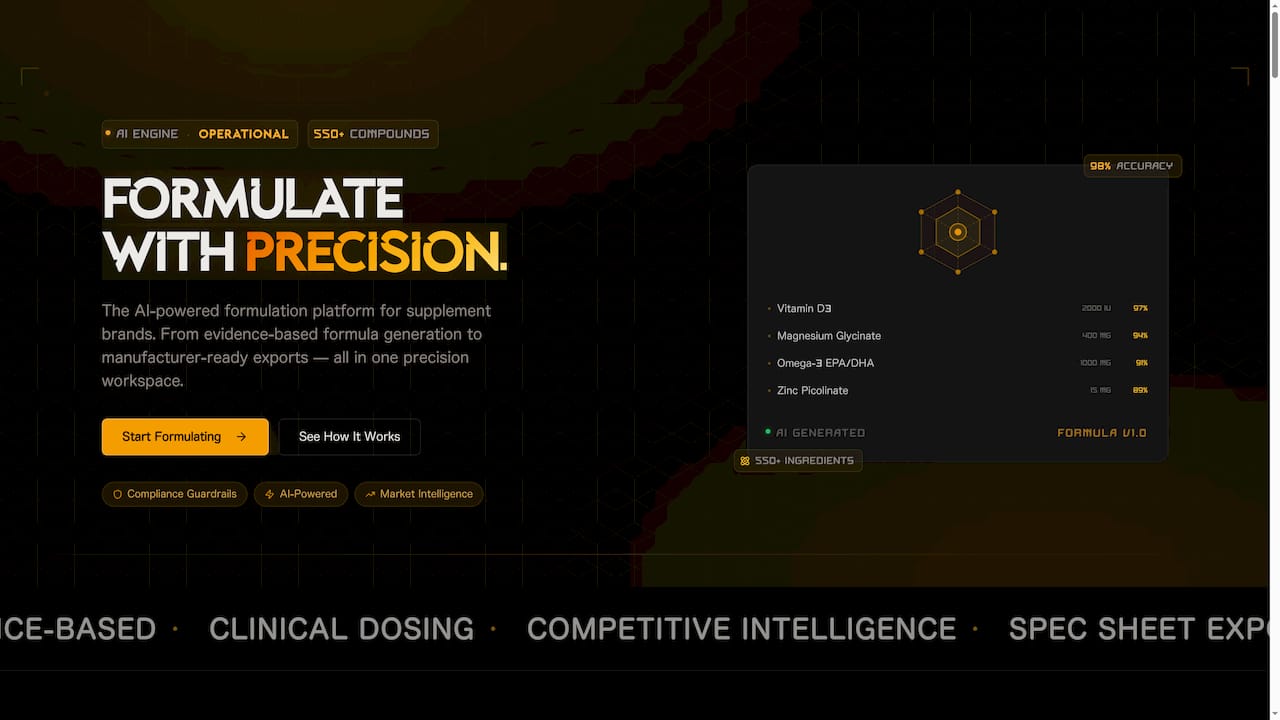
FormlyPro is built specifically for brand managers and product developers who need to move faster without cutting corners on compliance or quality. The platform supports your entire development process from ideation through production, including research-backed formulation guidance, real-time compliance checks, competitor analysis, market positioning tools, and an AI-powered packaging mockup designer. The 8-phase product development plan gives your team a structured workflow that covers every stage, from concept to shelf. If you are ready to reduce reformulation cycles, eliminate compliance surprises, and launch with confidence, explore what FormlyPro can do for your next product.
Frequently asked questions
What is the most common reason for formulation failure in food and beverage products?
Incorrect ingredient ratios are the most common root cause, leading to failures in taste, texture, stability, or regulatory compliance that require costly reformulation.
How can teams reduce the risk of compliance issues during formulation?
Teams reduce compliance risk most effectively by using structured processes and digital analytics throughout development, paired with routine regulatory audits against current market requirements.
Why is regular sample testing important in formulation?
Sample testing identifies issues with ingredient interactions, microbial stability, and sensory degradation early in the development cycle, before those issues reach production scale.
Can digital platforms help prevent formulation pitfalls?
Yes. Digital tools increase efficiency by centralizing formula data, automating compliance flags, and giving every team member access to the same information, which eliminates the data silos where errors typically hide.
What role does interdepartmental teamwork play in formulation success?
Effective cross-functional collaboration ensures that R&D, regulatory, quality, and marketing teams share information in real time, which prevents the miscommunication gaps that allow formulation mistakes to go undetected until they are expensive to fix.