

TL;DR:
- Implementing a structured compliance process from day one prevents delays and costly reformulations.
- Early ingredient screening in multiple markets avoids restricted substances and streamlines certification.
- Continuous monitoring and proper documentation turn compliance into a competitive advantage, not a barrier.
Imagine spending twelve months developing a new skincare line, finalizing your formulas, designing your packaging, and locking in your manufacturing partner, only to discover at the eleventh hour that two of your hero ingredients are restricted in the EU markets you planned to enter. That scenario plays out far more often than most brand owners expect, and the cost is not just delay. It means reformulation, retesting, relabeling, and sometimes scrapping an entire product concept. The good news: a structured compliance process, applied from the very first day of formulation, prevents almost all of it.
Table of Contents
- Understanding the stages of product compliance
- Regulatory review: Early ingredient screening and formulation
- Testing, verification, and claims substantiation
- Documentation, certification, and ongoing compliance monitoring
- Why effective compliance is the real innovation driver for brand success
- Streamline your compliance process with FormlyPro
- Frequently asked questions
Key Takeaways
| Point | Details |
|---|---|
| Start with regulation | Early regulatory screening prevents costly reformulation and launch delays. |
| Integrate compliance in design | Compliance must be built into product design and ingredient selection from day one. |
| Document everything | Well-organized documentation speeds certification and protects against legal risks. |
| Continuous monitoring is vital | Brands need ongoing monitoring to stay ahead of regulatory changes and avoid market disruptions. |
| Leverage compliance for innovation | Treating compliance as an opportunity, not a barrier, fuels brand growth and differentiates products. |
Understanding the stages of product compliance
Compliance is not a single checkpoint at the finish line. It is a layered process that runs parallel to product development from ideation through to post-launch monitoring. Product compliance process for consumer goods involves structured stages: identifying applicable regulations by market and product category, integrating compliance into design and formulation from the outset, conducting testing and verification in accredited labs, preparing documentation and labeling, obtaining certifications, and implementing continuous monitoring for changes.
Understanding where each stage sits in your timeline is what separates brands that launch on schedule from those that stall. Most delays happen because teams treat compliance as a post-formulation review rather than a concurrent workflow. By the time a formulation is finalized, changing an ingredient can mean weeks of additional stability testing, renegotiating supplier contracts, and updating label claims. Building compliance review into your compliance in product development process from day one prevents that cascade.
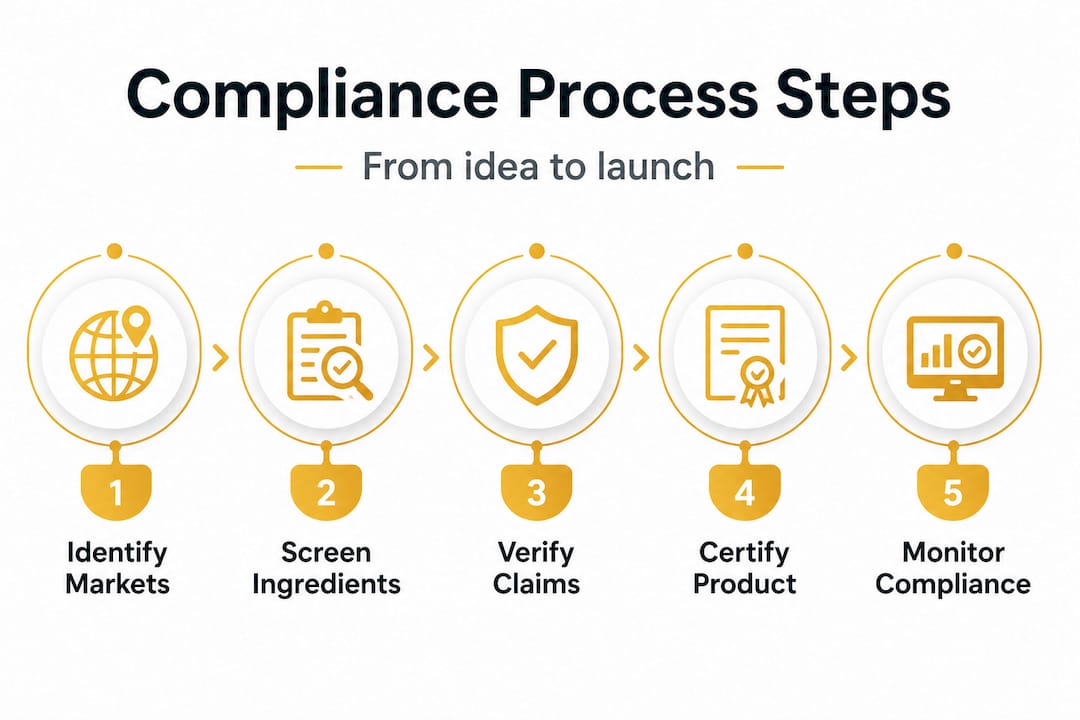
Here is a summary of the six core stages and what each one requires:
| Stage | Primary activity | Key output |
|---|---|---|
| 1. Regulatory identification | Define markets, identify applicable laws | Regulatory matrix per region |
| 2. Design and formulation integration | Screen ingredients, align formula with rules | Compliant ingredient list |
| 3. Testing and verification | Stability, toxicology, lab analysis | Verified test reports |
| 4. Documentation and labeling | Assemble dossiers, finalize label claims | Complete product file |
| 5. Certification | Submit to regulatory bodies or third parties | Certificates, registrations |
| 6. Continuous monitoring | Track regulatory changes, manage updates | Revised compliance plan |
Using a compliance checklist for product success that maps every stage to specific deliverables keeps your team accountable at each phase and gives leadership clear visibility into where risks are sitting.
Pro Tip: Start your compliance review before your formulation brief is written. A one-hour regulatory scan of your target markets at the concept stage costs almost nothing compared to reformulating after a testing failure.
Regulatory review: Early ingredient screening and formulation
Once you understand the structure of the compliance process, the most important place to focus first is ingredient-level regulatory review. This is where most launch problems begin, and it is where the most preventable mistakes are made.
Early regulatory review during ingredient selection avoids restricted substances such as the EU bans on titanium dioxide in food applications, PFAS across cosmetics, and restrictions on perborates and silver compounds introduced under Omnibus VIII. These are not obscure edge cases. Titanium dioxide, for example, was used as a whitening agent in thousands of food products before the EU banned it in 2022. Brands that had not built early screening into their workflows scrambled to reformulate under pressure.

The complexity multiplies when you sell across markets. The EU and the US operate under fundamentally different regulatory philosophies. The EU applies a precautionary principle, meaning an ingredient may be restricted even if harm is not fully proven. The US tends toward post-market enforcement, meaning an ingredient stays permissible until evidence of harm reaches a threshold for action. For brand owners selling globally, this creates a practical challenge because an ingredient that is legal and tested in the US may still be banned in Europe.
| Ingredient category | EU status | US status |
|---|---|---|
| Titanium dioxide (food) | Banned since 2022 | Permitted with conditions |
| PFAS in cosmetics | Under restriction | Phase-out underway, varies by state |
| Perborates (Omnibus VIII) | Restricted | Generally permitted |
| Certain synthetic colors | Several banned | Mostly permitted, under FDA review |
| Parabens (certain types) | Restricted concentrations | Permitted at various levels |
The table above is a starting point, not a complete list. Every product category carries its own specific restrictions, and those restrictions can change with each new regulatory cycle.
For brands developing health, beauty, or supplement products, an ingredient screening guide should be part of your standard operating procedure, not an occasional audit. The screening process should include:
- Identifying all raw ingredients by INCI name or chemical identifier
- Cross-referencing each ingredient against restricted substance lists for every target market
- Flagging any ingredient that is on a watch list, even if not yet formally banned
- Documenting supplier Safety Data Sheets and Certificates of Analysis for every raw material
- Capturing the rationale for every ingredient decision in your formulation log
That last point matters more than most brands realize. Documented ingredient decisions speed up certification because you can demonstrate due diligence. Regulators and third-party certifiers want to see that your team made deliberate, informed choices, not that you simply used whatever was available. This connects directly to the market-ready formulation steps you need to complete before any product can credibly enter retail.
Pro Tip: Document every ingredient decision with a short rationale, including why you chose a specific supplier and what regulatory basis you used for confirming acceptability. This creates an audit trail that cuts weeks off your certification timeline.
Looking at formulation examples for compliance across cosmetics and food categories can also help you see how other brands structure their ingredient decisions in practice. Benchmarking against compliant competitors at this stage gives you a realistic picture of what is actually achievable in your category.
Testing, verification, and claims substantiation
With compliant ingredients selected, the next challenge is proving that your finished product is safe, stable, and that any claims on your label are backed by evidence. This is where many brands underestimate both the time and the rigor required.
Here is a practical framework for moving through testing and verification:
-
Stability testing. Submit your product to stress conditions including elevated temperature, humidity, and light exposure to confirm that the formulation holds its integrity over its claimed shelf life. Stability testing should be initiated early in development so you have accelerated data available before launch and real-time data accumulating in parallel.
-
Toxicological assessment. For cosmetics and personal care products, a qualified toxicologist must review the full ingredient list and concentrations to confirm the product is safe for intended use. This is a legal requirement in the EU and a best practice in the US.
-
Novel ingredient notification. If you are working with supplement formulations, any novel dietary ingredient requires an NDI notification submitted to the FDA 75 days prior to market entry. Missing this step creates significant legal exposure.
-
Laboratory verification. Finished product testing at an accredited third-party lab confirms that the actual product matches the formulation specification. This protects you in the event of a label claim challenge or a regulatory audit.
-
Claims substantiation. Every claim on your label, whether it is "clinically tested," "dermatologist recommended," or "supports immune health," must be supported by documented evidence. Substantiation files typically include study summaries, clinical data, or peer-reviewed research.
The claims landscape is shifting fast, and the risks of getting it wrong are growing. Consider a recent example:
"FDA enforcement discretion on 'no artificial colors' allows natural colors but increases litigation and state risk as consumers may perceive claims as misleading. Reformulation races, such as the redefinition of 'healthy' expected by 2028, are already straining supply chains."
That quote captures exactly why claims substantiation is not just a regulatory formality. It is a brand risk issue. A claim that is technically permissible under current FDA guidance may still expose you to class action litigation if consumers interpret it differently than you intended. Reviewing compliance standards for consumer goods in your specific category gives you a clearer picture of where those exposure points sit and how to structure your claims language defensively.
Documentation, certification, and ongoing compliance monitoring
Testing done, certifications secured, it is tempting to consider compliance finished. That mindset is what gets brands into trouble twelve months after launch. Documentation and labeling, obtaining certifications, and ongoing monitoring for regulatory changes are not one-time activities. They are a continuous system.
Here is how to build that system effectively:
-
Assemble your product technical file. This includes your formulation specification, ingredient safety data, test reports, toxicological assessment, stability data, and label artwork with claims documentation. Everything in one organized location.
-
Finalize label compliance. Check every mandatory statement, font size requirement, and claim against current regulations for each market. In the US, this includes FDA labeling rules. In the EU, it means EU Cosmetics Regulation or the Food Information Regulation, depending on category.
-
Submit for required certifications. Depending on your product type, this may include USDA Organic, NSF certification, Ecocert, Halal or Kosher certification, or EU Responsible Person registration. Each certification body has its own submission requirements and timelines, so build these into your project plan early.
-
Establish a regulatory monitoring system. Subscribe to regulatory update services for every market you sell in. Assign a team member or external consultant to review updates monthly and flag anything that affects your current product range.
-
Schedule annual compliance reviews. At least once per year, pull your full product files and audit them against current regulations. Ingredient restrictions evolve. Testing standards get updated. Label requirements change. Annual reviews catch drift before it becomes a crisis.
Your ongoing documentation checklist should cover:
- Active product technical files for every SKU
- Supplier documentation including updated Certificates of Analysis and Safety Data Sheets
- Test report renewal schedule based on shelf life claims and product modifications
- Label version control with dated records of every change
- Regulatory watch list tracking ingredients and claims under review
For brands in the food and supplement space, food and supplement compliance is particularly dynamic because FDA guidance evolves frequently and state-level regulations often move faster than federal rules. For personal care and cosmetics brands, cosmetic compliance tips outline the specific documentation and monitoring practices that apply to your category.
Why effective compliance is the real innovation driver for brand success
Here is an opinion that cuts against the conventional narrative: compliance is not the brake on innovation. It is the engine.
Most brand teams experience compliance as friction. Slow, expensive, bureaucratic friction that delays the products they want to launch. That perception is not wrong exactly, but it misses the bigger picture. The brands that consistently win in competitive consumer goods markets are not the ones that move fastest. They are the ones that move deliberately, with formulations that hold up to scrutiny, claims that survive litigation, and supply chains that do not collapse when regulations shift.
Consider what happens when a brand treats compliance as a strategic design constraint rather than a legal checkbox. They select higher-quality, better-documented ingredients. They build supplier relationships with manufacturers who provide complete transparency. They develop label claims that are conservative but defensible, which means those claims last for years instead of being pulled after a complaint. They build customer trust that compounds over time.
The brands that skip corners on compliance often launch faster in the short term. But they also face higher recall risk, higher reformulation cost, and higher customer acquisition costs because trust is harder to build when your product history includes a label controversy or an ingredient recall. Regulatory-driven reformulation, such as removing a restricted colorant or updating a nutrient claim, is actually an opportunity to relaunch with a stronger, cleaner story if you approach it proactively.
Custom health and beauty formulation done with compliance integrated from the start produces products that are genuinely differentiated, not just differentiated on paper. When your formulation can survive a deep regulatory audit and your claims are fully substantiated, you have something that most competitors cannot easily copy or undercut. That is a real competitive advantage.
The uncomfortable truth is that most compliance failures are predictable. They happen at the same pressure points: ingredient selection without regulatory review, claims written by marketing without substantiation files, and post-launch monitoring that never gets set up because everyone moved on to the next launch. A structured process does not slow you down. It removes the surprises that actually kill timelines.
Streamline your compliance process with FormlyPro
Applying every step in this guide consistently requires systems, not just knowledge. Tracking ingredient restrictions across markets, managing documentation files for multiple SKUs, monitoring regulatory changes, and keeping your formulation aligned with certification requirements is genuinely complex work.
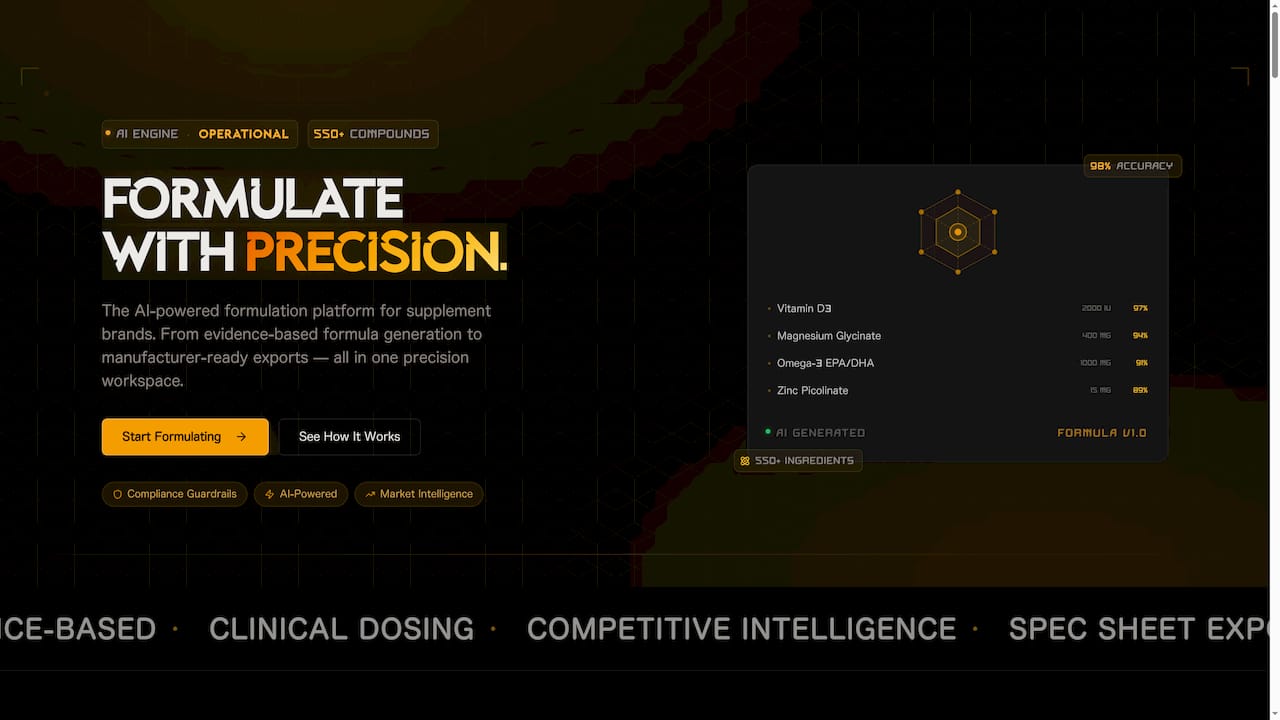
FormlyPro is built specifically for brand owners and product developers navigating exactly this process. The platform guides your team through an 8-phase plan from product ideation through formulation, prototyping, compliance, and production. Built-in ingredient screening, compliance documentation tools, and market-ready formulation frameworks mean you are not managing compliance in spreadsheets while running a business. The AI Mockup designer handles packaging, competitor analysis tools show you what is selling and what those formulations contain, and subscription tiers scale with your brand's needs. If you want your next launch to move faster and land cleaner, this is the infrastructure that makes it possible.
Frequently asked questions
What are the first steps in product compliance for new formulations?
Early regulatory review during ingredient selection is the correct starting point: identify regional regulations for every target market and screen all candidate ingredients against current restricted substance lists before any formulation decisions are locked in.
What kinds of tests are required for consumer product compliance?
Stability testing under temperature, humidity, and light exposure conditions, toxicological assessments by a qualified professional, and third-party laboratory verification of the finished product are the core requirements for most consumer goods categories.
How often should brands monitor changes in regulation after launching a product?
Continuous compliance monitoring is the standard practice, with monthly regulatory update reviews and at least one full annual audit of all active product files against current rules to catch changes before they create a recall or label violation risk.
Are "no artificial colors" claims risky for brands?
Yes. FDA enforcement discretion on these claims may permit natural color use, but it also opens the door to state-level litigation if consumers interpret the claim more broadly than the label intends, making substantiation and careful claim language essential.