

TL;DR:
- Custom formulation offers brands unique product differentiation and better target performance.
- The process includes defining a brief, developing prototypes, testing, and ensuring regulatory compliance.
- It enables innovation across personal care, supplements, and cosmetics, with accessible options for smaller brands.
Off-the-shelf formulas are holding brands back. When every competitor can order the same stock product from the same contract manufacturer, your formula becomes your weakest differentiator, not your strongest asset. Custom formulation changes that equation entirely, giving brand owners and product developers the ability to build something genuinely distinct. And despite what many assume, it is not a process reserved for Fortune 500 companies with dedicated R&D labs. Smaller brands are doing it successfully right now, and the barriers are lower than they have ever been.
Table of Contents
- Defining custom formulation: Beyond standard recipes
- The custom formulation process: Steps from idea to launch
- Compliance, safety, and regulations in custom formulation
- Custom formulation applications: Beauty, supplements, and more
- Why brands underestimate the value of custom formulation
- Start your custom formulation journey with FormlyPro
- Frequently asked questions
Key Takeaways
| Point | Details |
|---|---|
| Custom formulation defined | It’s the process of developing a unique product tailored to specific brand goals and market needs. |
| Key benefits | Custom formulations provide distinct identity and control over ingredients, boosting competitiveness. |
| Essential steps | Successful projects require clear scope, compliance focus, and iterative development. |
| Compliance matters | Navigating regulatory and safety requirements ensures smooth market entry. |
| Wider accessibility | Custom formulation is now achievable for brands of all sizes in health and beauty. |
Defining custom formulation: Beyond standard recipes
Custom formulation is the process of developing a product from scratch, or significantly modifying an existing base, to meet a specific set of performance, ingredient, and positioning goals. Instead of choosing from a catalog of ready-made formulas, you define what goes in, what stays out, and exactly how the final product should perform.
The contrast with off-the-shelf or white label solutions is significant. Here is a side-by-side comparison:
| Feature | Custom formulation | Stock/white label formula |
|---|---|---|
| Ingredient control | Full | Minimal |
| Brand differentiation | High | Low |
| Regulatory flexibility | Designed in | Fixed |
| Time to first prototype | Longer | Faster |
| Long-term IP ownership | Yes | No |
| Cost at scale | Lower | Higher |
The table makes one thing clear: white label is faster to start, but custom formulation builds lasting competitive value. Custom formulation enables unique product positioning and tailored functionality that stock formulas simply cannot replicate.
The core benefits that drive brands toward custom development include:
- Unique market positioning built on a formula competitors cannot copy
- Targeted performance matched to your customer's specific needs
- Ingredient transparency that resonates with today's informed consumers
- Regulatory alignment baked in from day one, not retrofitted later
- Scalability without being locked into a supplier's existing product
Who should pursue custom formulation? Any brand that wants to own a category, serve a niche audience, or respond to a gap that existing products do not fill. If you are looking at brand formulation basics for the first time, the learning curve is real but manageable. Reviewing formulation examples from similar categories can sharpen your brief before you engage a developer. Understanding product performance fit early also prevents costly reformulations later.
Pro Tip: Bring a formulator into the conversation during your brand strategy phase, not after. Early collaboration cuts R&D cycles and surfaces formulation compliance insights before they become expensive problems.
The custom formulation process: Steps from idea to launch
Structured formulation processes drive faster and more predictable product development. Knowing each phase before you start prevents the most common cause of project delays: scope creep and undefined success criteria.
Here is how a well-run custom formulation project unfolds:
- Define your product brief. Document the target consumer, desired claims, key actives, format (cream, capsule, serum, etc.), and any ingredient exclusions. This brief is your north star.
- Market and competitive research. Identify gaps in the current market. Understand what competing products contain and where they fall short.
- Formulation development. A chemist or formulation scientist builds initial prototypes based on your brief. Expect two to four iterations before a stable candidate emerges.
- Stability and safety testing. Formulas are tested under accelerated conditions to confirm shelf life, compatibility, and safety profiles.
- Regulatory review. Claims, labeling, and ingredient lists are checked against applicable rules before any product goes to market.
- Pilot batch production. A small-scale manufacturing run validates that lab results translate to real-world production.
- Consumer testing. Real users evaluate the product for sensory experience, performance, and satisfaction.
- Scale-up and launch. Full production begins with documentation in place for ongoing quality control.
Typical timelines vary by product type:
| Product category | Average development time |
|---|---|
| Topical skincare | 4 to 7 months |
| Hair care | 3 to 6 months |
| Dietary supplement | 5 to 9 months |
| Color cosmetics | 3 to 5 months |
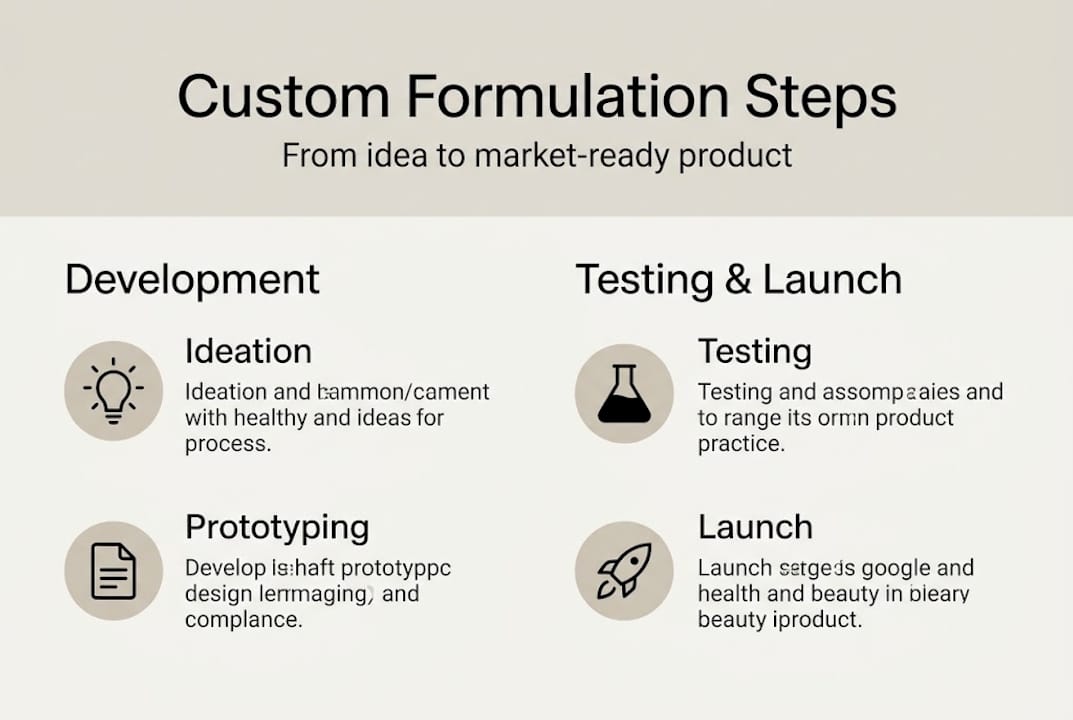
The most common challenge brands face is underestimating the testing phase. Skipping or compressing stability testing leads to product failures after launch, which is far more expensive than doing it right the first time. Resources on creating market-ready formulations walk through each milestone in detail. Pairing that with guidance on developing effective formulations gives you a complete picture of what success looks like at each stage.
Pro Tip: Iterative prototyping, where you test small and adjust quickly, consistently saves more money than trying to perfect a formula on the first attempt. Build iteration cycles into your timeline from the start.
Compliance, safety, and regulations in custom formulation
As you navigate the process, it is vital to consider the evolving regulatory and safety landscape. Compliance is not a final checkbox. It is a design constraint that shapes every formulation decision you make.
Adhering to compliance requirements is crucial for a legal product launch. In the U.S., the FDA regulates cosmetics under the Federal Food, Drug, and Cosmetic Act, while dietary supplements fall under DSHEA. The EU operates under the EU Cosmetics Regulation (EC) No 1223/2009, which maintains a list of over 1,300 prohibited or restricted substances. If you plan to sell in multiple markets, your formula must satisfy the strictest applicable standard.
Every custom formula should document the following:
- Full ingredient list with INCI names and percentages
- Safety assessment conducted by a qualified assessor
- Stability test data confirming shelf life under intended storage conditions
- Microbial testing results for water-containing formulas
- Certificate of analysis for each raw material used
- Claims substantiation tied to clinical or consumer study data
- Labeling review confirming compliance with country-specific rules
The most frequent compliance mistakes brands make include using prohibited ingredients without checking jurisdiction-specific lists, making drug-like claims on cosmetic products, and failing to update documentation when a formula is modified post-launch.
"A formula that performs brilliantly but fails a regulatory review will never reach the consumer. Build compliance into the brief, not the back end."
For brands working in personal care, compliance for cosmetics is a practical resource for understanding what documentation is required. If your product sits in the supplement space, food and supplement brand compliance covers the specific obligations that apply to that category.
Custom formulation applications: Beauty, supplements, and more
With compliance covered, let's see where custom formulation truly unlocks innovation and growth. The range of applications is broader than most brand owners initially expect.

Personal care and skincare is the most active category. Brands are building formulas around specific skin concerns, such as barrier repair, hyperpigmentation, or microbiome support, using actives like niacinamide, ceramides, and postbiotics. Custom development allows precise concentration control that stock formulas never offer.
Hair care is experiencing a surge in custom demand driven by the natural hair movement and growing awareness of scalp health. Brands are creating sulfate-free, allergen-free, and fragrance-free options that serve communities historically underserved by mainstream products.
Color cosmetics benefit from custom formulation through shade matching, texture engineering, and clean beauty reformulation. Replacing synthetic dyes with mineral pigments, for example, requires formulation expertise that off-the-shelf products cannot provide.
Dietary supplements represent one of the fastest-growing custom formulation segments. Custom formulation in supplements enables novel combinations that improve compliance and patient outcomes, particularly in areas like gut health, cognitive performance, and sports nutrition.
Key trends driving demand right now include:
- Personalization as consumers seek products built for their biology, not the average
- Clean label pressure pushing brands to remove controversial ingredients
- Functional beauty blurring the line between skincare and supplementation
- Sustainability requirements that demand reformulation of legacy products
Pro Tip: Track ingredient search trends on retail platforms and social channels. Consumer ingredient preferences shift fast, and brands that reformulate ahead of the curve capture market share before competitors react. Reviewing cosmetic formulation examples and monitoring supplement industry alternatives can surface gaps worth building toward.
Why brands underestimate the value of custom formulation
Most brands enter a category by studying the leader and building something similar. It feels safe. The problem is that copying category leaders means you are always one step behind, competing on price and marketing spend rather than product substance.
Custom formulation is not just a technical exercise. It is a strategic asset. Brands that treat formulation as an investment, rather than a cost to minimize, build products that are genuinely harder to copy and easier to defend. When a competitor launches something similar, a custom formula gives you the agility to iterate quickly because you own the formula and understand every variable in it.
The other underestimated value is regulatory agility. When ingredient restrictions change, brands with custom formulas can adapt without losing their product identity. White label brands are at the mercy of their supplier's decisions.
The mindset shift we see in leading brands is treating formulation as table stakes, not a luxury. Formulation analytics insights show that data-driven development consistently outperforms intuition-based approaches. Customization is more accessible than ever. The brands that act on that now will be the category leaders others copy in three years.
Start your custom formulation journey with FormlyPro
If you are ready to move from concept to a compliant, market-ready product, FormlyPro is built for exactly that.
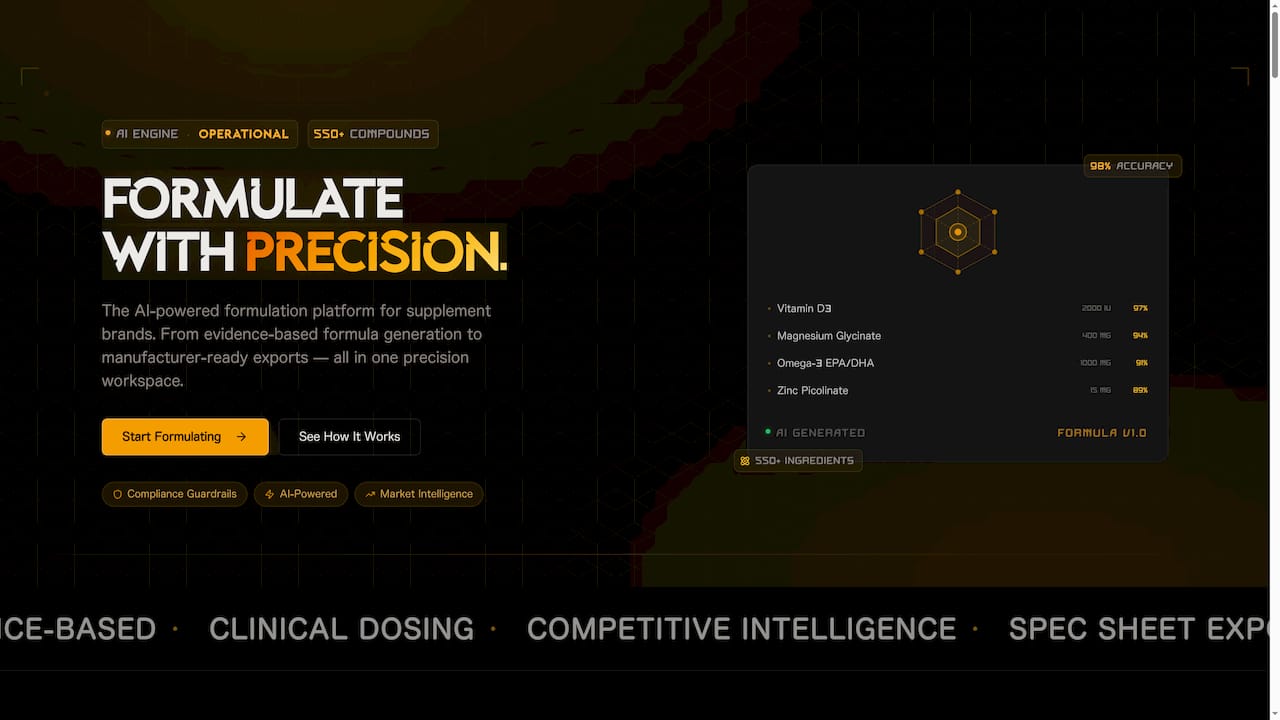
The FormlyPro supplement platform gives brand owners and product developers an 8-phase development system covering ideation, formulation, prototyping, compliance, and production. Built-in market research and competitor analysis show you what is selling and what is in those formulas. The AI-powered packaging mockup designer means your product vision comes to life end to end, without switching tools. Whether you are launching your first custom formula or scaling an existing line, FormlyPro removes the guesswork and keeps every phase on track.
Frequently asked questions
What makes custom formulation different from white label products?
Custom formulation develops a unique product from scratch with tailored ingredients, while white label uses pre-made formulas with minimal changes. Custom formulation enables unique positioning that white label products cannot replicate.
How long does custom formulation take for a new health or beauty product?
Most projects take between 3 and 9 months depending on product type, testing requirements, and regulatory steps. Structured formulation processes reduce that timeline by preventing rework.
What regulations affect custom formulation in the U.S.?
FDA regulations, labeling laws, and ingredient restrictions all apply to custom health, beauty, and supplement products. Compliance requirements must be addressed before any product goes to market.
Can small brands afford to create custom formulations?
Yes. More accessible manufacturing partners and streamlined processes make custom formulation viable even for smaller brands entering the market for the first time.