

TL;DR:
- Scientific rigor in formulation ensures safety, compliance, and effective product claims.
- Building in-house scientific expertise accelerates innovation and protects market position.
- Empirical benchmarks and early regulatory integration prevent costly failures and recalls.
Product formulation looks simple from the outside. You pick ingredients, mix them together, and launch. But brands that operate on that assumption face recalls, rejected claims, and failed launches at a rate that would surprise you. The real story of formulation success is written in labs, not boardrooms. Scientists bring the systematic rigor that transforms a concept into a safe, effective, compliant product. If you want to compete at a serious level in food or cosmetics, understanding what scientific leadership actually does for your formulation strategy is not optional.
Table of Contents
- Why scientists are essential for modern formulation
- Key methodologies: From ideation to safety testing
- Empirical standards and benchmarks: What 'good' looks like
- Navigating compliance and risk: The scientist's regulatory roadmap
- What most brands overlook about scientific leadership in formulation
- Get expert support for your next formulation breakthrough
- Frequently asked questions
Key Takeaways
| Point | Details |
|---|---|
| Science-driven safety | Formulation experts build in safety and efficacy from the start with systematic scientific protocols. |
| Benchmarking for quality | Empirical targets and data-back testing mean brands can promise and deliver high-quality products. |
| Regulatory compliance | Scientists embed compliance with FDA and GMP guidelines to protect both brand and consumer. |
| Strategic leadership | Hiring the right scientific leadership accelerates innovation and ensures lasting market advantage. |
Why scientists are essential for modern formulation
With demand for safer, high-performing products, scientific know-how has become the backbone of successful formulation.
Most brand owners understand that ingredients matter. What they underestimate is the gap between knowing an ingredient works and knowing how it works under heat, humidity, oxidative stress, or combined with five other actives. Scientists close that gap systematically. They do not guess. They test, validate, and document every decision in a way that holds up to regulatory scrutiny.
Food scientists develop new products through ingredient selection, formulation, and testing for safety, quality, and compliance with standards like FDA and FSSC 22000. That process is not linear. It involves iteration, failure analysis, and controlled experimentation. The average brand owner cannot replicate that workflow without deep scientific training.
Here is what scientists actually contribute to your formulation pipeline:
- Ingredient validation: Confirming that each component meets purity, stability, and regulatory acceptance standards before it ever touches your formula
- Interaction analysis: Identifying how actives, preservatives, emulsifiers, and carriers affect each other's performance or safety profile
- Claims substantiation: Designing testing protocols that generate data to legally support your product claims
- Recall prevention: Catching stability failures, contamination risks, and label inaccuracies before they become expensive public problems
- Regulatory alignment: Ensuring your formula meets FDA, EU, or other applicable standards from day one
Scientists also drive innovation. When you want to position a product with a novel delivery mechanism, a cleaner ingredient label, or a first-in-category functional claim, that requires formulation analytics for innovation backed by credible science. You cannot fabricate that differentiation. You have to build it through expertise.
"The scientist's job is not just to make a formula work. It is to make it work consistently, safely, and in a way that stands behind every claim printed on the label." This is what separates market leaders from brands that cycle through launches without traction.
Pro Tip: If you are building a formulation team, prioritize scientists who understand both the chemistry of your product category and the regulatory environment. Technical skill without regulatory fluency creates expensive blind spots.
The return on investing in scientific oversight is measurable. Brands that build scientific expertise into their process reduce reformulation cycles, avoid the average cost of a product recall (which regularly exceeds $10 million for food brands), and reach launch timelines faster because they get it right earlier in the process.
Key methodologies: From ideation to safety testing
This scientific foundation supports the structured process that begins with an idea and ends with a validated formula.
Formulation does not start at the bench. It starts with a structured definition of what success looks like. Scientists initiate projects by mapping desired outcomes against real-world constraints: shelf life expectations, target pH ranges, processing temperatures, packaging compatibility, and the regulatory framework for every market you plan to enter. Without that foundation, you are formulating blind.
Food scientists use methodologies including brainstorming formulations, ingredient sourcing analysis, chemical analysis, quality checks simulating real-world conditions, hazard identification, and nutrient determination. Each of these steps catches a different category of failure before it becomes a market problem. Together, they form a framework that is reproducible and defensible.
Here is what that structured process looks like in practice:
- Outcome mapping: Define your target product profile, including texture, flavor, appearance, efficacy, and shelf-life goals, before selecting a single ingredient
- Ingredient sourcing analysis: Vet suppliers for consistency, purity documentation, and regulatory compliance in your target markets
- Bench-scale formulation: Develop initial prototypes using controlled ratios and documented methodology so every iteration is traceable
- Chemical and physical analysis: Measure viscosity, pH, water activity, particle size, and other critical quality attributes at every stage
- Simulated storage testing: Subject your formula to accelerated aging, temperature cycling, and light exposure to predict real-world shelf-life performance
- Hazard identification: Systematically review every ingredient and processing step for contamination risk, allergen presence, or toxic interaction potential
- Nutrient and actives determination: Verify that the levels of key ingredients claimed on your label are actually present in the final product
Pro Tip: Build simulated storage testing into your timeline from the start. Brands that skip this step and rely on theoretical shelf life often face returns, reformulations, or regulatory action after launch. Real data protects you.
"Every shortcut in the formulation process is a debt you pay later, usually at the worst possible moment." The brands that look decisive at launch are usually the ones who did the slow, careful scientific work months before anyone saw the product.
You can explore formulation case studies that show how this methodology plays out across food and cosmetics categories. If you want a step-by-step structure for your own product development process, reviewing market-ready formulation steps gives you a practical framework to apply immediately.
Empirical standards and benchmarks: What 'good' looks like
With scientific processes in place, the next question is: what standards do successful formulations meet?
Brand owners sometimes treat product quality as a subjective target. Scientists treat it as a number. Empirical benchmarks turn vague goals like "smooth texture" or "stable emulsion" into precise, testable values that your formula either hits or misses. That precision is what makes quality reproducible across production batches and defensible to regulators and consumers alike.

Empirical benchmarks in food and cosmetics include food viscosity targets of 6500 to 7000 mPa·s, lipstick melting points of 60 to 70°C with hardness of 35 to 40N, nanoemulsion particle sizes of 100 to 200nm, and RSM optimization yielding R² values of 0.99 for texture and antioxidant performance. These are not arbitrary numbers. They represent the ranges where products perform consistently, resist degradation, and meet consumer and regulatory expectations.
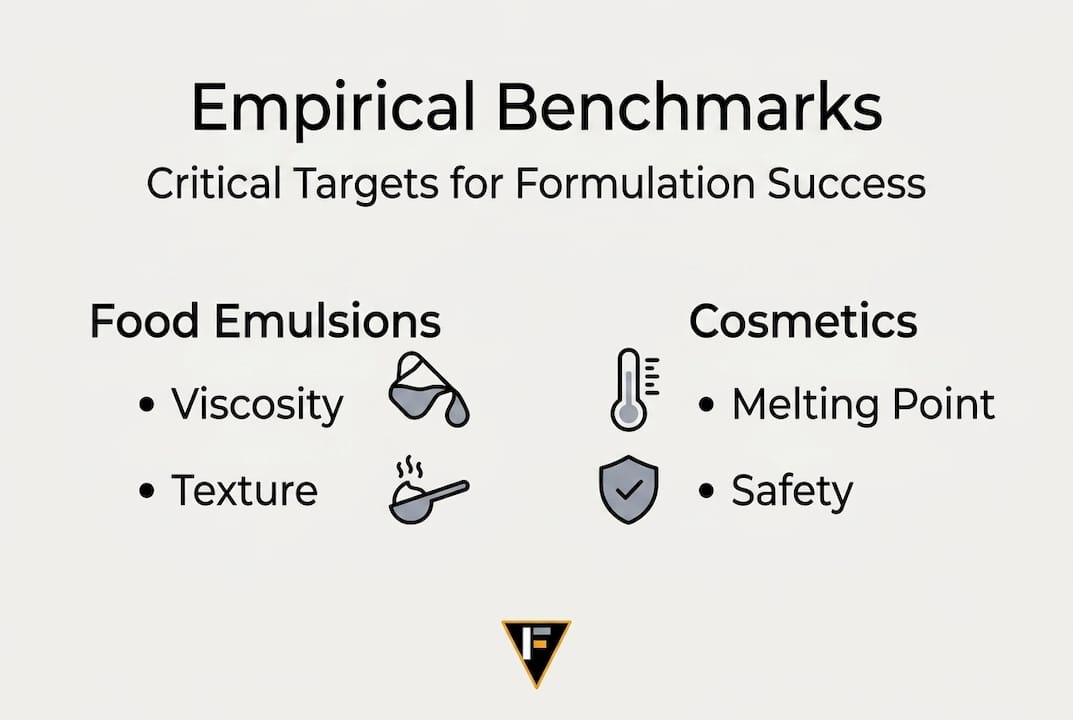
Here is a snapshot of key benchmarks across product categories:
| Product category | Key parameter | Target benchmark |
|---|---|---|
| Food emulsions | Viscosity | 6500 to 7000 mPa·s |
| Lipstick | Melting point | 60 to 70°C |
| Lipstick | Hardness | 35 to 40N |
| Nanoemulsion actives | Particle size | 100 to 200nm |
| Texture/antioxidant RSM | Model fit (R²) | 0.99 |
These product performance benchmarks matter because they directly connect to your claims, your consumer experience, and your ability to consistently reproduce quality at scale.
Here is why data-backed benchmarks create competitive advantage:
- Consistency: Hitting a quantified target across production runs eliminates the batch-to-batch variation that erodes consumer trust
- Claims confidence: When a benchmark supports an efficacy claim, you have documentation to stand behind it if regulators ask
- Faster reformulation: If a batch fails, a clear benchmark tells you exactly where the deviation occurred and what to fix
- Supplier accountability: Benchmarks give you objective criteria to hold ingredient suppliers to consistent quality standards
Think about what this means in practical terms. A lipstick that melts at 55°C instead of 65°C will fail in shipping during summer months. A food emulsion with viscosity outside the target range will separate on shelf. These are not minor inconveniences. They are brand-damaging events that science predicts and prevents by establishing clear targets upfront.
The brands that consistently win on product quality are not lucky. They are disciplined about measuring what matters and formulating to verified standards. Scientists make that discipline systematic.
Navigating compliance and risk: The scientist's regulatory roadmap
While quality and benchmarks shape products, regulatory rigor ensures they even make it to market.
Compliance is not a checklist you hand to a lawyer at the end of development. It is a scientific process that runs parallel to formulation from the first ingredient decision to final label review. Brands that treat regulatory compliance as an afterthought spend significantly more time and money correcting problems than those who build it in from the start.
Regulatory compliance integrated early means addressing ingredient safety through Margin of Safety (MoS) calculations, stability testing under ICH guidelines, GMP checks for contamination control, and labeling accuracy before you ever approach a manufacturer.
Here is what proactive regulatory compliance looks like versus reactive compliance:
| Approach | Timing | Cost impact | Launch risk |
|---|---|---|---|
| Proactive (science-led) | Built into formulation | Lower overall | Minimal |
| Reactive (post-development) | Discovered at review | High reformulation cost | Delays and recalls |
The proactive model is not just cheaper. It is strategically smarter because it positions your brand to support claims, enter regulated markets, and build consumer trust from the first launch.
Key elements of a scientist's regulatory roadmap include:
- MoS calculation: Quantifying the safety margin between ingredient exposure levels and established toxicological thresholds for every active and preservative in your formula
- Stability protocol under ICH guidelines: Conducting controlled long-term and accelerated stability studies that demonstrate your product maintains safety and efficacy throughout its claimed shelf life
- GMP verification: Auditing manufacturing practices for contamination prevention, equipment validation, and documentation standards
- Label accuracy review: Verifying that ingredient declarations, net weights, allergen statements, and claims reflect the actual, tested formula
You can review a regulatory compliance checklist to see how these elements map to your product category. For cosmetics specifically, the cosmetic formulation compliance requirements around restricted ingredient lists, claim language, and safety substantiation add another layer that requires trained scientific interpretation.
Pro Tip: Do not assume that an ingredient being sold commercially means it is compliant in your specific formula, at your specific concentration, in your target market. MoS calculations exist precisely because dose and context matter as much as ingredient identity.
The cost of ignoring regulatory science is not hypothetical. The FDA issues warning letters, mandatory recalls, and import alerts regularly to brands that launch products with inadequate safety substantiation. Each of those events represents a recoverable but painful brand setback that science could have prevented.
What most brands overlook about scientific leadership in formulation
There is a meaningful difference between accessing scientific expertise and owning it. Most growing brands treat formulation science as a service they buy when they need it. They outsource to contract manufacturers or freelance consultants, get a formula, and move on. That model works until you want to innovate faster than your competitors, respond to a regulatory shift, or build a proprietary platform that cannot be easily copied.
Entrepreneurs who hire scientists with 3 to 5 years of formulation experience and Food Science or Chemistry degrees for R&D leadership accelerate compliant product launches in ways that outsourced science simply cannot replicate. In-house scientists learn your brand's specific constraints, your target consumer, and your competitive landscape. They build institutional knowledge that compounds over time.
The "outsource it" approach feels efficient at early stages. It becomes a ceiling. When your competitor has a scientist who wakes up thinking about your product category every day, and you are waiting on a contractor's availability, the innovation gap grows.
Investing in scientific leadership through platforms designed to support brand formulation leadership is not a cost center decision. It is a market position decision. The brands with the best science have the most defensible products, the strongest claims, and the fastest path from idea to shelf.
Get expert support for your next formulation breakthrough
Scientific expertise drives product safety, compliance, and innovation, but not every brand has the internal resources to build a full R&D team from day one. That gap is exactly where the right platform changes everything.
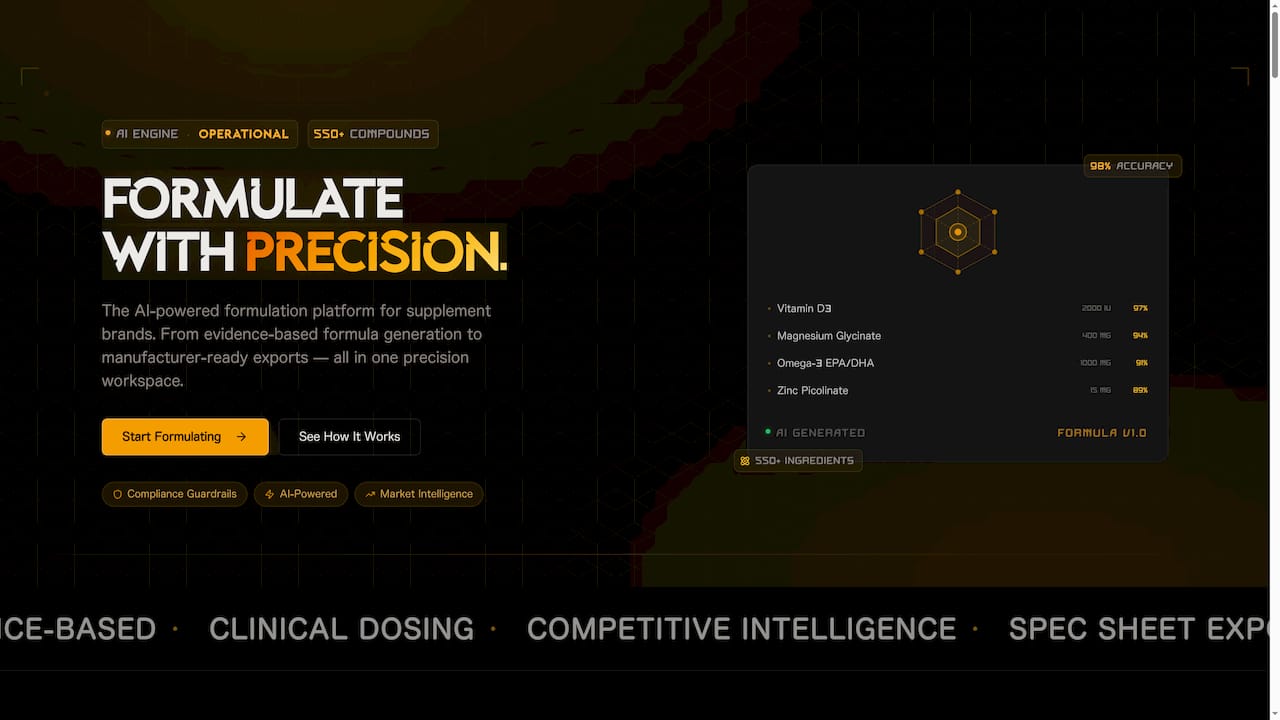
FormlyPro gives brand owners and entrepreneurs direct access to the FormlyPro formulation platform, which integrates market research, competitor analysis, compliance guidance, and an 8-phase product development plan into a single system. From ingredient validation through prototyping, regulatory review, and production, every step is structured, data-backed, and built to support brands that take science seriously. The AI-powered packaging mockup designer means your product strategy stays aligned from formula to shelf. If your next formulation needs scientific rigor without the overhead of building everything from scratch, this is where you start.
Frequently asked questions
What qualifications should a scientist have for product formulation?
Formulation scientists should hold Food Science or Chemistry degrees and have 3 to 5 years of hands-on formulation experience to lead R&D and accelerate compliant product launches.
How do scientists ensure product safety during formulation?
Scientists implement ingredient safety checks, simulate real-world use conditions, and follow regulatory guidelines including GMP and labeling accuracy reviews from concept through launch.
Why is regulatory compliance important in formulation?
Compliance prevents costly recalls, ensures consumer safety, and gives brands the documented evidence needed to support product claims and enter regulated markets without delays.
What are typical benchmarks in food and cosmetics formulation?
Key empirical standards include food viscosity of 6500 to 7000 mPa·s and lipstick melting points between 60 and 70°C, both of which directly affect product stability and consumer experience.