

TL;DR:
- Ingredient sourcing is essential for safety, regulation compliance, and brand trust in health and beauty products.
- Building a rigorous, transparent sourcing system reduces the risk of recalls, adulteration, and ethical issues.
- Choosing between domestic and international suppliers depends on speed, rarity of ingredients, costs, and supply chain risks.
Ingredient sourcing is the single decision that can make or break your product before it ever reaches a customer. Many founders obsess over branding and marketing while treating raw material selection as an afterthought, but ingredient sourcing is the process of identifying, evaluating, and procuring the raw materials that determine whether your formulation is safe, effective, and legally compliant. Across health supplements, skincare, and personal care, the brands that win long-term are almost always the ones who build rigorous sourcing systems early. This guide takes you from core definitions through practical steps, tradeoffs, and the ethical risks that most brands never see coming.
Table of Contents
- Defining ingredient sourcing in health and beauty
- Key steps in the ingredient sourcing process
- Comparing domestic and international sourcing options
- Challenges: Transparency, traceability, and ethical risks
- Sourcing natural vs. synthetic and multifunctional ingredients
- A practical perspective: Why sourcing is your brand's insurance policy
- Streamline ingredient sourcing with FormlyPro
- Frequently asked questions
Key Takeaways
| Point | Details |
|---|---|
| Ingredient sourcing basics | Sourcing means identifying, vetting, and procuring raw materials while ensuring quality and compliance. |
| Steps to source successfully | A clear, documented process—from supplier research to ongoing audits—reduces risk and boosts product quality. |
| Domestic vs. international | Local sourcing offers control while international options provide access to rare botanicals and fair trade. |
| Overcoming sourcing risks | Transparency, traceability, and ethical practices are essential for handling supply chain challenges. |
| Natural vs. synthetic choices | Choosing ingredient types impacts compliance, branding, and consumer perceptions; each has distinct risks and advantages. |
Defining ingredient sourcing in health and beauty
At its most basic, ingredient sourcing means deciding what you put in your product, where it comes from, and how you verify its quality. But in the health and beauty space, that definition carries serious weight. A single contaminated or mislabeled raw material can trigger a product recall, expose your brand to regulatory action, and permanently damage consumer trust.
Ingredient sourcing is not just a procurement task. It is a quality control framework, a compliance strategy, and a brand reputation tool all at once. When you source ingredients for health products, you are making decisions that affect your Certificate of Analysis, your label claims, your marketing credibility, and ultimately your customer's safety.
The process applies to food, beauty, and supplements and involves tracking growth conditions, handling procedures, and labeling accuracy across every tier of your supply chain. That means you are responsible for understanding not just what an ingredient is, but where it was grown, how it was processed, who tested it, and what certifications back those claims.
Here are the core areas where sourcing directly impacts your brand:
- Product safety: Contaminated or adulterated inputs cause adverse reactions and recalls
- Regulatory compliance: Incorrectly sourced ingredients can violate FDA, EU, or market-specific rules
- Label accuracy: Sourcing determines whether your ingredient claims are truthful and defensible
- Sustainability positioning: Ethical sourcing supports eco and fair-trade claims that drive purchase decisions
- Cost control: Reliable supplier relationships reduce last-minute shortages and price volatility
"Ingredient sourcing is foundational, not optional. It shapes every downstream decision in your formulation, from safety testing to consumer trust."
One of the most common misconceptions among new brand founders is that all suppliers offering the same ingredient are interchangeable. They are not. Differences in growing region, extraction method, and storage conditions can produce dramatically different purity levels, potency, and microbial counts for what looks like the same raw material on paper.
Key steps in the ingredient sourcing process
Now that we know what ingredient sourcing is, here is how brands can approach it step by step.
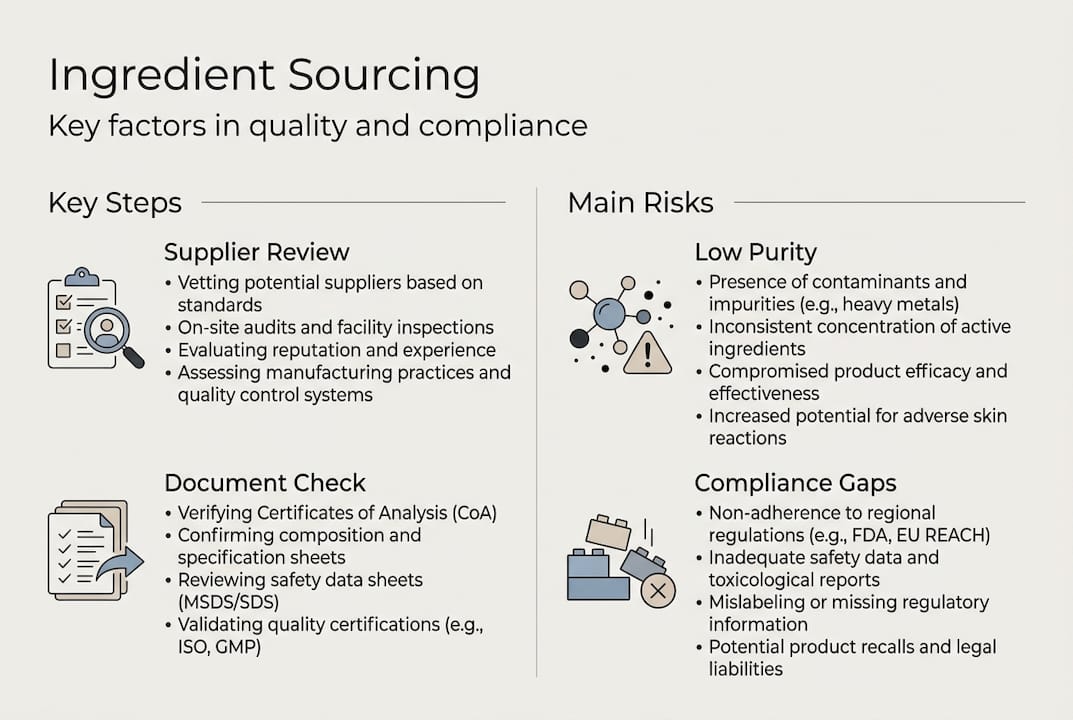
The sourcing process covers five stages: identify requirements, research suppliers, request samples and documentation, evaluate quality, and manage ongoing supplier relationships. Each step has specific deliverables and failure points you need to anticipate.
- Identify your formulation requirements. Before contacting a single supplier, document exactly what each ingredient must deliver: purity grade, particle size, solubility, allergen status, and any certifications required by your target market.
- Research and shortlist suppliers. Look for suppliers with verifiable track records, third-party certifications (USDA Organic, NSF, ISO), and transparent sourcing histories. Never rely on a single source.
- Request samples and documentation. Ask for a Certificate of Analysis (COA), Safety Data Sheet (SDS), microbial testing results, and any relevant certifications before committing to an order.
- Evaluate samples independently. Send samples to a third-party lab. Do not rely solely on supplier-provided data. Cross-reference purity, potency, and contamination levels against your formulation specs.
- Manage the relationship ongoing. Audit suppliers regularly, re-test batches, and revisit contracts when volumes or formulations change.
Pro Tip: Build a sourcing matrix that scores each supplier on price, lead time, certification quality, and audit responsiveness. This makes it easy to switch suppliers quickly if one fails a batch test.
| Document | Purpose | When to request |
|---|---|---|
| Certificate of Analysis (COA) | Confirms purity and potency | Every batch |
| Safety Data Sheet (SDS) | Identifies handling and safety requirements | First order |
| Microbial test results | Verifies contamination limits | Every batch |
| Origin documentation | Supports traceability and ethical claims | First order and annually |
| Third-party certification | Validates organic, fair-trade, or NSF claims | Annually |
Following a regulatory compliance checklist at each sourcing stage reduces the risk of documentation gaps that regulators flag during audits. The importance of compliance cannot be overstated: non-compliant ingredients are one of the top reasons brands face market withdrawal.
Comparing domestic and international sourcing options
After establishing the process, choosing where and how to source is crucial.
Domestic and international sourcing each offer real advantages and genuine risks. The right choice depends on your ingredient type, speed-to-market goals, and compliance obligations.

Domestic suppliers offer simpler logistics and faster QC, while international sources give you access to rare botanicals and fair-trade supply chains that simply do not exist locally. Neither option is universally better.
Domestic sourcing advantages:
- Easier to audit in person
- Faster shipping and lower lead times
- Simpler regulatory alignment with FDA or domestic standards
- Reduced risk of customs delays or import documentation errors
- Easier communication and relationship management
International sourcing advantages:
- Access to rare or endemic botanicals (e.g., Moroccan argan, Indian ashwagandha, Brazilian cupuaçu)
- Often lower raw material costs at scale
- Access to fair-trade and biodiverse supply chains that support sustainability claims
- Unique ingredient stories that strengthen brand positioning
Domestic sourcing disadvantages:
- Higher per-unit raw material costs for some ingredients
- Limited access to exotic botanicals or climate-specific actives
International sourcing disadvantages:
- Longer lead times and higher freight costs
- More complex import documentation and customs compliance
- Greater risk of supply chain opacity and ethical issues
- Currency fluctuation can affect ingredient pricing
Understanding compliance standards for sourcing in your target market is essential before you commit to any international supplier. Some actives face import restrictions or require additional testing documentation when crossing borders.
| Sourcing type | Best for | Main risk |
|---|---|---|
| Domestic | Speed, compliance simplicity | Higher cost, limited range |
| International | Rare actives, cost at scale | Opacity, lead time, ethics |
Challenges: Transparency, traceability, and ethical risks
Regardless of sourcing location, significant risks and ethical challenges persist.
Most brands manage their Tier 1 supplier well but have almost no visibility into Tier 2 and beyond. That is where serious problems hide. Traceability issues beyond Tier 1, geopolitical disruptions, natural ingredient variability, adulteration, greenwashing, and child labor in supply chains like jasmine are documented, recurring challenges across the industry.
Key risks every brand needs to address:
- Adulteration: Ingredients cut with cheaper substitutes that pass basic testing but fail advanced analysis
- Natural variability: Seasonal or regional changes that alter potency, color, or smell batch to batch
- Greenwashing exposure: Suppliers who claim certifications they cannot verify under scrutiny
- Child labor and forced labor: Documented in certain floral and agricultural supply chains
- Geopolitical disruption: Trade disputes, climate events, or political instability that halt supply
Pro Tip: Use blockchain-based traceability tools or platforms that require suppliers to submit georeferenced harvest data. This makes it significantly harder for bad actors to misrepresent ingredient origins.
Building a market-ready formulation process requires that traceability be built in from day one, not retrofitted after a problem occurs. Conduct announced and unannounced audits of key suppliers. Require annual re-certification. Make traceability a contractual obligation, not a polite request.
Sourcing natural vs. synthetic and multifunctional ingredients
One final sourcing decision is whether to use natural, synthetic, or multifunctional ingredients.
This is one of the most misunderstood tradeoffs in health and beauty formulation. Many founders default to "natural" because it sounds better to consumers, without fully accounting for what that decision means for quality control, cost, and regulatory burden.
Natural ingredients offer biodiversity and potency but are inherently variable and carry ethical sourcing risks. Synthetic ingredients deliver consistency and stability but raise concerns around microplastics and environmental impact. Multifunctional ingredients, those designed to serve multiple formula roles at once, often face the most complex sourcing and regulatory requirements of all.
Key considerations when choosing ingredient type:
- Natural: Higher potency possible, strong consumer appeal, but batch-to-batch variability requires more rigorous testing
- Synthetic: Highly consistent, stable across climates and storage, but sustainability narrative is harder to build
- Multifunctional: Allows formula simplification and premium positioning, but each claim requires separate substantiation
- Biosynthetic (lab-grown natural): Emerging category that addresses variability and ethics while maintaining a natural profile
"The 'natural' label is not a compliance strategy. Regulators care about purity, safety data, and labeling accuracy, not whether something grew in the ground."
For brands pursuing cosmetic formulation compliance, the ingredient type determines which testing protocols apply, which label claims are permissible, and which markets you can enter. Understanding these nuances before you finalize your health and beauty formulation strategies saves you from costly reformulation down the line.
A practical perspective: Why sourcing is your brand's insurance policy
Having covered sourcing from all sides, here is a hard-won truth that separates leading brands from risky ones.
Most product recalls in health and beauty are not caused by bad marketing or weak positioning. They are caused by sourcing decisions made under cost pressure or time pressure. A founder who saves $0.40 per kilogram by skipping supplier audits is not optimizing. They are building a liability that will surface at the worst possible moment.
The brands that avoid these disasters treat sourcing documentation the same way lawyers treat contracts. Every batch. Every supplier. Every time. No exceptions. This discipline does not slow you down; it gives you the confidence to scale without the fear that a single bad shipment will take you off shelves.
Custom formulation for brands that are built on rigorous sourcing systems attract better retail partners, survive audits cleanly, and earn consumer trust that advertising alone cannot buy. Think of sourcing rigor not as overhead, but as the premium you pay to protect everything you build.
Streamline ingredient sourcing with FormlyPro
Building a sourcing system that is audit-ready, compliant, and scalable takes more than a spreadsheet.
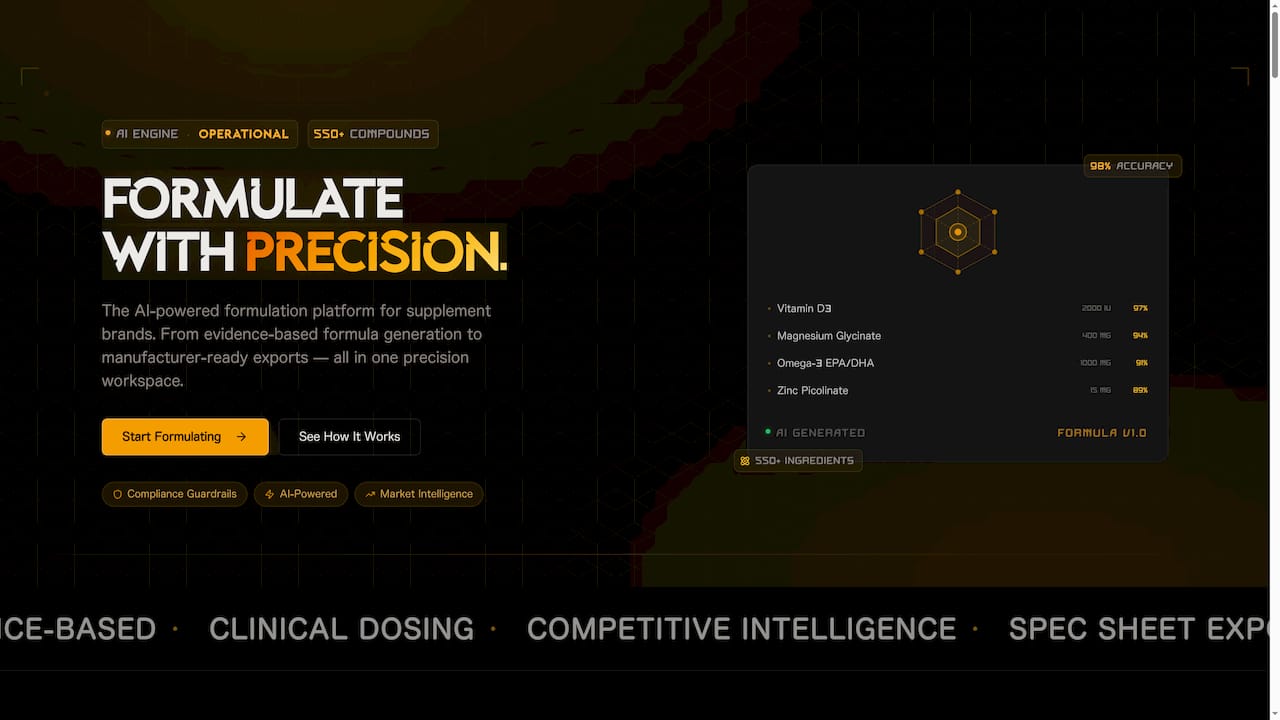
FormlyPro gives brand founders and product developers a structured, data-backed environment to manage every stage of ingredient sourcing and formulation development. From compliance guidance and competitor analysis to an 8-phase product development plan and AI-powered packaging design, the platform is built to take your product from concept to shelf with confidence. If you are serious about building a brand that lasts, start with sourcing systems that are designed to scale.
Frequently asked questions
How do you assess if an ingredient supplier is reputable?
Request origin certifications and documentation from every potential supplier, and conduct regular in-person or third-party audits to verify that quality and compliance claims hold up under scrutiny.
Why is supply chain traceability important in ingredient sourcing?
Traceability opacity and ethical risks are major sourcing challenges that can expose your brand to recalls, regulatory action, and reputational damage if issues are found in lower supply chain tiers.
What are the main differences between natural and synthetic ingredient sourcing?
Natural versus synthetic ingredients each present different sourcing considerations: natural offers potency but comes with variability, while synthetic delivers consistency but may raise sustainability concerns.
What key documents should you obtain from ingredient suppliers?
Obtain a Certificate of Analysis, a Safety Data Sheet, and independent microbial testing reports for every batch, as requesting samples and documentation is one of the most critical steps in the sourcing process.