

TL;DR:
- Choosing trending ingredients without benchmarking can lead to high costs and inconsistent performance in formulations. Ingredient benchmarking involves comparing performance, cost, stability, and safety against established standards under realistic conditions, ensuring genuine value and competitive edge. Implementing a rigorous, cross-functional benchmarking process helps brands validate claims, accelerate launches, and build consumer trust through science-backed differentiation.
Choosing an ingredient because it's trending is one of the most common and costly mistakes in product development. The ingredient that dominates trade show booths this year might cost three times more per unit, perform inconsistently at real use rates, or buckle under your specific formulation conditions. Ingredient benchmarking is the disciplined process that separates brands building on solid science from those chasing buzzwords. In this article, you'll learn what benchmarking actually involves, how to run it step by step, which metrics determine real value, and how to translate test results into formulations that outperform the competition on every shelf.
Table of Contents
- What is ingredient benchmarking?
- The benchmarking process: How it works
- Key metrics to evaluate during benchmarking
- Why ingredient benchmarking gives your products a competitive edge
- Practical applications: Using benchmarking to improve your formulations
- Why most brands underuse ingredient benchmarking (and how you can do better))
- Accelerate your next formulation with FormlyPro
- Frequently asked questions
Key Takeaways
| Point | Details |
|---|---|
| Go beyond trends | Ingredient benchmarking analyzes real-world performance and value, not just popularity. |
| Test against standards | Always compare new ingredients to industry gold standards at realistic use levels. |
| Use practical metrics | Prioritize efficacy, cost-in-use, and consumer acceptance in your benchmarking process. |
| Leverage evidence for edge | Benchmarking data secures regulatory approvals and strengthens market claims. |
| Integrate benchmarking early | Embedding benchmarking in product development accelerates innovation and competitive advantage. |
What is ingredient benchmarking?
Ingredient benchmarking means systematically comparing a candidate ingredient's performance, cost, and value against a defined reference standard, often called the "gold standard," under realistic formulation and use conditions. It is not a single lab test. It's a structured comparison that accounts for real use rates, cost-in-use, and measurable performance outcomes.
In the beauty space, for example, benchmarking new ingredients against established actives like hyaluronic acid is standard practice. A supplier claims their novel humectant delivers superior hydration at half the concentration. Benchmarking tests whether that claim holds at realistic percentages in a finished formula, measures the actual hydration improvement, and then calculates what you actually spend per unit of product to achieve that result.
Here's what rigorous ingredient benchmarking covers:
- Performance testing against the gold standard at matched use rates
- Cost-in-use analysis for genuine dollar-for-dollar value comparisons
- Stability evaluation under real storage and formulation conditions
- Safety and regulatory screening specific to your target markets
- Consumer or sensory acceptance to validate real-world appeal
"In beauty ingredient launches, benchmarking involves testing new ingredients against gold standards like hyaluronic acid at realistic use rates, measuring performance metrics like hydration, and calculating cost-in-use for dollar-for-dollar comparisons to prove superior value."
The same logic applies in food and supplements. If you're evaluating a new bioavailable form of magnesium, your benchmark is the market-leading form, tested at equivalent elemental doses, in the same delivery format, and assessed for both efficacy and cost per serving.
The benchmarking process: How it works
Understanding the concept is one thing. Executing it well is another. The brands that consistently launch differentiated, high-performance products follow a clear process rather than running ad hoc tests.
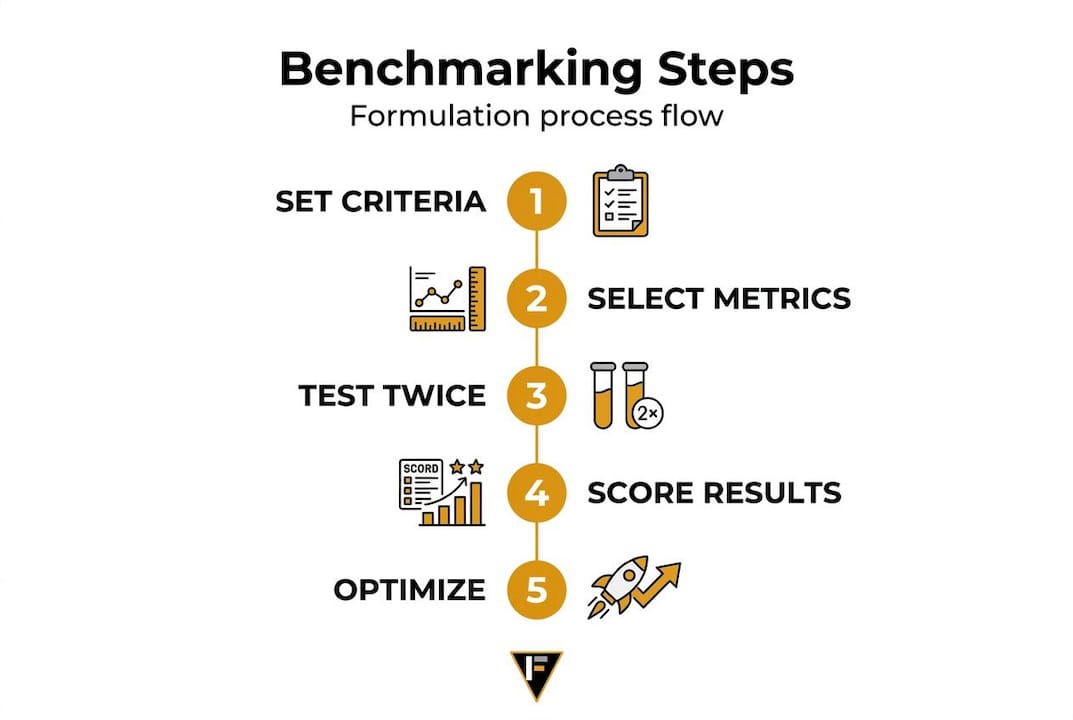
Here's how a thorough benchmarking process unfolds:
- Define the benchmark. Identify the industry gold standard for your specific application. For a skin hydration claim, that's hyaluronic acid at a well-established use rate. For an omega-3 supplement, it might be a specific rTG (re-esterified triglyceride) fish oil with documented bioavailability data.
- Set your test parameters. Decide on use rates, formulation type, testing environment, and duration before you start. Changing parameters mid-test corrupts your data and wastes time.
- Design comparable test formulations. Your benchmark formula and your candidate formula should be identical in every variable except the ingredient under evaluation. Control for pH, processing conditions, and excipients.
- Measure key performance metrics. For cosmetics, this typically includes hydration, skin barrier function, and texture. For food products, it includes taste, shelf stability, and nutrient retention. For supplements, focus on absorption rate and bioavailability measurements.
- Calculate cost-in-use. Divide the ingredient cost by the amount needed to achieve the target performance. An ingredient that costs more per kilogram but performs at 0.5% versus 2% may actually be far cheaper per finished unit.
- Document, analyze, and decide. Run statistical analysis on your results. Determine whether differences are significant and whether performance improvements justify any cost premiums.
Your brand formulation strategy should build benchmarking into every ingredient evaluation cycle, not just when you're considering a major reformulation.
Pro Tip: Always run your benchmark test twice, once in your lab conditions and once under simulated real-world conditions (temperature cycling, humidity, typical shipping stress). A candidate ingredient that falls apart under stress testing would have caused expensive recalls or consumer complaints if you had skipped that step.
Key metrics to evaluate during benchmarking
Not all metrics are created equal. The ones you choose must directly match your ingredient's claimed benefit and the product's end-use application. Testing an antioxidant for hydration performance tells you nothing useful. Selecting the right metrics is where benchmarking either earns its value or wastes your budget.
Performance and value metrics together reveal a new ingredient's real-world standing against the gold standard. Here is a practical reference table:
| Metric category | Specific metric | Application example |
|---|---|---|
| Efficacy | Hydration, absorption, TEWL reduction | Skin care actives |
| Stability | Oxidation rate, pH stability, shelf life | Omega-3s, vitamin C |
| Safety | Irritation index, allergen screen | Fragrance, preservatives |
| Consumer acceptance | Texture, taste, sensory score | Food and topical products |
| Cost-in-use | Cost per unit of effect at use rate | All categories |
| Regulatory fit | Approved status per target market | All categories |
| Supply reliability | Single-source risk, lead time variance | All categories |
The metrics you prioritize depend on your category. In custom formulation work for premium skin care, hydration efficacy and consumer sensory scores often outweigh cost. In mass-market food products, cost-in-use and shelf stability typically drive the final choice.

Pro Tip: Build a weighted scoring matrix before testing. Assign a percentage weight to each metric based on your product's priorities. Then score each ingredient numerically after testing. This removes subjective decision-making and gives you a defensible, documented rationale for your ingredient choices, which is extremely useful for regulatory submissions and investor presentations.
Supply reliability deserves far more attention than most brands give it. Selecting an ingredient with a single-source supply chain creates a hidden vulnerability that no amount of lab performance can fix. Your gold standard comparison should include supply chain resilience as a scored metric.
Why ingredient benchmarking gives your products a competitive edge
You can formulate a technically sound product without benchmarking. But you cannot consistently formulate a provably superior product without it. That distinction is exactly what separates category leaders from also-rans.
Benchmarking validates claims of superior value, and that validation gives you a genuine competitive edge in crowded categories. Here's why it matters commercially:
- Defensible marketing claims. When your packaging states "clinically shown to outperform hyaluronic acid," that claim must be backed by real comparative data. Benchmarking provides exactly that documentation.
- Faster regulatory approvals. Regulatory bodies respond better to submissions that include head-to-head comparisons against established safe ingredients. Your dossier becomes significantly stronger.
- Reduced launch risk. Testing against a known standard before launch catches formulation problems before they reach consumers. The cost of a benchmarking study is a fraction of the cost of a product recall or reformulation after launch.
- Investor and retailer confidence. Data-backed formulation decisions communicate credibility. Retailers with premium shelf space want assurance your product will perform as claimed.
Brands that invest in science-driven competitive advantages consistently command higher price points and build stronger consumer loyalty than those relying on trend-based formulation.
Consider this: In the supplement industry, brands that published comparative bioavailability studies saw average price premiums of 20 to 40% over category competitors using generic ingredient forms. The benchmarking data essentially paid for itself many times over in margin.
Building formulation transparency into your brand story is only possible when you have rigorous comparative data behind every ingredient choice. Without that data, transparency claims ring hollow.
Practical applications: Using benchmarking to improve your formulations
Theory lands when it connects to action. Here's how benchmarking integrates into actual product development timelines and decisions.
Case example: Launching a moisturizer with a next-generation humectant
Suppose you're evaluating a polyglutamic acid serum to compete in the premium hydration segment. Your benchmark is hyaluronic acid at 1% in a standard serum base. Here's how the benchmarking cycle integrates into your R&D timeline:
- Week 1 to 2: Define gold standard, set use rates (0.1%, 0.5%, 1% polyglutamic acid vs. 1% hyaluronic acid), prepare test formulas.
- Week 3 to 4: Run corneometer (skin hydration) and TEWL (transepidermal water loss) measurements on 10 to 15 subjects.
- Week 5: Conduct stability testing, calculate cost-in-use per 30ml unit, run sensory panel.
- Week 6: Analyze data, apply weighted scoring matrix, make formulation decision.
- Week 7 to 8: Finalize formula, document benchmarking data for market-ready formulation process and regulatory filing.
Here's a comparison snapshot from a typical outcome:
| Evaluation factor | Hyaluronic acid (1%) | Polyglutamic acid (0.5%) |
|---|---|---|
| Hydration improvement (24hr) | +18% | +23% |
| Cost-in-use per unit | $0.42 | $0.31 |
| Stability (6mo at 40°C) | Pass | Pass |
| Sensory score (out of 10) | 7.8 | 8.3 |
| Regulatory status (EU/US) | Approved | Approved |
Results like this give you every element you need for a justified launch decision. The checklist for applying benchmarking results to formulation decisions looks like this:
- Confirm the candidate ingredient outperforms (or matches plus saves cost) on your weighted metrics
- Verify regulatory compliance for every target market
- Document all comparative data for claims substantiation
- Update your supply chain risk assessment
- Brief your marketing team on the specific performance differences so claims are accurate and defensible
Staying current with 2026 formulation trends is also valuable here. Benchmarking gives you the rigor to evaluate whether a trending ingredient like fermented actives or bio-identical lipids genuinely outperforms your current formulation or simply looks good in a pitch deck.
Why most brands underuse ingredient benchmarking (and how you can do better)
Here's the uncomfortable reality: most brands run some form of performance testing, but very few run true benchmarking. They test their formula. They don't compare it against the gold standard at matched use rates. They measure one or two metrics that confirm what they already want to believe. And they almost never calculate cost-in-use until the finance team forces the conversation months later.
Many ingredient launches fail to apply benchmarking rigorously because most measure one metric but skip cost or real-use testing, which severely weakens their competitive case. We've seen this pattern across food, beauty, and supplement brands repeatedly.
The brands that do benchmarking well treat it as a cross-functional exercise. The formulation scientist handles test design and execution. The regulatory team evaluates each candidate against compliance requirements before the test concludes, not after. Marketing defines which performance claims matter most to the consumer before testing starts, so the metrics actually connect to commercial value. Finance sets the acceptable cost-in-use ceiling at the outset. When all four functions are aligned around a shared benchmarking framework, the data you generate is immediately actionable across every department.
There's another overlooked dimension: competitive benchmarking. Instead of just comparing a new ingredient against a generic gold standard, pull apart the formulas of the top three products in your target category. What actives are they using, at what concentrations, and what performance outcomes are they claiming? Then benchmark your candidate against those specific benchmarks. This turns ingredient evaluation into genuine competitive intelligence.
Using a formulation checklist for scientists that incorporates benchmarking criteria at each phase ensures nothing gets skipped. The brands building durable market positions right now are the ones treating benchmarking as a strategic capability, not a one-time test.
Accelerate your next formulation with FormlyPro
Running a rigorous benchmarking process requires organized data, clear workflows, and visibility into what competitors are actually putting in their products.

FormlyPro's formulation platform gives brand owners and product developers a structured system to manage every phase of ingredient evaluation, from competitive ingredient analysis to formulation prototyping, compliance checking, and packaging design with an integrated AI mockup tool. You can see which ingredients top-selling products in your category are using, benchmark your candidates against those benchmarks with real cost-in-use frameworks, and generate market-ready formulations through an 8-phase development plan. Whether you're in food, beauty, or health supplements, FormlyPro gives you the research-backed foundation and the competitive intelligence to formulate with confidence and launch faster.
Frequently asked questions
How do you choose a gold standard for ingredient benchmarking?
Select the gold standard based on market reputation, established performance data, and broad industry adoption in your specific product segment. The gold standard should represent the most recognized benchmark your target consumer or retailer would recognize.
Why is cost-in-use more important than ingredient price alone?
Cost-in-use reflects real formulation costs at actual usage rates, revealing value differences that ingredient price alone misses. As established in dollar-for-dollar comparisons, an expensive ingredient used at 0.1% may cost far less per finished unit than a cheaper ingredient required at 2%.
Can ingredient benchmarking help with regulatory compliance?
Yes. Benchmarking supports regulatory acceptance by producing head-to-head data that demonstrates your ingredient's safety and efficacy relative to trusted, already-approved standards. Regulatory dossiers supported by comparative data are typically stronger and faster to process.
What mistakes should brands avoid in benchmarking?
Avoid testing only in ideal laboratory conditions, ignoring cost-in-use, or selecting metrics that conveniently favor your preferred ingredient. Common benchmarking errors include missing real-world use tests and skipping supply chain risk assessment. Rigorous, multi-metric comparisons against a genuine gold standard are the only way to generate data you can trust.