

TL;DR:
- Effective formulation ideation is a structured, multi-stage process that ensures product feasibility and compliance.
- It involves early screening of ingredients, detailed briefs, and interdisciplinary collaboration to prevent costly failures.
- Treating ideation as infrastructure rather than just brainstorming boosts innovation speed and market success.
Product batches that perform flawlessly in the lab but collapse on the factory floor. Formulations that clear your internal review only to hit a regulatory wall in a new market. These aren't random bad luck events; they're the predictable result of skipping or rushing formulation ideation. When brand managers treat ideation as a quick brainstorm session before handing off to the lab, they're building on sand. This guide breaks down what formulation ideation actually involves, where teams consistently get it wrong, and how to build a process that turns early-stage thinking into scalable, compliant, market-ready products.
Table of Contents
- What is formulation ideation?
- The formulation ideation process: Key stages
- Common pitfalls: Why formulation fails at scale
- Best practices: Making formulation ideation work for your team
- Our perspective: Why formulation ideation is your innovation engine
- Where to go next: Power up your formulation ideation
- Frequently asked questions
Key Takeaways
| Point | Details |
|---|---|
| Structured ideation | Formulation ideation organizes creative and compliance review upfront for fewer errors later. |
| Compliance integration | Integrating regulatory checks in ideation prevents costly reformulations and delays. |
| Cross-team collaboration | Effective formulation requires input from R&D, regulatory, and marketing teams for market-ready outcomes. |
| Scalability focus | Thorough ideation addresses issues that can cause failures when scaling up from lab to factory. |
What is formulation ideation?
Formulation ideation is the structured process of generating, evaluating, and filtering product concepts before a single prototype is mixed. It sits upstream of everything: ingredient sourcing, lab work, regulatory submission, and production planning. Think of it as the architectural phase before construction. You wouldn't start pouring concrete without blueprints, and you shouldn't start formulating without a validated concept.
What separates formulation ideation from basic brainstorming is structure. A brainstorm generates ideas. Formulation ideation takes those ideas through a series of filters: technical feasibility, ingredient compatibility, regulatory compliance, market fit, and manufacturing scalability. By the time a concept exits the ideation phase, it should be defensible on all fronts, not just exciting on a whiteboard.
The core elements of a strong formulation ideation process include:
- Creative input: Trend intelligence, consumer insights, and competitive benchmarking to define what the product needs to achieve.
- Regulatory foresight: Early identification of restricted ingredients, market-specific prohibitions, and labeling obligations before any lab work begins.
- Technical feasibility screening: Assessing whether proposed ingredient combinations are chemically compatible, stable, and manufacturable at scale.
- Market alignment: Confirming that the concept fills a genuine gap and aligns with your brand positioning, not just a passing trend.
- Documentation discipline: Recording every decision and rationale so the downstream team inherits context, not confusion.
"For brand managers, formulation ideation streamlines compliance by integrating regulatory checks early via detailed briefs, reducing reformulation risks; AI enhances speed while ensuring market adherence."
The practical payoff is significant. Teams that invest in thorough ideation spend far less time and money on reformulation. When regulatory flags surface in the ideation phase, they're a two-hour conversation. When they surface after lab validation, they're a two-month setback. Understanding the full formulation development overview makes it clear that the decisions made before the first prototype are often the most consequential ones in the entire product lifecycle.
For beauty and wellness brands specifically, this matters even more. Your category is dense with active ingredients, delivery system innovations, and overlapping regulatory frameworks (FDA, EU Cosmetics Regulation, ISO standards). A formulation ideation process that doesn't account for all of those simultaneously is leaving serious risk on the table.

Pro Tip: Assign a regulatory stakeholder to your ideation sessions from day one. Not to slow things down, but to flag issues before they become embedded in a concept the whole team has fallen in love with.
The formulation ideation process: Key stages
Understanding what formulation ideation means, it's critical to explore its actual workflow. This isn't a single meeting or a linear checklist. It's an iterative cycle with defined gates that prevent weak concepts from consuming lab resources.
Here is how a rigorous formulation ideation process should be structured:
-
Brief building: Define the product objective with precision. What does it do, for whom, under what conditions, and in which markets? A strong brief includes target demographics, performance benchmarks, packaging constraints, price point targets, and key regulatory markets. Vague briefs are the single biggest cause of ideation drift.
-
Trend and market research: Pull consumer insight data, search trend analytics, and competitive formulation intelligence. Identify what's selling, what's saturated, and where a genuine white space exists. This stage should inform ingredient selection, not just aesthetic choices.
-
Ingredient screening: Generate a shortlist of candidate ingredients that match the brief. Screen each one for regulatory status across target markets, known compatibility issues, supplier availability, cost at scale, and stability history. This step alone eliminates roughly 40% of initial ideas before they ever reach the lab.
-
Concept ideation and ranking: With a screened ingredient pool, generate multiple formulation concepts. Score each concept against weighted criteria: efficacy, safety, cost, regulatory clearance, and brand fit. Use a scoring matrix, not gut instinct, to select which concepts move forward.
-
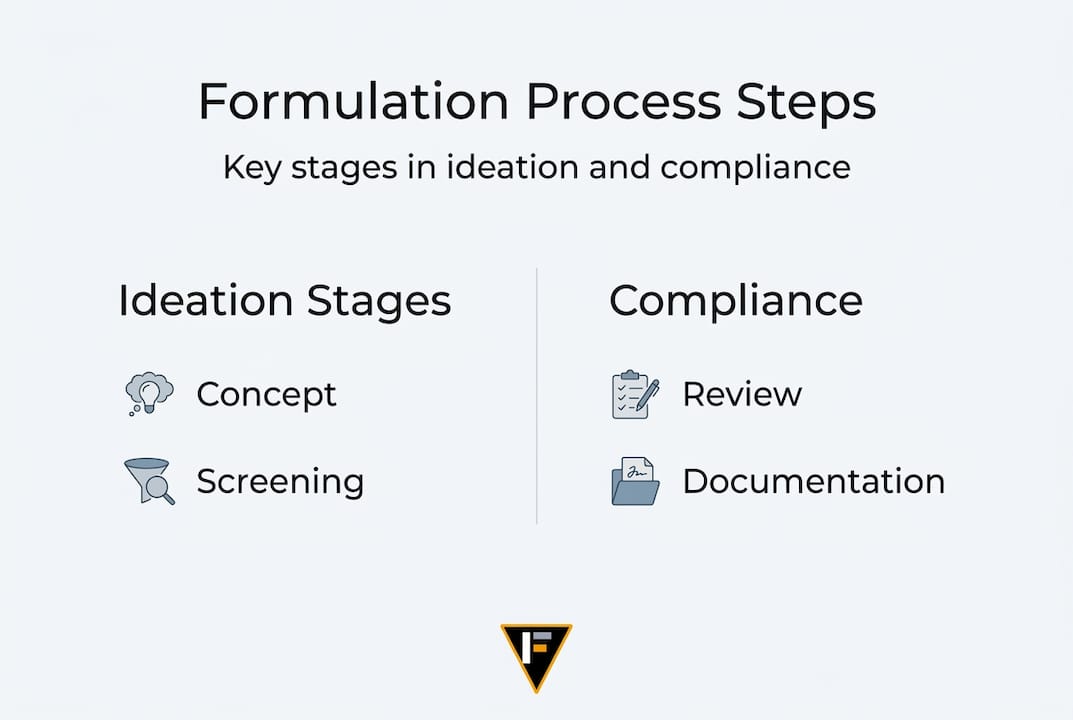
Compliance review: Before prototyping begins, run each surviving concept through a formal compliance check. This includes reviewing concentration limits, prohibited ingredient lists, claim substantiation requirements, and any category-specific regulations (e.g., SPF, anti-dandruff, or preservative-free claims). Refer to market-ready formulation steps for a granular breakdown of what compliance review should capture.
-
Prototyping brief: Once a concept clears compliance, hand it to the lab with a fully documented brief that includes target pH range, viscosity specifications, fragrance restrictions, stability test requirements, and any performance claims that need substantiation data.
The feedback loops between these stages are just as important as the stages themselves. When a prototype fails a stability test, that information should cycle back to the ideation phase, not just trigger a quick ingredient swap. Understanding the formulation analytics role in this feedback cycle helps teams turn each iteration into structured intelligence rather than a frustrating reset.
Documentation is the connective tissue that makes this work. Every screening decision, every compliance flag, and every scoring outcome should be logged. When a product reaches production 18 months later, the team needs to understand why specific ingredient choices were made, not guess.
Pro Tip: Build your compliance review into stage five as a hard gate, not a soft advisory step. If a concept can't clear compliance at the ideation stage, it won't magically clear it later.
Common pitfalls: Why formulation fails at scale
Once you know the steps, it's crucial to recognize where breakdowns most often occur and why. Even well-resourced teams with experienced formulators hit these walls, because the problems usually originate in decisions made during ideation, not during lab work.
Full ideation vs. shortcut approach: A direct comparison
| Outcome area | Full ideation process | Shortcut approach |
|---|---|---|
| Regulatory clearance | Identified and resolved in stage 5 | Discovered post-prototype or post-launch |
| Reformulation cycles | 1 to 2 targeted iterations | 4 to 6 reactive cycles |
| Time to first prototype | 4 to 6 weeks | 1 to 2 weeks (then 3 to 6 months of rework) |
| Scale-up success rate | High, with documented specifications | Unpredictable, batch-dependent |
| Compliance cost | Integrated and low | Reactive and expensive |
The technical failures that most commonly trace back to rushed ideation include:
- pH drift: When multiple actives are combined without modeling their combined pH impact, the final formulation can shift outside the stability window. This degrades efficacy, triggers preservation system failure, and can compromise skin safety.
- Emulsion breakdown: Emulsion failure from pH drift, a high cool-down phase exceeding 10%, and electrolyte-rich actives are among the most common edge cases that cause lab-validated emulsions to fail in production. These are predictable problems when ingredient interactions are mapped during ideation.
- Scale-up mixing failures: A formulation that behaves perfectly in a 500-gram lab batch can behave completely differently in a 500-kilogram production vessel. Shear rates, heat transfer, and mixing time all change at scale. If ideation doesn't flag these variables, the first production run becomes an expensive experiment.
- Incompatible active combinations: Vitamin C and niacinamide at specific concentrations, retinoids and AHAs at low pH, and peptide complexes with high-ionic emulsifiers are all combinations that require compatibility modeling before prototyping. Missing this in ideation means discovering it mid-stability study.
The risks that teams most often overlook during ideation in beauty and wellness include compliance in cosmetics for specific claim categories, raw material supplier variability across batches, packaging material interactions (especially for active-rich formulations), and the difference between a safe formulation and a safe-for-claim formulation. Reviewing tailored formulation solutions can reveal how much variation there is in how these risks surface across different product categories.
The uncomfortable reality is that a formulation can pass every lab test and still fail at the factory. When ideation is incomplete, lab success gives teams false confidence. The true test of ideation quality is not whether the prototype works; it's whether the production batch works the first time.
Best practices: Making formulation ideation work for your team
To avoid these pitfalls, here's how top beauty and wellness brands make formulation ideation a competitive advantage. The difference between brands that consistently launch on time and brands that spiral through reformulation cycles almost always comes down to how seriously they treat the ideation phase.
Pitfalls vs. best practice solutions
| Common pitfall | Best practice solution |
|---|---|
| Vague or incomplete product brief | Use a standardized brief template with mandatory regulatory fields |
| Compliance review too late in process | Assign compliance as a gate between ideation and prototyping |
| No documented ingredient screening rationale | Log all screening decisions with justification in a shared platform |
| Single-discipline ideation team | Include R&D, regulatory, marketing, and ops in ideation sessions |
| Analytics used only post-launch | Integrate market and competitive analytics into the brief-building stage |
Here are the practices that make the biggest measurable difference:
-
Standardize your brief templates: A brief that includes target markets, claim categories, price point, shelf-life requirements, and packaging material specs eliminates the most common source of downstream confusion. Every ideation session should start with a completed brief, not a blank page.
-
Pre-screen for regulatory compliance before ideation sessions: Build a pre-approved ingredient library that's been cleared for your primary markets. When ideation draws from a pre-screened pool, compliance review becomes a confirmation step, not a discovery process.
-
Use scoring matrices with weighted criteria: Score every concept against efficacy, safety profile, manufacturing complexity, cost at scale, and regulatory clearance. Weight the criteria to match your brand's actual priorities. A brand competing on clinical efficacy should weight that criteria higher than a brand competing on cost.
-
Integrate competitive analytics into the research phase: Before ideating, know what's already on the market, what ingredient combinations competitors are using, and where consumer satisfaction gaps exist. This prevents teams from reinventing what's already selling or iterating on what's already failing. The brand formulation steps framework shows how analytics integration can sharpen ideation focus significantly.
-
Document decisions in real time, not retrospectively: The team that launches the product is rarely the same team that developed it. Real-time documentation means institutional knowledge doesn't walk out the door when people change roles.
-
Run parallel ideation tracks: Rather than developing one concept in depth before screening alternatives, run three to four concepts through initial screening simultaneously. This increases the odds that one survives all gates without sacrificing efficiency.
Pro Tip: Use detailed briefs and ingredient pre-screening as your first compliance filter. By the time a concept reaches your formulator, it should already have a green light on regulatory status in all target markets.
Our perspective: Why formulation ideation is your innovation engine
With best practices in mind, here's a sharper take from behind the scenes of product innovation. Most teams think of formulation ideation as the creative phase, the fun part before the serious work begins. That framing is exactly what's causing the failures.
Formulation ideation is not a creative exercise. It's infrastructure. The brands that consistently win in beauty and wellness don't treat ideation as inspiration; they treat it as a cross-disciplinary system. Compliance, R&D, marketing, and operations all sit in the same room (or the same platform) from the moment a brief is opened. Not to slow creativity down, but because creative decisions made without that input cost money that doesn't need to be spent.
The lesson from watching products fail is almost never about poor chemistry or bad science. It's about organizational silos. A marketing team falls in love with a claim. A formulator builds to that claim. A compliance review two months later shows the claim can't be substantiated without a clinical study the timeline doesn't allow. The product launches with a watered-down claim, a demoralized team, and a margin that absorbed three unnecessary reformulation cycles.
Treating ideation as a formal, documented, compliance mastery guide-informed system prevents exactly that. The brands building the most durable innovation pipelines are the ones that understand this. Ideation is where your competitive advantage is either built or lost.
Where to go next: Power up your formulation ideation
Knowing how formulation ideation works is a strong start. Putting that knowledge into a system your whole team can execute consistently is where real gains happen.
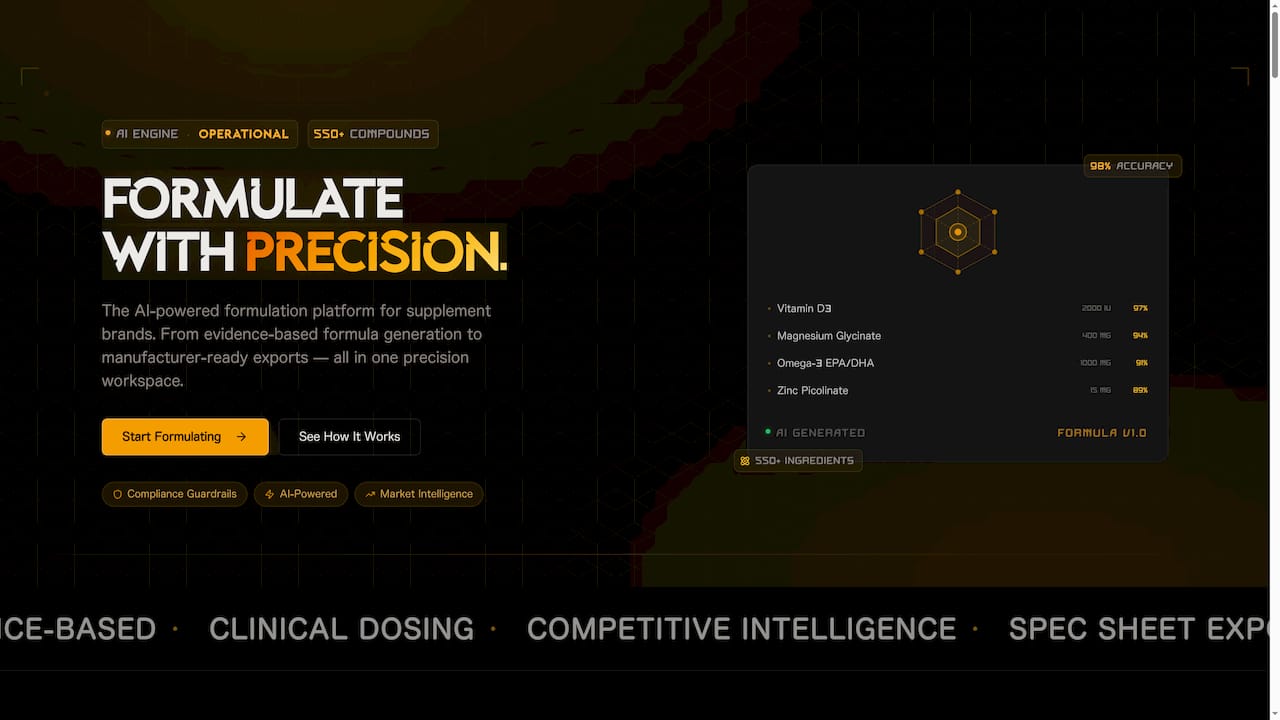
FormlyPro is built specifically for brand managers and product developers who need more than a project management tool. The FormlyPro platform guides you through an 8-phase product development plan that takes a concept from ideation all the way through formulation, prototyping, compliance, market research, and production. You get integrated competitor analysis, real-time compliance guidance, market positioning support, and an AI-powered mockup designer for custom packaging. Every phase is documented, every decision is logged, and every compliance requirement is flagged before it becomes a problem. This is formulation ideation built into the infrastructure of your product development workflow.
Frequently asked questions
How does formulation ideation help with compliance?
Formulation ideation embeds regulatory checks early in development via detailed briefs and pre-screening, reducing reformulation risks and significantly shortening time-to-market.
What are common technical failures in beauty product formulation?
Technical failures often include emulsion breakdown and pH drift as well as scale-up challenges where lab batches perform well but fail in full production due to mixing and shear differences.
What makes formulation ideation different from simple brainstorming?
Formulation ideation includes not only creative idea generation but also structured technical and compliance screening before prototyping, making it a filtered, gate-based system rather than an open-ended session.
How can AI support formulation ideation for beauty brands?
AI tools accelerate market adherence by rapidly screening ingredient options against compliance databases, efficacy benchmarks, and scalability requirements, compressing what used to take weeks into hours.