

A controlled-release (CR) formulation is a dosage form engineered to deliver an active ingredient at a predetermined rate, maintaining a near-constant concentration over an extended period. Per the IUPAC definition, CR provides predefined release kinetics, including zero-order profiles, to sustain therapeutic or functional levels without the peaks and troughs of immediate-release formats. That precision is what separates true CR from the broader category of extended-release (ER): CR is a precise subset of ER, not a synonym for it.
- Adherence and efficacy: Fewer doses per day, steadier exposure, and reduced side effects tied to concentration spikes
- Positioning risk: Using CR and ER interchangeably on labels or in claims invites regulatory scrutiny — the distinction matters to the FDA
- Your immediate next step: Profile your active ingredient (solubility, dose, stability), shortlist two or three candidate mechanisms, and run a feasibility screen before committing to a formulation path
Table of Contents
- What is controlled release formulation, and why does it matter commercially?
- How do the core release mechanisms actually work?
- How do you choose the right mechanism for your ingredient?
- From concept to pilot: the CR development timeline
- U.S. regulatory and safety considerations for CR supplements
- What testing does a CR supplement actually need?
- Common CR formulation risks and how to avoid them
- Key Takeaways
- The part most brand managers underestimate
- How Formlypro supports your CR product from concept to launch
- Useful sources
What is controlled release formulation, and why does it matter commercially?
For supplement and wellness brands, the business case for CR goes beyond science. Transitioning from immediate-release to controlled-release delivers improved adherence through reduced dosing frequency, minimized peak-trough fluctuations, and fewer dose-related side effects. Each of those outcomes maps directly to commercial value.
- Adherence: A once-daily melatonin matrix tablet is a simpler consumer habit than three doses. That simplicity shows up in repeat purchase rates.
- Differentiated positioning: A sustained-release ashwagandha capsule that delivers adaptogen exposure across a full workday is a distinct product story, not just a reformulation.
- Reduced side effects: Vitamins like niacin cause flushing at high immediate-release doses; a CR format blunts that peak and keeps the consumer on the product.
- Lifecycle strategy: CR formats can support IP protection and extend a product's commercial window, which is why CR increases up-front development cost but often pays back through brand premium and defensibility.
Getting the scientific validation right is what separates a credible CR claim from a marketing label.
How do the core release mechanisms actually work?
Four primary mechanisms cover most oral CR supplement applications. Advanced platforms exist but require specialized regulatory and analytical handling.

| Mechanism | How it works | GI sensitivity | Complexity |
|---|---|---|---|
| Diffusion/polymer matrix | Drug diffuses through a rate-controlling polymer network (e.g., HPMC, ethylcellulose) | Moderate | Low–moderate |
| Dissolution/erosion matrix | Release rate governed by polymer dissolution or surface erosion | Moderate | Low–moderate |
| Functional coating/reservoir | Drug core coated with a membrane; release controlled by coating thickness and pore formers | Moderate | Moderate |
| Osmotic pump | Osmotic pressure drives drug through a laser-drilled orifice; largely unaffected by GI conditions | Low | High |
| Ion-exchange resin | Drug bound to resin; released by ionic exchange in GI fluid | Moderate | Moderate |
Polymer choice and process parameters — coating thickness, viscosity grade, pore former concentration, and particle geometry — are the primary levers that tune release rate. Excipient selection is therefore one of the highest-leverage decisions in CR formulation. Advanced options like stimuli-responsive systems and nanoparticle platforms exist for specialized therapeutics, but they carry different regulatory pathways and analytical demands that most supplement brands are not positioned to navigate at launch.
Pro Tip: Osmotic systems deliver near zero-order kinetics with minimal GI variability — attractive for ingredients where absorption consistency matters most — but they require dedicated manufacturing equipment and higher capital expenditure. Weigh that against a simpler HPMC matrix before committing.
How do you choose the right mechanism for your ingredient?
Mechanism selection starts with your active ingredient's profile, not with what sounds most advanced. Work through this checklist before your first vendor conversation.
Ingredient and product inputs:
- Solubility class (high vs. low — solubility drives mechanism eligibility)
- Dose per unit and dose strength
- Chemical and physical stability under processing conditions
- Target site of release (upper GI, colon, systemic)
- Desired kinetic profile (zero-order vs. first-order)
- Permitted dosage form (tablet, capsule, bead, matrix)
- pH sensitivity across GI tract
Questions to ask a CRO or contract manufacturer:
- What CR mechanisms have you scaled commercially for this ingredient class?
- Can you provide in-vitro/in-vivo correlation (IVIVC) data from comparable projects?
- What coating or compression equipment is on-site, and what batch sizes have you validated?
- What release reproducibility data can you share across batches?
- What is your typical timeline from feasibility to pilot batch?
Cost tradeoffs at a glance:
- Matrix systems: lowest CAPEX, scalable on standard tablet lines, but release tuning is less precise
- Coated reservoir systems: moderate CAPEX, good reproducibility, sensitive to coating process variation
- Osmotic systems: highest CAPEX, most GI-independent kinetics, often require dedicated equipment
More complex technology is not always better. The right mechanism depends on the ingredient's properties and the use case — a principle that applies as much to a sleep-aid melatonin product as to a pharmaceutical API.
From concept to pilot: the CR development timeline
| Phase | Typical duration | Key deliverables |
|---|---|---|
| Feasibility screening | 4–8 weeks | Mechanism shortlist, preliminary release data, go/no-go recommendation |
| Pilot formulation | 8 weeks | Prototype batches, initial dissolution profiles, excipient compatibility data |
| Accelerated stability | 26 weeks (parallel) | ICH-condition stability data, release profile at time points |
| Analytical method development | 6 weeks (parallel) | Validated dissolution method, specification draft |
| Manufacturing scale-up | 24 weeks | Pilot-to-commercial batch records, process validation plan |
| Regulatory documentation | 4–8 weeks | Label language, claims substantiation, DSHEA compliance file |
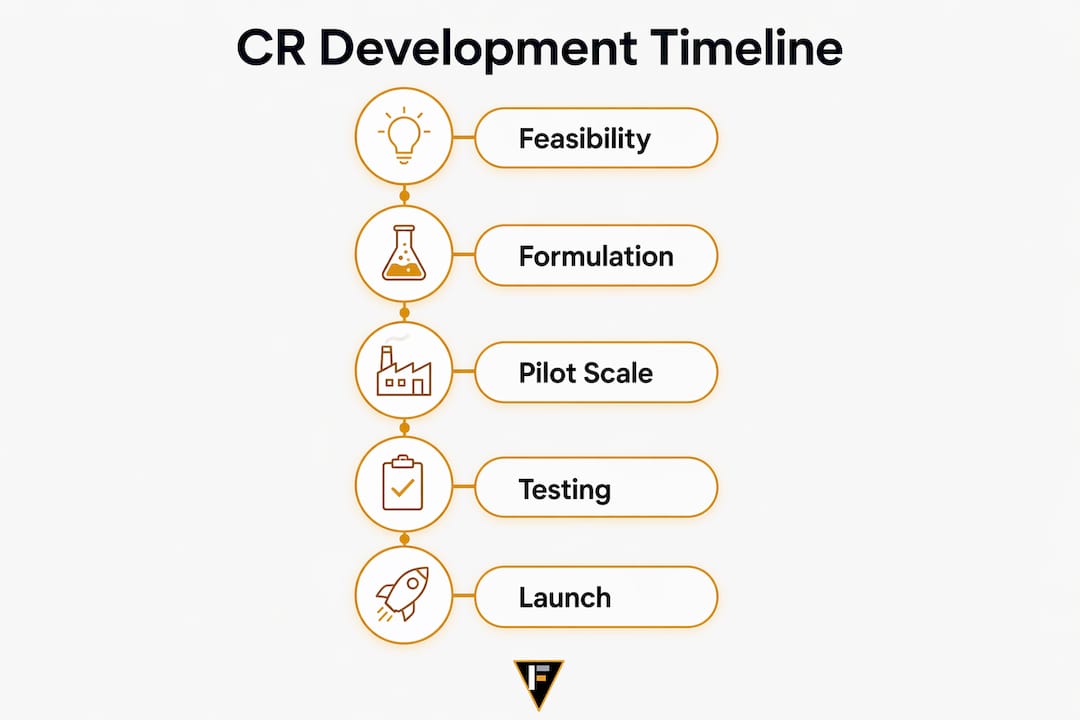
Packaging design and consumer claims testing can run in parallel with stability to compress the overall timeline. The formulation scalability checklist is worth reviewing before scale-up begins.
Primary cost drivers:
- Specialized coating or compression equipment (often a contract manufacturer cost passed through)
- Analytical method development and validation for release testing
- Rate-controlling polymer sourcing (ethylcellulose, acrylic polymers, HPMC grades)
- Regulatory and safety testing for novel excipients
U.S. regulatory and safety considerations for CR supplements
The regulatory path depends on how you classify the product. Under DSHEA, dietary supplements do not require pre-market FDA approval, but a CR delivery system that makes drug-like claims or uses novel excipients can push the product toward OTC drug expectations. Get that classification right before you finalize the formulation.
Regulatory checklist:
- Confirm DSHEA vs. OTC drug pathway based on intended claims and active ingredients
- Safety and toxicity data for any novel rate-controlling excipient
- Biocompatibility assessment for polymer degradation products
- Label statement: "Do not crush, split, or chew" — mandatory for matrix and coated CR forms
- Manufacturing controls: demonstrate release reproducibility across production batches
- Claims substantiation file tied to the CR mechanism (not just the active ingredient)
- Packaging: moisture barrier and light protection appropriate to the excipient system
Pro Tip: Mislabeling a product as "controlled release" when it is technically only "extended release" is not a minor terminology issue. The FDA distinguishes these in guidance, and biopharma regulatory trends show increasing scrutiny of delivery-related label claims. Use the term your mechanism actually supports.
What testing does a CR supplement actually need?
Release testing is the analytical backbone of any CR program. The core methods:
- USP dissolution assays adapted for modified-release forms (Apparatus 1, 2, or 3 depending on dosage form and mechanism)
- Discrimination testing across agitation speeds and pH conditions to confirm the method detects formulation changes
- Accelerated stability under ICH conditions (40°C/75% RH for 6 months minimum) with release profile monitoring at each time point
- IVIVC development where feasible, to bridge in-vitro data to expected in-vivo performance and support label claims
- Similarity factor (f2) comparisons between batches and against reference profiles as an acceptance criterion
Establishing IVIVC is not always required for supplements, but it strengthens claims and reduces the risk of reformulation late in development.
Pro Tip: Validate a discriminatory dissolution method in the first formulation screening round, not after you have selected a lead formula. A method that cannot detect a 20% change in coating thickness will miss real formulation drift — and you will find out at scale-up, not at the bench.
Common CR formulation risks and how to avoid them
The risks that cause launch delays are predictable. Most are preventable with early controls.
- Dose dumping: Destruction of the release mechanism (crushing, alcohol interaction, coating failure) releases the full dose immediately. This is the highest-severity risk for consumer safety.
- Batch-to-batch variability: Coating weight variation, polymer lot differences, and process drift all shift release profiles between batches.
- Excipient interactions: Incompatible ingredients can degrade rate-controlling polymers or alter release kinetics under storage. Ingredient compatibility testing should happen at the feasibility stage, not after pilot manufacture.
- Moisture and temperature sensitivity: Many CR polymer systems are hygroscopic. Storage conditions that exceed specification can alter release behavior before the product reaches the consumer.
Mitigation starts with reducing formulation risks early: run accelerated and real-time stability in parallel, qualify polymer suppliers before scale-up, and lock packaging specifications before the stability study begins.
Key Takeaways
Controlled-release formulation requires matching the active ingredient's physicochemical profile to the right mechanism, validating release performance analytically, and managing regulatory classification from the first day of development.
| Point | Details |
|---|---|
| CR vs. ER distinction | CR is a precise subset of ER targeting near-constant kinetics; using the terms interchangeably risks regulatory scrutiny. |
| Mechanism selection | Solubility, dose, GI sensitivity, and target kinetic profile determine which CR mechanism is appropriate before any vendor conversation. |
| Development timeline | Expect 12–18 months from feasibility to regulatory-ready pilot, with stability and analytical method development running in parallel. |
| Dose dumping risk | CR forms must never be crushed or split; this label warning is a mandatory consumer safety requirement, not optional guidance. |
| Formlypro platform | Formlypro's 8-phase development workflow, excipient intelligence, and compliance guidance support CR projects from mechanism shortlisting through packaging and launch. |
The part most brand managers underestimate
The technical complexity of CR formulation is real, but it is not the part that kills projects. What actually stalls launches is the gap between selecting a mechanism and understanding what that choice commits you to: a specific analytical method, a specific excipient supply chain, a specific label claim, and a specific manufacturing partner with the right equipment.
Most brands treat mechanism selection as a formulation decision. It is actually a business decision with formulation consequences. Choosing an osmotic system because it sounds precise, without a contract manufacturer who has validated that system at commercial scale, is how a 14-month development program becomes a 26-month one.
The other thing that gets underestimated: the CR vs. ER labeling question. It reads like semantics. It is not. A product labeled "controlled release" that delivers first-order kinetics rather than near-constant kinetics is making a claim the formulation cannot support. That gap between label and mechanism is where regulatory problems start.
Get the mechanism right for the ingredient. Get the label right for the mechanism. Build the analytical method that can actually detect when either one drifts. Everything else in CR development follows from those three decisions.
How Formlypro supports your CR product from concept to launch
Building a CR supplement is one of the more complex product development paths in the supplement category. Formlypro is built specifically for that complexity.
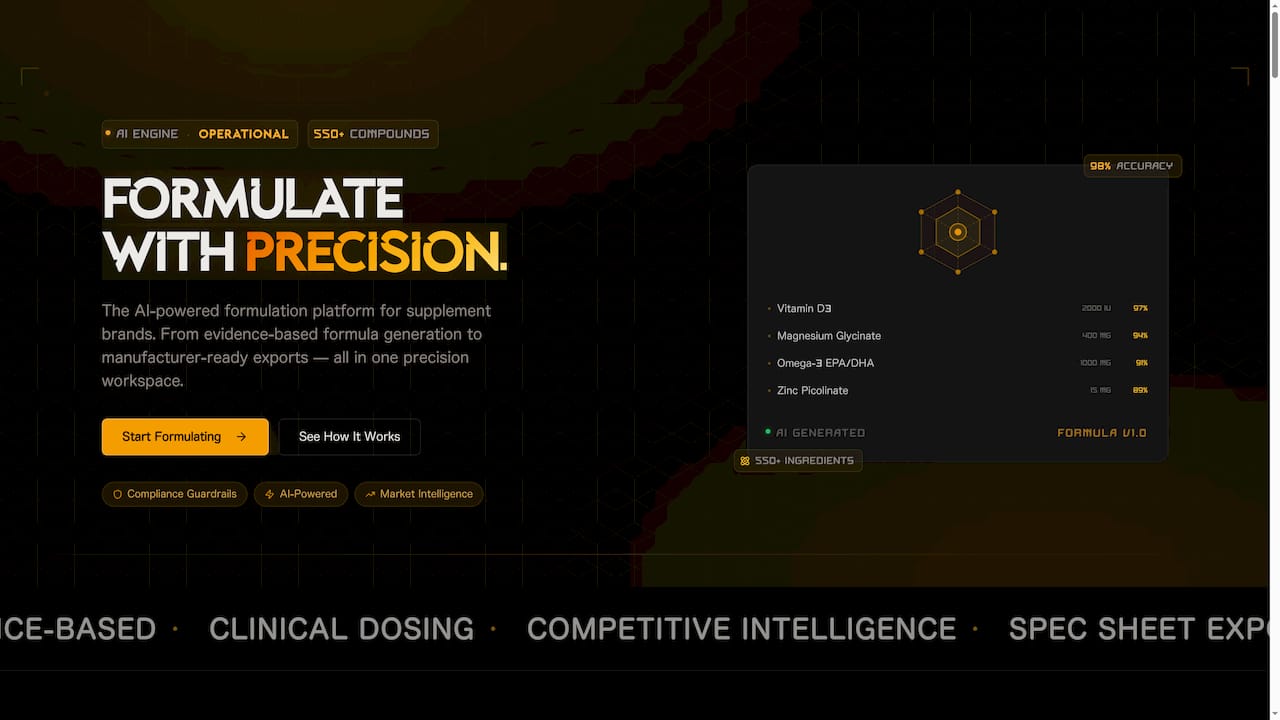
The platform's 8-phase product development workflow walks your team from ingredient profiling and mechanism shortlisting through formulation prototyping, stability planning, compliance documentation, and packaging design. The excipient intelligence layer surfaces rate-controlling polymer options with compatibility data, so you are not starting from scratch on every feasibility screen. The compliance module flags DSHEA vs. OTC pathway considerations and generates label language guidance tied to your specific delivery format. And the AI Mockup designer means your packaging brief and your formulation brief develop together, not in separate silos.
CR projects move faster when the formulation science, regulatory checklist, and market positioning live in one place. Start with Formlypro and take your CR concept through its first feasibility phase with the tools built for it.
Useful sources
- IUPAC: Controlled-release dosage form definition — Primary technical definition; use to anchor CR vs. ER distinction in labeling and claims
- Colorcon: What Is Controlled Release? — Mechanism overview, osmotic systems, and GI independence; U.S.-relevant technical guidance
- Colorcon: Controlled vs. Sustained vs. Extended Release — Authoritative source for CR/ER/SR terminology and polymer excipient guidance
- PMC: CR Design Challenges (PMC7998118) — Peer-reviewed safety and biocompatibility considerations for novel excipients
- PMC: Degradable Polymers and Controlled Release (PMC5509216) — Technical review of polymer mechanisms and nanoparticle platforms
- IntechOpen: Fundamentals and Applications of Controlled Release — IVIVC methodology, dissolution testing, and acceptance criteria
- ScienceDirect: Controlled Drug Release Overview — Advanced delivery platforms and regulatory pathway context
- FDA DSHEA guidance — U.S. regulatory framework for supplement classification and label claims