

TL;DR:
- Solubility limits how much active ingredient can reach systemic circulation and influences formulation strategies. Addressing solubility early through classification, particle size reduction, or excipient use improves bioavailability and stability, preventing costly reformulations later. Incorporating stability testing and design of experiments helps optimize formulations effectively and ensures consistent clinical outcomes.
Solubility is defined as the maximum amount of a substance that can dissolve in a given solvent under specific conditions, and it sets the hard ceiling for how much active ingredient can ever reach systemic circulation. Understanding why solubility affects formulation is not optional for product developers. It is the first decision point that shapes bioavailability, stability, dosage form selection, and clinical outcomes. The Biopharmaceutics Classification System (BCS) provides the industry standard framework for categorizing drugs by solubility and permeability. 40–70% of new chemical entities fall into BCS Class II or IV, meaning poor aqueous solubility is the rule in modern drug development, not the exception. That statistic alone explains why solubility sits at the center of every formulation strategy.

Why solubility affects formulation outcomes
Solubility and dissolution are not the same property. Solubility is the thermodynamic limit; dissolution is the kinetic rate at which a solid moves into solution. Formulators rarely change intrinsic solubility. They manipulate dissolution rate to push the system toward that thermodynamic ceiling as fast as physiologically possible.
The practical consequence is significant. A drug with low intrinsic solubility can still achieve adequate bioavailability if its dissolution rate is fast enough relative to gastrointestinal transit time. When dissolution is too slow, absorption becomes erratic. Plasma concentrations vary between doses, between patients, and between fed and fasted states. That variability is a clinical liability, not just a formulation inconvenience.
The relationship between solubility, dissolution, and absorption forms what formulation scientists call the "bioavailability triangle." Enhancing solubility alone is insufficient when permeability is the limiting factor. BCS Class IV compounds are poorly soluble and poorly permeable, meaning both sides of the triangle need attention simultaneously.
- Dissolution rate determines how quickly drug enters solution in the GI tract
- Solubility sets the maximum concentration achievable at any given pH and temperature
- Permeability governs how fast dissolved drug crosses the intestinal membrane
- Bioavailability is the product of all three working together
Pro Tip: Run BCS classification screening as early as the lead optimization stage. Knowing your compound's class before you commit to a dosage form saves months of reformulation work downstream.
How solubility modifications affect formulation stability
Improving solubility rarely comes for free. Every intervention that raises apparent solubility introduces a new set of chemical interactions that can shorten shelf life or generate degradation products.
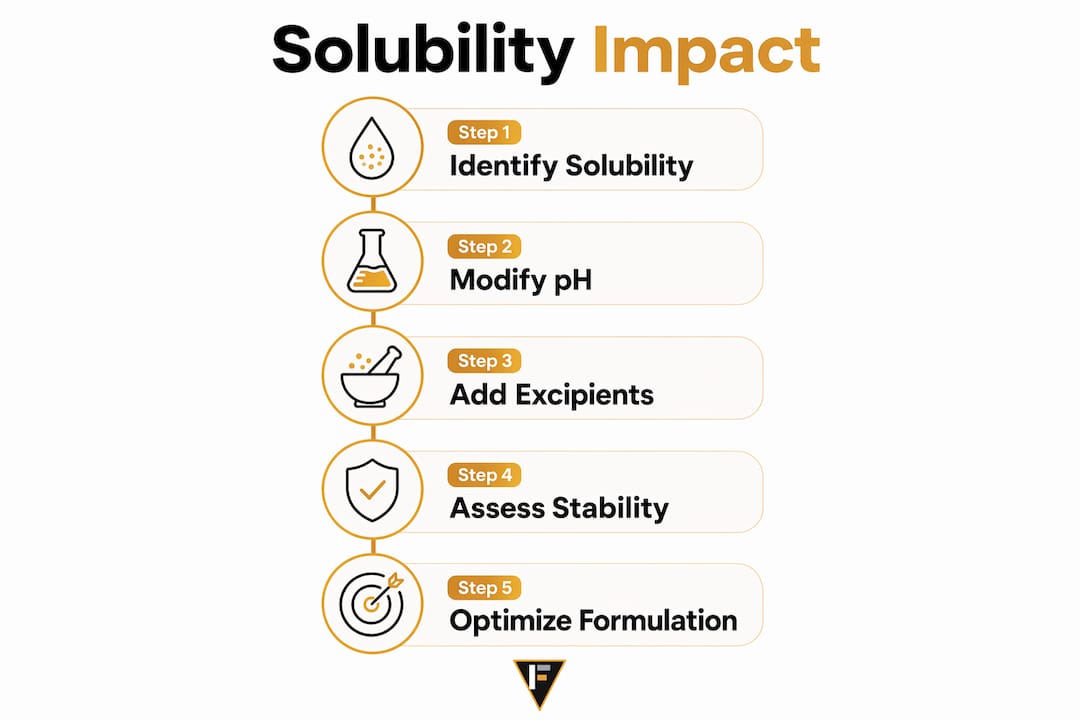
pH adjustment is a common solubility tool. Raising pH to dissolve a weakly acidic drug, or lowering it for a weakly basic compound, works well in solution formulations. The problem is that pH modification can accelerate hydrolysis or oxidation, two of the most common degradation pathways in pharmaceutical products. A formulation that is more soluble at pH 7 may also degrade three times faster at that pH than at pH 5.
Cosolvents and surfactants carry similar risks. Surfactants improve wettability and apparent solubilization, but they can interact with the active ingredient or with other excipients in ways that create new degradation pathways. Forced degradation studies targeting 10–20% degradation are the standard method for revealing these interactions before they appear in long-term stability batches. That degradation window is deliberate. It is wide enough to expose pathways without destroying the sample entirely.
The following steps describe a systematic approach to evaluating stability when solubility is modified:
- Establish baseline degradation under stress conditions (heat, humidity, light, acid, base, oxidation) before adding any solubilizing excipient.
- Introduce one excipient at a time and repeat stress testing to isolate which additive creates new degradation signals.
- Map the pH stability profile across the formulation's intended microenvironmental range, not just at the target pH.
- Apply Design of Experiments (DOE) to characterize how excipient concentration and pH interact. DOE identifies formulation stability cliffs that one-variable-at-a-time testing misses entirely.
- Confirm with stability-indicating analytical methods that can separate the parent compound from all known and unknown degradation products.
Pro Tip: Treat the formulation design space as an interactive system. Changing one excipient concentration by 5% can produce non-linear stability changes that only DOE-based screening will catch.
What formulation strategies manage poor solubility?
Formulators have a well-developed toolkit for BCS Class II and IV compounds. The choice of strategy depends on the compound's physicochemical properties, the target dosage form, and the manufacturing infrastructure available.
Particle size reduction
Micronization and nanonization increase the surface area of drug particles, which directly accelerates dissolution rate. Micronization speeds dissolution by reducing particle diameter into the micron range, while nanonization pushes particles below 1 micron for compounds where micronization alone is insufficient. Nanonized particles also improve dose uniformity in low-dose formulations.
Lipid-based formulations and amorphous solid dispersions
Lipid carriers and amorphous solid dispersions are the two most powerful enabling technologies for BCS Class II drugs. Lipid-based drug delivery systems present the drug in a pre-dissolved or self-emulsifying state, bypassing the dissolution step entirely. Amorphous solid dispersions convert the crystalline drug into an amorphous form with higher apparent solubility, typically by hot-melt extrusion or spray drying with a polymer carrier.
Solubilizing excipients
Surfactants, cyclodextrins, and co-solvents each address solubility through different mechanisms. Surfactants reduce interfacial tension and form micelles that solubilize hydrophobic drugs. Cyclodextrins form inclusion complexes that increase aqueous solubility by orders of magnitude for certain molecules. Co-solvents like polyethylene glycol or propylene glycol increase the polarity of the medium to dissolve poorly water-soluble compounds.
Excipients improve apparent solubilization without changing intrinsic solubility. That distinction matters because the benefit disappears if the excipient is diluted or removed during absorption.
The spring and parachute concept
Even a well-designed formulation can fail if the drug precipitates after dosing. Precipitation risk remains high even when the formulation achieves high initial solubility, because GI dilution and pH changes can push the system past the supersaturation limit. The "spring and parachute" approach addresses this directly. The spring creates supersaturation rapidly after dosing. The parachute, typically a hydrophilic polymer like hydroxypropyl methylcellulose (HPMC) or polyvinylpyrrolidone (PVP), inhibits nucleation and slows precipitation long enough for absorption to occur.
| Strategy | Mechanism | Best suited for |
|---|---|---|
| Micronization | Surface area increase | BCS II with moderate solubility |
| Amorphous solid dispersion | Apparent solubility increase | BCS II with very low solubility |
| Lipid-based delivery | Pre-dissolved state | Highly lipophilic BCS II/IV |
| Cyclodextrin complexation | Inclusion complex formation | Molecules with compatible geometry |
| Spring and parachute | Supersaturation maintenance | Compounds with precipitation risk |
Microenvironmental factors like local pH and surfactant concentration in the GI tract dominate over theoretical solubility predictions. Empirical screening under physiologically relevant conditions is not optional. It is the only way to confirm that a strategy that works in a buffer system will also work in vivo.
What analytical tools evaluate solubility during formulation development?
Early solubility screening prevents late-stage failures. BCS classification at the lead stage identifies compounds that will need enabling formulation technology before any significant development resources are committed.
Design of Experiments is the most efficient tool for mapping how excipient type, excipient concentration, and pH interact to affect both solubility and stability simultaneously. A well-designed DOE study with 16–32 runs can characterize a formulation design space that would require hundreds of one-variable-at-a-time experiments to map manually. DOE and modeling tools identify non-linear excipient effects that linear screening misses, which is where most formulation surprises originate.
Stability-indicating analytical methods, typically high-performance liquid chromatography (HPLC) with validated separation of parent compound and degradants, are required to confirm that solubility-enhancing interventions do not compromise chemical integrity. These methods must be developed and validated before forced degradation studies begin.
Pro Tip: Test solubility under simulated intestinal fluid (SIF) and simulated gastric fluid (SGF) conditions in addition to standard buffer systems. Biorelevant media reveal precipitation behavior that phosphate buffer at pH 6.8 will never show.
For formulators working on suspension formulation development, solubility screening also determines whether a suspension is even the appropriate dosage form, or whether a solubilized system would deliver better bioavailability with less physical stability risk.
Rapid iteration platforms that integrate solubility data with stability outcomes and excipient compatibility data accelerate the path from screening to a confirmed formulation design space. The goal is to reach a robust formulation with documented design space boundaries before entering formal stability studies, not after. Consulting injectable solution techniques used in parenteral development also offers useful cross-disciplinary insight into solubility management under physiological conditions.
Key Takeaways
Solubility determines the upper boundary of drug availability, and every formulation decision either works with that boundary or works around it.
| Point | Details |
|---|---|
| Solubility vs. dissolution | Solubility is the thermodynamic limit; formulators manipulate dissolution rate to reach it faster. |
| BCS classification matters | 40–70% of new chemical entities are BCS Class II or IV, making solubility management a primary formulation challenge. |
| Stability trade-offs are real | pH adjustment and cosolvents that improve solubility can accelerate hydrolysis and oxidation, requiring early compatibility testing. |
| Spring and parachute kinetics | Maintaining supersaturation after dosing requires polymer stabilizers to prevent precipitation during absorption. |
| DOE over one-variable testing | Design of Experiments identifies non-linear excipient interactions that sequential single-variable studies will miss. |
Solubility is the first problem, not the last
I have reviewed formulation programs that failed at Phase II not because the molecule was inactive, but because solubility was treated as a late-stage problem. The team had a potent compound, a clean safety profile, and a tablet that simply could not deliver consistent plasma levels. The fix required a complete reformulation into an amorphous solid dispersion, which added 18 months to the timeline.
The uncomfortable truth is that solubility screening is still deprioritized in early development because it feels like a chemistry problem rather than a formulation problem. That framing is wrong. Solubility is a formulation problem from day one. The bioavailability optimization steps that matter most are the ones taken before a single prototype batch is manufactured.
What I have found actually works is treating solubility, permeability, and stability as a single integrated system from the start. Changing one without modeling the effect on the others is how teams end up with a formulation that passes solubility screening and fails stability, or vice versa. DOE-based design space characterization is not a regulatory formality. It is the only method that captures the interactions between variables that matter in real manufacturing conditions.
The formulators who move fastest are not the ones who pick the most sophisticated enabling technology. They are the ones who characterize their compound's behavior earliest and make decisions based on data rather than assumptions.
— Ben
How Formlypro supports solubility-driven formulation design
Solubility challenges do not exist in isolation. They connect to stability decisions, excipient selection, compliance requirements, and market positioning. Formlypro is built to hold all of those threads together in one place.
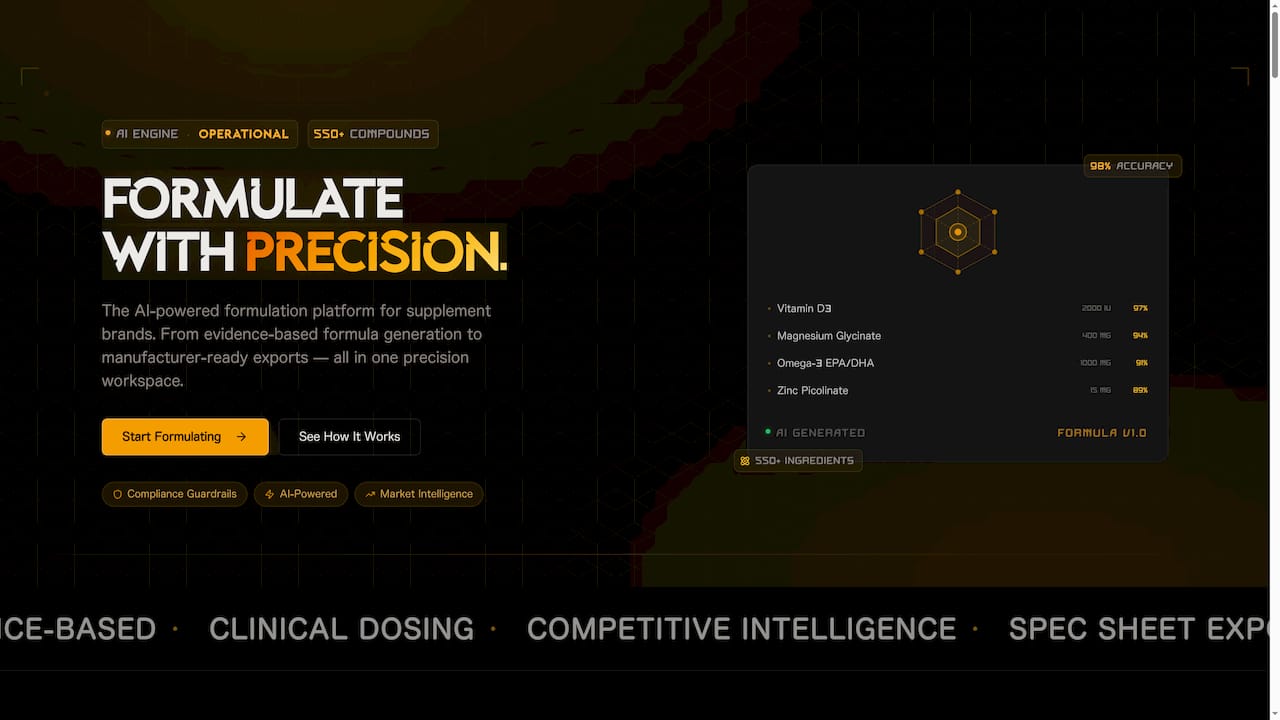
The Formlypro platform guides product developers through an 8-phase formulation process that integrates solubility and stability data with market research, compliance guidance, and packaging design. Formulators can move from compound characterization through prototype development with full documentation of design space decisions at each stage. The AI-powered mockup designer and competitor analysis tools mean that solubility decisions connect directly to product positioning, not just lab outcomes. For teams building research-backed formulations that need to reach market efficiently, Formlypro provides the structure that keeps every phase connected.
FAQ
What is the difference between solubility and dissolution?
Solubility is the maximum concentration a substance can reach in a solvent under fixed conditions. Dissolution is the rate at which a solid dissolves, which formulators can manipulate through particle size, excipients, and dosage form design.
Why do BCS Class II and IV drugs present the biggest formulation challenges?
BCS Class II drugs have low solubility and high permeability, meaning dissolution is the rate-limiting step for absorption. BCS Class IV drugs have both low solubility and low permeability, requiring formulation strategies that address both barriers simultaneously.
How does solubility affect drug stability?
Solubility-enhancing interventions like pH adjustment and cosolvents can accelerate degradation pathways including hydrolysis and oxidation. Forced degradation studies targeting 10–20% degradation are used to identify these stability risks before long-term storage studies begin.
What is spring and parachute formulation kinetics?
The spring creates rapid supersaturation after dosing, and the parachute, typically a hydrophilic polymer like HPMC or PVP, slows precipitation long enough for intestinal absorption to occur. This approach is used for compounds with high precipitation risk after GI dilution.
How early should solubility screening occur in formulation development?
Solubility screening should occur at the lead optimization stage, before dosage form selection. Early BCS classification identifies which compounds need enabling technologies like amorphous solid dispersions or lipid-based delivery systems, preventing costly late-stage reformulation.