

TL;DR:
- Bioavailability optimization involves characterizing the molecule, selecting suitable formulation strategies, and testing iteratively.
- Common steps include calculating Dose Number, profiling solubility, and matching techniques like amorphous dispersions, SNEDDS, or nanocarriers to the molecule's failure mode.
Bioavailability optimization formulation steps are a structured series of actions formulators apply to increase how much of an active ingredient actually reaches systemic circulation. Poor oral bioavailability is one of the most common reasons health and wellness products underperform, and fixing it requires more than swapping excipients. The Biopharmaceutics Classification System (BCS) and Quality by Design (QbD) provide the regulatory and scientific frameworks that anchor every decision. Emerging tools like Bayesian optimization and nanocarrier engineering have expanded what is achievable, but the foundation remains the same: characterize the molecule first, then select the right formulation approach, and test iteratively until the data confirms the design.

What are the essential bioavailability optimization formulation steps?
Every effective formulation development process starts with molecule characterization. Before selecting a delivery system, you need to know exactly where your compound sits in the BCS framework, which classifies drugs by solubility and permeability. That classification determines whether your problem is dissolution-limited, permeability-limited, or both, and it directly dictates which formulation strategies are worth pursuing.
Calculating the Dose Number (D0) is a non-negotiable early step. If D0 exceeds 1, the drug cannot fully dissolve in gastrointestinal fluids at the administered dose, which means bioavailability enhancement through formulation is not optional. Most formulation failures trace back to skipping this calculation and moving straight to prototype development.
Solubility profiling follows molecule classification. Tools like UpperSolv allow formulators to screen multiple formulation routes rapidly. Systematic solubility screening requires approximately 5g of API and about 8 weeks to evaluate the most promising routes. That timeline sounds long, but it prevents months of wasted effort on formulations that were never going to work.
Key physicochemical parameters to measure at this stage include:
- Aqueous solubility across the pH range of the GI tract (pH 1.2 to 7.4)
- Log P and Log D to assess lipophilicity and membrane permeability
- Melting point as a proxy for crystal lattice energy and amorphization potential
- pKa to understand ionization state at different GI pH values
- Particle size and surface area for dissolution rate prediction
Pro Tip: Map your compound's solubility at pH 1.2, 4.5, and 6.8 before any formulation work begins. These three points represent the stomach, duodenum, and jejunum, and a compound that fails at pH 6.8 will fail in vivo regardless of how elegant the formulation looks on paper.
Which formulation techniques best enhance bioavailability?
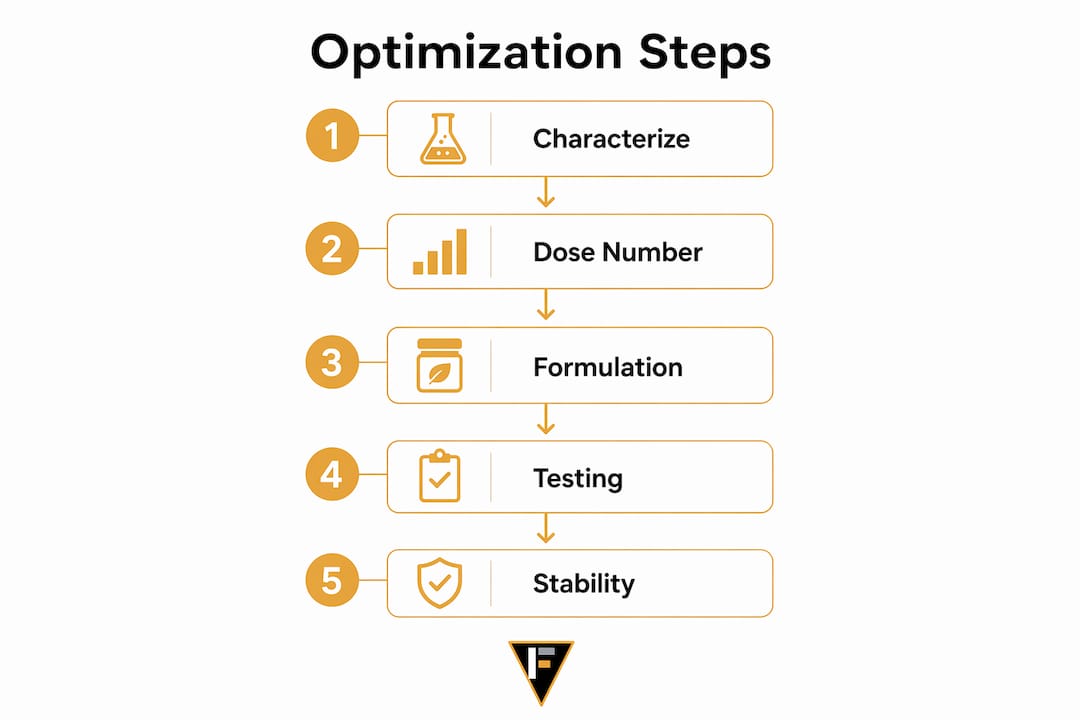
The right technique depends entirely on the molecule's failure mode. A BCS Class II compound (low solubility, high permeability) needs solubility enhancement. A BCS Class III compound (high solubility, low permeability) needs permeability enhancement. Applying the wrong strategy wastes resources and produces misleading in vitro data.
Amorphous solid dispersions
Amorphous solid dispersions (ASDs) convert a crystalline drug into an amorphous form dispersed within a polymer matrix. Polymers like PVP, HPMC, and HPMCAS inhibit nucleation and maintain supersaturation in the GI tract, which keeps dissolved drug concentration high long enough for absorption. The mechanism matters here: ASDs do not just increase solubility at a single time point. They sustain it. Polymer selection is the central design decision, and it must account for both the drug's physicochemical properties and the intended manufacturing process (hot melt extrusion vs. spray drying).
Lipid-based formulations and SNEDDS
Self-Nanoemulsifying Drug Delivery Systems (SNEDDS) form fine oil-in-water nanoemulsions when diluted by GI fluids. SNEDDS produce droplet sizes between 20–200 nm, which enhances solubilization, improves membrane permeability, and reduces efflux transporter activity. That last point is underappreciated. Efflux pumps like P-glycoprotein actively remove drugs from intestinal cells, and lipid-based systems can partially bypass this mechanism. SNEDDS work best for highly lipophilic BCS Class II compounds with log P values above 2.
Nanocarrier strategies
Biodegradable polymer nanoparticles and functionalized nanocomposites address both solubility and GI barrier challenges. Nanoparticle formulations can improve bio-accessibility by approximately 70%, and PEG-functionalized nanocomposites can extend circulating half-lives from 5 to 22 hours. That kind of pharmacokinetic extension changes dosing frequency and consumer compliance in health and wellness products. Nanocarriers engineered for mucus penetration use surface functionalization and permeability enhancers to overcome the mucus layer, one of the most underestimated absorption barriers in oral delivery.
| Technique | Best for | Key mechanism | Main challenge |
|---|---|---|---|
| Amorphous solid dispersions | BCS Class II (low solubility) | Supersaturation maintenance | Physical stability, recrystallization |
| SNEDDS | Lipophilic BCS Class II | Nanoemulsion formation, efflux reduction | Excipient compatibility |
| Nanoparticle carriers | BCS Class II and IV | Mucus penetration, targeted release | Scale-up complexity |
| Cyclodextrin complexation | Moderate solubility issues | Inclusion complex formation | Drug loading limits |
Pro Tip: For health and wellness products where clean-label positioning matters, check excipient regulatory status in your target markets before committing to a lipid-based system. Some SNEDDS excipients carry restrictions under EU Novel Food regulations that do not apply in the US.
How can DoE and AI methods improve formulation efficiency?
Classical Design of Experiments (DoE) has been the standard optimization tool in pharmaceutical formulation for decades. Response Surface Methodology (RSM) and factorial designs map how formulation variables interact and identify the design space where performance is acceptable. QbD builds on DoE by requiring formulators to define a Quality Target Product Profile (QTPP) upfront and then work backward to identify Critical Quality Attributes (CQAs) and Critical Process Parameters (CPPs).
The limitation of classical DoE is that it assumes linear or polynomial relationships between variables. Complex formulations, particularly ASDs and nanoparticle systems, often have nonlinear, high-dimensional design spaces that RSM cannot map efficiently. Running a full factorial design across 6–8 variables is prohibitively expensive.
Bayesian optimization addresses this by updating a statistical model after each experiment and directing the next experiment toward the most informative region of the design space. The result is fewer total experiments and faster convergence on the optimal formulation. This adaptive approach also maintains regulatory transparency because every decision is documented and traceable.
Practical steps to implement an adaptive optimization workflow:
- Define the design space boundaries using physicochemical data from preformulation. Set realistic ranges for each variable before running any experiments.
- Run a small initial DoE (8–12 runs) to build the first statistical model. This gives Bayesian optimization enough data to make useful predictions.
- Apply the acquisition function to select the next experiment. The algorithm balances exploration (testing unknown regions) with exploitation (refining known good regions).
- Update the model after each experimental result. The model improves with every data point, which means later experiments are far more efficient than earlier ones.
- Validate the predicted optimum with a confirmatory batch. Never skip this step, even when the model confidence is high.
Machine learning models trained on historical formulation data can also predict dissolution profiles, stability outcomes, and manufacturing behavior before a single prototype is made. For formulators building a formulation scalability checklist, integrating these predictions early prevents costly surprises at the pilot scale.
What are common challenges during bioavailability enhancement?
Physical instability is the most common failure mode in enabling formulations. Amorphous solid dispersions are thermodynamically unstable by design. Recrystallization and phase separation are constant risks, particularly under elevated temperature and humidity conditions during storage and shipping. A formulation that performs well at 25°C and 60% relative humidity may fail completely at 40°C and 75% relative humidity, which is the standard accelerated stability condition.
Key challenges and practical responses:
- Moisture sensitivity in ASDs: Use moisture-barrier packaging and desiccants. Select polymers with low hygroscopicity, such as HPMCAS over PVP where possible.
- Drug loading limits: Higher drug loads in ASDs increase recrystallization risk. Keep drug load below 30% by weight unless polymer screening data supports higher loads.
- Excipient interactions: Lipid-based systems can interact with gelatin capsule shells, causing softening or leakage. Test compatibility early and consider HPMC capsules as an alternative.
- Manufacturing constraints: Spray drying and hot melt extrusion require specialized equipment. Confirm manufacturing partner capabilities before finalizing the formulation design.
- Bioavailability vs. stability trade-off: The formulation that maximizes in vitro dissolution is not always the most stable. Build stability testing into the optimization loop, not as an afterthought.
Pro Tip: Run a 2-week stress stability test at 40°C/75% RH on your top three prototype candidates before investing in a full 6-month ICH stability study. It eliminates the weakest candidates fast and saves significant time and cost.
For a deeper look at managing these risks systematically, the reduce formulation risks framework covers six proven strategies that apply directly to enabling technology development. Formulators preparing for testing submissions can also find structured guidance on how to submit formulations for evaluation.
Understanding how these steps connect to a finished, market-ready product is equally important. The market-ready formulation process outlines how each optimization decision feeds into the broader product development timeline.
Key Takeaways
Effective bioavailability enhancement requires molecule characterization first, then targeted formulation selection, then iterative optimization with validated testing at every stage.
| Point | Details |
|---|---|
| Characterize before formulating | Calculate Dose Number and BCS class before selecting any delivery system. |
| Match technique to failure mode | Use ASDs for low solubility, SNEDDS for lipophilic compounds, and nanocarriers for GI barrier challenges. |
| Use adaptive optimization | Bayesian optimization reduces total experiments and improves design space coverage over classical DoE. |
| Test stability in parallel | Run accelerated stability tests alongside dissolution testing to catch physical instability early. |
| Plan for manufacturing early | Confirm equipment availability and excipient compatibility before finalizing the formulation design. |
What I have learned from years of formulation optimization work
The biggest mistake I see formulators make is treating bioavailability optimization as a linear checklist. They characterize the molecule, pick a technique, run a DoE, and expect a clean answer. Real formulation development is messier than that. The molecule that looks like a straightforward ASD candidate on paper often shows unexpected polymer incompatibility in the first spray-drying run. The SNEDDS that performs brilliantly in simulated intestinal fluid fails in a fed-state model because nobody accounted for bile salt competition.
What actually works is treating each formulation decision as a hypothesis, not a conclusion. When I shifted from fixed DoE designs to adaptive Bayesian workflows, the number of experiments dropped significantly, but more importantly, the quality of the questions improved. The algorithm forces you to be explicit about what you do not know, which is where most formulation projects go wrong.
The supplement and health and wellness space adds another layer of complexity that pharmaceutical formulators sometimes underestimate. Clean-label constraints, cost-per-serving targets, and consumer-facing stability claims all create boundaries that pure pharmaceutical development does not face. A formulation that requires a $0.40 capsule shell to maintain stability is not viable for a $30 retail product. Regulatory considerations for dietary supplements under FDA 21 CFR Part 111 also differ meaningfully from drug product requirements, and that affects which excipients and processes are practical.
My honest recommendation: invest more time in preformulation than feels necessary. The supplement decision workflow perspective is useful here because it shows how ingredient selection decisions made early in development constrain every downstream formulation choice. Get the characterization right, and the rest of the process becomes significantly more predictable.
— Ben
How Formlypro supports your formulation development process
Formlypro is built specifically for formulators and product developers working in health and wellness. The platform guides you through an 8-phase product development plan that takes a concept from ideation through formulation, prototyping, compliance, and production.
Formlypro includes market research and competitive analytics so you can see what formulations are already selling and what ingredients those products contain. The compliance module covers FDA and regulatory requirements so you are not discovering gaps late in development. The AI-powered packaging mockup designer lets you visualize the finished product while formulation is still in progress. For formulators who want to reduce experimental cycles and make faster, better-supported decisions, explore Formlypro to see how the platform fits your workflow.
FAQ
What is the first step in bioavailability optimization?
The first step is characterizing the molecule using BCS classification and Dose Number calculation. These two parameters define whether solubility, permeability, or both are limiting absorption.
When is an amorphous solid dispersion the right choice?
ASDs are best suited for BCS Class II compounds with low aqueous solubility and adequate permeability. Polymer selection, particularly HPMC, PVP, or HPMCAS, determines whether supersaturation is maintained long enough for absorption.
How does Bayesian optimization differ from classical DoE?
Classical DoE uses a fixed experimental design, while Bayesian optimization updates its statistical model after each run and directs the next experiment adaptively. This reduces total experiments and improves efficiency in complex, nonlinear formulation spaces.
What causes physical instability in enabling formulations?
Recrystallization and phase separation are the primary causes, driven by moisture, elevated temperature, and high drug loading. Accelerated stability testing at 40°C and 75% relative humidity identifies these risks before long-term studies begin.
How do SNEDDS improve oral absorption?
SNEDDS form nanoemulsions with droplet sizes between 20–200 nm upon GI dilution, which increases solubilization, improves membrane permeability, and reduces efflux transporter activity to enhance drug absorption.