

TL;DR:
- Most product launches fail during scale-up due to inadequate planning and documentation, risking regulatory and quality issues. A comprehensive formulation scalability checklist guides early assessment, controls process variability, and ensures regulatory compliance to facilitate smooth commercialization. Embedding this checklist throughout development reduces failures, accelerates approval, and improves overall product success.
Moving a formulation from the lab bench to commercial production is where most product launches quietly fall apart. A formulation scalability checklist gives you a structured way to catch problems before they become expensive recalls, regulatory holds, or batch failures. The challenge isn't just making a bigger batch. It's maintaining the exact physicochemical performance your lab formula delivered, while satisfying FDA, EU, and other regulatory bodies that your process is controlled, documented, and reproducible. This guide walks you through every critical checkpoint.
Table of Contents
- Key takeaways
- 1. Your formulation scalability checklist starts here
- 2. Preformulation and physicochemical property mapping
- 3. Pilot scale design space and QbD integration
- 4. Process validation lifecycle checkpoints
- 5. Stability testing protocols as checklist checkpoints
- 6. Risk assessment tools: FMEA and DoE
- 7. Common scale-up challenges your checklist must address
- 8. Checklist framework comparison: what belongs and what doesn't
- 9. Implementing your checklist across the full workflow
- What I've learned from watching formulations fail at scale
- How Formlypro helps you manage formulation scale-up
- FAQ
Key takeaways
| Point | Details |
|---|---|
| Start with design space | Define acceptable ranges for critical process parameters before pilot scale, not after. |
| Stability testing is mandatory | EU Regulation 1223/2009 requires at least 3 months of accelerated stability testing before market placement. |
| Regulatory landscape is shifting | FDA is reviewing SUPAC guidances with public comments due June 2026, which may affect your CMC change strategy. |
| Checklists must be living documents | Update your checklist after every batch, regulatory change, or raw material switch. |
| Cross-functional teams catch more | Involving QA, regulatory, and manufacturing early reduces late-stage surprises and approval delays. |
1. Your formulation scalability checklist starts here
Before you touch a pilot reactor or file a single regulatory document, you need a framework that defines what "scalable" actually means for your specific formulation. The formulation scalability checklist is not a single universal form. It's a set of evaluation criteria tailored to your product type, regulatory market, and manufacturing environment.
Chemical and physical stability screening comes first. You need documented evidence that your active ingredients, excipients, and processing aids remain compatible across the temperature ranges, shear levels, and pH conditions your commercial process will introduce.
Equipment compatibility and process adaptability are frequently underestimated. A formulation that mixes perfectly in a 10-liter vessel can behave completely differently in a 500-liter tank because of differences in shear profile, heat transfer rate, and mixing time. Your checklist should flag any ingredient or process step that is sensitive to these variables before scale-up begins.
Regulatory compliance checkpoints belong in the checklist from day one, not as an afterthought before submission. EU Regulation 1223/2009 mandates a CPSR requiring accelerated testing for a minimum of 3 months before market placement. For pharmaceutical products, FDA's SUPAC framework governs what changes require prior approval versus a simple notification.
Quality by Design principles should underpin every checkpoint. QbD encourages operating within a defined design space, which reduces regulatory burden and gives your manufacturing team flexibility to address minor process variation without triggering new submissions.
Pro Tip: Build your checklist in a shared platform that allows version control. A checklist buried in a static PDF is a liability, not an asset.
2. Preformulation and physicochemical property mapping
This is where most teams underinvest. Preformulation studies that document solubility, particle size distribution, polymorphism, and compatibility screens are not just nice to have. Identifying incompatibilities early through preformulation work prevents downstream failures that cost orders of magnitude more to fix.
Your checklist at this stage should include:
- Solubility profiles across pH and solvent systems relevant to your manufacturing process
- Particle size and surface area characterization to predict blending and flow behavior
- Thermal and photostability screening under ICH-aligned conditions
- Excipient compatibility matrix covering every combination in your formula
- Viscosity and rheology profiling to anticipate pumping, mixing, and fill behavior at scale
The most overlooked item on this list is the rheology profile. A cream that pours cleanly at lab scale may require a completely different pump specification at commercial scale because viscosity changes non-linearly with batch size and mixing speed.
3. Pilot scale design space and QbD integration
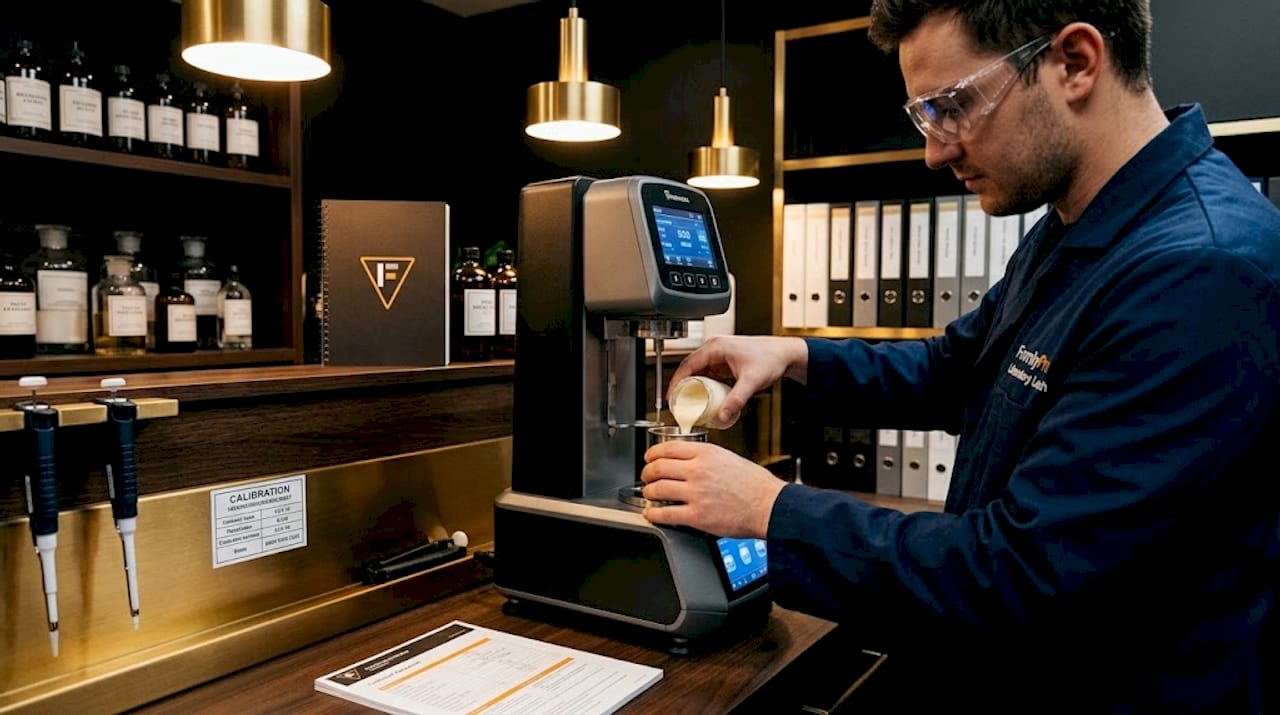
The pilot plant is where you stop guessing and start defining. Design of Experiments at pilot scale is how you identify Critical Material Attributes and Critical Process Parameters, and then establish the ranges within which your product consistently meets quality specifications.
Your pilot scale checklist should confirm:
- DoE protocols covering the CPPs most likely to vary between pilot and commercial equipment
- CMA ranges for every raw material with documented rationale for each specification limit
- A defined design space submitted or documented in your regulatory dossier
- In-process controls aligned with the design space boundaries
- Statistical process control methods assigned to each CPP
Operating within a risk-based design space gives your team the flexibility to adjust process parameters during commercial manufacturing without triggering additional regulatory submissions. That flexibility has real financial value. Every prior approval submission to FDA can take 10 or more months, which means a well-documented design space is worth building correctly the first time.
4. Process validation lifecycle checkpoints
FDA's lifecycle approach to process validation breaks the work into three stages, and your checklist should mirror that structure. The three stages are Process Design, Process Qualification, and Continued Process Verification.
- Process Design: Document the manufacturing process based on knowledge gathered during development. This is where your design space gets formalized and your control strategy gets written.
- Process Qualification: Demonstrate that your commercial-scale process consistently produces product meeting all predetermined specifications. This includes equipment qualification, utility qualification, and process performance qualification.
- Continued Process Verification: Ongoing data collection and analysis that confirms your process remains in a state of control across commercial batches.
Documenting scale-up rationale and your full control strategy at each stage reduces regulatory questions during review and shortens approval timelines. Regulators are not looking for perfection. They're looking for evidence that you understand your process.
5. Stability testing protocols as checklist checkpoints
Stability testing is both a legal requirement and a practical quality signal. Stability testing protocols covering accelerated, long-term, freeze-thaw, and photostability conditions are required before you can legally place a cosmetic or personal care product on EU or UK shelves.
Your stability checklist should confirm:
- Accelerated stability testing at 40°C/75% RH for a minimum of 3 months before launch
- Real-time stability studies running in parallel to support shelf life claims
- Freeze-thaw cycling protocols relevant to your distribution and storage chain
- Photostability testing aligned with ICH Q1B guidelines
- Organoleptic, chemical, and microbiological testing at each timepoint
Pro Tip: Run stability samples in your intended commercial packaging, not just lab containers. Packaging interactions can invalidate stability data and delay your compliance submission.
Documenting comprehensive stability protocols before finalizing any formulation decision protects you from both regulatory rejection and costly reformulation after launch. The cost of a thorough stability program is always less than the cost of a post-launch recall.
6. Risk assessment tools: FMEA and DoE
Risk assessment tools like FMEA and DoE give your team a systematic method for identifying which process steps and material attributes carry the highest risk to product quality. FMEA assigns severity, occurrence, and detectability scores to each potential failure mode, producing a risk priority number that tells you where to focus your validation effort.
Your checklist item here is not just "conduct FMEA." It's "conduct FMEA before pilot scale runs, revisit after pilot data, and update before commercial validation." The tool only works if it's treated as a living document.
DoE at the pilot stage lets you test multiple variables simultaneously rather than changing one factor at a time. A well-designed DoE at pilot scale can identify interaction effects between process parameters that a one-factor-at-a-time approach would miss entirely. That's data you want before your commercial validation campaign, not during it.
7. Common scale-up challenges your checklist must address
Residence time changes significantly at scale, and this single factor is responsible for a disproportionate share of commercial scale failures. An emulsion that forms cleanly in 15 minutes at 10 liters may require 45 minutes at 1,000 liters, and your emulsifier system may not hold through that extended processing time.
The most common scale-up failures your checklist should anticipate:
- Raw material variability: Suppliers that deliver on-spec material at lab quantity may show lot-to-lot variation at commercial volume. Build supplier qualification and raw material specification tightening into your checklist.
- Shear sensitivity: Active ingredients, polymers, and emulsifiers can degrade under high-shear commercial mixing. Map shear exposure at each scale and compare against your API or active's stability profile.
- Heat transfer differences: Heating and cooling rates in large vessels are slower and less uniform. This affects emulsification, crystallization, and any process step that is temperature-sensitive.
- Fill timing and viscosity: Products that flow well at processing temperature may thicken during fill, creating weight variation and defect rates.
- Ingredient variability at scale routinely compromises formulations that performed perfectly in the lab. Your checklist should include a raw material risk register scored by criticality and supply chain risk.
Pro Tip: Request technical data sheets and Certificate of Analysis data from at least three supplier lots before setting your raw material specification limits. Single-lot specs create fragile formulations.
8. Checklist framework comparison: what belongs and what doesn't
A scalable formulation guide needs structure, but overloaded checklists become unusable. Here's how common framework elements compare in terms of practical value.
| Checklist element | Regulatory value | Manufacturing value | When to include |
|---|---|---|---|
| Preformulation stability screen | High | High | Always, before any scale-up |
| DoE at pilot scale | High | High | Any formulation with sensitive CPPs |
| FMEA risk assessment | High | High | Always, updated at each stage |
| Accelerated stability testing | Required (EU/UK) | High | Always, before market placement |
| Equipment compatibility matrix | Medium | High | Complex equipment trains |
| Supplier qualification protocol | Medium | High | Commercial production entry |
| SUPAC change control log | High (US) | Medium | Any FDA-regulated product |
| Continued process verification plan | High | High | Commercial manufacturing start |
The items marked "Always" are non-negotiable in any formulation development checklist. The others are triggered by product type, market, and manufacturing complexity. Building a tiered checklist that separates mandatory items from conditional items makes the tool far more usable for your team.
9. Implementing your checklist across the full workflow
A formulation scalability checklist that lives in one person's folder is not a system. It's a personal habit. Getting real value from the checklist requires embedding it into your product development workflow at every stage.
Practical implementation steps include:
- Assign ownership of each checklist section to a specific function: regulatory, QA, manufacturing, or R&D
- Link checklist completion to decision gates so no stage advances without documented sign-off
- Use a platform that timestamps entries, tracks version history, and allows cross-functional access
- Schedule mandatory checklist reviews after each pilot batch, raw material change, or regulatory update
- Partner with your contract manufacturer early to align their process capabilities with your checklist requirements
Incorporating QbD compliance steps from the start of development, rather than retrofitting them before submission, consistently reduces approval timelines. The brands that treat the checklist as a quality tool rather than a filing requirement are the ones that launch on schedule.
A formulation checklist for compliance that connects directly to your regulatory dossier structure is especially useful for teams managing multiple SKUs or market submissions simultaneously. It eliminates duplicated work and creates a single source of truth for every product's development history.
What I've learned from watching formulations fail at scale
I've seen product developers hand a beautifully performing lab formula to a contract manufacturer, expect a straightforward scale-up, and then spend the next six months diagnosing batch failures. Almost every time, the root cause traces back to the same thing: the team treated scale-up as a production task rather than a development stage.
The counterintuitive lesson is that rigorous documentation early in development actually speeds up launch. It feels like overhead. In practice, it means you have answers ready when regulators ask questions, and you spend your pilot runs gathering data instead of guessing.
Managing raw material variability proactively is the item I see most consistently skipped. Teams set specifications based on a single supplier lot, and those specs fail the moment commercial volumes bring in new lot variation.
FDA's current SUPAC review is also worth watching closely. Potential SUPAC changes could shift the risk classification of common manufacturing changes, which would directly affect how you structure your change control checklist for US-regulated products.
The checklist is not a form you fill out once. It's the documentation that proves your process understanding grows with your scale.
— Ben
How Formlypro helps you manage formulation scale-up
Scaling a formulation without the right infrastructure leads to delays, failed batches, and compliance gaps that cost far more than they should.
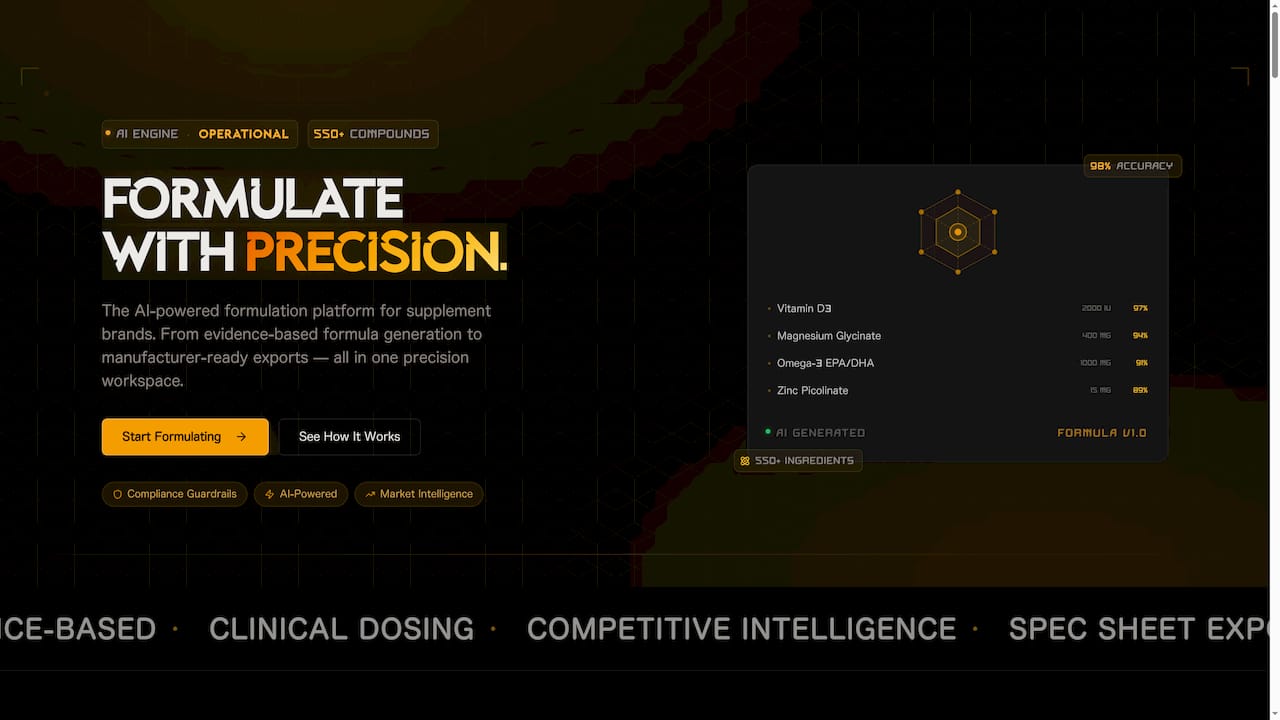
Formlypro gives product developers and brand managers a single platform to manage every stage of the scale-up process, from initial formulation development through compliance documentation and production. The platform's 8-phase development program walks you through preformulation, prototyping, stability, compliance, and commercial production with built-in market analytics and competitor formulation data. You get the checklist structure, the regulatory guidance, and the competitive intelligence in one place. If you're building a product that needs to survive scale-up and pass regulatory review, explore Formlypro and see how the platform supports your full development workflow.
FAQ
What is a formulation scalability checklist?
A formulation scalability checklist is a structured set of evaluation criteria that product developers use to confirm a formulation can move from lab to commercial production without losing quality, stability, or regulatory compliance.
When should you start the scalability checklist?
You should start at the preformulation stage, before pilot scale, so that physicochemical incompatibilities and process sensitivities are identified while changes are still inexpensive.
How does QbD improve formulation scale-up?
QbD improves scale-up by defining a design space of acceptable process parameter ranges, allowing manufacturers to make controlled adjustments without triggering additional regulatory submissions.
What stability tests are required before EU market placement?
EU Regulation 1223/2009 requires a Cosmetic Product Safety Report supported by at least 3 months of accelerated stability testing before a cosmetic product can legally be placed on the EU or UK market.
How do FMEA and DoE fit into the checklist?
FMEA identifies and prioritizes potential failure modes at each process step, while DoE at pilot scale defines the acceptable ranges for critical process parameters, together forming the risk foundation of your commercial validation strategy.