

TL;DR:
- Suspension formulation disperses insoluble solid particles in a liquid to deliver active ingredients that do not dissolve in water. It relies on precise particle size and excipient choices to ensure stability, uniform dosing, and redispersibility during storage and use.
A suspension formulation is defined as a biphasic heterogeneous liquid dosage form where insoluble solid particles, typically 0.5–5 μm in size, are dispersed throughout a liquid medium and require agitation before use. This structure solves a fundamental problem: many active ingredients simply will not dissolve in water. Suspensions appear across pharmaceuticals, cosmetics, and food manufacturing, each with distinct regulatory expectations and formulation goals. USP guidelines and compounding standards like USP 795 govern how these systems are built, tested, and released to market.
What is suspension formulation and why does it matter?
Suspension formulation is the process of creating a stable liquid product by uniformly dispersing insoluble solid particles throughout a continuous liquid phase. The term "biphasic" is the recognized industry descriptor. It signals that two distinct phases coexist: the dispersed solid phase and the continuous liquid vehicle.
The purpose of suspension formulation goes beyond simple mixing. Many active pharmaceutical ingredients (APIs) are poorly water-soluble, meaning a true solution is impossible at therapeutic concentrations. Suspensions allow delivery of those actives at the required dose without chemical modification of the molecule. That is why oral pediatric antibiotics, antacids, and topical mineral sunscreens all rely on this format.
The particle size range of 0.5–5 μm is not arbitrary. Particles below 0.1 μm behave more like colloids; particles above 5 μm settle too quickly and create dosing inconsistency. Hitting the right size range is the first technical decision a formulator makes, and it shapes every subsequent choice about excipients and processing.
What are the core ingredients in a suspension formulation?
Every suspension formulation contains a defined set of functional ingredients. Each one performs a specific job, and removing or under-dosing any of them creates a predictable failure mode.
-
Active ingredient (API or functional active): The insoluble solid that must be dispersed. In pharmaceuticals, this is the drug substance. In cosmetics, it may be zinc oxide or titanium dioxide. In food, it could be a flavor oil or a spice extract. The API's particle size, density, and surface chemistry drive every other formulation decision.
-
Suspending agents: These are the backbone of physical stability. Xanthan gum and sodium CMC are the most widely used options. They increase the viscosity of the continuous phase, which slows particle settling according to Stokes' Law. Natural polymers like acacia (arabic gum) and synthetic options like carbomers each offer different viscosity profiles and pH sensitivities.
-
Wetting agents: Most APIs are hydrophobic. A wetting agent, typically a humectant like glycerin or polysorbate 80, reduces the contact angle between the solid particle and the liquid vehicle. Without a wetting agent, the API clumps at the surface and never disperses properly.
-
Preservatives: Aqueous suspensions support microbial growth. Benzalkonium chloride, sodium benzoate, and parabens are common choices, selected based on the product's pH and intended use.
-
Sweeteners and flavoring agents: Patient compliance depends heavily on how a suspension tastes and smells. Sucrose, sorbitol, and artificial flavors mask bitter APIs. Unpleasant suspensions get rejected by patients regardless of their therapeutic value.
-
pH adjusters and buffers: Most suspending agents and preservatives have optimal activity within a specific pH window. Citric acid and sodium citrate are standard buffering pairs for oral suspensions.
Pro Tip: Always check the compatibility of your preservative with your suspending agent before finalizing the formula. Anionic polymers like sodium CMC can bind cationic preservatives like benzalkonium chloride, rendering both ineffective.
How is a suspension formulation created?
The formulation process follows a defined sequence. Deviating from the order is the most common cause of batch failure.
-
Size reduction by trituration. The API is ground to the target particle size range using a mortar and pestle or a mill. Consistent particle size is the foundation of uniform dosing and predictable settling behavior.
-
Levigation (wetting the API). The ground API is triturated with a small volume of wetting agent, typically glycerin, to form a smooth paste. Skipping levigation causes hydrophobic clumps that are nearly impossible to break up once the aqueous vehicle is added. This step is the most frequent failure point in compounding.
-
Paste formation. Additional vehicle is added in small increments to the levigated paste, creating a uniform, lump-free intermediate. Rushing this step by adding too much liquid at once traps air and creates aggregates.
-
Vehicle incorporation. The suspending agent is pre-hydrated separately, then combined with the paste. Preservatives, sweeteners, and flavors are dissolved in a portion of the vehicle and added at this stage.
-
pH adjustment. The suspension's pH is measured and corrected using a buffer system. This step protects chemical stability of the API and ensures preservative efficacy.
-
Volume adjustment (QS). The formulation is brought to final volume with the remaining vehicle. A final homogenization step, either by high-shear mixing or manual inversion, distributes all components evenly.
Pro Tip: Pre-hydrate xanthan gum or sodium CMC in hot water (60–70°C) before adding it to the formulation. Cold water causes lumping that is almost impossible to reverse without high-shear equipment.
Before releasing any batch, review the formulation testing checklist to confirm that each step has been documented and verified against your target specifications.
What factors affect suspension stability?
Physical stability is the defining challenge of suspension formulation. A suspension that separates irreversibly in storage is a dosing hazard, not just a cosmetic problem.

Stokes' Law predicts the settling rate of particles based on particle size, density difference between the solid and liquid phases, and the viscosity of the continuous phase. Reducing particle size, increasing vehicle viscosity, and matching densities all slow sedimentation. Formulators use these levers in combination, not isolation.
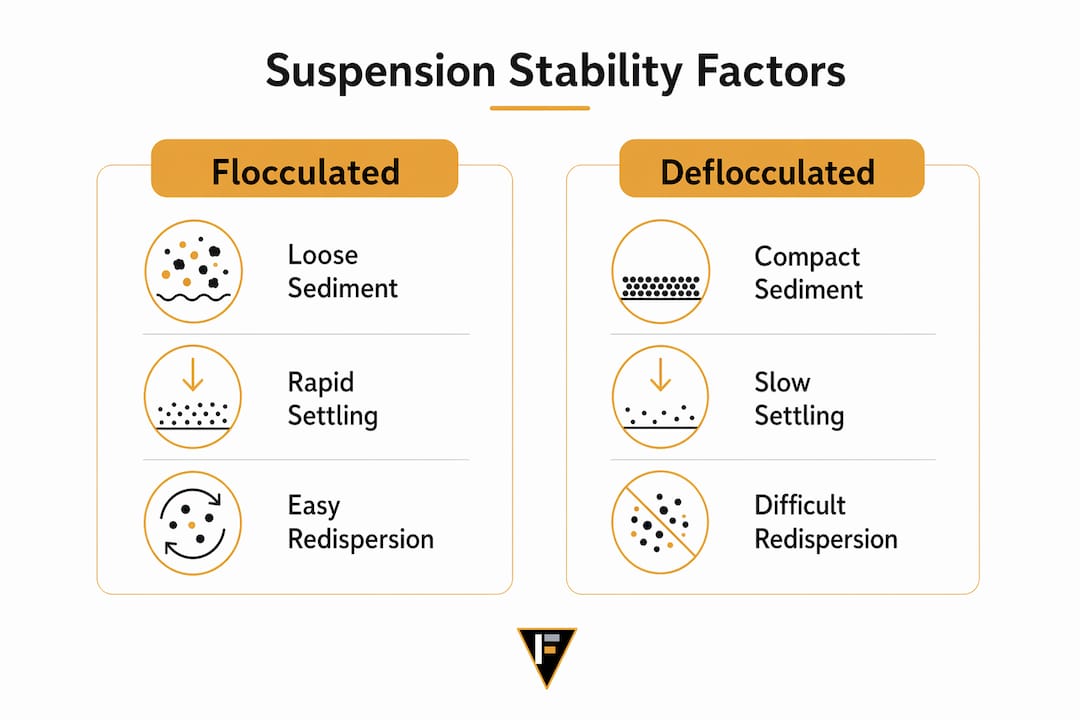
Flocculation control is where formulation science gets genuinely complex. Flocculated suspensions form loose, fluffy sediment that redisperses easily with gentle shaking. Deflocculated suspensions pack tightly into a hard cake that resists redispersion entirely. Flocculated systems are the preferred design for this reason.
| Stability parameter | Flocculated system | Deflocculated system |
|---|---|---|
| Sediment structure | Loose, fluffy | Dense, compact |
| Redispersibility | Easy, few inversions | Difficult, may cake |
| Appearance | Slightly cloudy | Clear supernatant |
| Dosing risk | Low | High if caked |
Electrolyte concentration controls whether a system flocculates or deflocculates. Low electrolyte concentrations tend to deflocculate; higher concentrations promote flocculation. The relationship is concentration-dependent, so small changes in ionic strength can shift a system from one state to the other.
Stability testing validates the formulation's design. A well-built suspension should redisperse uniformly after 24 hours of settling with no more than 10 gentle inversions. That benchmark is a practical pass/fail criterion used in compounding and manufacturing alike.
Balancing viscosity with pourability is the stability trade-off that trips up many formulators. A suspension thick enough to prevent sedimentation may be too viscous to pour accurately from a bottle. The target viscosity range depends on the delivery format: oral liquids, topical creams, and food-grade beverages each have different acceptable ranges.
Pro Tip: Run a freeze-thaw cycling study early in development. Temperature fluctuations during shipping can collapse a suspension's structure in ways that room-temperature storage testing will never catch.
What are real-world examples of suspension formulations?
Suspension formulations appear in three major industries, and the formulation goals differ significantly across each.
-
Pharmaceutical oral suspensions. Pediatric antibiotics like amoxicillin and azithromycin are classic examples. Children cannot swallow tablets, so the drug is supplied as a dry powder that reconstitutes into a suspension at the pharmacy. The formulation must deliver a precise dose per milliliter, taste acceptable to a child, and remain stable for 10–14 days after reconstitution. Dose flexibility is the primary driver of this format. For formulators scaling these products, a scalability checklist helps identify process parameters that must be locked before moving to pilot scale.
-
Topical pharmaceutical suspensions. Calamine lotion is one of the oldest examples. Zinc oxide and calamine are insoluble powders dispersed in an aqueous vehicle with a suspending agent. The formulation must spread evenly on skin and leave a uniform film after evaporation.
-
Cosmetic suspensions. Mineral sunscreens use zinc oxide or titanium dioxide as UV filters. These particles must be dispersed to a specific size to provide broad-spectrum protection without leaving a white cast. Pigment dispersions in foundation makeup follow the same logic: particle size and surface treatment determine color payoff and skin feel.
-
Food and beverage suspensions. Chocolate milk, salad dressings, and fruit juice with pulp are all suspension systems. The regulatory framework differs from pharmaceuticals, but the physics are identical. Xanthan gum appears in food suspensions for the same reason it appears in oral syrups: it increases viscosity without affecting flavor. For nutraceutical products that cross into supplement payment processing and distribution, stability requirements align closely with pharmaceutical-grade standards.
-
Regulatory considerations by industry. Pharmaceutical suspensions fall under FDA drug approval pathways and USP 795 compounding standards. Cosmetic suspensions are governed by FDA cosmetic regulations and, in the European Union, the EU Cosmetics Regulation. Food suspensions must meet FDA food additive regulations and GRAS (Generally Recognized as Safe) standards for all excipients used.
Key Takeaways
A stable suspension formulation requires precise particle sizing, correct excipient selection, and a disciplined manufacturing sequence, with flocculated systems and redispersibility testing as the non-negotiable quality benchmarks.
| Point | Details |
|---|---|
| Particle size is foundational | Target 0.5–5 μm to balance settling rate and dosing uniformity. |
| Levigation prevents batch failure | Wetting the API with glycerin before adding vehicle stops hydrophobic clumping. |
| Flocculated systems outperform deflocculated | Loose sediment redisperses easily; hard cake creates dosing errors. |
| Viscosity must balance stability and usability | Excessive thickness prevents sedimentation but makes accurate dosing difficult. |
| Redispersibility is the key stability test | A well-formulated suspension redisperses in 10 or fewer gentle inversions after 24 hours. |
What I've learned from watching suspension formulations fail
The formulators who struggle most with suspensions are the ones who treat it as a mixing problem. It is not. It is a surface chemistry problem that happens to involve mixing at the end.
The levigation step is where I see the most avoidable failures. A formulator in a hurry adds the API directly to the aqueous vehicle, watches it float on the surface, and then tries to fix it with more mixing. More mixing does not fix poor wetting. It just creates smaller clumps distributed more evenly through the batch. The only real fix is to go back to the beginning and levigate properly.
The electrolyte issue is subtler and gets overlooked far more often. Formulators add a buffer system, a preservative, and a flavor, each of which contributes ions to the continuous phase. The cumulative ionic strength can push a carefully designed flocculated system into a deflocculated state. The sediment goes from fluffy to hard, and the formulation fails its redispersibility test weeks into stability. Tracking total ionic contribution from every excipient is not optional.
The sensory side gets underweighted in technical discussions. A suspension that passes every physical stability test but tastes like chalk will not be used consistently. For pediatric formulations especially, taste masking is as critical as chemical stability. Sweetener selection, flavor type, and even the mouthfeel contributed by the suspending agent all affect whether a patient takes the dose correctly.
My practical advice: run your redispersibility test at week one, week two, and week four of stability, not just at the endpoint. The failure mode often appears early and then stabilizes. Catching it early tells you whether you have a formulation problem or a storage condition problem.
— Ben
How Formlypro supports suspension formulation development
Building a stable suspension from scratch involves tracking dozens of variables simultaneously: excipient compatibility, particle size targets, pH windows, stability test schedules, and regulatory requirements by market.
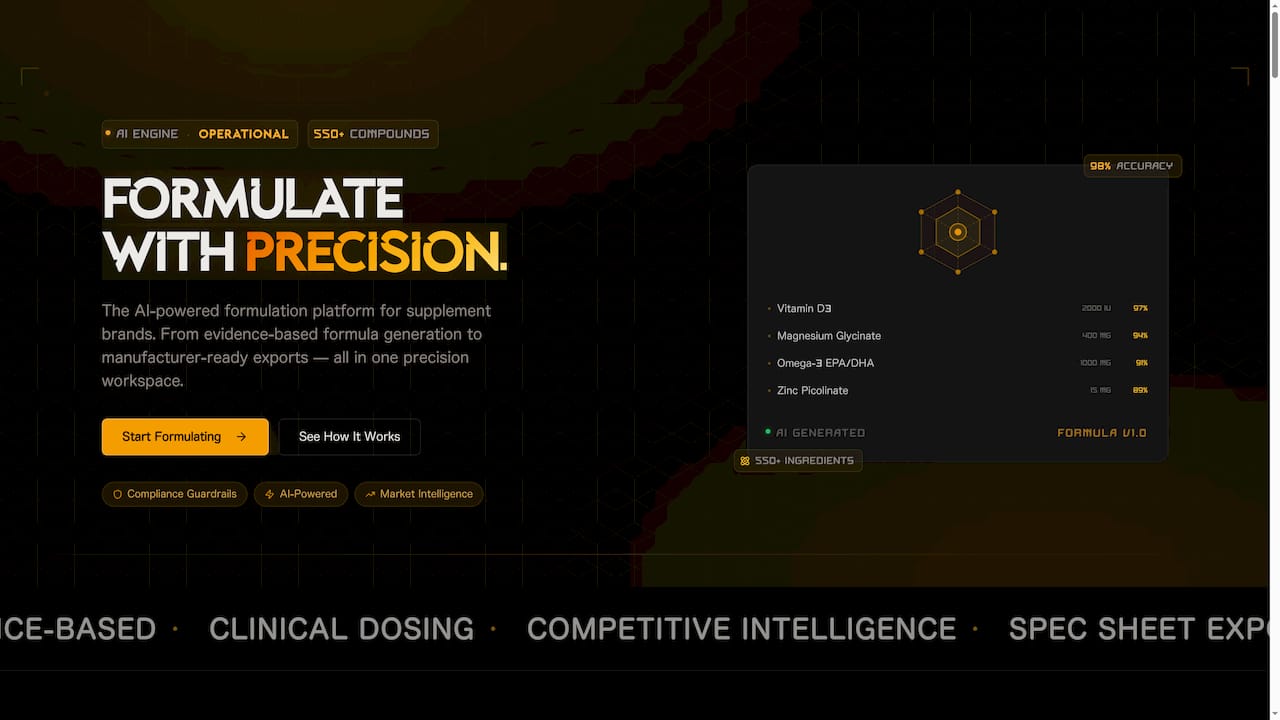
Formlypro gives formulators and manufacturers a structured platform to manage that complexity. The 8-phase formulation plan takes a product from initial concept through ingredient selection, prototyping, stability planning, compliance review, and production readiness. The built-in compliance guidance covers USP 795 compounding standards and FDA regulatory pathways, so formulators are not piecing together requirements from separate sources. For teams ready to move from lab to market, Formlypro's formulation platform connects ingredient decisions directly to compliance and packaging, all in one place.
FAQ
What is the suspension formulation definition?
A suspension formulation is a biphasic liquid system where insoluble solid particles (0.5–5 μm) are dispersed in a liquid vehicle and require shaking before use to ensure uniform dosing.
What suspending agents are most commonly used?
Xanthan gum and sodium CMC (carboxymethylcellulose) are the most widely used suspending agents because they increase vehicle viscosity and slow particle settling without significantly affecting taste or appearance.
Why is levigation critical in the formulation process?
Levigation wets the API with a humectant like glycerin before the aqueous vehicle is added. Skipping this step leaves hydrophobic particles clumped at the surface, which cannot be corrected by additional mixing.
How is suspension stability tested?
Redispersibility is the standard practical test: a well-formulated suspension should redistribute uniformly after 24 hours of settling with no more than 10 gentle inversions. Freeze-thaw cycling and accelerated stability studies complement this test.
What is the difference between a flocculated and deflocculated suspension?
A flocculated suspension forms loose sediment that redisperses easily with gentle shaking. A deflocculated suspension packs into a dense, hard cake that resists redispersion and creates serious dosing errors.