

TL;DR:
- Formulation safety testing confirms that cosmetic products are safe for consumers before market launch. It involves toxicological assessments of ingredients, stability and microbiological evaluations, and maintaining a compliant safety report. Regular updates are essential as new safety data and regulatory changes occur to ensure ongoing compliance.
Formulation safety testing is the scientific process of substantiating that a finished cosmetic or personal care product is safe for consumers under normal and reasonably foreseeable conditions of use. In practice, this means conducting a toxicological assessment of every ingredient, evaluating the complete formula for interaction effects, running stability and microbiological evaluations, and calculating a Margin of Safety (MoS) for each ingredient of concern. The process culminates in a Cosmetic Product Safety Report (CPSR), a regulatory document required by frameworks like EU Cosmetics Regulation 1223/2009. Qualified toxicologists and safety assessors compile and sign off on the CPSR, which must be maintained and updated throughout the product's commercial life.
What is formulation safety testing and why does it matter?
Formulation safety testing is the structured evaluation that proves a cosmetic formulation is safe and compliant before market release. The term covers what regulatory professionals formally call a cosmetic safety assessment, a process that links ingredient data, exposure scenarios, and toxicological references into one auditable document. Simple lab assays are insufficient. Comprehensive evaluation is required to substantiate product safety under EU Cosmetics Regulation 1223/2009 and equivalent global frameworks.
The importance of formulation testing goes beyond regulatory box-checking. A product that fails safety evaluation after launch creates liability, triggers recalls, and destroys brand trust. Getting the safety file right before market placement is the only defensible position for any regulatory professional or product developer.
What regulatory requirements drive formulation safety testing?
EU Cosmetics Regulation 1223/2009 is the primary legal driver for cosmetic formulation safety assessments in Europe. It mandates that every cosmetic product undergo a safety assessment before placement on the market, supported by a CPSR prepared by a qualified assessor. The regulation also requires a Product Information File (PIF) that includes the full formula, manufacturing method, and evidence of safety. The CPSR must be updated continuously as new post-market safety information becomes available.
Outside the EU, regulatory expectations vary but converge on similar principles. The U.S. Modernization of Cosmetics Regulation Act (MoCRA), enacted in 2022, introduced mandatory safety substantiation requirements for the American market for the first time. The Association of Southeast Asian Nations (ASEAN) Cosmetic Directive and Health Canada's cosmetic notification system each impose their own documentation standards. The table below summarizes the major frameworks and their core documentation requirements.
| Regulatory Framework | Key Document Required | Qualified Assessor Needed | Post-Market Update Required |
|---|---|---|---|
| EU Cosmetics Regulation 1223/2009 | CPSR + PIF | Yes | Yes |
| U.S. MoCRA | Safety substantiation file | No formal requirement | Yes |
| ASEAN Cosmetic Directive | Product Information Dossier | Recommended | Yes |
| Health Canada | Cosmetic Notification + safety data | No formal requirement | Yes |
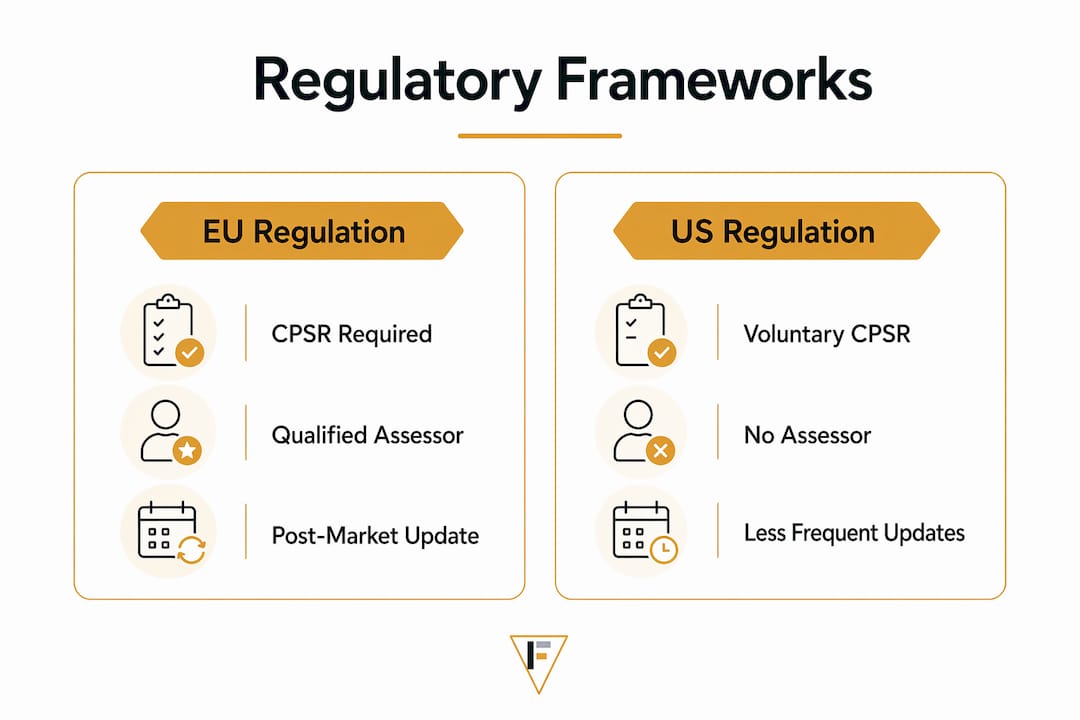
One practical implication of this table: the EU framework is the most demanding. Formulators targeting the EU market should treat the CPSR standard as the baseline for all markets. Meeting it satisfies most other jurisdictions with minimal additional work.
How is a toxicological assessment conducted in formulation safety testing?
A toxicological assessment evaluates every ingredient in a formula individually before examining the complete formulation for cumulative and interaction effects. Each ingredient is identified by its INCI name, CAS number, and EINECS number, then cross-referenced against toxicological databases such as the Scientific Committee on Consumer Safety (SCCS) opinions, CosIng, and peer-reviewed literature. The goal is to establish a toxicological profile covering acute toxicity, skin and eye irritation, sensitization potential, reproductive toxicity, and carcinogenicity.

The Margin of Safety calculation is the quantitative core of the assessment. MoS compares the toxicological Point of Departure (POD) to the Systemic Exposure Dose (SED). A MoS of 100 or above supports a conclusion of safe use. The SED depends on how much product a consumer applies, how often, and how much of the ingredient penetrates the skin. These assumptions are the most audit-sensitive part of the entire safety file.
The standard toxicological assessment follows this sequence:
- Ingredient identification. Confirm INCI, CAS, and EINECS data for every substance in the formula.
- Toxicological profile compilation. Gather data on acute toxicity, irritation, sensitization, genotoxicity, reproductive toxicity, and carcinogenicity for each ingredient.
- Exposure estimation. Calculate the SED using product type, application area, frequency of use, and dermal absorption values.
- MoS calculation. Divide the POD by the SED. Flag any ingredient where MoS falls below 100 for further review.
- Interaction and cumulative effect analysis. Assess whether combinations of ingredients create additive or synergistic toxicological risks not captured by individual evaluations.
- Overall safety conclusion. Compile findings into the CPSR with a signed conclusion from a qualified toxicologist.
Dermal absorption factors are the largest single variable in MoS calculations. Using a default 100% absorption value when validated in vitro data exist for an ingredient inflates the SED unnecessarily and can push MoS below the 100 threshold without scientific justification.
Pro Tip: Challenge your dermal absorption assumptions at the start of the safety file, not at the end. If validated absorption data exist for a key ingredient, use them. Switching from a default 100% to a validated lower value late in the process delays CPSR sign-off and adds cost.
What role do stability and microbiological testing play in formulation safety?
Stability testing confirms that a cosmetic product maintains its physical, chemical, and microbiological properties throughout its intended shelf life. Formulators run accelerated stability studies at elevated temperatures (typically 40°C and 50°C) and real-time studies at ambient conditions, monitoring parameters including viscosity, pH, color, odor, and emulsion integrity. A product that separates, discolors, or changes pH outside specification is not just aesthetically compromised. It may deliver active ingredients at incorrect concentrations or create conditions that support microbial growth.
Microbiological testing covers two distinct but related protocols:
- Microbial limits testing. Performed on finished batches before release, this test confirms the absence of specified pathogens such as Pseudomonas aeruginosa, Staphylococcus aureus, Candida albicans, and Escherichia coli, and verifies that total aerobic microbial count stays within acceptable limits.
- Preservative efficacy testing (challenge testing). This protocol deliberately inoculates the product with a panel of microorganisms and monitors their reduction over 28 days. It evaluates whether the preservative system can defend the formula against contamination during consumer use.
- Repeat-insult patch testing. Used for products with extended skin contact, this test assesses sensitization potential under repeated exposure conditions.
- Photostability testing. Required for products containing UV filters or photosensitive actives, confirming that the formula does not degrade or generate harmful photoproducts under UV exposure.
Microbial contamination in cosmetics is not a theoretical risk. Products used near the eyes, on broken skin, or by immunocompromised individuals carry real infection risk if preservative systems fail. Challenge testing over 28 days against a defined microbial panel is the industry standard for proving preservative performance.
Pro Tip: A challenge test that shows borderline preservative performance is not a pass. If microbial counts drop but do not reach the required reduction criteria within the specified timeframe, reformulate the preservative system before filing the CPSR. Regulators and auditors treat borderline results as failures.
How do extractables and leachables impact formulation safety testing?
Extractables are chemical compounds that can migrate out of packaging materials or manufacturing equipment under exaggerated laboratory conditions. Leachables are the subset of those compounds that actually migrate into the product under normal storage and use conditions. Both categories represent a toxicological risk that sits outside the formula itself but must be captured within the formulation safety assessment. Packaging materials including plastics, elastomers, adhesives, and coatings are the primary sources.
The toxicological risk assessment of extractables and leachables uses a structured, endpoint-by-endpoint framework. Mutagenicity is evaluated first using Threshold of Toxicological Concern (TTC) limits. A compound that passes the mutagenicity screen proceeds to evaluation for irritation, sensitization, and systemic toxicity. This sequenced approach prevents premature safety conclusions and ensures that no effect category is skipped.
The table below compares extractables and leachables across key characteristics and evaluation steps.
| Characteristic | Extractables | Leachables |
|---|---|---|
| Source | Packaging, equipment under stress conditions | Packaging, equipment under normal use |
| Detection method | Aggressive solvent extraction in lab | Product analysis under real storage conditions |
| Regulatory relevance | Screening and worst-case estimation | Direct safety assessment input |
| Toxicological evaluation start point | Mutagenicity via TTC | Mutagenicity via TTC |
| Subsequent evaluation | Irritation, sensitization, systemic toxicity | Irritation, sensitization, systemic toxicity |
| Documentation location | Safety dossier appendix | CPSR toxicological assessment section |
A practical example: a polyethylene terephthalate (PET) bottle used for a rinse-off body wash may leach trace levels of acetaldehyde. The assessor evaluates acetaldehyde for mutagenicity first. If TTC limits are not exceeded, the assessment proceeds to systemic effects. Leachable evaluation that skips the mutagenicity screen first risks missing a critical safety signal.
What are current trends in formulation safety testing?
The most significant shift in formulation safety assessments over the past decade is the move from late-stage verification to early integration of safety evaluation within the formulation development cycle. Safety assessors now work alongside formulators from the concept stage, not after the formula is locked. This reduces costly reformulations and CPSR delays.
New Approach Methodologies (NAMs) are driving the technical evolution of safety testing methods. Key developments include:
- In vitro skin models. Human 3D tissue substitutes such as EpiDerm™ replace animal skin irritation tests with validated, reproducible results that regulators accept.
- In silico toxicology. Computational tools predict toxicological endpoints from molecular structure, reducing the need for wet-lab testing on every new ingredient.
- Read-across and category approaches. Assessors group structurally similar ingredients and apply toxicological data from well-studied analogs to data-poor substances.
- Integrated testing strategies. Rather than running tests in isolation, assessors combine in vitro, in silico, and existing literature data into a weight-of-evidence conclusion.
- Digital documentation platforms. Software tools now support exposure calculation, ingredient data management, and CPSR generation, reducing manual error and improving audit readiness.
The reduction of animal testing is both an ethical imperative and a regulatory direction. The EU banned animal testing for cosmetic ingredients in 2013. NAMs are now the expected approach for generating new safety data on cosmetic ingredients across most major markets.
Key takeaways
Formulation safety testing requires linking toxicological data, exposure assumptions, and regulatory documentation into a defensible, continuously updated safety file.
| Point | Details |
|---|---|
| CPSR is mandatory in the EU | EU Cosmetics Regulation 1223/2009 requires a qualified assessor to prepare and maintain the CPSR before market placement. |
| MoS of 100 or above is the threshold | Margin of Safety calculations must account for dermal absorption and realistic exposure to produce a valid safety conclusion. |
| Stability and microbial testing are non-negotiable | Challenge testing over 28 days and microbial limits testing confirm preservative performance and batch safety. |
| Extractables and leachables need structured evaluation | Mutagenicity screening via TTC must precede all other toxicological endpoints for packaging migration compounds. |
| NAMs are replacing animal models | In vitro and in silico methods now generate regulatory-accepted safety data without animal testing. |
The part of formulation safety testing most teams get wrong
After reviewing safety dossiers across dozens of product launches, the pattern that creates the most problems is not missing data. It is inconsistent assumptions. A safety file where the dermal absorption value for ingredient A uses a validated in vitro figure, while ingredient B defaults to 100% with no justification, will not survive regulatory scrutiny. Assessors and regulators expect harmonized assumptions across the entire dossier.
The second most common failure is treating the CPSR as a one-time deliverable. Qualified toxicologists must update safety reports when new post-market data emerge, when the formula changes, or when a regulatory opinion on an ingredient is revised. Teams that file the CPSR and archive it are accumulating compliance risk with every passing month.
My practical recommendation: build a review calendar into your product compliance workflow. Set a 12-month trigger to revisit every active CPSR and check for new SCCS opinions, ingredient restriction updates, and any adverse event signals from post-market surveillance. Pair that with a formulation checklist that flags safety documentation requirements at every stage of development, not just at launch. You can find a structured approach to this in a formulation compliance guide that covers regulatory expectations from concept through market placement.
The formulators who build the cleanest safety files are not the ones with the most data. They are the ones who document every assumption, justify every default value, and treat the safety file as a living document.
— Ben
How Formlypro supports your formulation safety workflow
Formlypro is built for regulatory professionals, cosmetic formulators, and product developers who need to manage ingredient data, exposure calculations, and compliance documentation in one place.
The platform's 8-phase product development plan guides teams from ideation through formulation, prototyping, compliance, and production. Ingredient data management, competitor formulation analysis, and regulatory guidance are integrated into a single workflow. For teams working toward CPSR readiness, Formlypro reduces the manual effort of tracking ingredient profiles, updating documentation, and preparing audit-ready files. Explore the full platform at Formlypro and see how it fits your compliance process.
FAQ
What is formulation safety testing in cosmetics?
Formulation safety testing is the scientific process of evaluating a cosmetic product's ingredients and finished formula to confirm it is safe for consumers under normal use conditions. The process produces a Cosmetic Product Safety Report (CPSR) required by EU Cosmetics Regulation 1223/2009.
What is a Margin of Safety and why does it matter?
The Margin of Safety (MoS) compares the toxicological Point of Departure to the Systemic Exposure Dose. A MoS of 100 or above supports a conclusion of safe use; values below 100 require reformulation or additional data.
How long does preservative efficacy testing take?
Preservative efficacy testing, also called challenge testing, runs for 28 days. The test inoculates the product with defined microorganisms and measures their reduction over time to confirm the preservative system performs adequately.
Do extractables from packaging need to be included in the safety assessment?
Yes. Leachables that migrate from packaging into the product under normal storage conditions must be assessed toxicologically within the CPSR. Mutagenicity is evaluated first using Threshold of Toxicological Concern limits before other endpoints are assessed.
How often should a Cosmetic Product Safety Report be updated?
The CPSR must be updated whenever new post-market safety data emerge, the formula changes, or a regulatory opinion on an ingredient is revised. EU Cosmetics Regulation 1223/2009 requires the safety file to remain current throughout the product's commercial life.