

TL;DR:
- A chemist formulator designs, tests, and optimizes formulations for cosmetics, personal care, and food products, ensuring regulatory compliance from the start. They evaluate ingredient functionality, stability, safety, and coordinate with suppliers while integrating legal requirements like EU CPSR and US MoCRA into product development. Effective formulation strategy involves early testing, cross-team collaboration, and meticulous documentation to enable successful market entry and regulatory approval.
A chemist formulator is a product development specialist who designs, tests, and optimizes chemical formulations for cosmetics, personal care, and food products, applying scientific principles and regulatory knowledge to bring safe, compliant products to market. The role sits at the intersection of bench science and commercial strategy, which makes it one of the most technically demanding positions in consumer product development. Whether you are hiring a formulation chemist, collaborating with one, or building your own formulation capability, understanding what this role actually requires changes how you approach product development entirely. Regulatory frameworks like EU Cosmetics Regulation 1223/2009, U.S. MoCRA, and FDA FSMA are not optional checkboxes. They are design constraints that a skilled chemical formulation expert builds into every decision from day one.
What does a chemist formulator actually do?
A formulation chemist designs product formulas by selecting ingredients for their functional roles, testing those combinations for stability and safety, and documenting everything to satisfy regulatory requirements across target markets. The scope is broader than most product teams realize.
Core responsibilities include:
- Ingredient functionality mapping: Understanding how emulsifiers, preservatives, actives, and rheology modifiers interact at specific pH ranges and temperatures
- Stability and performance optimization: Designing formulas that hold their physical and chemical properties through the product's intended shelf life
- Regulatory screening: Checking every ingredient against restricted or prohibited lists, such as EU Annex II through VI, before a formula is finalized
- Safety substantiation: Compiling raw material specifications, microbial test data, and stability results into documentation packages that support safety assessments
- Supplier and manufacturer coordination: Working with ingredient suppliers on technical data sheets and with contract manufacturers on scale-up parameters
The skills that separate a strong product formulation specialist from an average one are analytical thinking, regulatory literacy, and the ability to communicate technical trade-offs to non-technical stakeholders. A cosmetic chemist who cannot explain why a preservative system was chosen, or what reformulation risk a marketing change creates, is a liability in a cross-functional team.
Pro Tip: When briefing a formulation chemist, always specify target markets before ideation begins. A formula built for the EU requires CPSR-ready documentation from the start. Retrofitting compliance documentation after formulation is complete costs significantly more time and money than building it in from day one.

How do formulators navigate EU and U.S. regulatory frameworks?
Regulatory compliance is not a post-formulation task. A skilled cosmetic product developer treats regulatory requirements as formulation inputs, not outputs.
In the EU, CPSR compliance under Regulation (EC) No 1223/2009 is mandatory before any cosmetic product reaches the market. The Cosmetic Product Safety Report consists of Part A, which covers safety information including ingredient profiles, microbiological data, and stability results, and Part B, which is the qualified safety assessor's signed conclusion. That assessor must hold qualifications in pharmacy, toxicology, or an equivalent discipline. The Responsible Person is legally accountable for ensuring this documentation is complete and accurate.
In the U.S., MoCRA significantly expanded FDA authority over cosmetics. Facility registration became effective December 29, 2023, with biennial renewals required. Product listing, adverse event reporting, and GMP rulemaking are all active obligations or pending rules as of 2026. Under MoCRA, the Responsible Person must report serious adverse events to the FDA within 15 business days and retain records for six years, or three years for small businesses.
For food product formulation, the FDA FSMA Preventive Controls rule requires food facilities to develop and implement written Food Safety Plans based on hazard analysis and preventive controls aligned with HACCP principles. This covers biological, chemical, and physical hazards at every formulation and processing stage.
| Regulatory framework | Scope | Key formulator obligation |
|---|---|---|
| EU Cosmetics Regulation 1223/2009 | Cosmetics sold in EU/EEA | Contribute to PIF and support CPSR documentation |
| U.S. MoCRA (2023 onward) | Cosmetics sold in the U.S. | Facility registration, product listing, adverse event records |
| FDA FSMA Preventive Controls | Food and beverage products | Written Food Safety Plan with hazard analysis and controls |
Common pitfalls include launching in the EU with incomplete microbiological data, or entering the U.S. market without registering the manufacturing facility. A pharmaceutical formulator or skincare formulator working across both regions must maintain parallel documentation workflows, since the two systems share almost no structural overlap.
What testing methods do chemist formulators rely on?
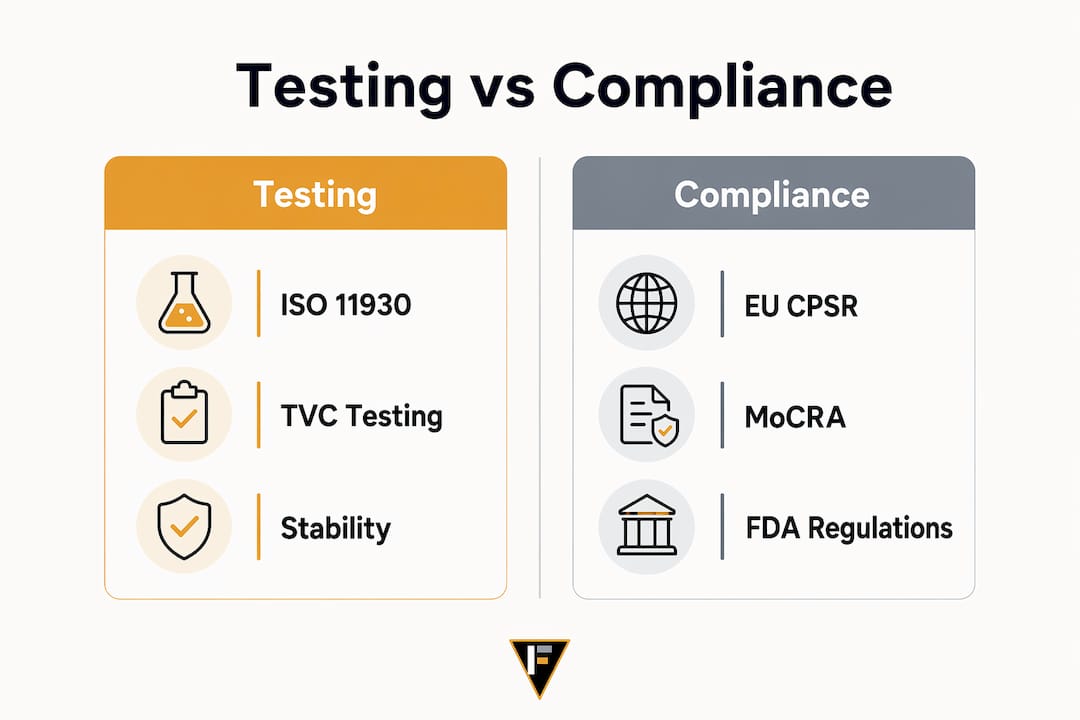
Testing is where formulation science becomes legally defensible. A personal care formulator working on water-containing products must distinguish between two fundamentally different microbiological tests: the ISO 11930 challenge test and total viable count (TVC) testing.
ISO 11930 challenge testing inoculates a finished product with five reference organisms and measures viable counts at days 7, 14, and 28 to validate preservative performance under simulated contamination stress. This test is required for CPSR defensibility in the EU and is considered best practice globally for water-containing cosmetics. TVC testing, by contrast, measures the total microbial load in a batch at a single point in time and is used for batch release quality control, not preservative validation. Confusing the two is one of the most common documentation errors in EU cosmetic submissions.
- Plan preservative efficacy testing early. Reformulations affecting preservative systems require retesting per regulatory expectations. Build this into your project timeline, not as an afterthought.
- Run accelerated and real-time stability testing in parallel. Accelerated testing at elevated temperatures provides early signals, but stability testing programs must include real-time monitoring and packaging compatibility assessments to be fully defensible.
- Document sample preparation protocols. Regulators and safety assessors expect to see how samples were prepared, stored, and tested. Gaps in this record create audit risk.
- Align test timing with your launch schedule. Real-time stability data takes months to generate. Starting testing after formula lock is a reliable way to delay your launch.
Pro Tip: Packaging compatibility is frequently overlooked until late in development. A formula that passes stability testing in glass may fail in HDPE or PET. Test in your intended commercial packaging from the first stability time point, not as a final check.
What formulation strategies lead to successful product launches?
Successful product development is not just about finding the right formula. It is about building a workflow that connects ingredient selection, supplier coordination, safety testing, and regulatory documentation into a single traceable process.
Ingredient selection starts with EU Annex II through VI screening for any product targeting European markets. Every ingredient must be checked against prohibited substances, restricted substances with concentration limits, and approved colorants and preservatives. This screening should happen before prototype development, not after.
Supplier coordination is equally critical. A cosmetic product developer needs certificates of analysis, safety data sheets, and INCI-confirmed ingredient names from every raw material supplier before a formula can be submitted for safety assessment. Gaps in supplier documentation are a leading cause of CPSR delays.
Safety substantiation under MoCRA now favors laboratory test data over general literature references. FDA's records access authority enables direct inspection of adverse event assessments, manufacturing results, and analytical data. This means your documentation must be inspection-ready from the moment a product is listed, not assembled retroactively.
| Formulation phase | Key action | Compliance link |
|---|---|---|
| Concept and ingredient selection | Screen against EU Annex II–VI and MoCRA ingredient requirements | Prevents late-stage reformulation |
| Prototype development | Initiate stability and preservative efficacy testing | Feeds CPSR Part A data |
| Scale-up | Confirm supplier documentation and GMP alignment | Supports facility registration records |
| Pre-launch | Finalize safety substantiation package | Required for CPSR sign-off and MoCRA product listing |
Cross-functional communication between formulation, marketing, and regulatory teams prevents the most expensive mistakes in product development. Marketing changes to fragrance levels, colorants, or claims can trigger regulatory reclassification or require retesting. A formulation scalability checklist that includes regulatory sign-off at each phase gate keeps all teams aligned and reduces costly late-stage changes.
For food products, preventive controls covering sanitation, allergen management, supplier verification, and recall procedures must be documented and coordinated between the formulation team and quality assurance. This is not a QA-only responsibility. The formulation chemist's ingredient choices directly determine which hazards require controls.
Key takeaways
A chemist formulator's value is determined not just by scientific skill but by the ability to integrate regulatory compliance, safety testing, and cross-functional documentation into every phase of product development.
| Point | Details |
|---|---|
| Regulatory frameworks are design inputs | Screen EU Annex II–VI and MoCRA requirements before prototype development begins. |
| ISO 11930 and TVC serve different purposes | Use challenge testing for preservative validation and TVC for batch release quality control. |
| Documentation must be inspection-ready | MoCRA's records access authority means safety substantiation files must be complete before product listing. |
| Cross-functional alignment prevents costly reformulations | Marketing and regulatory teams must review formulation changes before they are finalized. |
| Food formulation requires a written Safety Plan | FDA FSMA mandates documented hazard analysis and preventive controls for all food facilities. |
Why the formulator's role is more strategic than most brands realize
I have watched brands treat formulation as a purely technical function, something to hand off to a lab and collect results from. That model breaks down the moment a product hits a regulatory review or a stability failure surfaces six weeks before launch.
The most effective product development teams I have seen treat their formulation chemist as a strategic partner from the first brief. When a cosmetic chemist is in the room when marketing sets claims, they can flag that a "clinically proven" positioning requires clinical data that needs to be planned and funded upfront. When they are involved in supplier selection, they catch documentation gaps before those gaps become CPSR delays.
The expansion of MoCRA and the ongoing complexity of EU Cosmetics Regulation have made this even more true. EU submission failures most often stem from inadequate microbiological and exposure assessment data, not from poor formulation creativity. That is a documentation and workflow problem, not a chemistry problem. Brands that invest in formulation workflow infrastructure, including traceability systems, supplier qualification processes, and integrated safety substantiation, consistently outperform those that treat compliance as a final-stage checklist.
The next frontier for formulation chemists is not a new ingredient category. It is mastering the data architecture that makes their scientific work commercially defensible.
— Ben
How Formlypro supports your formulation workflow
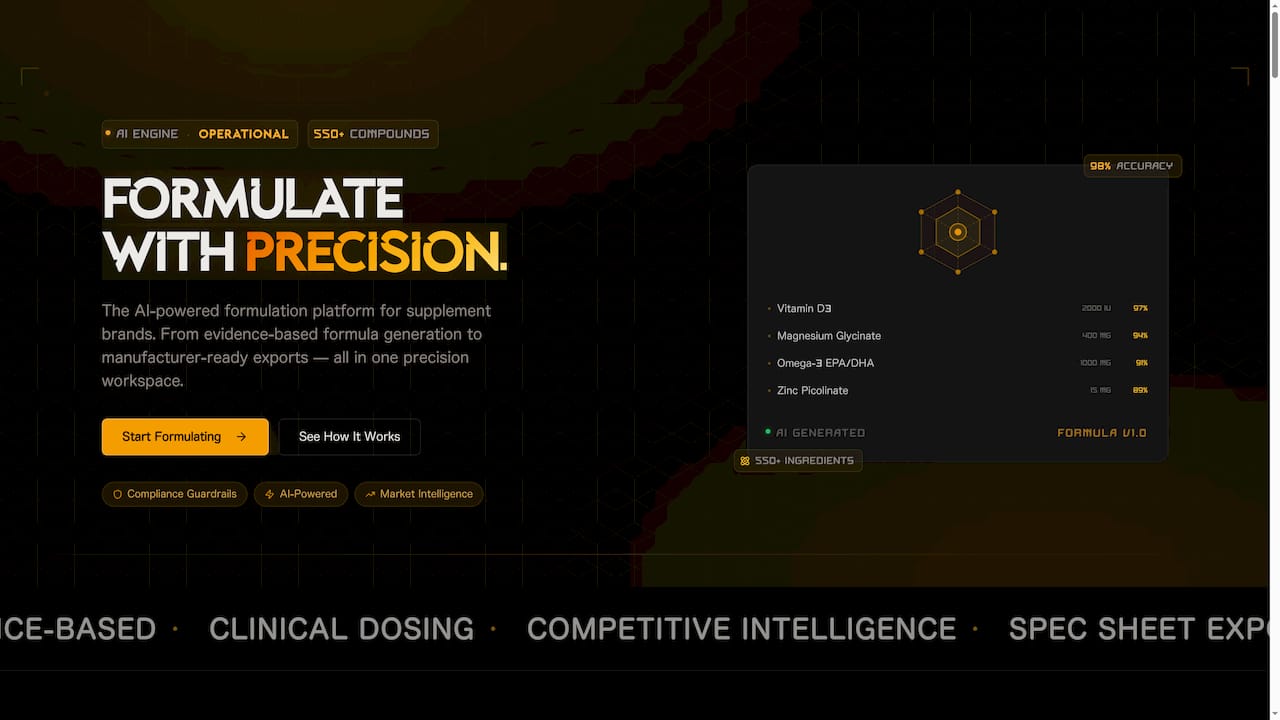
Formlypro is built for product development and marketing teams that need more than a formula. The platform's 8-phase product development plan takes a new product from ideation through formulation, prototyping, compliance, and production, with integrated market research and competitor analysis at every stage. Compliance guidance covers MoCRA, EU Cosmetics Regulation, and FSMA requirements, so your documentation is structured correctly from the start. The AI Mockup designer handles custom packaging development inside the same system. If you are building a product that needs to be both market-ready and inspection-ready, Formlypro gives your team the structure to get there.
FAQ
What is a chemist formulator?
A chemist formulator is a product development specialist who designs, tests, and optimizes chemical formulations for cosmetics, personal care, or food products. The role combines ingredient science, stability testing, and regulatory compliance to produce safe, market-ready products.
What is the difference between ISO 11930 and TVC testing?
ISO 11930 is a challenge test that validates preservative performance in finished cosmetic products by measuring microbial reduction over 28 days. TVC testing measures total microbial load in a batch at a single point and is used for batch release, not preservative validation.
What does MoCRA require from cosmetic formulators?
MoCRA requires facility registration, product listing, and adverse event reporting within 15 business days of receipt. Safety substantiation must be documented and inspection-ready, as FDA now has direct records access authority for cosmetic products.
How does a formulation chemist support EU CPSR compliance?
A formulation chemist contributes ingredient safety data, microbial test results, and stability reports to the Product Information File. This data forms Part A of the CPSR, which a qualified safety assessor then uses to complete and sign Part B before market placement.
When should stability testing begin in the formulation process?
Stability testing should begin at the prototype stage, not after formula lock. Running accelerated and real-time testing in parallel, using commercial packaging from the first time point, gives you defensible data and protects your launch timeline.