

TL;DR:
- Successful product development requires a clear Target Product Profile that aligns consumer needs, brand positioning, and regulatory requirements to guide formulation.
- Implementing staged decision gates and risk-managed experiments ensures cross-functional alignment and reduces costly post-launch reformulations.
A flawless formula in the lab is no guarantee of a winning product on the shelf. Many brands have experienced this firsthand: a beautiful emulsion that separates during freight, a supplement that fails potency claims after six months, or a texture that consumers love in a focus group but reject at retail. The gap between a promising concept and commercial success is wider than most entrepreneurs expect, and it is almost never about the chemistry alone. This article walks you through a proven, criteria-driven process to build formulations that scale, comply, and resonate with real buyers.
Table of Contents
- Define your target product profile and critical attributes
- Move through staged decision gates and risk-managed experiments
- Identify and control critical process parameters for robust scale-up
- Align formulation with market positioning and consumer evidence
- Why most formulation failures come down to skipped basics—and how to avoid them
- Supercharge your formulation process with FormlyPro
- Frequently asked questions
Key Takeaways
| Point | Details |
|---|---|
| Start with clear objectives | Defining your product profile and critical attributes is step one for successful formulation. |
| Use staged gates to reduce risk | Evaluating your process at key decision points prevents costly late-stage failures. |
| Control scale-up variables | Managing critical process parameters ensures lab success translates to commercial viability. |
| Validate market positioning | Align your formulation with consumer-driven evidence and brand differentiation for maximum impact. |
Define your target product profile and critical attributes
Every successful product starts with a clear definition of what success actually looks like. Before a single ingredient is weighed out, your team needs to agree on measurable, non-negotiable product attributes. This is not a vision statement. It is a technical and commercial contract that keeps your R&D, marketing, and operations teams aligned throughout development.
When you are creating brand formulations, start by layering three inputs: consumer needs, brand positioning, and regulatory requirements. Consumer needs tell you what problems you are solving. Positioning tells you how your product will be different from what already exists. Regulatory requirements set the legal floor that everything must meet before launch.
From these inputs, you build what the industry calls a Target Product Profile (TPP). A well-constructed TPP answers specific questions: What physical form is the product (gel, powder, spray, tablet)? What performance claims must it support, and what evidence is needed? What is the minimum acceptable shelf life? What sensory experience will reinforce the brand promise? What packaging format is required, and is the formula chemically compatible with it?
Quality by Design (QbD) is an evidence-based formulation methodology that starts from predefined objectives and uses quality risk management plus design and process understanding, rather than relying only on end-product tests. This approach shifts the mindset from "test and hope" to "design with intent," and the difference in launch outcomes is significant.
Here is a practical checklist of attributes to define upfront:
- Physical form and delivery mechanism (lotion, capsule, powder sachet, spray)
- Active ingredient targets and minimum efficacy thresholds
- Sensory profile (texture, scent, color, viscosity, feel on skin or palate)
- Shelf life and stability under expected storage and shipping conditions
- Packaging compatibility including material interaction and fill compatibility
- Regulatory claims status and evidence requirements per target market
- Sustainability or sourcing criteria that align with brand values
Pro Tip: Run at least one round of consumer co-creation or ethnographic research before you finalize your TPP. The attributes consumers talk about in qualitative interviews often differ from what R&D teams assume matter most. Catching that gap early saves months of reformulation later.
Move through staged decision gates and risk-managed experiments
With a clear target product profile in hand, you need a disciplined process for moving from concept through prototype to final formula. The mistake most brands make is treating formulation as a linear "pass it from R&D to manufacturing" handoff. In reality, the best brands use a structured, iterative stage gate process that requires cross-functional sign-off before advancing.

Each gate is a formal checkpoint where technical, regulatory, and market fit criteria are evaluated together. The gate is not a bureaucratic hurdle. It is a deliberate moment to ask: "Do we have enough evidence to move forward, or does this path carry unacceptable risk?" Teams that skip gates to save time routinely face costly reformulations after expensive tooling or packaging commitments have been made.
As the principle behind formulation analytics makes clear, data should drive gate decisions, not assumptions or enthusiasm. A strong gate review will assess stability data so far, compatibility results, preliminary consumer feedback, and supply chain feasibility simultaneously.
"Successful consumer-product formulation is usually treated as a cross-functional, risk-managed development program where the formula alone is not enough." — Formulation Strategies for Scalability
A practical stage gate structure for consumer product formulation looks like this:
- Gate 1: Concept validation — Does the TPP align with a real, underserved consumer need and a viable regulatory pathway?
- Gate 2: Feasibility — Can the core formula be built with accessible, scalable ingredients at a cost that supports the intended price point?
- Gate 3: Prototype performance — Does the prototype meet defined sensory, stability, and efficacy thresholds in bench testing?
- Gate 4: Pilot scale — Does the formula hold up on pilot-scale equipment, and are CPPs (critical process parameters) identified?
- Gate 5: Consumer validation — Does consumer testing confirm perceived value, purchase intent, and preference over key competitors?
- Gate 6: Regulatory and commercial readiness — Is the final formula compliant, claims-substantiated, and ready for full production?
This approach is especially powerful because it pulls R&D, marketing, supply chain, and regulatory functions into each gate together. When you boost product performance by building cross-functional feedback loops into every stage, you catch misalignments early when they are cheap to fix rather than late when they are expensive.
Identify and control critical process parameters for robust scale-up
The single most common cause of post-launch reformulations is scale-up failure. A formula can perform beautifully on a 2-liter bench mixer and fall apart on a 500-liter commercial vessel. The physics are different. The shear forces, heat transfer rates, and mixing dynamics all change significantly as you increase batch size, and if your formulation development process did not account for these variables, you are building on sand.
QbD-style scale-up work for lab-to-industrial translation identifies critical process parameters (CPPs) and demonstrates the ability to scale while preserving key quality outcomes. CPPs are the process variables such as temperature, mixing speed, homogenization cycles, and fill rate that must stay within defined ranges to produce a consistent, compliant product every time.
For semisolid and complex formats like creams, gels, and emulsions, the challenge is even greater. QbD strategies for semisolid formulations require defining control strategies around both CPPs and critical material attributes (CMAs), directly linking manufacturing parameters to microstructure, performance, and safety outcomes.
Here is a comparison of typical parameter ranges across pilot and commercial scale to illustrate the challenge:
| Process parameter | Pilot scale (5–50 L) | Commercial scale (200–2000 L) |
|---|---|---|
| Mixing speed (RPM) | 300–600 RPM | 80–150 RPM |
| Emulsification temperature | 70–75°C | 68–78°C (wider tolerance needed) |
| Homogenization cycles | 2–3 passes | 1–2 passes (higher shear per pass) |
| Batch processing time | 45–90 minutes | 120–240 minutes |
| Fill temperature tolerance | ±2°C | ±5°C |
The implications are clear: a formula optimized only for bench scale may require emulsifier adjustments, viscosity modifier tweaks, or processing sequence changes before it will hold consistently at commercial scale. The formulation quality checklist for scale-up should include equipment compatibility assessments, not just ingredient compatibility.
Key areas to address during scale-up risk assessment:
- Equipment set variability: Does your formula perform consistently across different manufacturers' vessels or only on one specific lab unit?
- Raw material variation: Do you have specification tolerances for each raw material that reflect real-world batch-to-batch supplier variation?
- In-process controls: What are the measurable checkpoints during manufacturing that confirm the process is on track before you reach final fill?
- Contamination scenarios: What is your validated protocol for microbial challenge, especially for water-containing formulas?
To build market-ready formulations, brands that invest early in process characterization avoid the expensive surprises that come from treating scale-up as an afterthought.
Pro Tip: Never validate your control strategy on only one piece of equipment. Run at least one trial on a second manufacturing line or contract manufacturer's equipment before you commit to commercial production agreements. Equipment-specific formulas create fragile supply chains.
Align formulation with market positioning and consumer evidence
Technical excellence is necessary, but it will not generate pricing power or brand loyalty on its own. The formulations that command a premium and build genuine consumer loyalty are the ones that make the brand's positioning tangible and believable. This is where formulation strategy and brand strategy must be deliberately integrated.
Positioning defines a unique market space and translates brand decisions into signals that consumers can actually read. In practical terms, this means your formula needs to embody the claims you make, not just technically satisfy them. A brand positioning itself as "gentle and microbiome-friendly" needs a formula that demonstrably avoids harsh surfactants, includes clinically studied prebiotics, and performs that way in consumer use testing. Saying it in marketing without building it into the formula is a credibility gap that sophisticated consumers will detect quickly.
Formulation transparency and consumer trust are increasingly driving purchase decisions, particularly in beauty, wellness, and functional food categories. Brands that publish detailed ingredient rationale and evidence-based formulation strategies build faster trust and reduce the cost of consumer acquisition over time.
Here is a practical framework for aligning formulation decisions with positioning claims:
| Positioning claim | Formulation requirement | Validation method |
|---|---|---|
| "Fast-absorbing" | Optimized emulsifier system, low occlusive load | Tewameter/absorption timing test |
| "Clinically effective" | Active at proven dose, peer-reviewed evidence | Published clinical study or IRB trial |
| "Clean formula" | No restricted ingredients, positive list only | Third-party certification (EWG, etc.) |
| "Long-lasting results" | Film-forming or slow-release delivery system | 8-hour or 12-hour consumer use panel |
| "Sustainable" | Biodegradable ingredients, recycled packaging | Life cycle assessment documentation |
Consider running blind comparison sensory testing against your two or three top competitors before finalizing your formula. This is not just about matching performance. It is about identifying where your formula genuinely outperforms and building those moments of difference into your claims architecture. Brands that can say "outperforms in 3 out of 4 consumer tests" with documented evidence command stronger shelf presence and retailer confidence.
Key principles for evidence-based positioning alignment:
- Claims must be built in, not bolted on. If a claim is not supported at the formulation level, no marketing budget can save it long-term.
- Consumer language matters. Technical superiority means nothing if consumers cannot feel or articulate the difference. Test perceived benefit, not just measured performance.
- Price premium follows differentiation. Research consistently shows that brands with transparent, differentiated formulations capture meaningful price premiums over category averages.
Why most formulation failures come down to skipped basics—and how to avoid them
Here is the uncomfortable truth that most formulation consultants will not say directly: the majority of product failures in the consumer goods space are not caused by bad science. They are caused by perfectly capable teams cutting corners on process fundamentals because of timeline pressure, budget constraints, or overconfidence in early positive results.
We have seen this pattern repeatedly. A brand gets a great lab result in week three, leadership gets excited, and suddenly the pressure mounts to "move faster." Gates get collapsed. Scale-up testing is abbreviated. Consumer validation is replaced with internal team tastings or texture assessments. The packaging compatibility study gets skipped because "it is just a bottle." Six months after launch, the product is separating on shelf, or the fill line is running at 40% efficiency because the formula is too viscous at production temperatures.
The pre-mortem technique is one of the most underused tools in product development. Before you enter final production, gather your cross-functional team and ask explicitly: "Assume this launch fails in six months. What caused it?" This forces people to articulate risks they have been privately worried about but not voicing. The answers are almost always revealing. Skipped scale-up validation, unresolved supplier qualifications, uncertain claims substantiation, and packaging that was chosen based on aesthetics rather than fill compatibility are consistently the top themes that surface.
Addressing common formulation pitfalls before they become launch crises requires institutional discipline, not just individual talent. Build it into your gates. Make it non-negotiable. The brands that consistently win in crowded, competitive categories are not necessarily the ones with the best chemists. They are the ones with the most rigorous processes.
Pro Tip: Set up a pre-mortem session at Gate 5 and document every risk that surfaces. Then assign owners and resolution deadlines for each one before Gate 6 sign-off. This single practice has saved more launches than any reformulation budget.
Supercharge your formulation process with FormlyPro
Building a rigorous, market-winning formulation process sounds demanding because it is. But you do not need to navigate every decision from scratch or manage all this complexity across disconnected tools and spreadsheets.
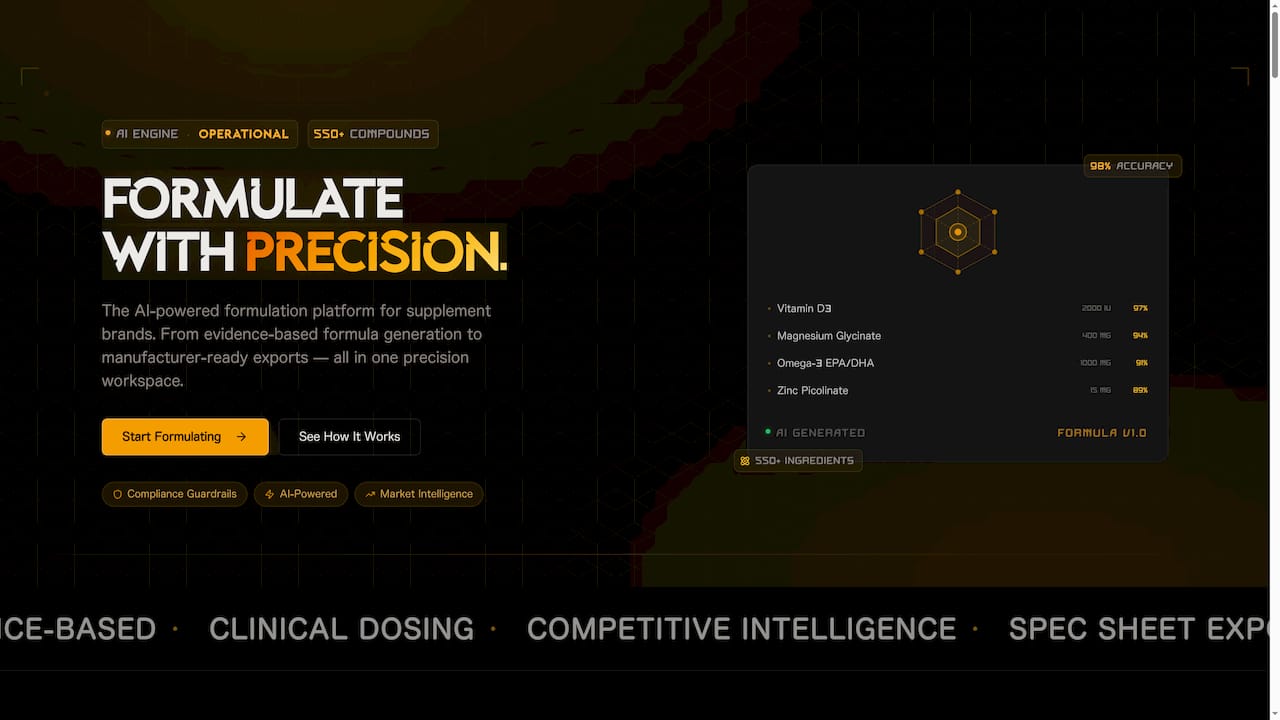
FormlyPro gives consumer brand entrepreneurs and product teams a structured platform that takes you from initial product brief through compliance, competitive analysis, and final production readiness. The 8-phase development plan built into the platform mirrors the exact framework covered in this article, including dedicated modules for formulation analytics, market positioning, regulatory compliance, and custom packaging design with an AI mockup tool integrated directly into the workflow. Whether you are launching your first product or scaling a proven line, FormlyPro helps you move faster without skipping the basics that separate successful launches from expensive lessons.
Frequently asked questions
What is a critical process parameter (CPP) in product formulation?
A CPP is a process variable like temperature or mixing speed that must be controlled within defined limits to produce a consistent, compliant product at any scale. QbD-driven scale-up research shows that identifying and controlling CPPs is essential for preserving quality outcomes when moving from lab to commercial production.
How does QbD (Quality by Design) improve formulation success rates?
QbD integrates risk management, structured experimentation, and systematic process controls into development from day one, dramatically reducing late-stage surprises. The QbD methodology starts from predefined objectives rather than testing finished product and hoping for the best.
Why do so many new products fail after a successful lab trial?
Formulas that perform well in pilot scale can fail commercially if the emulsifier system or processing sequence lacks robustness across the variable conditions of real equipment, supply chain handling, and consumer use environments.
How do I link my product's formulation strategy to market positioning?
Translate your positioning into specific formulation requirements and then validate those claims with consumer evidence before launch. Effective positioning defines a unique market space and turns it into product decisions that consumers can see, feel, and believe.