

pH is not just a quality control checkbox. It is the single variable most likely to determine whether your drug product survives its shelf life or quietly degrades before it reaches a patient. The role of pH in formulation stability is direct: it governs the kinetics of hydrolysis, oxidation, and deamidation, and it shapes physical behavior like solubility, precipitation, and aggregation. Get it wrong by even one unit, and degradation rates can increase by a factor of 10 or more due to acid/base catalysis effects.
Here is what pH controls in a formulation:
- Chemical degradation rate: pH sets the speed of hydrolysis and oxidation through acid and base catalysis, producing a characteristic V-shaped or U-shaped stability curve where degradation is slowest at one narrow optimal point.
- Physical stability: pH determines ionization states that govern solubility, aggregation tendency, and precipitation risk, particularly for proteins and peptides.
- Bioavailability: ionization state at physiological pH directly affects membrane permeability and absorption.
- Preservative efficacy: many antimicrobial preservatives are only active in their un-ionized form, which is pH-dependent.
- Regulatory compliance: FDA and ICH Q1A both require pH monitoring as a critical stability attribute throughout shelf-life studies.
How pH drives chemical degradation in drug formulations
Hydrolysis is the dominant degradation pathway in most liquid pharmaceutical formulations, and pH controls it directly. Both acid-catalyzed and base-catalyzed hydrolysis mechanisms operate simultaneously, which is why the degradation rate versus pH plot forms a V-shape rather than a simple linear relationship. The bottom of that V, where the rate is lowest, is the pH of maximum stability for that specific molecule. Above and below it, degradation accelerates.
Oxidation follows a similar pH dependence, though the mechanism differs. At higher pH, metal-catalyzed oxidation of methionine and cysteine residues in proteins accelerates because the ionization state of the metal chelates changes. Deamidation of asparagine residues, a major concern in monoclonal antibodies and peptide therapeutics, proceeds through a succinimide intermediate that forms faster under alkaline conditions. For biologics, these three pathways, hydrolysis, oxidation, and deamidation, often compete simultaneously, and the pH that minimizes one may accelerate another.
Key degradation pathways modulated by pH:
- Acid-catalyzed hydrolysis: dominant at low pH; cleaves ester, amide, and glycosidic bonds.
- Base-catalyzed hydrolysis: dominant at high pH; particularly destructive to ester linkages and peptide bonds.
- Oxidation: metal-catalyzed oxidation of susceptible residues accelerates at alkaline pH.
- Deamidation: asparagine and glutamine deamidation rates increase sharply above pH 7.
- Beta-elimination: relevant for proteins at alkaline pH, leading to irreversible backbone cleavage.
- Racemization: pH-dependent isomerization of amino acid residues, especially aspartate.
A shift of just one pH unit can increase the rate of acid- or base-catalyzed hydrolysis by a factor of 10 or more. For a drug product with a two-year shelf life, that difference can mean the gap between a compliant product and one that fails potency specifications within six months.
Peptide therapeutics illustrate this acutely. The V-shaped stability curve for peptides is often narrow, with the optimal pH window spanning less than one unit. Monoclonal antibodies present a related challenge: the pH that minimizes aggregation may not be the same pH that minimizes deamidation, forcing formulators to identify a compromise point through empirical screening rather than calculation alone.
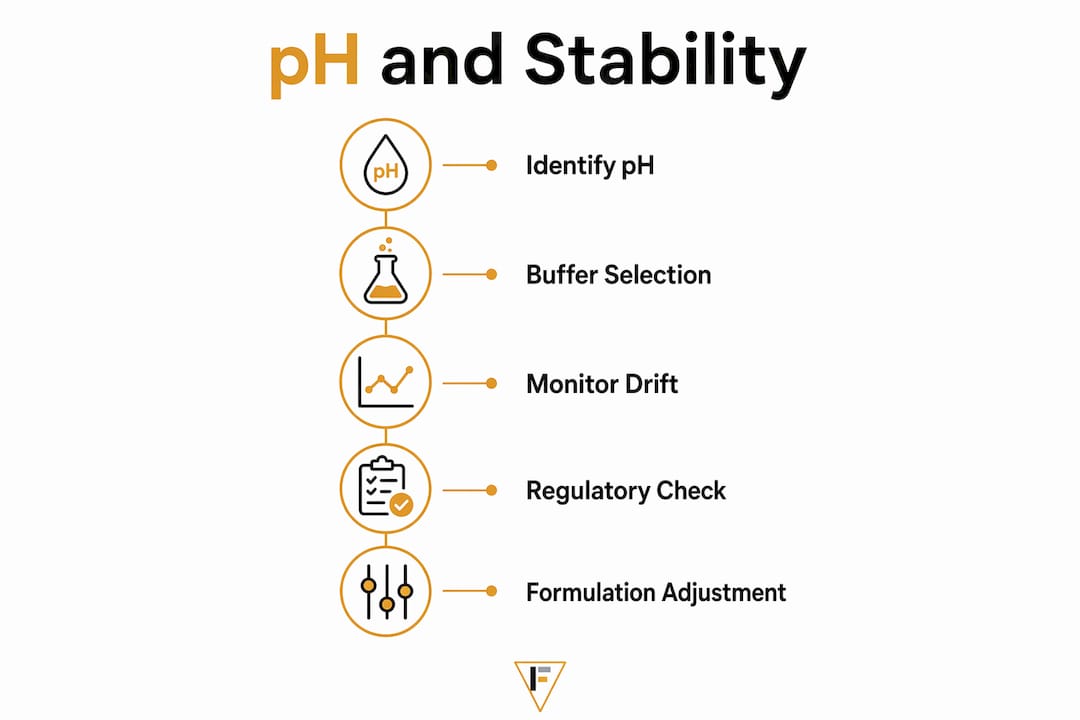
Why pH monitoring is central to pharmaceutical stability testing
FDA guidance and ICH Q1A both classify pH as a stability-indicating critical quality attribute (CQA) that must be measured at defined intervals throughout formal shelf-life studies. That classification is not arbitrary. pH drift during storage is one of the earliest and most reliable signals that something has gone wrong inside the formulation, whether that is chemical degradation of the active ingredient, breakdown of a preservative system, or an incompatibility between excipients.
ICH Q1A requires stress testing to evaluate drug substance susceptibility to hydrolysis across a wide range of pH values when in solution or suspension. This is not just a regulatory formality. The data generated from pH-stress studies identifies the degradation pathways most likely to operate during real storage, informs the choice of stability-indicating analytical methods, and sets the acceptance criteria for pH in the finished product specification.
Instruments and methods used for pH measurement in formulations include:
- Calibrated glass electrode pH meters: the standard for aqueous liquid formulations; require two-point or three-point calibration with NIST-traceable buffers.
- Microelectrodes: used for small-volume samples such as protein formulations where sample volume is limited.
- Indicator dyes and colorimetric methods: useful for rapid screening but lack the precision required for regulatory submissions.
- Solid-state pH sensors: emerging tools for monitoring pH in lyophilized or semi-solid matrices, though not yet universally adopted.
Reasons pH monitoring belongs in every stability protocol:
- Detects chemical degradation before potency loss becomes measurable by assay.
- Signals preservative failure in multi-dose products, where antimicrobial efficacy depends on pH.
- Identifies excipient incompatibilities that shift internal pH and trigger unexpected degradation.
- Provides a leading indicator for physical instability events like precipitation or phase separation.
- Satisfies regulatory requirements under FDA and ICH Q1A for stability-indicating attribute testing.
| Formulation type | Typical pH specification range | Significance of drift |
|---|---|---|
| Parenteral solutions | ±1 unit from target | Indicates hydrolysis or oxidation; patient safety concern |
| Ophthalmic solutions | ±1 unit from target | Comfort and preservative efficacy affected |
| Oral liquids | ±1 unit from target | Signals preservative failure or API degradation |
| Protein/biologic injectables | ±1 unit from target | Aggregation and deamidation risk; narrow tolerance |
| Topical formulations | ±1 unit from target | Affects skin compatibility and preservative function |
pH drift outside the specification range at any stability time point triggers a formal investigation under most regulatory frameworks. A product that passes assay but fails pH specification is still a failing product.
Pro Tip: Run pH measurements at each stability time point before opening the container for other tests. pH can shift during sample handling, particularly for CO2-sensitive formulations, so the first measurement taken is the most representative of actual storage conditions.
How to select pH ranges and buffers that protect your formulation
Every drug molecule has a pH of maximum stability that is unique to its chemical structure. There is no universal target pH, and no buffer system that works for every molecule. The optimal pH window must be determined empirically, typically through forced degradation studies at a series of pH values spanning the physiologically and pharmaceutically relevant range, usually pH 2–10 for small molecules and pH 4–8 for biologics.
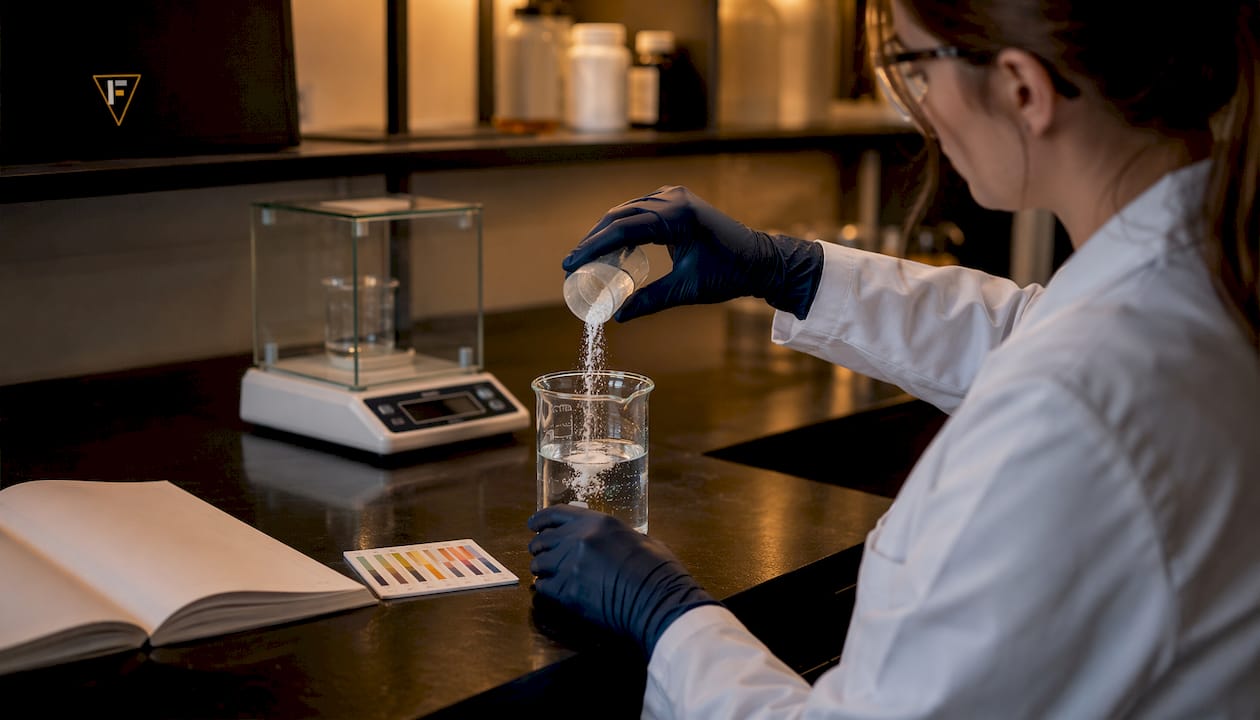
Buffer species common in pharmaceutical formulations each carry trade-offs. Histidine buffers, widely used for monoclonal antibody formulations at pH 5.0–6.5, offer good buffering capacity in the relevant range and contribute some conformational stabilization. Phosphate buffers provide strong buffering at pH 6–8 but can promote aggregation in some proteins and may catalyze specific degradation reactions. Citrate buffers are effective at pH 3–6 but can chelate metal ions in ways that either help or harm stability depending on the molecule. Alternative buffer systems such as arginine/citrate have shown superior performance for freeze-thaw stress in monoclonal antibody formulations compared to conventional phosphate or histidine systems.
Excipient interactions add another layer of complexity. Buffers do not operate in isolation. Excipient selection affects the local pH environment within the formulation matrix, and incompatibilities can shift the internal pH away from the target even when the bulk pH reads correctly. Crospovidone and povidone, for example, are hygroscopic excipients that can absorb moisture and catalyze degradation reactions in solid dosage forms, a mechanism that operates independently of the measured bulk pH.
Key considerations for buffer and excipient selection:
- Match buffer pKa to the target formulation pH, ideally within one unit of the pKa for adequate buffering capacity.
- Evaluate buffer species for direct chemical interactions with the API, particularly for proteins susceptible to histidine oxidation under light stress.
- Screen pH modifiers in solid formulations for hygroscopicity, since hygroscopic pH modifiers can increase water uptake and accelerate hydrolysis, negating the intended stabilization.
- Consider ionic strength effects: buffer concentration affects colloidal stability of proteins and can shift aggregation behavior.
- Test buffers under all anticipated stress conditions, including freeze-thaw, heat, and light, because a buffer that performs well at 25°C may destabilize the formulation during frozen storage.
- Verify that the chosen buffer system is compatible with the container closure system, particularly for parenteral products where leachables can shift pH over time.
Pro Tip: When screening buffers for a new biologic, test at least three buffer species at two concentrations each under temperature and freeze-thaw stress before committing to a formulation. The buffer that looks best at 25°C is not always the winner after three freeze-thaw cycles.
Buffers contribute more than pH control. Research on protein formulations confirms that buffer species influence conformational and colloidal stability directly, meaning the choice of buffer is simultaneously a choice about protein structure preservation. That dual role makes buffer selection one of the highest-leverage decisions in biopharmaceutical formulation development.
What regulatory agencies actually require for pH in stability studies
FDA and ICH do not treat pH as an optional measurement. Under ICH Q1A, pH is explicitly listed among the physical and chemical attributes that must be tested in stability studies for drug products susceptible to change during storage. The FDA stability guidance reinforces this, requiring pH data as part of the finished product specification and as a stability-indicating parameter tracked at each time point in formal studies.
pH qualifies as a CQA under ICH Q8 principles when changes in pH can affect the safety, efficacy, or quality of the drug product. For parenteral and ophthalmic products, that threshold is almost always met. For oral liquids and topical formulations, the case is product-specific but generally straightforward to make given pH's role in preservative function and API stability.
Regulatory expectations and best practices for pH compliance:
- Establish pH acceptance criteria at the development stage, based on forced degradation data, and justify the limits in the regulatory submission.
- Measure pH at every formal stability time point: typically 0, 3, 6, 9, 12, 18, and 24 months for a two-year shelf life study under ICH Q1A long-term conditions.
- Include pH in accelerated stability studies (40°C/75% RH for most products) to detect potential drift that would not appear at long-term conditions within the study duration.
- Investigate any pH drift outside specification immediately; a pH excursion is a potential signal of a broader stability failure that may require batch recall or label change.
- For biologics, document the relationship between pH and aggregation, deamidation, and other CQAs as part of the quality-by-design (QbD) framework described in ICH Q8–Q11.
- Ensure that analytical methods for pH measurement are validated for the specific formulation matrix, particularly for viscous, turbid, or protein-containing solutions where electrode response may differ from aqueous standards.
Failing to monitor pH during stability studies is not just a regulatory gap. A product that reaches the market with an undetected pH drift may have compromised potency, failed preservative function, or increased immunogenicity risk for biologics. Regulatory agencies treat pH excursions in post-market surveillance as serious findings. Formulators who build pH monitoring into stability protocols from the start avoid the far more expensive problem of discovering pH instability after approval.
Advanced pH considerations in modern pharmaceutical formulations
Lyophilized and solid-state formulations present a conceptually different pH challenge. In a dried product, there is no bulk aqueous phase to measure with a standard electrode. What governs stability instead is the microenvironmental pH, the local ionization state within the solid matrix, which can differ substantially from the pH of the solution before drying. Research on solid-state formulations confirms that this microenvironmental pH governs long-term stability in lyophilized products, and that the pH of the pre-lyophilization solution does not reliably predict the microenvironmental pH of the dried cake.
This has practical consequences. A protein formulation buffered to pH 6.0 before lyophilization may experience significant pH shifts during the drying process due to differential crystallization of buffer components. Phosphate buffers are particularly prone to this: disodium hydrogen phosphate crystallizes preferentially during freezing, driving the pH of the remaining solution sharply downward and exposing the protein to acidic conditions during the most mechanically stressful phase of the process. Histidine buffers are more resistant to this freeze-concentration effect, which partly explains their dominance in lyophilized biologic formulations.
In solid-state formulations, the concept of pH as a single measurable value breaks down. What matters is the local ionization environment surrounding each drug molecule within the matrix, and that environment is shaped by the choice of buffer, excipients, and the lyophilization cycle itself.
Small pH changes produce disproportionately large effects on degradation rates because acid/base catalysis is exponential, not linear. A formulation drifting from pH 6.0 to pH 5.0 during storage is not experiencing a modest 17% change in hydrogen ion concentration. It is experiencing a tenfold increase in hydrogen ion concentration, with a corresponding acceleration in acid-catalyzed hydrolysis. For a molecule sitting near the bottom of its V-shaped stability curve, that shift can move it into a region where degradation is orders of magnitude faster.
Novel strategies for managing pH in advanced formulations:
- Use histidine or succinate buffers in lyophilized biologics to minimize freeze-concentration pH shifts during the freezing step.
- Incorporate arginine as a third buffer component in histidine systems to improve freeze-thaw resilience, as arginine/citrate combinations have demonstrated superior aggregate control under stress.
- Apply solid-state NMR or FTIR spectroscopy to characterize the ionization state of drug molecules in lyophilized matrices, providing a proxy for microenvironmental pH.
- Screen pH modifiers in high-drug-load solid dispersions for hygroscopicity before committing to a formulation, since water uptake from a hygroscopic modifier can accelerate hydrolysis even when the nominal pH appears acceptable.
- Use design of experiments (DoE) approaches to map the interaction between pH, buffer species, ionic strength, and excipient composition across the full stability-relevant parameter space.
- For protein formulations, combine pH optimization with conformational stability screening using differential scanning calorimetry or intrinsic fluorescence to identify the pH that simultaneously maximizes thermal stability and minimizes aggregation propensity.
Understanding pH in laboratory solutions and how measurement conditions affect accuracy is equally relevant at the bench level. Electrode calibration, temperature correction, and sample handling all introduce variability that can obscure real pH trends in stability samples if not controlled rigorously.
The intersection of pH with physical stability deserves particular attention for high-concentration protein formulations. At concentrations above 100 mg/mL, the relationship between pH and viscosity becomes significant: small pH changes can shift the net charge of a protein, altering protein-protein interactions and driving viscosity changes that affect both manufacturability and syringeability. A formulation that is chemically stable at a given pH may still fail if the viscosity at that pH makes it impossible to administer through a standard needle gauge.

Key Takeaways
pH is the most consequential single variable in pharmaceutical formulation stability, governing both chemical degradation kinetics and physical behavior across every dosage form.
| Point | Details |
|---|---|
| pH governs degradation kinetics | A one-unit pH shift can increase hydrolysis or oxidation rates by a factor of 10 or more. |
| Optimal pH is molecule-specific | No universal target exists; the pH of maximum stability must be determined empirically for each drug. |
| Buffer choice affects more than pH | Buffer species directly influence protein conformational and colloidal stability, not just pH control. |
| Microenvironmental pH matters in solids | In lyophilized products, the local ionization state within the matrix governs stability, not bulk solution pH. |
| Regulatory monitoring is mandatory | FDA and ICH Q1A require pH measurement at every formal stability time point as a critical quality attribute. |
Formlypro supports pH-driven formulation development
Building a stable formulation means getting pH right from the first prototype, not discovering a drift problem during a stability audit two years later. Formlypro's 8-phase formulation platform guides you through pH optimization as part of a structured development process, from initial degradation pathway mapping through excipient screening, stability protocol design, and regulatory compliance documentation. The platform integrates market analytics and competitor formulation data so you can benchmark your pH strategy against what is actually working in the market, not just what the literature recommends in theory.
Whether you are developing a lyophilized biologic, a high-drug-load solid dispersion, or a parenteral solution, Formlypro gives you the research infrastructure and compliance guidance to make pH decisions with confidence. Explore how the platform supports solubility and stability across every phase of formulation development.