

TL;DR:
- Proper pH optimization in food formulations relies on selecting suitable acidulants, defining pH windows, and validating in real ingredient matrices. Buffer systems paired with acids prevent pH drift during processing and shelf life, ensuring product stability and safety. Continual testing and strict process controls are essential to maintain consistent and reliable pH in production.
pH optimization in food formulations is the process of balancing free acidity, buffering capacity, and ingredient interactions to produce products that are safe, stable, and sensorially consistent. Food formulators who treat pH as a single fixed target rather than a managed system routinely encounter shelf life failures, off-flavors, and microbial risk. Mastering how to optimize pH in food formulations requires selecting the right acidulants, defining workable pH windows, controlling addition sequences, and validating results in real ingredient matrices. The FDA and Codex Alimentarius both recognize acidity regulators as a distinct functional class, separate from acidulants, because their roles in food systems are fundamentally different.
How to optimize pH in food formulations: acidulant and buffer selection
Selecting the right acidulant is the first decision that shapes every downstream pH outcome. Citric acid delivers a clean, citrusy note; malic acid produces a smoother, longer-lasting sourness; lactic acid reads as dairy-like; and fumaric acid, with its low solubility, suits dry mix applications. Each acid carries a distinct flavor signature that becomes part of your product's sensory profile, not just its chemistry.

Acid strength and physical form matter as much as flavor. Liquid acids disperse faster in aqueous systems, while granular or powdered forms suit dry blends where moisture control is critical. Phosphoric acid drives sharp, clean acidity in cola-style beverages; acetic acid dominates in vinegar-based sauces and pickles. Matching the acid to the food matrix prevents formulation defects before they start.
Acidulants add sourness but do not stabilize pH on their own. Pairing an acid with its conjugate salt, such as citric acid with sodium citrate or lactic acid with sodium lactate, creates a buffer system that resists pH drift during processing and storage. This distinction between acidulants and acidity regulators is the most commonly missed concept in early-stage formulation.
| Acidulant | Flavor profile | Acid strength | Solubility | Best matrix fit |
|---|---|---|---|---|
| Citric acid | Clean, citrusy | Medium-high | High | Beverages, confectionery |
| Malic acid | Smooth, lingering | Medium | High | Fruit drinks, gummies |
| Lactic acid | Mild, dairy-like | Low-medium | High (liquid) | Dairy, fermented products |
| Fumaric acid | Tart, dry | High | Low | Dry mixes, baked goods |
| Phosphoric acid | Sharp, clean | High | High (liquid) | Cola beverages |
| Acetic acid | Pungent, vinegar | Medium | Miscible | Sauces, pickles |
Pro Tip: Always specify FCC (Food Chemicals Codex) or USP grade for your acidulants in your ingredient specifications. Grade differences affect purity, heavy metal limits, and batch consistency, all of which affect your final pH readings and regulatory standing.
What target pH windows and buffering strategies ensure stability?
A target pH window is more useful than a single target value because manufacturing always introduces variation. Raw material lots, water mineral content, and processing temperatures all shift pH. Defining system critical parameters like pH bands early prevents late-stage formula failures that cost time and money to correct at pilot scale.
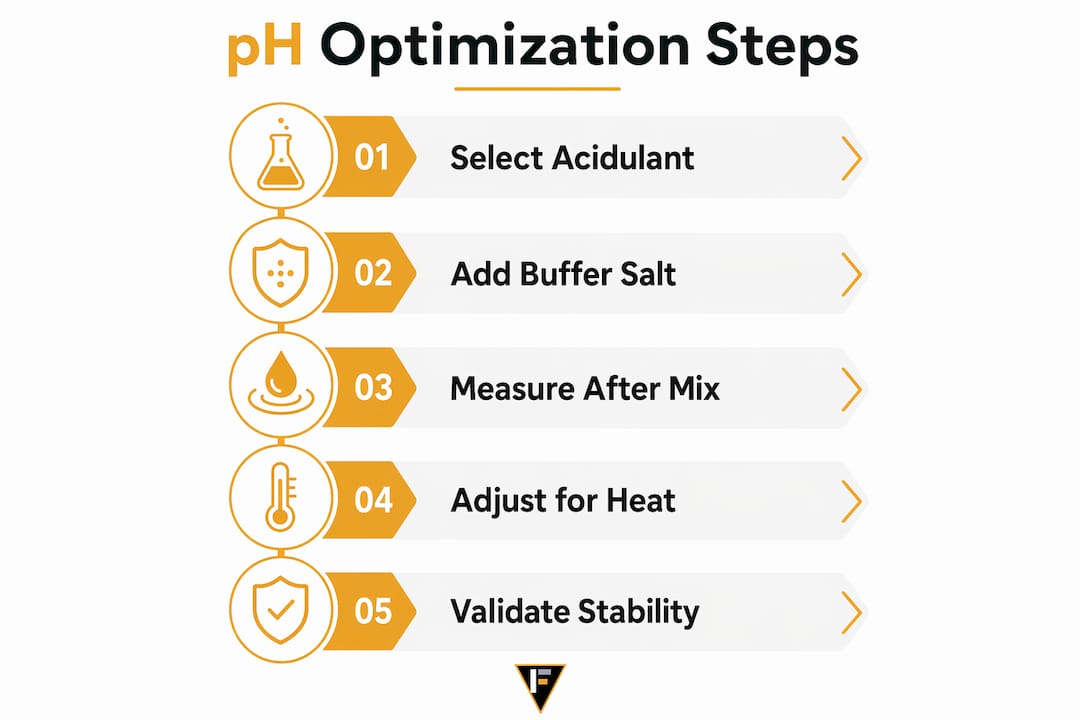
Proteins and minerals in your formula consume acid and change the buffering capacity of the system. A formula that reads pH 3.8 in lab water may settle at pH 4.2 in a real dairy or protein beverage matrix. Validating pH after heat treatment and during shelf life using real ingredient matrices is non-negotiable, because lab water tests underpredict buffering. This single oversight causes more reformulations than any other pH-related error.
Adding more acid does not produce a more stable pH. Excess acid without a buffer partner creates harsh flavor notes and can corrode packaging over time. Buffering separates acidity control from flavor delivery, which is why protein-based systems and fruit systems require completely different buffer strategies.
| Buffer system | Components | Typical pH range | Common applications |
|---|---|---|---|
| Citrate buffer | Citric acid + sodium citrate | 3.0–6.2 | Beverages, jams, dressings |
| Lactate buffer | Lactic acid + sodium lactate | 3.6–4.8 | Dairy, fermented foods |
| Phosphate buffer | Phosphoric acid + sodium phosphate | 2.0–7.2 | Beverages, processed meats |
| Acetate buffer | Acetic acid + sodium acetate | 3.6–5.6 | Pickles, sauces, marinades |
Pro Tip: Always measure pH after mixing is complete and after any heat treatment step. pH equilibrates slowly in high-viscosity or high-protein systems. Reading too early gives a false low value and leads to over-acidification.
How do you safely adjust pH during formulation and production?
Safe pH adjustment in production is a process control problem, not just a chemistry problem. The sequence and method of acid addition determine whether your formula performs consistently across batches.
-
Dilute concentrated acids before addition. Direct addition of concentrated acid creates localized low-pH hotspots that denature proteins, collapse hydrocolloid networks, and cause haze or gelation. Always prepare a working solution at a safe concentration before introducing acid to the batch.
-
Fix your mixing order and document it. Failures in stability often result from incorrect dissolution sequence or failure to disperse stabilizers before acid addition. Hydrocolloids and proteins must be fully hydrated and dispersed before any acid contacts them.
-
Add acid slowly with controlled agitation. Rapid acid addition, even when diluted, creates concentration gradients. Slow, continuous addition under steady mixing distributes acid evenly and prevents localized damage.
-
Set pH hold rules and sampling points. Define the pH range at each process step and document it in your SOP. Sampling at the wrong point in the process gives misleading data and leads to unnecessary corrections.
-
Troubleshoot off-notes by tracing the addition sequence. Metallic or harsh flavors after acidification usually trace back to over-acidification or hotspot damage, not the wrong acid choice. Check your addition rate and mixing energy before switching acidulants.
-
Use a control sheet for every batch. Record acid lot, dilution ratio, addition rate, mixing time, and pH readings at each checkpoint. This documentation catches drift before it becomes a product failure.
Pro Tip: If you use inline dosing for acid addition, calibrate the dosing pump against a gravimetric check at least weekly. Pump drift is a silent source of batch-to-batch pH variation that rarely gets caught until a stability failure occurs.
How to validate and maintain pH stability through real-world testing
Validation is where pH optimization either holds or falls apart. Bench testing in distilled water tells you almost nothing about how your formula will behave in production conditions.
-
Test in your actual ingredient matrix. Measure pH in the full formula, not in a simplified model system. Proteins, minerals, sugars, and gums all affect buffering capacity and will shift your pH reading significantly.
-
Run real-time and accelerated stability studies. Measure pH at production, then at regular intervals through the intended shelf life. Temperature cycling studies reveal whether your buffer system holds under distribution stress.
-
Measure titratable acidity alongside pH. Most developers confuse pH and titratable acidity; pH relates to free acidity impacting sharpness, while TA reflects total acid affecting flavor longevity. A product can have a stable pH reading but still taste increasingly sour over time if TA is rising. Tracking both gives you the full picture.
-
Account for packaging interactions. Metal ions from can linings, oxygen ingress through flexible packaging, and headspace gas composition all affect pH over time. Your food safety validation plan should include packaging as a variable, not an afterthought.
-
Document every change and its pH impact. Ingredient supplier changes, water source shifts, and process equipment upgrades all affect pH. A change control log tied to your pH records is your first line of defense against unexplained stability failures.
-
For powder formulations, validate under reconstitution conditions. In powder bases, acidulant and carrier selection affects moisture absorption, caking, and reconstitution behavior. Validate pH in the reconstituted product, not just the dry blend, and test across the full range of water temperatures your consumer will use.
Connecting your validation data to your formulation risk reduction process creates a feedback loop that catches pH drift before it reaches market. Formulators who treat validation as a one-time event rather than an ongoing practice are the ones who face costly reformulations.
Key Takeaways
Controlling pH in food formulations requires matching acidulants to the food matrix, building a buffer system that resists drift, and validating results in real ingredient conditions rather than lab water.
| Point | Details |
|---|---|
| Match acidulant to matrix | Choose citric, malic, lactic, or fumaric acid based on flavor profile and physical form requirements. |
| Buffer, don't just acidify | Pair every acid with its conjugate salt to resist pH drift during processing and storage. |
| Define a pH window, not a point | Set an acceptable pH range to account for raw material and process variation across batches. |
| Control addition sequence | Dilute acids before addition and disperse stabilizers first to prevent localized damage and defects. |
| Validate in real conditions | Measure pH and titratable acidity in the full formula matrix across the full shelf life, not in water. |
Why pH optimization is harder than most formulators expect
Most formulators I've worked with treat pH as a finishing step. They build the formula, run a bench trial, check the pH at the end, and add a splash of citric acid to hit the target. That approach works exactly once, and then it fails at pilot scale when the protein load is higher, the water is harder, or the mixing time is shorter.
The real insight that changed how I approach pH work is this: pH is a consequence of your entire formula, not a variable you control directly. Every ingredient you add is either consuming acid, releasing minerals, or changing the buffering capacity of the system. When you understand that, you stop chasing a number and start designing a system.
The other thing most guides skip is the relationship between pH and titratable acidity. I've seen products with a perfectly stable pH reading that tasted progressively more sour over a six-month shelf life study. The pH meter said everything was fine. The TA data told a completely different story. Tracking both from day one is the difference between a product that passes sensory panels at launch and one that still passes at month nine.
The formulation pitfalls that kill products almost always trace back to skipping the systematic work: no defined pH window, no buffer strategy, no real-matrix validation. Following current 2026 best practices on buffer selection and change control reduces reformulations and builds the kind of product reliability that earns repeat business.
— Ben
Formlypro supports your pH formulation work
Getting pH right across every batch, every supplier change, and every new market requires more than a good bench protocol. It requires a system.
Formlypro gives food formulators and product developers the infrastructure to build that system. The platform's 8-phase product development plan walks you through formulation, prototyping, and compliance in sequence, so pH decisions are made with full ingredient and process context from the start. The ingredient selection tools, compliance guidance, and market-ready formulation support help you move from concept to production without the reformulation cycles that eat time and budget. If you're building a new product or tightening an existing formula, Formlypro is built for exactly that work.
FAQ
What is the difference between pH and titratable acidity?
pH measures free hydrogen ions and reflects the sharpness of acidity at a given moment. Titratable acidity measures total acid in the system and predicts how flavor will develop over shelf life.
Which acidulant works best for beverages?
Citric acid is the most common choice for beverages because of its clean flavor, high solubility, and broad regulatory acceptance. Malic acid suits fruit-forward drinks where a longer-lasting sour note is desirable.
Why does my formula pH shift after heat treatment?
Heat accelerates acid-base equilibration and can drive off volatile acids or alter protein buffering. Always measure pH after heat treatment, not before, to get an accurate reading of your final product.
How do I prevent pH drift during shelf life?
Pair your acidulant with a conjugate buffering salt, such as sodium citrate with citric acid, to resist pH change from dilution, ingredient variation, or storage temperature shifts.
Do I need HACCP controls for pH management in production?
Yes. pH is a critical control point for microbial safety in many food categories. HACCP compliance for pH requires defined critical limits, monitoring procedures, and corrective actions documented in your food safety plan.