

TL;DR:
- Effective formulation cost reduction relies on implementing systems approaches like QbD and DoE to minimize waste and experimentation expenses. Strategic ingredient benchmarking and packaging harmonization can significantly lower procurement and packaging costs, while upfront preservative and stability planning reduces costly reformulations. Optimizing batch size, freight logistics, and leveraging analytics further streamline development, balancing cost savings with product integrity.
Manufacturers and brand developers know that formulation costs are deceptively complex. The raw material bill is only part of the picture. Every inefficient experiment, unstable batch, or last-minute packaging swap compounds into serious production expense. Getting the cost-saving tactics for formulation right means treating it as a systems problem, not a shopping problem. The goal is protecting quality, maintaining compliance, and building a product worth selling, all while spending less to get there. This article breaks down the tactics that deliver real, repeatable savings.
Table of Contents
- Key takeaways
- 1. Apply quality by design from the start
- 2. Benchmark ingredients before you source them
- 3. Simplify your formula structure deliberately
- 4. Replace OFAT experiments with design of experiments
- 5. Harmonize and protect your packaging
- 6. Build preservative and stability plans before prototyping
- 7. Optimize production scale and batch size planning
- 8. Outsource freight consolidation strategically
- 9. Use formulation analytics to cut R&D cycle time
- My take on balancing cost and brand integrity
- How Formlypro helps you build cost-efficient formulations
- FAQ
Key takeaways
| Point | Details |
|---|---|
| QbD and PAT cut waste | Implementing these frameworks reduces batch failures by 20 to 40%, cutting rework and lab costs substantially. |
| Packaging drives major savings | Switching to recyclable PET and harmonizing components across SKUs can reduce packaging spend by up to 30%. |
| DoE beats trial and error | Design of Experiments explores multiple variables at once, slashing R&D cycle time and cost significantly. |
| Sourcing strategy matters | Using benchmarked, well-characterized ingredients with backup suppliers protects against price volatility. |
| Logistics savings add up fast | Outsourcing freight consolidation alone can reduce landed costs by 10 to 15%. |
1. Apply quality by design from the start
Quality by Design (QbD) is one of the most proven cost-saving tactics for formulation, yet most brands treat it as a regulatory checkbox rather than a budget tool. That framing is expensive. QbD builds product understanding into the design phase rather than discovering problems during manufacturing. The practical result is fewer surprises downstream.
Here is what QbD delivers in concrete terms:
- Reduced trial-and-error cycles by defining the design space before lab work begins
- Faster scale-up with fewer deviations because critical process parameters are already known
- Batch failure reduction of 20 to 40%, directly cutting rework costs
- Smoother regulatory submissions because the dossier reflects systematic process understanding
Process Analytical Technologies (PAT) layer on top of QbD by enabling real-time monitoring during manufacturing. Real-time release testing replaces end-stage lab work, and QC lab time can fall by 40 to 60% when PAT is fully integrated. The upfront investment is real, and the organizational change required is not trivial. Most teams resist it early.
Pro Tip: Start PAT and QbD implementation on your highest-cost or highest-risk production line, not across the board. An iterative QbD rollout focused on your biggest cost drivers delivers faster ROI and builds internal confidence before wider adoption.
2. Benchmark ingredients before you source them
Ingredient selection is where most formulation cost reduction methods fail quietly. Brands either copy market leaders without understanding why those formulas work, or they grab the cheapest raw material without modeling long-term stability risk. Both paths lead to reformulation expense.
Effective ingredient benchmarking means understanding what competitors are using, why those ingredients perform, and whether a better-value alternative exists without sacrificing stability or consumer experience. The benchmarking goal is to inspire defensible formulations, not to replicate someone else's formula cheaply.
Practical sourcing principles for budget-friendly formulation strategies:
- Prioritize well-characterized ingredients with established safety and stability data to reduce testing burden
- Qualify at least two suppliers for every key raw material to maintain leverage and reduce risk from supply disruption
- Require full supplier documentation including certificates of analysis (COAs), safety data sheets, and origin documentation before committing to volume
- Use substitution strategically when price volatility hits, but test substitutes under realistic conditions before committing to production scale
Benchmarking guides innovation toward differentiated, defensible formulas rather than simply replicating the cheapest version on the market. That distinction protects both cost and brand equity simultaneously.
3. Simplify your formula structure deliberately
There is a direct correlation between formula complexity and R&D cost. Every additional active ingredient adds testing requirements, stability interactions, and regulatory documentation. Lean formula design is not about making inferior products. It is about focusing on what actually drives performance.
Fewer actives with a strong base formulation reduces R&D complexity and stability risk in parallel. The brands that scale most efficiently are often the ones with tightly focused ingredient lists built around a well-tested core. That core can then be adapted across SKUs without starting from scratch each time.

Standardizing your core formulation architecture across multiple products means shared stability data, consolidated testing, and predictable manufacturing behavior. A single stabilizer system that works across your entire line costs far less to validate than five separate approaches across five products.
4. Replace OFAT experiments with design of experiments
One of the most effective formulation cost reduction methods in modern R&D is replacing the traditional "one factor at a time" (OFAT) approach with Design of Experiments (DoE). OFAT feels logical but it is systematically inefficient. You test one variable, get a result, move to the next. You never see how variables interact.
DoE investigates multiple factors simultaneously, identifying interaction effects that OFAT would miss entirely, in a fraction of the experimental runs. The result is a complete understanding of the formulation space in fewer trials, with less material used and less lab time consumed.
The comparison speaks for itself:
| Approach | Variables explored per experiment | Interaction effects detected | Relative cost |
|---|---|---|---|
| OFAT | 1 | None | High |
| Full factorial DoE | Multiple | Yes | Moderate |
| Fractional factorial DoE | Multiple | Partial | Lower |
For any formulation with three or more variables affecting quality attributes, DoE is the smarter investment. Factor in the cost of reformulation after discovering an interaction effect at scale and the math becomes obvious quickly.
5. Harmonize and protect your packaging
Packaging often costs more than the formula inside it. That fact surprises many developers who focus heavily on ingredient budgets while letting packaging costs drift. Switching to recyclable PET and reducing decoration complexity can cut packaging spend by up to 30%, and the savings scale with volume.
Harmonizing packaging components across your SKU range is one of the highest-leverage effective formulation budget tips available. When you use the same closure, the same bottle, or the same outer carton format across multiple products, you consolidate your minimum order quantities (MOQs), simplify procurement, and reduce warehousing complexity.
Pro Tip: Evaluate packaging cost in full lifecycle terms. A cheaper package that allows formula degradation, increases returns, or triggers a reformulation is not actually cheaper. Protective packaging choices reduce product loss and avoid the downstream cost of quality failures.
The table below shows how decoration and material choices affect packaging unit cost:
| Packaging choice | Relative unit cost | Recyclability | Decoration complexity |
|---|---|---|---|
| PET with minimal labeling | Low | High | Low |
| PET with full-wrap shrink | Moderate | Moderate | High |
| Glass with screen print | High | Moderate | High |
| HDPE with heat transfer | Moderate | Low | Moderate |
6. Build preservative and stability plans before prototyping
One of the most expensive mistakes in product development is treating preservative efficacy testing and stability studies as afterthoughts. When a stability failure occurs post-prototype, the reformulation cycle begins again from scratch, costing time, materials, and potentially regulatory work.
Planning your preservation system and stability architecture at the formulation design stage is a core best practice for cost-efficient formulation. Select a preservative system with known broad-spectrum efficacy across your pH range. Map potential incompatibilities before they emerge in the lab. A few hours of upfront planning eliminates weeks of reactive reformulation.
This is especially important if you are working across multiple SKUs. A single validated preservation system that covers your full product line is worth its weight in reformulation avoided.
7. Optimize production scale and batch size planning
Batch size tiers directly influence unit cost outcomes, and most brands underestimate how much production scale affects their per-unit formulation economics. Fixed overhead costs spread across larger batches. Raw material pricing improves at volume thresholds. Manufacturing efficiency increases when changeover frequency drops.
This does not mean running the largest possible batch from day one. The smarter approach is modeling your cost curve across batch size scenarios before committing to a production run. Understand at what volume your unit economics become defensible for your price point.
Pro Tip: Consolidate formulations wherever possible to share batch processes. Products that share a base formula can often be manufactured in sequence with minimal changeover, spreading setup costs across a larger effective volume.
8. Outsource freight consolidation strategically
Freight is a category where brands reliably leave savings on the table. Outsourcing freight consolidation to a specialist reduces landed costs by 10 to 15% in most cases, with the savings driven by full container loads, regional consolidation hubs, and volume leverage the brand could not achieve independently.
The cost allocation across a typical body care product breaks down roughly as follows, and understanding it reframes where to focus cost efforts:
| Cost category | Approximate share of total landed cost |
|---|---|
| Formula and raw materials | 20 to 35% |
| Packaging components | 30 to 45% |
| Filling and manufacturing | 15 to 20% |
| Freight and logistics | 10 to 20% |
Freight consolidation requires careful risk management, particularly around damage in transit. The packaging durability decisions you make upstream directly affect your freight cost profile. Fragile packaging that increases breakage rates during shipping erases any freight savings quickly.
9. Use formulation analytics to cut R&D cycle time
Data-driven development is one of the most underutilized affordable formulation techniques for brands that want to reduce development time without sacrificing quality. Most teams still rely on institutional memory and spreadsheets to track formula iterations. That approach loses information, slows decisions, and repeats experiments that should be built upon.
Formulation analytics surfaces patterns across your formulation history, flags redundant testing, and identifies which variables most consistently drive quality outcomes. The result is fewer experimental cycles and faster decisions about which formulations are worth advancing to prototype.
Brands using analytics-driven formulation report significantly faster R&D cycles, with better knowledge retention across team changes. For manufacturers running multiple development projects in parallel, that institutional knowledge becomes a direct cost asset.
My take on balancing cost and brand integrity
I have seen brands cut costs in ways that looked brilliant on a spreadsheet and catastrophic in the market. The pattern is almost always the same. A team under budget pressure makes a series of individually defensible decisions. A cheaper ingredient here, a lighter package there, a shorter stability study because the timeline is tight. Each decision seems reasonable in isolation. Together, they produce a product that underperforms, fails on shelf, or triggers returns.
What I have learned is that saving money in formulation requires treating cost as a systems variable, not a line-item problem. The brands that do this well invest strategically upfront in design, sourcing infrastructure, and data tools. They spend more in the design phase deliberately, because they have calculated what a reformulation or a product recall actually costs. That framing changes every decision.
Reducing formulation risks and reducing formulation costs are not in opposition. They are the same goal approached from different angles. When your formulation is stable, well-characterized, and built on validated inputs, it is also cheaper to manufacture at scale. Quality and cost efficiency converge at the same point: systematic design.
— Ben
How Formlypro helps you build cost-efficient formulations
Formlypro is built for exactly the kind of systematic, data-driven formulation development this article describes. The platform gives manufacturers and brand developers access to research-backed formulation support, competitive benchmarking, and market analytics in one place. You can see what ingredients competitors are using, assess which products are gaining traction, and build formulations with full compliance guidance from the start.
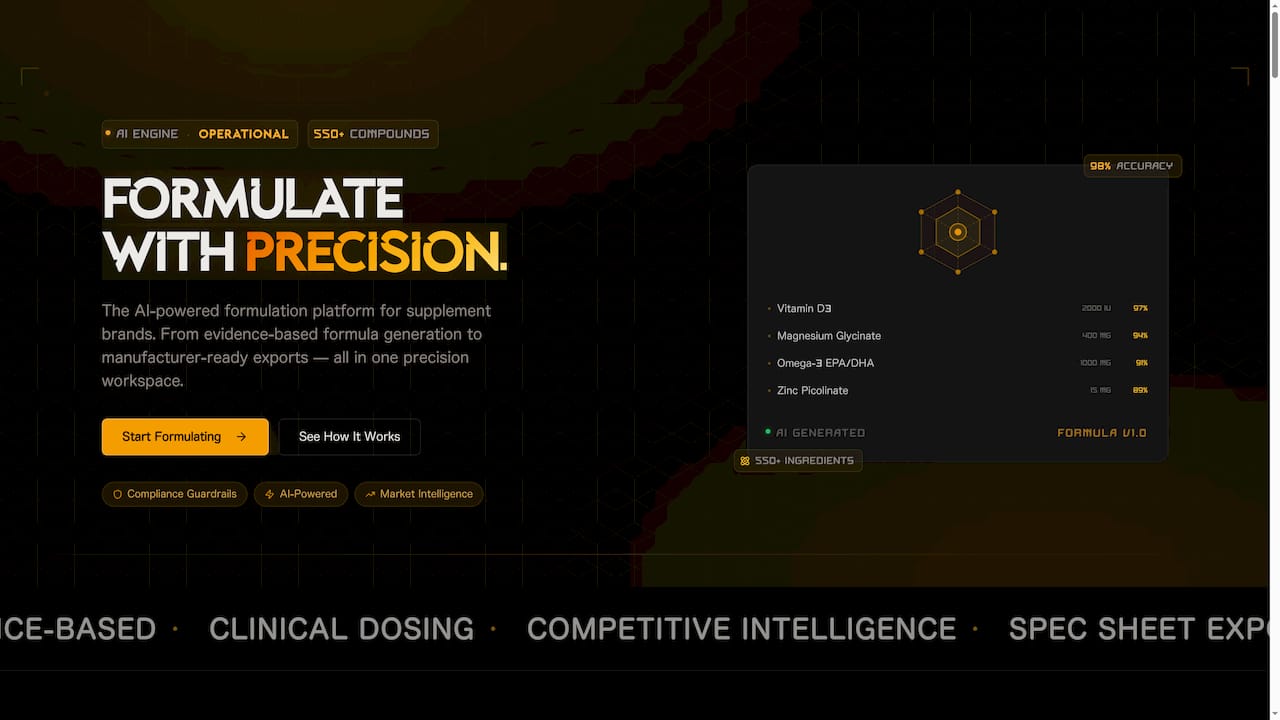
The 8-phase development plan inside Formlypro takes your product from initial concept through formulation, prototyping, compliance, and production, with analytics feeding every decision. The packaging section with AI mockup design means you can evaluate packaging concepts without external agency costs. If you are serious about cutting development expense without cutting corners, explore Formlypro and see how the platform supports smarter, leaner product development from day one.
FAQ
What are the most effective cost-saving tactics for formulation?
The most effective tactics combine QbD design frameworks, lean ingredient selection, DoE experimentation, packaging harmonization, and freight consolidation. Each addresses a different cost driver, and applying them together produces compounding savings across the full product cost structure.
How much can packaging changes reduce formulation costs?
Switching to recyclable PET and reducing decoration steps can save up to 30% on packaging spend, which directly lowers total product cost since packaging often represents 30 to 45% of landed cost.
Does DoE actually reduce R&D costs?
Yes. Design of Experiments identifies variable interactions in fewer experimental runs than OFAT, reducing material usage, lab time, and reformulation risk. For formulations with multiple interacting variables, the cost reduction is substantial.
How does QbD reduce formulation expenses?
QbD reduces expenses by catching design problems early, before they become manufacturing failures. Batch failures drop by 20 to 40% with QbD adoption, and rework costs fall proportionally.
Can freight optimization really impact formulation budgets?
Freight consolidation reduces landed costs by 10 to 15%, and since freight can represent up to 20% of total product cost, those savings are material. The key is pairing freight strategy with durable packaging choices that prevent damage losses from erasing the gains.