

Why ingredient compatibility is the foundation of every successful formula
Ingredient compatibility determines whether a product works, stays stable, and reaches consumers safely. When ingredients coexist without harmful physical or chemical interactions, the formula holds together across its entire shelf life. When they don't, you get phase separation, discoloration, potency loss, and products that fail before they ever reach a store shelf.
Incompatibility issues often surface during storage, shipping, or thermal stress, not during initial bench testing. That gap between early development and real-world conditions is exactly where formulation failures hide. The FDA's current Good Manufacturing Practices (cGMP) and the ICH Q8 guidelines both require documented understanding of how formulation components interact, making compatibility validation a regulatory requirement, not just a best practice.
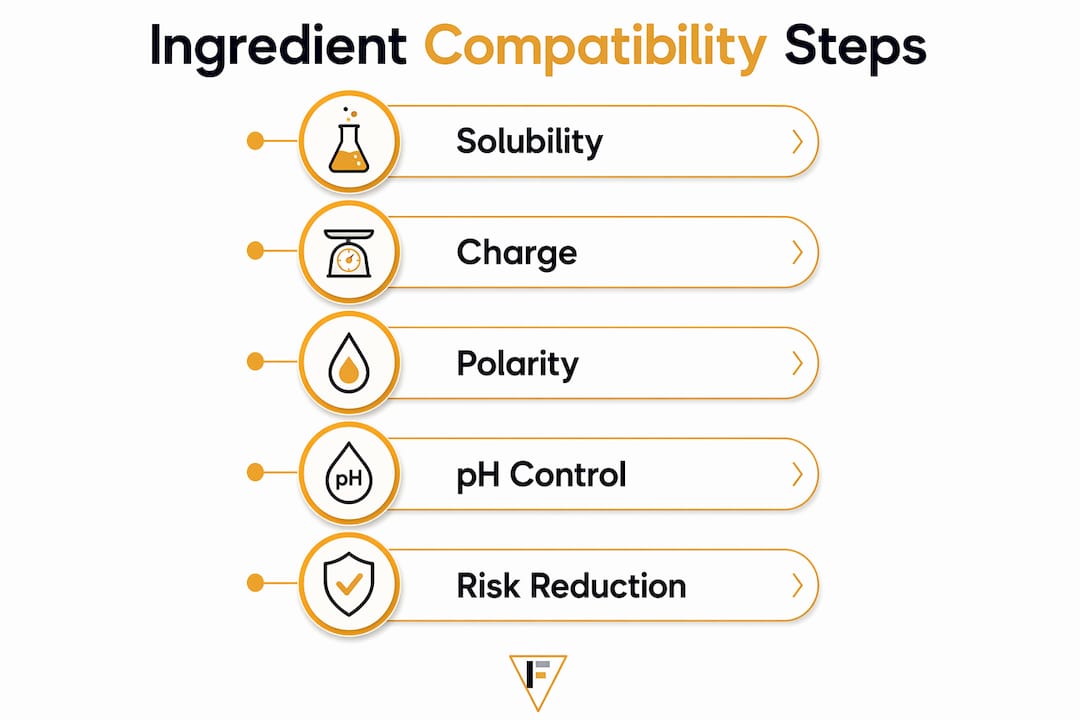
The core pillars that predict whether ingredients will work together are solubility, charge, polarity, and pH. Each one governs a different dimension of how ingredients behave in a formula base. Getting all four right is what separates a product that performs consistently from one that fails six months post-launch.
Why ingredient compatibility matters for product success:
- Prevents physical defects like separation, clumping, and crystallization
- Maintains active ingredient potency throughout shelf life
- Protects preservative efficacy against microbial contamination
- Reduces irritation risk from unintended chemical reactions
- Satisfies FDA cGMP and ICH Q8 regulatory documentation requirements
- Avoids costly reformulation cycles that can run into thousands of dollars per incident
- Preserves brand credibility by delivering consistent texture, color, and performance
Table of Contents
- How chemical and physical interactions break formulations
- What solubility, charge, polarity, and pH actually control
- Flavor, botanicals, probiotics, and dosage: where real-world formulation gets complicated
- How to reduce ingredient compatibility risks before they cost you
- How Formlypro supports ingredient compatibility management
- What ingredient incompatibility actually does to consumers
- Key Takeaways
- Formlypro gives formulators a research-backed path from concept to compliant product
How chemical and physical interactions break formulations
Chemical and physical incompatibilities are distinct problems, but both destroy product integrity. Understanding which mechanism is at work tells you how to fix it.

Chemical interactions alter the molecular structure of one or more ingredients. The most common degradation pathways include hydrolysis, oxidation, the Maillard reaction, chelation, and pH-driven degradation. The Maillard reaction is a textbook example: ingredients containing primary or secondary amine groups react with reducing sugars like lactose, forming degradants that reduce potency and can introduce toxicity. Oxidation cascades are equally destructive. Ascorbic acid combined with trace metal ions can generate free radicals instead of neutralizing them, turning an antioxidant into an oxidative stressor.
Physical incompatibilities don't change molecular structure but still wreck the product. Phase separation, precipitation, flocculation, and clumping all fall into this category. Mixing positively and negatively charged polymers, for instance, produces visible flocculation immediately. Emulsions break when an emulsifier's capacity is overwhelmed by certain botanical oils or when pH shifts introduced by actives weaken the emulsifier system.
| Interaction Type | Mechanism | Effect on Product | Example |
|---|---|---|---|
| Hydrolysis | Water cleaves molecular bonds | Potency loss, degradant formation | Peptide bonds broken at low pH |
| Oxidation | Electron transfer degrades actives | Reduced efficacy, free radical generation | Ascorbic acid + metal ions |
| Maillard reaction | Amine groups react with reducing sugars | Discoloration, potency loss | Drug + lactose excipient |
| Chelation | Metal ions bind to active molecules | Inactivation of active | Copper peptides + ascorbic acid |
| Phase separation | Immiscible phases disengage | Visible separation, texture failure | Oil-water emulsion breakdown |
| Flocculation | Charge neutralization causes clumping | Visual instability, uneven dosing | Cationic + anionic polymer mix |
| Precipitation | Solubility limit exceeded | Gritty texture, potency loss | Active crystallizing out of solution |
Key incompatibility mechanisms to screen for early:
- Oxidation sensitivity of vitamins and antioxidants
- Charge conflicts between cationic and anionic polymers
- pH-driven hydrolysis of peptides and proteins
- Emulsifier overload from high-concentration botanical oils
- Moisture-accelerated degradation in powder blends
What solubility, charge, polarity, and pH actually control
These four properties are the core compatibility pillars that predict whether a formula will hold together or fall apart. Each one operates differently, and they interact with each other constantly.
Solubility is the first checkpoint. It determines which phase an ingredient belongs in and whether it will disperse properly. Solubility mismatches cause precipitation, crystallization, or potency loss when ingredients are added to the wrong phase or without the correct solubilizer. A water-soluble active added to an oil phase simply won't disperse, and the resulting gritty texture or floating particles signal a fundamental formulation error.
Charge governs texture, viscosity, and preservation. Ingredients carry positive, negative, or neutral charges, and when incompatible charges meet, you get thickening failure, coagulation, or weakened preservative performance. This is why formulators must map the ionic character of every ingredient before combining them.

Polarity is the variable most often overlooked in oil-phase formulation. Not all oils behave the same way. High-polarity oils blend differently from low-polarity ones, and blending oils with dramatically different polarities can destabilize a balm or butter. An oil-soluble active requires a carrier oil with compatible polarity to dissolve and remain stable throughout shelf life.
pH controls both ingredient performance and preservative efficacy. L-ascorbic acid requires a pH below 3.5 for effective skin penetration. Retinol is most stable at a slightly acidic to near-neutral pH range. Niacinamide performs best between pH 5.0 and 7.0. Forcing two actives with dramatically different pH requirements into the same formula means at least one will underperform, and the preservative system may fail entirely if the formula drifts outside its effective range.
Pro Tip: Map every active's optimal pH range, oxidation sensitivity, and ionic charge before writing a formula brief. This pre-screen alone eliminates the most common causes of failed bench trials.
Actionable insights for formulators:
- Confirm solubility before assigning an ingredient to a phase
- Check charge compatibility between polymers, actives, and preservatives
- Match oil-phase polarity when blending carrier oils with oil-soluble actives
- Set and verify target pH before adding pH-sensitive actives
- Recheck pH after every ingredient addition during development
Flavor, botanicals, probiotics, and dosage: where real-world formulation gets complicated
Practical formulation challenges go well beyond basic chemistry. Flavor compatibility, botanical variability, probiotic viability, and dosage concentration each introduce a layer of complexity that bench-scale testing doesn't always catch.
Flavor compatibility is a persistent issue in supplement and food formulations. Certain active ingredients carry bitter, metallic, or astringent notes that interact with flavor systems, producing off-flavors that worsen over shelf life. Masking agents can help, but they introduce their own compatibility variables, particularly around pH and emulsification.
Botanical extracts vary widely in composition, pH, and stability across batches and suppliers. Some contain naturally occurring acids or enzymes that interfere with emulsifiers or preservatives. Others discolor or oxidize under heat or light exposure. A botanical that passes compatibility testing with one supplier's material may behave differently with the next batch, which is why batch testing and sourcing consistency are non-negotiable for botanical-heavy formulas.
Probiotics present unique viability constraints. They are sensitive to moisture, heat, pH, and the presence of antimicrobial ingredients. A preservative system that protects the rest of the formula may reduce probiotic counts below the labeled claim. Encapsulation and careful moisture control are the standard approaches, but both require compatibility validation with the rest of the formula matrix.
Dosage concentration is where many formulators underestimate risk. Stacking five actives at maximum concentration can cause irritation even when each ingredient is individually safe. The interaction between high-concentration actives, particularly acids and retinoids, can overwhelm the skin barrier and generate consumer complaints that look like a safety failure rather than a formulation one.
Separating incompatible actives across products instead of forcing combinations into one formula is often the best practice for regimen success. When two actives truly can't coexist, designing them as separate steps in a routine turns a chemistry limitation into a commercial advantage: more SKUs, higher average order value, and a built-in cross-selling story.
Critical points for managing practical formulation hurdles:
- Test botanical materials from each new supplier batch before production
- Validate probiotic viability within the complete formula matrix, not in isolation
- Use encapsulation for actives that conflict with probiotic-friendly pH ranges
- Assess flavor interactions during accelerated stability testing, not just at day zero
- Cap active concentrations at levels that balance efficacy with irritation risk
How to reduce ingredient compatibility risks before they cost you
The most expensive compatibility failures are the ones discovered after scale-up. A formula that looks stable at bench scale can fail commercially because larger batches introduce variables that small-scale testing never encounters: differences in heating uniformity, mixing efficiency, and ingredient addition timing all influence how ingredients interact.
Pilot batches are the single most effective risk-reduction tool. Running a pilot batch before full-scale production lets you validate stability under real manufacturing conditions. Bench-top stability tests must be complemented by accelerated stability protocols to catch long-term incompatibility effects that only emerge over time.
The most common formulation mistakes tied to compatibility failures include skipping a pre-screen of ingredient interactions, adding ingredients in the wrong order, and assuming that a formula that worked at small scale will behave identically at commercial volume. Order of ingredient addition and temperature control during manufacturing critically impact both compatibility and stability. Adding a heat-sensitive active before the batch has cooled, or introducing a charged polymer before the pH is set, creates problems that are difficult to diagnose after the fact.
Advanced formulation techniques like encapsulation, pH buffering, and derivative selection can resolve many ingredient pairings that appear incompatible at first. Encapsulating one active inside a lipid or polymer shell allows it to coexist with a chemically incompatible partner by delaying release until application. Many "incompatible" pairings are actually solvable challenges, not dead ends. For early compatibility testing in pharmaceutical and biopharma contexts, systematic pre-screening frameworks reduce the number of failed trials significantly.
Regulatory compliance and documentation practices are part of risk management, not just paperwork. Detailed batch records, processing parameters, and stability data create the audit trail that protects brands during retail onboarding and regulatory review.
Risk reduction strategies for formulators:
- Run a compatibility pre-screen before finalizing any formula brief
- Control ingredient addition order and temperature at every manufacturing stage
- Conduct accelerated stability testing alongside real-time studies
- Use encapsulation or pH buffering when actives have conflicting requirements
- Document all processing parameters and stability results for every batch
- Validate formulation scalability with pilot runs before committing to full production
Pro Tip: When two actives require dramatically different pH environments, check whether a stabilized derivative of one active can tolerate the other's optimal pH range before concluding the combination is impossible.
How Formlypro supports ingredient compatibility management
Managing ingredient compatibility across supplements, cosmetics, skincare, and food formulations requires more than a spreadsheet. Formlypro is built specifically for formulators and manufacturers who need research-backed guidance at every stage of product development.
Formlypro's 8-phase formulation process addresses compatibility from ideation through production. The platform integrates ingredient interaction data, regulatory compliance checks aligned with FDA cGMP and ICH Q8 requirements, and pilot batch guidance so formulators can catch incompatibility issues before they become costly production failures. The excipient selection process is supported with sourcing and early compatibility testing strategies built directly into the workflow.
Beyond formulation, Formlypro includes market research and competitor analysis tools that show which products are selling and what formulations competitors are using. The platform's packaging section, with an AI mockup designer, also addresses packaging compatibility with ingredient stability, since improper packaging leads to degradation from light, oxygen, and moisture exposure.
Formlypro capabilities relevant to compatibility management:
- Ingredient interaction database integrated into the formulation workflow
- FDA cGMP and ICH Q8 compliance checks built into each development phase
- Pilot batch guidance and stability validation support
- Packaging design with AI mockup tools that account for ingredient stability
- Market research and competitor formulation analysis
- Full compliance documentation and audit trail generation
- Ingredient selection framework covering safety, performance, and regulatory criteria
What ingredient incompatibility actually does to consumers
Incompatibility doesn't just affect product aesthetics. It creates real safety risks for the people using the product. When a preservative system fails because an active ingredient has shifted the formula's pH outside the preservative's effective range, the product becomes susceptible to microbial contamination. Consumers using a contaminated product face infection risk, particularly with eye creams, wound-adjacent skincare, or ingestible supplements.
Chemical degradants formed through incompatibility reactions can be more harmful than the original ingredients. The Maillard reaction, for example, produces compounds that may introduce toxicity in pharmaceutical dosage forms. Oxidation byproducts from destabilized antioxidants can increase oxidative stress rather than reducing it. These outcomes are not theoretical. They are the reason FDA cGMP and ICH Q8 guidelines require documented compatibility studies as part of the development process.
Irritation from incompatible active combinations is the most visible consumer-facing consequence. Stacking acids, retinoids, and exfoliants at high concentrations without compatibility validation produces barrier damage that shows up as redness, peeling, and sensitivity. Consumers attribute this to the product being "too strong" or "not right for my skin," but the underlying cause is a formulation that was never validated for the interaction effects between its actives. Returns, negative reviews, and brand damage follow.
Products that change color, separate, or develop off-odors after purchase signal incompatibility to consumers even when they don't know the chemistry behind it. That loss of trust is difficult to recover from, particularly for emerging brands where each product launch carries significant reputational weight.
Key Takeaways
Ingredient compatibility is the single most critical variable in whether a formulation delivers on its claims, stays safe, and survives scale-up intact.
| Point | Details |
|---|---|
| Compatibility drives stability and safety | Incompatible ingredients cause separation, potency loss, preservative failure, and consumer health risks. |
| Four pillars govern compatibility | Solubility, charge, polarity, and pH each control a different dimension of how ingredients behave together. |
| Pilot batches catch what bench tests miss | Scale-up introduces variables that small-batch testing never encounters; accelerated stability protocols are required. |
| Advanced techniques resolve most conflicts | Encapsulation, pH buffering, and derivative selection make many "incompatible" pairings workable. |
| Formlypro guides compatibility at every stage | Formlypro's 8-phase process integrates interaction data, FDA cGMP compliance checks, and pilot batch guidance into one platform. |
Formlypro gives formulators a research-backed path from concept to compliant product
Most formulation platforms stop at ingredient lists. Formlypro goes further, giving you the compatibility intelligence, regulatory guidance, and production validation tools that prevent the reformulation cycles that cost emerging brands thousands of dollars per incident.
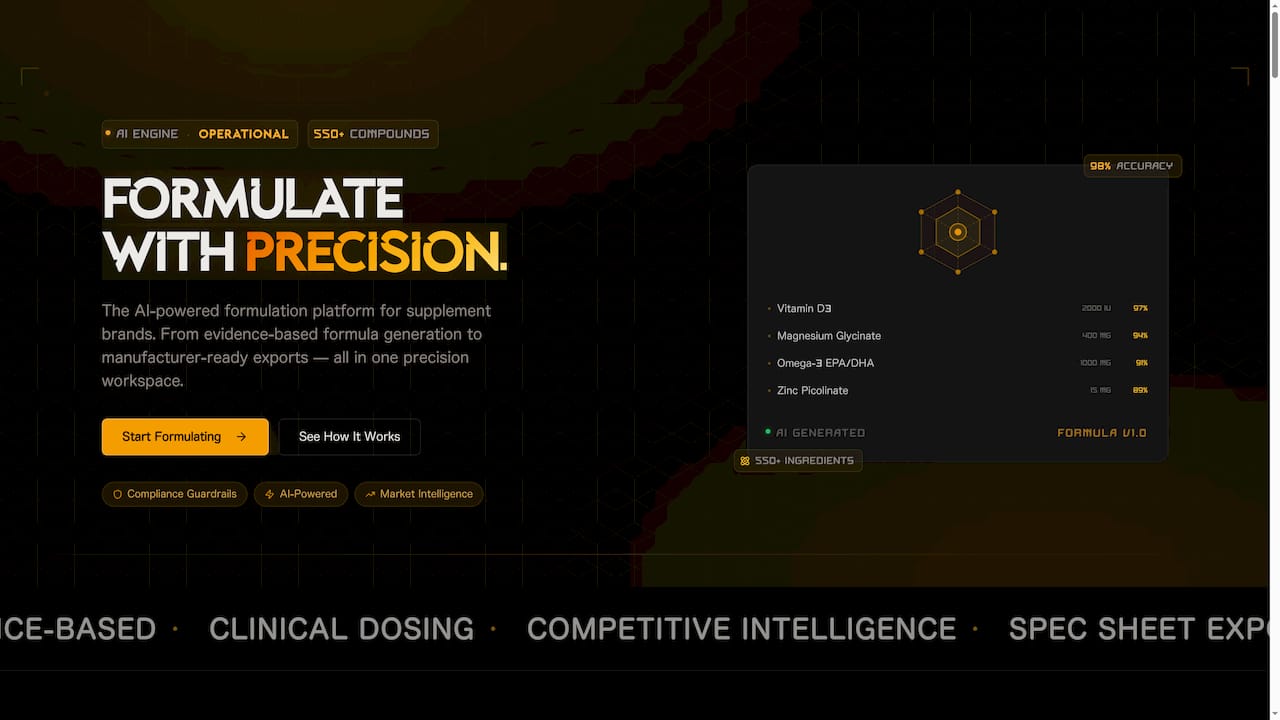
The platform's 8-phase process walks you from ideation through production, with ingredient interaction data, FDA cGMP and ICH Q8 compliance checks, and pilot batch guidance built into every stage. The packaging section with an AI mockup designer means you're not just building a formula. You're building a product that holds together from the first batch to the thousandth. Market research and competitor formulation analysis are included, so you know what's selling and how those formulas are built before you commit to development.
If you're a formulator or manufacturer who needs to get compatibility right the first time, start with Formlypro and see how the platform handles the complexity that typically derails product launches.