

TL;DR:
- Incorrect ingredient choices can lead to regulatory holds, product failures, and long-term brand liabilities.
- Effective selection requires comprehensive evaluation of safety, compliance, functionality, supply reliability, costs, and sustainability.
Picking the wrong ingredient doesn't just hurt a product. It can trigger a regulatory hold, kill a product launch, or expose your brand to liability that takes years to recover from. The criteria for ingredient selection in food, cosmetics, and pharmaceutical formulations have never been more complex, and the margin for error has never been smaller. This article walks you through every major selection criterion, from safety and compliance to supplier qualification and sustainability, with the specificity that actually helps you make defensible decisions.
Table of Contents
- Key takeaways
- 1. Regulatory and safety criteria for ingredient selection
- 2. Functional and performance criteria
- 3. Supply chain, sourcing, and quality assurance criteria
- 4. Cost, availability, and sustainability criteria
- 5. Comparison and decision framework for ingredient selection
- My honest take on ingredient selection mistakes
- How Formlypro supports your ingredient selection process
- FAQ
Key takeaways
| Point | Details |
|---|---|
| Regulatory compliance is non-negotiable | Know which restricted or banned lists apply in every target market before shortlisting any ingredient. |
| Function drives the selection process | Define the functional class need first, then screen candidates within that class by hazard and performance. |
| Supplier qualification is its own discipline | Approved supplier lists and identity testing on every incoming container are legal and quality requirements, not optional steps. |
| Cost analysis must include risk cost | An inexpensive ingredient that creates reformulation risk or compliance exposure is never actually cheap. |
| Decisions need a scoring framework | Use a weighted decision matrix to compare candidates across safety, performance, cost, and supply reliability simultaneously. |
1. Regulatory and safety criteria for ingredient selection
Before anything else, every candidate ingredient must pass a compliance screen against the regulations that govern your product category and your target markets. Get this wrong and nothing else matters.
For food brands, the FDA's GRAS (Generally Recognized as Safe) system and the allergen labeling requirements under Canada's Food and Drug Regulations represent two separate compliance gates. Canadian FDR sections B.01.008 and B.01.010 require ingredient declaration in descending order by proportion pre-mixing, with strict allergen identification built in. Sugars-based ingredients must be grouped under "Sugars" with manufacturer evidence provided to CFIA. That level of specificity is what ingredient transparency checklists need to capture.
For cosmetics, the EU operates the most restrictive framework globally. Over 1,700 substances are prohibited under Regulation (EC) No 1223/2009 Annex II, with permitted colorants, preservatives, and UV filters tightly defined in Annexes III through VI and the CosIng database. If you are selling into the EU, checking every candidate against this database is not a starting point. It is a hard requirement.
For pharmaceutical developers, ICH Q7 governs ingredient acceptance at the API level. Identity testing, supplier qualification, and batch traceability are all mandatory under GMP. Reviewing a certificate of analysis is not enough to satisfy those requirements.
Beyond regulatory lists, safety assessment must account for actual exposure, not just hazard classification. Unilever's approach, which evaluates both hazard and exposure levels including foreseeable unintended uses, reflects a more defensible methodology than hazard-only screening. An ingredient can have a moderate hazard profile and still be completely safe at the concentration and usage frequency your formulation requires.
- Confirm ingredient status on FDA GRAS, EU CosIng, and any market-specific restricted lists
- Assess exposure: amount used, application frequency, route of exposure (topical, ingested, inhaled)
- Check for cross-market conflicts (EU-approved ingredients banned in the US and vice versa)
- Review allergen and labeling obligations early, before finalizing ingredient selection
Pro Tip: Build your regulatory compliance checklist before you build your formula. Discovering a compliance conflict after prototype development is one of the most expensive mistakes in product development.
2. Functional and performance criteria
Regulatory clearance gets an ingredient into consideration. Functional performance is what decides whether it actually belongs in your formulation.
The EPA's Safer Choice program handles this through a functional-class screening approach that screens ingredients within defined classes like surfactants, solvents, and preservatives. Starting from the function your formulation needs rather than a specific ingredient name lets you compare candidates within real toxicity and performance thresholds. That approach consistently surfaces safer compliant options without sacrificing the result you need.
For each functional class in your formula, you need to evaluate:
- Efficacy at intended use levels: Does the ingredient perform reliably within the concentration range your formula allows?
- Compatibility: Does it interact negatively with other ingredients, packaging, or processing conditions?
- Stability: Does it degrade under your expected storage conditions, affecting both safety and shelf life?
- Regulatory status across functional uses: An ingredient approved as a food additive may be restricted when used as a cosmetic preservative.
Balancing efficacy against safety requires integrating functional class criteria with toxicity thresholds from the start. Developers who treat performance and compliance as sequential steps rather than simultaneous filters routinely end up reformulating at the worst possible stage of development.
Pro Tip: If you are evaluating a new preservative system, run it through both efficacy testing (challenge testing) and your compliance screen before committing to prototype batches. One step in the wrong order costs weeks.
3. Supply chain, sourcing, and quality assurance criteria
An ingredient that passes every safety and performance screen is still a liability if your supplier cannot deliver it reliably, traceably, and with documented quality verification.
-
Approved Supplier List (ASL) qualification. Every ingredient supplier should be vetted and formally approved before their materials enter your production workflow. ICH Q7 requires this for pharmaceutical APIs, but the same logic applies across food and cosmetics. Qualification means auditing, not just receiving paperwork.
-
Identity testing on every incoming container. The pharmaceutical identity testing standard under ICH Q7 requires 100% testing of incoming API containers, specifically because global supply chains carry real mix-up and counterfeiting risks. A certificate of analysis from a supplier does not verify what is in your container.
-
Certificate of Analysis review against your own specifications. COAs should be reviewed against your in-house spec, not accepted as confirmation of compliance. Suppliers write COAs against their own specs, which may not match yours.
-
Batch traceability from source to production. You need to trace every ingredient lot back to origin. This is both a recall defense mechanism and an audit requirement in most regulated markets.
-
Secondary and tertiary supplier options. Single-source dependency for a critical ingredient is a supply risk that becomes a production crisis the moment that supplier has an outage. Document your backup options before you need them.
For more detail on supply-chain verification and risk minimization strategies, the guide on reducing formulation risks walks through practical steps brands use to protect their supply chains.
4. Cost, availability, and sustainability criteria
Cost is always part of the decision. The problem is that most brands only calculate the purchase price and miss the full cost picture.

The real cost of an ingredient includes its effect on production yield, its shelf stability profile, any additional testing or compliance costs it triggers, and the risk of reformulation if availability dries up. A highly efficacious botanical extract that sources from one region and has seasonal availability constraints can look inexpensive on a per-kilo basis while carrying enormous risk-adjusted cost.
Sustainability has moved from differentiator to expectation in many categories. Retailers and consumers increasingly demand documented supply chain ethics, and regulatory frameworks in the EU and UK are beginning to formalize traceability requirements for high-risk ingredient categories. An ethical sourcing checklist for your supplier onboarding process should include:
- Environmental impact of extraction or manufacturing
- Labor and fair trade certifications for high-risk sourcing geographies
- Carbon footprint and transportation implications
- Packaging compatibility with circular economy commitments
Packaging and transportation deserve specific attention. Some ingredients degrade during transit under temperature or humidity variation, which directly affects performance in your formulation. A cost calculation that does not account for rejection rates at goods-in is incomplete.
5. Comparison and decision framework for ingredient selection
At some point you have a shortlist of candidate ingredients that have all cleared your safety, regulatory, performance, and sourcing screens. Now you need to make a final call. A structured decision matrix stops that choice from defaulting to whoever spoke loudest in the last meeting.
Here is a practical comparison framework for three common scenarios across industries:
| Criterion | Food formulation | Cosmetics formulation | Pharmaceutical formulation |
|---|---|---|---|
| Regulatory priority | FDA GRAS, CFIA allergen rules | EU CosIng, Annex II banned list | ICH Q7, pharmacopoeial grade |
| Safety assessment | Exposure levels, allergen flags | Dermal absorption, hazard class | Toxicological dossier, impurity profile |
| Performance metric | Taste, texture, stability | Sensory profile, skin compatibility | Bioavailability, dissolution rate |
| Supply chain priority | Traceability, food grade certification | INCI documentation, ethical sourcing | Approved Supplier List, identity testing |
| Cost consideration | Yield impact, seasonal pricing | Reformulation risk, batch consistency | Testing cost, batch traceability overhead |
Weighting these criteria depends on your product category, your primary markets, and your brand positioning. A pharmaceutical excipient selection requires heavier weighting on identity testing and pharmacopoeial compliance. A natural food product aimed at clean label consumers requires heavier weighting on sourcing ethics and labeling transparency.
Regulatory environments shift. Ingredient safety data evolves. Supplier situations change. Build reassessment into your product calendar, not just your launch process. Many brands run through ingredient selection guidelines once and then treat the decision as permanent until something goes wrong.
My honest take on ingredient selection mistakes
I've worked through enough formulation projects to know that the biggest ingredient selection failures rarely happen because brands ignored the obvious rules. They happen because the obvious rules were followed and the less visible criteria were skipped.
The exposure-versus-hazard distinction is the most common blind spot I see. A brand will confirm that an ingredient is not on any banned list, declare it safe, and move forward without ever asking what the actual consumer exposure looks like across all product uses and demographics. That gap is exactly where hazard and exposure need to be evaluated together, not as separate boxes to check.
I've also watched brands spend months on formulation only to discover at the supplier qualification stage that their preferred ingredient source cannot pass an audit. Starting functional-class thinking early, as the EPA's Safer Choice framework recommends, prevents most of those late-stage reformulation crises because it separates the function you need from attachment to a specific ingredient name.
My honest position on where this is heading: sustainability and safer chemistry are not marketing trends. They are the direction regulatory frameworks are moving. Brands that build their ingredient selection guidelines around these criteria now will have a structural advantage in two years. Those that treat it as optional will be reformulating under pressure.
— Ben
How Formlypro supports your ingredient selection process
Formlypro is built for exactly the kind of decision framework this article describes. The platform gives brand owners and product developers access to research-backed ingredient data, regulatory compliance checks across multiple markets, and supplier information, all within the same system that guides you through an 8-phase product development plan.
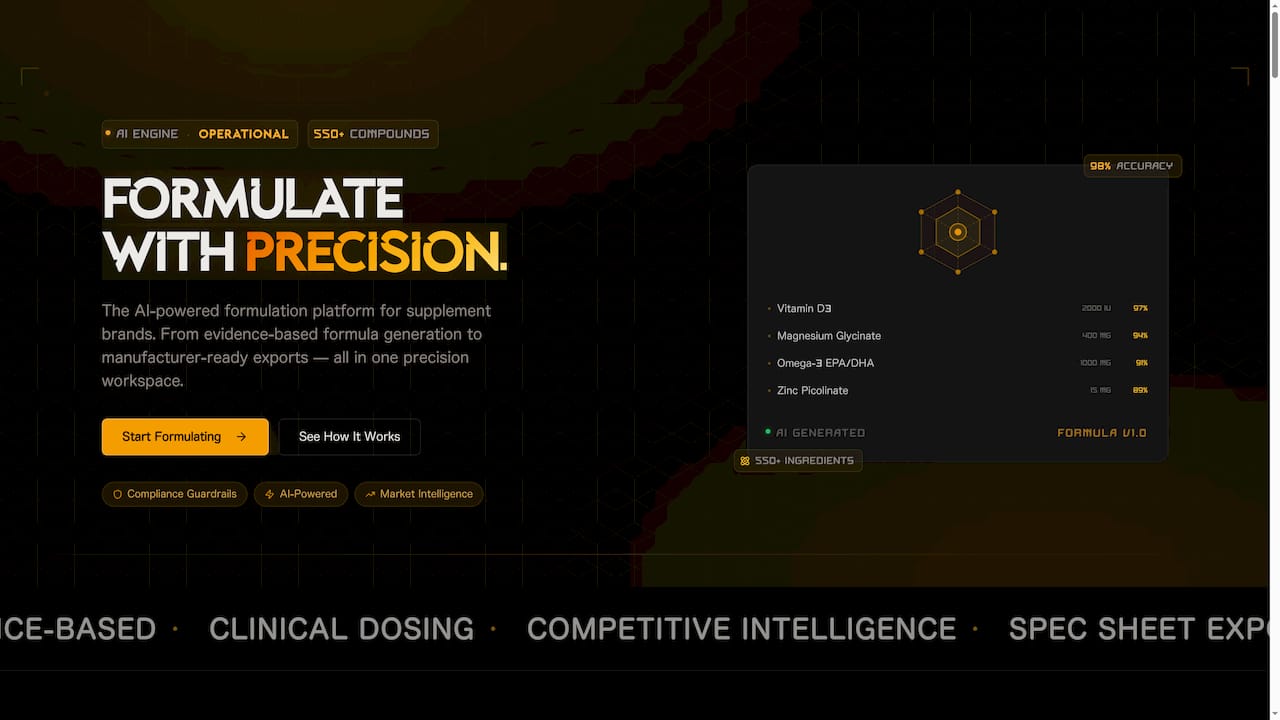
Instead of managing ingredient sourcing checklists, compliance screens, and competitor analysis across separate tools, Formlypro centralizes the process and flags conflicts before they become expensive problems. The AI-powered packaging mockup designer and built-in market research mean you can move from ingredient selection through to production-ready positioning without switching platforms. If you are building a new formulation or auditing an existing one, start with Formlypro and see how much faster the process moves when the compliance and formulation infrastructure are already built in.
FAQ
What are the main criteria for ingredient selection?
The main criteria cover regulatory compliance, safety (hazard and exposure), functional performance, supply chain reliability, cost, and sustainability. Prioritizing these in that order reduces the risk of late-stage reformulation.
How do ingredient selection guidelines differ by industry?
Food formulations prioritize allergen labeling and GRAS status, cosmetics require EU CosIng and Annex II checks, and pharmaceuticals mandate ICH Q7 supplier qualification with 100% identity testing on incoming materials.
What is functional-class criteria in ingredient selection?
Functional-class criteria, as defined by the EPA Safer Choice program, screen ingredient candidates within a defined function (surfactant, preservative, etc.) by both performance and lowest hazard threshold, rather than evaluating individual ingredient names in isolation.
Why is identity testing required for pharmaceutical ingredients?
ICH Q7 mandates identity testing on every incoming API container because global supply chains carry real risks of mix-up and counterfeiting. A certificate of analysis alone does not confirm what is actually in the container.
How should brands approach an ingredient sourcing checklist?
An effective ingredient sourcing checklist should cover supplier qualification status, available documentation, identity and quality testing protocols, traceability from origin, and backup supplier options before any ingredient enters a formulation.