

Mechanistic understanding is the practice of explaining how ingredients and biological processes produce specific effects, not just that they correlate with outcomes. For supplement and wellness brands, this distinction is the difference between a formula you can defend and one you can only hope works. When your product development is grounded in causal logic, as defined by the Stanford Encyclopedia of Philosophy's framework for mechanisms as organized systems of parts and causal relations, you can design faster, fail earlier and cheaper, and make structure/function claims that hold up under FDA/DSHEA scrutiny. Formlypro is built around exactly this approach.
The business case is direct:
- Faster iteration: Isolating causal levers cuts the number of blind experiments your team runs.
- Stronger claims: Causal evidence maps cleanly to permissible structure/function language under DSHEA.
- Lower late-stage failures: Mechanistic constraints catch implausible formulas before expensive clinical pilots.
- Premium positioning: Practitioners and expert buyers pay more for products with a documented mechanism of action.
Table of Contents
- How mechanistic models differ from descriptive and predictive approaches
- The concrete business benefits of mechanistic R&D
- How to operationalize mechanistic thinking in your product workflow
- What data, tools, and partners your team actually needs
- An 8-phase mechanistic product development workflow you can follow
- U.S. regulatory implications: what mechanistic evidence does for your claims
- Common pitfalls and how your team can avoid them
- Key Takeaways
- The case for mechanistic thinking that most brands miss
- Formlypro puts this workflow into practice
- Useful sources and further reading
How mechanistic models differ from descriptive and predictive approaches
Philosophy of science defines a mechanism as an organized set of components whose interactions produce an observable phenomenon. That framing matters practically. A descriptive model tells you what happened in a trial. A predictive or machine-learning model tells you what correlates with an outcome. A mechanistic model tells you why, by specifying which parts interact, in what order, and through which causal pathway.
Bernhard Schölkopf's mechanistic world models framing makes the stakes explicit: black-box predictive models can identify patterns without understanding them, which means they fail silently when conditions shift. For supplement formulation, that failure mode shows up as an ingredient that performs in one population and not another, or a biomarker that moves in vitro but not in vivo.
The Open Encyclopedia of Cognitive Science adds a useful structural point: mechanistic explanations work across multiple levels of organization. For your team, that means tracing an effect from molecular interaction, to cellular pathway, to measurable physiological endpoint. That chain is what makes a claim testable, documentable, and regulatorily defensible.
Key contrasts at a glance:
- Descriptive: "Subjects taking X showed improved scores." No causal chain, no design guidance.
- Predictive/ML: "Ingredient X correlates with outcome Y at r = 0.78." Useful for screening, not for claims.
- Mechanistic: "Ingredient X activates pathway Z, which upregulates biomarker B, producing effect Y." Testable, documentable, and legally usable.
The concrete business benefits of mechanistic R&D
The MIT Trancik Lab's mechanistic approach to innovation demonstrates that isolating mechanisms and quantifying their contributions to performance gains shortens discovery timelines and improves resource allocation. The principle translates directly to supplement formulation.
Faster iteration comes from knowing which variables to move. When you have a causal hypothesis tied to a specific pathway, you run targeted experiments instead of full-formula sweeps. Separate-effects testing, where you isolate ingredient sub-systems before integrating them, reduces the number of expensive full-formula trials your team needs.
Regulatory advantage is the less obvious benefit. Mechanistic evidence supports structure/function claims under DSHEA because it documents how an ingredient acts, not just that it produced an effect in a study. That documentation also reduces the risk of inadvertently crossing into disease-claim territory.
Marketing differentiation follows from the same logic. Practitioner channels and sophisticated DTC buyers respond to mechanism-level explanations. A product positioned around a named pathway, a specific biomarker target, or a documented interaction matrix commands higher perceived value than one positioned on ingredient dose alone.
How to operationalize mechanistic thinking in your product workflow
The practical steps below move from hypothesis to launch-ready evidence. The MIT Trancik Lab's approach of isolating mechanisms before scaling is the organizing principle throughout.
- Write a mechanistic hypothesis. Tie each product claim to a specific pathway and a measurable biomarker. "This formula supports cognitive performance" is a marketing line. "Ingredient A inhibits acetylcholinesterase, sustaining acetylcholine levels, measurable via reaction-time assay" is a mechanistic hypothesis.
- Decompose the formula. Run separate-effects tests on ingredient sub-systems before any full-formula trial. This catches interactions early and tells you which ingredients are doing the work.
- Use ML for screening, not for design. AI handles high-throughput prediction well. At PNNL, AI-driven labs fuse ML simulations with human-defined mechanistic constraints, with humans setting the gate criteria to ensure physical plausibility. That human-in-the-loop structure is non-negotiable for regulatory-ready evidence.
- Set phased timelines with gate criteria. Each phase should produce a specific deliverable that either confirms or kills the hypothesis before you spend on the next phase.
- Map claims to endpoints. Every structure/function claim needs a measurable endpoint that a third party can replicate.
Pro Tip: Calibrate mechanistic depth to your audience. Consumer psychology research shows that highly technical explanations lower perceived understanding for general audiences. Use a simplified causal narrative for DTC copy and reserve the full mechanism documentation for practitioner channels and regulatory dossiers.
| Phase | Typical Duration | Key Deliverable |
|---|---|---|
| Hypothesis generation | a short initial period | Pathway map + biomarker targets |
| Separate-effects testing | a moderate experimental phase | Per-ingredient effect data |
| Prototype integration | a few weeks | Full-formula bench data |
| Pilot efficacy testing | a multi-week human study | Human-relevant endpoint data |
| Stability and scale | a moderate stability testing period | Stability report + scale parameters |
What data, tools, and partners your team actually needs
The right infrastructure for mechanistic product development covers four layers.
Essential data types: biochemical pathway assays, targeted biomarker readouts, ingredient compatibility and interaction matrices, accelerated shelf-life stress tests, and stability data under real-use conditions.

Tool categories: bench assays and in vitro cell-based models for early mechanistic validation; targeted omics for pathway confirmation; simulation and ML platforms for screening; and formulation compatibility software for interaction prediction.
Vendor evaluation checklist:
- Does the platform expose its algorithm logic, or is it a black box?
- Can it support separate-effects test design, not just full-formula prediction?
- What is the provenance of its ingredient datasets, and are they peer-reviewed?
- Does it produce regulatory-ready documentation, or only internal reports?
Formlypro integrates formulation tools, compliance guidance, an 8-phase product workflow, ingredient intelligence, and packaging mockups in one platform. It is designed specifically for supplement and wellness brands that need to move from mechanistic hypothesis to manufacturer-ready export without switching tools. Aligning your AI tools with clinical objectives, as covered in this practical guide, is the same discipline Formlypro applies to formulation workflows.
| Tool Category | Primary Use | Mechanistic Role |
|---|---|---|
| Bench assays | Early ingredient validation | Confirms pathway activity |
| In vitro cell models | Cellular-level mechanism testing | Links molecular to cellular effect |
| Targeted omics | Pathway confirmation | Maps multi-level causal chain |
| ML simulation platforms | High-throughput screening | Generates hypotheses for testing |
| Formulation software | Interaction prediction | Flags compatibility issues pre-trial |
An 8-phase mechanistic product development workflow you can follow
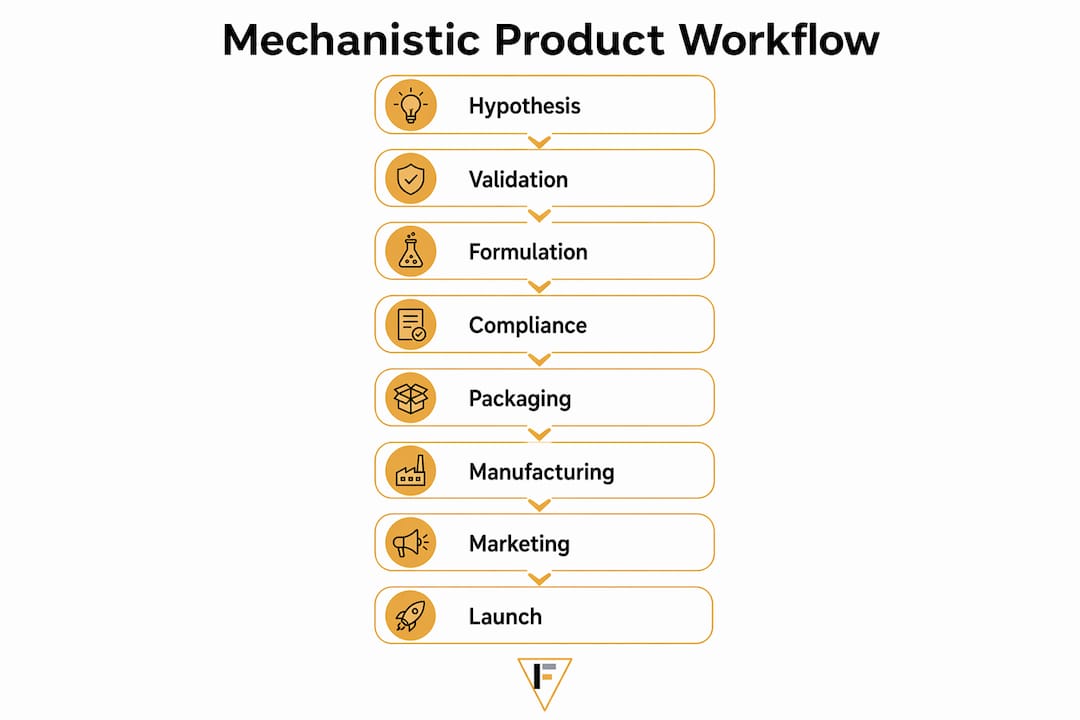
This workflow maps directly to Formlypro's 8-phase plan and applies separate-effects testing principles at each gate.
- Hypothesis generation: Define the causal chain and target biomarkers. Deliverable: pathway map.
- Separate-effects testing: Isolate each ingredient sub-system. Deliverable: per-ingredient effect data.
- Prototype integration: Combine validated sub-systems into a full formula. Deliverable: bench-scale prototype.
- Pilot efficacy testing: Run human-relevant endpoint assays. Deliverable: efficacy data package.
- Scale-up: Transfer formula to manufacturing scale. Deliverable: scale parameters and yield data.
- Stability and compatibility: Run accelerated shelf-life tests. Deliverable: stability report.
- Regulatory packaging: Compile mechanistic evidence into a claims dossier. Deliverable: DSHEA-compliant claims package.
- Launch readiness: Finalize packaging, positioning, and production documentation. Deliverable: manufacturer-ready export.
Formlypro features map to this workflow directly: formulation exports at phase 3, compliance checks at phase 7, packaging mockups and the pipeline planner at phase 8.
U.S. regulatory implications: what mechanistic evidence does for your claims
Under DSHEA, dietary supplements may carry structure/function claims but not disease claims. The practical line is this: "supports healthy cortisol balance" is permissible; "treats adrenal fatigue" is not. Mechanistic evidence strengthens the former by documenting the causal chain behind it, and it reduces the risk of accidentally writing the latter.
Clinical data that supports formulation claims is most useful when it is tied to a documented mechanism, not just an observed outcome. The FDA does not require pre-market approval for structure/function claims, but it does require that claims be truthful and substantiated.
Mitigation checklist:
- Avoid causal disease language in any consumer-facing copy.
- Document the full causality chain from ingredient to endpoint in your internal dossier.
- Preserve raw data provenance and lab certificates of analysis for audit readiness.
- Use a qualified disclaimer ("This statement has not been evaluated by the FDA…") on all structure/function claims.
Common pitfalls and how your team can avoid them
Correlation traps are the most expensive failure mode. A Royal Society comparative analysis confirms that pure ML models reveal correlations without causal structure, which means they can point your team at an ingredient that performs in a dataset but fails in a real formula. Mitigation: require separate-effects validation before any ML-screened ingredient enters a prototype.
Translation failure happens when a strong in vitro signal does not replicate in vivo. Mitigation: use tiered validation, moving from cell-based models to human-relevant endpoints before committing to a full clinical study. Reducing formulation risks at each tier is cheaper than discovering the failure at pilot scale.
Over-explaining to consumers is a real cost. Consumer psychology research on mechanistic detail and audience response shows that technical depth can lower perceived understanding for general audiences. Mitigation: segment your content. Give consumers a simplified causal narrative; give practitioners the full mechanism documentation.
IP risk is the most overlooked pitfall. Mechanistic discoveries are protectable, but only if they are documented. Mitigation: maintain dated lab notebooks, file provisional patents where appropriate, and control data access from the start.
Pro Tip: Before filing any IP, run a freedom-to-operate search on the specific pathway or interaction your formula targets. A mechanistic claim that overlaps with an existing patent is a liability, not an asset.
Key Takeaways
Mechanistic understanding converts correlation into testable, defensible design choices that reduce late-stage failures and support legally permissible structure/function claims under DSHEA.
| Point | Details |
|---|---|
| Start with a causal hypothesis | Tie every product claim to a specific pathway and a measurable biomarker before formulating. |
| Run separate-effects tests first | Isolate ingredient sub-systems before full-formula trials to catch failures early and cheaply. |
| Use ML with human constraints | Assign ML the screening role; domain experts must set mechanistic gate criteria for validity. |
| Document for regulatory readiness | Compile a causality chain and preserve raw data provenance to support DSHEA claims dossiers. |
| Formlypro maps to this workflow | The platform's 8-phase plan, compliance tools, and formulation exports operationalize each phase above. |
The case for mechanistic thinking that most brands miss
Most supplement brands treat mechanistic science as a marketing upgrade, something to add after the formula is locked. That sequencing is backwards, and it is why so many products fail at the pilot stage or get reformulated after launch.
The real value of mechanistic understanding is not the language it gives your marketing team. It is the decisions it prevents. When you know why an ingredient works, you know which combinations are redundant, which interactions are risky, and which claims you can actually defend. That knowledge compresses your R&D timeline and protects your margins.
The brands that will own premium positioning in the next five years are not the ones with the most ingredients or the highest doses. They are the ones that can explain, in a documented causal chain, exactly what their product does and why. That is a standard worth building toward now, not after your next reformulation.
Formlypro puts this workflow into practice
Most product teams have the science. What they lack is a system that connects mechanistic research to formulation, compliance, and launch in one place. Formlypro closes that gap.
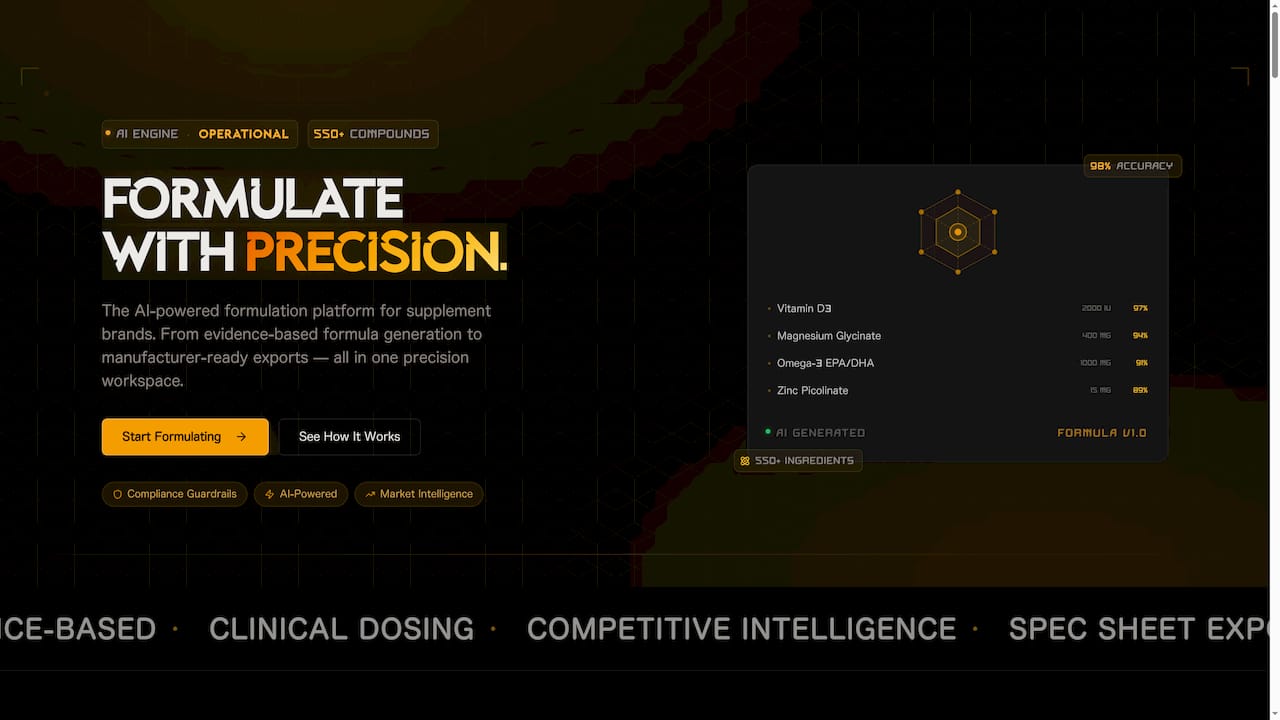
The platform's 8-phase workflow guides your team from hypothesis to manufacturer-ready export, with built-in compliance checks mapped to FDA/DSHEA requirements, ingredient intelligence for separate-effects planning, and an AI mockup designer for packaging. Market research and competitor analysis are integrated so you can position your mechanistic advantage against what is already on shelves. You get formulation exports your manufacturer can use immediately, a pipeline planner to manage every phase, and compliance documentation your regulatory team can act on.
If your next product deserves a defensible mechanism of action and a faster path to market, start with Formlypro and run your first mechanistic formulation through the 8-phase plan.
Useful sources and further reading
The following primary sources underpin the claims and frameworks in this article. They are worth bookmarking when building a claims dossier or technical appendix.
- Stanford Encyclopedia of Philosophy — Mechanisms: The foundational definition of mechanism as organized components producing observable phenomena. Use this when framing your mechanistic hypothesis for regulatory or scientific audiences.
- MIT Trancik Lab — Mechanistic Approach to Innovation: Demonstrates how isolating mechanisms and quantifying contributions accelerates discovery and improves resource allocation. Directly applicable to separate-effects testing design.
- Bernhard Schölkopf — Mechanistic World Models (2026): Argues for the shift from black-box predictive models to causal mechanistic models. Relevant when evaluating AI platforms for formulation screening.
- Royal Society — Mechanistic Models vs. Machine Learning: Comparative analysis of mechanistic and ML approaches; supports the case for human-in-the-loop constraints.
- U.S. Department of Energy / PNNL — AI and the Bioeconomy: Case study of AI fused with mechanistic constraints to shorten bioprocess timelines. Practical model for supplement R&D workflows.
- Open Encyclopedia of Cognitive Science — Mechanistic Explanation: Covers decomposition and multi-level organization in mechanistic explanations; useful for structuring your pathway maps.
- Fernbach et al. — Explanation Fiends and Foes: Consumer psychology research on how mechanistic detail affects perceived understanding. Use when designing layered content for practitioner vs. consumer audiences.