

TL;DR:
- A supplement formulator designs ingredients, dosages, and delivery formats to meet regulatory, scientific, and brand goals.
- Their process includes defining product concept, selecting ingredients, choosing delivery formats, developing prototypes, and preparing GMP-compliant documentation.
- Regulatory requirements, such as FDA cGMP, label formatting, and disclaimers, influence every formulation and labeling decision from the start.
A supplement formulator is a specialist who designs dietary supplement products by selecting ingredients, dosages, and delivery formats that meet both brand goals and regulatory compliance requirements from concept through scalable production. The role sits at the intersection of nutritional science, manufacturing feasibility, and FDA regulatory law. For entrepreneurs building a supplement brand in 2026, understanding what a formulator actually does, and how to work with one effectively, is the difference between a product that reaches market and one that stalls in compliance review. Platforms like Formlypro and contract manufacturers such as Welsdom and Pure Nutra Labs have made the custom supplement formulation process more accessible, but the fundamentals of the discipline remain non-negotiable.
What does a supplement formulator actually do?
A supplement formulator, sometimes called a dietary supplement scientist or nutritional supplement developer, is responsible for translating a product concept into a documented, testable, and manufacturable formula. The role goes well beyond picking ingredients. It requires understanding how ingredients interact, how delivery formats affect absorption, and how every decision maps back to a regulatory framework.
The typical formulation process follows a structured sequence:
- Define the product concept and target consumer. Before selecting a single ingredient, the formulator establishes what the product is intended to do, who it is for, and what claims the brand wants to make. This step directly shapes every downstream decision.
- Select ingredients and model dosages. Ingredient selection is driven by clinical evidence, supplier quality standards, and cost targets. Dosage modeling accounts for bioavailability, synergistic effects, and the upper tolerable limits established in published research.
- Choose a delivery format. Capsules, tablets, powders, softgels, and gummies each carry different bioavailability profiles, manufacturing requirements, and consumer compliance rates. The format choice is a formulation decision, not just a packaging one.
- Develop prototypes with a contract manufacturer. The formulator works alongside a contract manufacturer to produce initial samples, then iterates based on sensory evaluation, stability data, and lab testing results.
- Prepare GMP-compliant documentation. The final formula must be captured in a master manufacturing record (MMR) that specifies every ingredient, quantity, process step, and quality control checkpoint. This document is the legal and operational backbone of the product.
Pro Tip: Write your master manufacturing record as if an FDA auditor will read it tomorrow. Vague process descriptions are the most common documentation failure in cGMP inspections.
The formulation checklist for a compliant product is longer than most entrepreneurs expect. The real bottleneck in supplement product launches is documentation and verification under cGMP, not only ingredient blending. Entrepreneurs who treat documentation as an afterthought consistently face delays at the manufacturing stage.

How do regulatory requirements shape formulation and labeling?
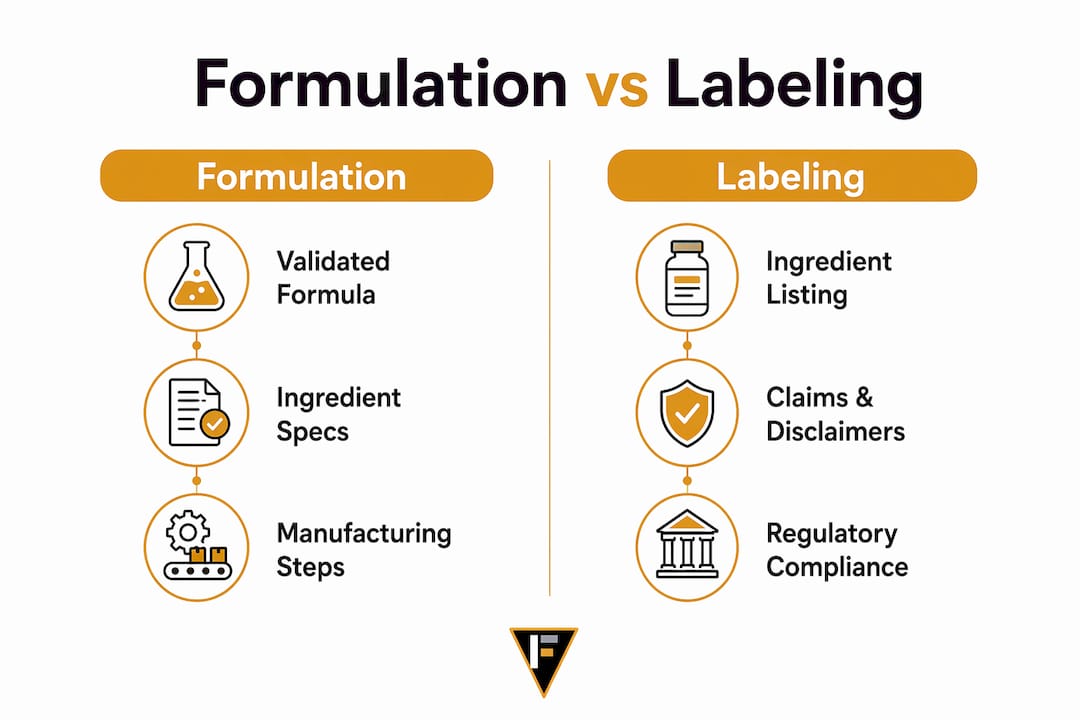
Regulatory compliance is not a final step in supplement product design. It is a constraint that shapes every formulation decision from the start. Three federal frameworks govern the vast majority of what a supplement formulator must account for in the U.S. market.
- 21 CFR Part 111 (cGMP). FDA 21 CFR Part 111 establishes current Good Manufacturing Practice requirements for dietary supplement manufacturing. It covers personnel qualifications, equipment calibration, production controls, component testing, quality control procedures, packaging, and complaint handling. Every formula a supplement formulator creates must be designed with these requirements in mind, because the manufacturer producing it must operate under them.
- 21 CFR Part 101 (Supplement Facts panel). U.S. dietary supplement labels must include a Supplement Facts panel with serving size, servings per container, dietary ingredient amounts, and percent Daily Value, all formatted to strict FDA specifications. The formulator's ingredient choices and dosage decisions directly determine what appears on this panel, which means label accuracy depends on formula accuracy.
- DSHEA disclaimer requirements. Any structure/function claim on a supplement label or in marketing materials triggers a mandatory disclaimer. The DSHEA disclaimer must appear adjacent to every claim, in boldface type, at a minimum size of 1/16 inch. This is not a design preference. It is a legal requirement with specific placement and formatting rules.
Structure/function claims increase labeling obligations, requiring carefully placed disclaimers that directly influence both formulation and label copy design. This means the marketing team's claim decisions and the formulator's ingredient decisions must be coordinated before label design begins, not after.
Pro Tip: Never finalize your label copy before your formula is validated. Discrepancies between formula specs, label content, and master records create audit risks and potential FDA enforcement actions.
Common compliance pitfalls include listing ingredient quantities on the label that differ from the validated formula, making claims that exceed what the formula's dosage can support, and failing to update the Supplement Facts panel after a formula revision. All three are avoidable with a synchronized documentation workflow. The compliance requirements for health and wellness brands make this coordination a structural necessity, not an optional best practice.
What should you know about custom formulation partnerships?
Custom supplement formulation is the process of working with a contract manufacturer to develop a proprietary formula built to your brand's specifications. It is distinct from private label, where you select a pre-existing formula and apply your branding. Custom formulation gives you ownership of the formula, but it requires more time, investment, and documentation.
Here is what the partnership process typically involves:
- Formula brief submission. You provide the manufacturer with a detailed brief covering the product category, target consumer, desired ingredients, dosage targets, delivery format, and any regulatory or label claims you intend to make.
- Sample production and iteration. The manufacturer produces initial prototypes. You evaluate them for taste, texture, solubility, and stability, then request revisions. This cycle typically runs two to four rounds before a formula is approved.
- Minimum order quantities. MOQ varies significantly by manufacturer. Some manufacturers offer low MOQ custom formulation starting at 500 units with development timelines of four to ten weeks. This makes custom formulation viable for early-stage brands that cannot commit to large production runs.
- Intellectual property protection. A proprietary formula is a business asset. Confirm that your manufacturing agreement includes clear IP ownership language assigning the formula to your brand, not the manufacturer.
- Compliance and documentation handoff. A quality manufacturer will provide you with the MMR, batch records, certificate of analysis (COA) for each ingredient, and finished product testing results. These documents are your audit file.
Custom formulation success hinges on delivering documented, compliant, and manufacturable formulations, not just mixing ingredients. The table below compares private label and custom formulation across the dimensions that matter most to entrepreneurs.
| Factor | Private label | Custom formulation |
|---|---|---|
| Formula ownership | Manufacturer retains | Brand owns |
| Development time | Days to weeks | 4 to 10+ weeks |
| MOQ | Often lower | Varies, can start at 500 units |
| Differentiation | Limited | High |
| Documentation burden | Lower | Higher |
| Compliance control | Shared | Brand-directed |
How do bioactive factors influence formulation strategy?
Supplement formulation strategy is not the same as food product development, even when the ingredients overlap. Supplement-specific factors such as dose, matrix, purity, and bioavailability require dedicated intake guidance frameworks beyond general food-based recommendations. This distinction matters enormously for a nutritional supplement developer trying to build a product that actually performs.
Bioavailability is the percentage of an ingested nutrient that reaches systemic circulation and is available for use. It varies by ingredient form, delivery format, co-ingested compounds, and the consumer's physiological state. Magnesium glycinate, for example, has meaningfully higher bioavailability than magnesium oxide, yet both appear on labels simply as "magnesium." A formulator who does not account for this difference will produce a product that underdelivers on its intended effect.
Matrix effects add another layer of complexity. The same ingredient can behave differently depending on what surrounds it in the formula. Fat-soluble vitamins like D3 and K2 require dietary fat for absorption. Certain minerals compete for the same transport pathways and should not be dosed together at high levels. These interactions are not theoretical. They determine whether your product works as intended or simply passes through the consumer without effect.
Delivery format selection is a direct lever on bioavailability and consumer compliance. Softgels outperform tablets for fat-soluble nutrients. Liposomal delivery formats increase absorption for compounds like vitamin C and glutathione. Powders allow higher dosing flexibility but require flavor masking for bitter compounds like berberine or ashwagandha extract.
Pro Tip: When evaluating contract manufacturing partners, ask specifically how they handle bioavailability and matrix effects in their formulation process. Partners who cannot answer this question with specificity are not equipped to build a high-performance product.
Emerging scientific frameworks stress supplement-specific evidence gaps like matrix and bioavailability differences that formulators must address. Brands that ignore these nuances produce products that may be compliant on paper but fail to deliver results, which is the fastest path to poor reviews and customer churn.
Key takeaways
A supplement formulator's value is measured not by ingredient knowledge alone, but by the ability to produce a formula that is scientifically sound, regulatory-compliant, and manufacturable at scale.
| Point | Details |
|---|---|
| Formulation precedes labeling | Finalize your formula before designing labels to prevent costly compliance rework. |
| Documentation is the real bottleneck | Master manufacturing records and batch records determine audit readiness under 21 CFR Part 111. |
| Bioavailability drives efficacy | Ingredient form and delivery format determine whether your product works, not just what it contains. |
| Custom formulation requires IP protection | Confirm formula ownership in your manufacturing agreement before production begins. |
| Compliance is built in, not added on | Regulatory requirements from FDA 21 CFR Part 101 and DSHEA shape formulation decisions from day one. |
Why I think most supplement brands get formulation backwards
Most entrepreneurs I speak with treat formulation as a technical task they hand off to a manufacturer, then circle back to once the branding is done. That sequence is exactly backwards, and it costs brands months of rework and thousands of dollars in label reprints and formula revisions.
The brands that launch cleanly are the ones that treat the formula as the foundation. They finalize ingredient selection, validate dosages, and lock the master manufacturing record before a single word of label copy is written. They understand that product compliance is not a legal checkbox. It is a design discipline that runs through every phase of development.
The other mistake I see constantly is selecting manufacturing partners based on price and MOQ alone. Those are real constraints, and I understand them. But a manufacturer who cannot speak fluently about bioavailability, matrix effects, and cGMP documentation is not a partner. They are a blending service. The difference shows up in your product's performance, your audit file, and ultimately your customer retention.
Maintaining synchronization of formula master specifications with batch records and labeling is fundamental to FDA audit readiness. I have seen brands with genuinely good products get derailed by a single discrepancy between their label and their MMR. Build the documentation habit early. It is far easier to maintain than to reconstruct under pressure.
The supplement market rewards specificity. A product built on a well-documented, bioavailability-optimized formula with a clean compliance record will outperform a hastily assembled private label product every time, not because of marketing, but because it actually works.
— Ben
How Formlypro helps you build formulas that are ready for market
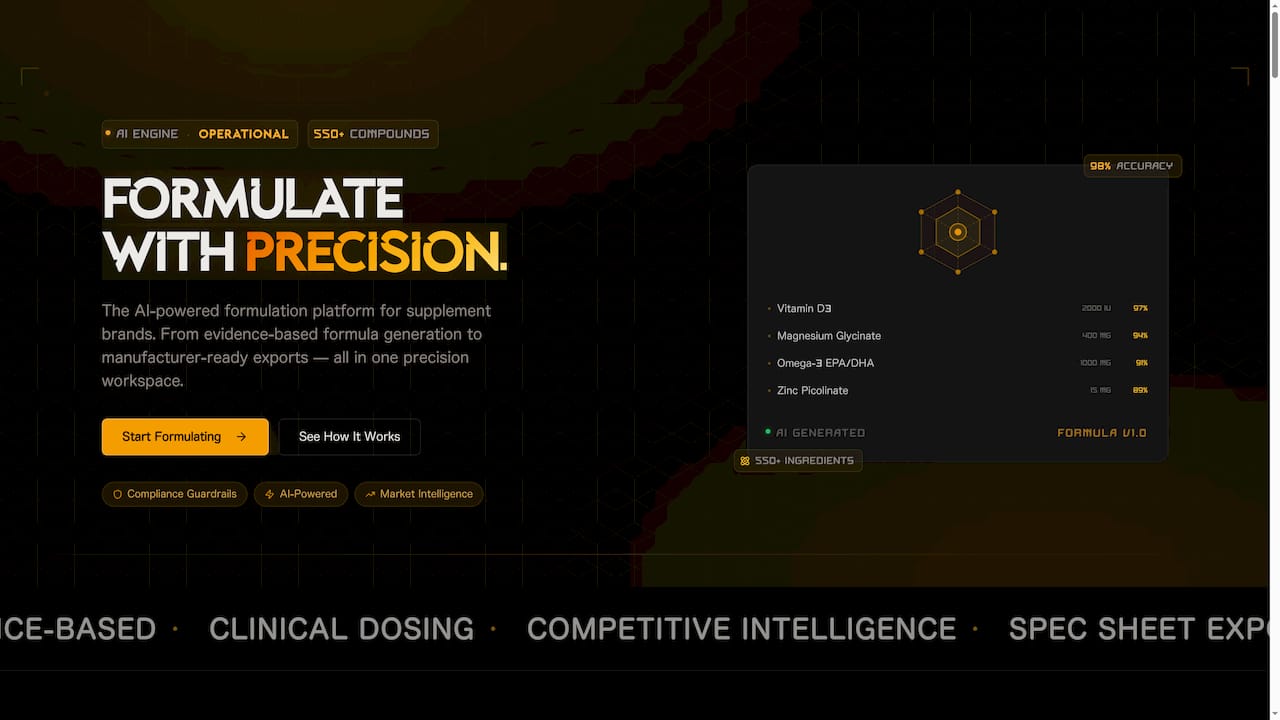
Formlypro is built specifically for entrepreneurs who want to develop high-quality, research-backed supplement formulas without needing a full-time dietary supplement scientist on staff. The platform walks you through an 8-phase process covering ideation, formulation, prototyping, market research, compliance, and production, with competitor analysis and market data integrated at every stage. You can design your formula, check compliance requirements, and even create custom packaging using the built-in AI Mockup designer, all within a single subscription. For brands ready to move from concept to a manufacturing-ready formula, start with Formlypro and see how far you can get before your first manufacturer call.
FAQ
What is a supplement formulator?
A supplement formulator is a specialist who designs dietary supplement products by selecting ingredients, dosages, and delivery formats that meet brand goals, scientific evidence standards, and FDA regulatory requirements. The role covers the full process from product concept through GMP-compliant documentation.
What regulations govern supplement formulation in the U.S.?
The primary frameworks are FDA 21 CFR Part 111, which sets cGMP manufacturing requirements, and 21 CFR Part 101, which governs Supplement Facts panel formatting. DSHEA also requires specific disclaimer language adjacent to any structure/function claims made on labels or in marketing.
How long does custom supplement formulation take?
Development timelines for custom supplement formulation typically range from four to ten weeks, depending on the complexity of the formula, the number of prototype iterations required, and the manufacturer's production schedule.
What is a master manufacturing record?
A master manufacturing record (MMR) is a GMP-required document that specifies every ingredient, quantity, process step, and quality control checkpoint for a supplement formula. It is the legal and operational foundation for compliant, repeatable production under 21 CFR Part 111.
Should I finalize my label before or after my formula?
Always finalize your formula first. Label content, including the Supplement Facts panel and any structure/function claims, must accurately reflect the validated formula. Designing labels before formula validation creates a high risk of regulatory misbranding and costly reprints.