

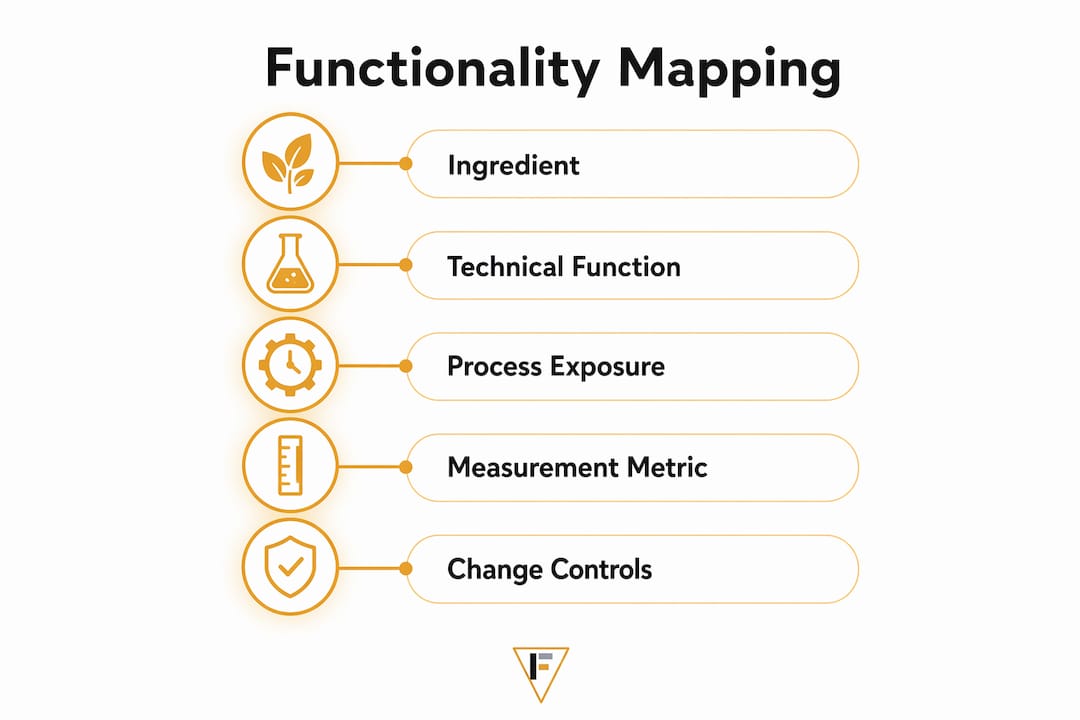
Food ingredient functionality is the technical role an ingredient plays in a formula's processing, stability, and measurable consumer outcome. Every ingredient you add to a supplement does something structural, chemical, or physical, and that behavior changes depending on how you process it. The working framework: ingredient → technical function → process exposure → measurable outcome. Two quick examples: a microencapsulant like modified starch protects omega-3 oil from oxidation during spray drying, with peroxide value as the measurable outcome; a binder like microcrystalline cellulose holds tablet mass together under compression, with dissolution rate as the proof point.
Table of Contents
- Why ingredient functionality determines launch success or failure
- How to build an ingredient functionality map
- Common technical function classes and what to measure
- Managing multi-functionality and ingredient interactions
- Testing and validating ingredient functionality in supplements
- U.S. regulatory and labeling implications for nutraceutical teams
- How to build a living ingredient functionality document
- Key Takeaways
- What most formulation teams get wrong about ingredient functionality
- Formlypro brings your ingredient functionality map into your product workflow
- Primary references and further reading
Why ingredient functionality determines launch success or failure
Misread a function and you pay for it at scale. Clumping in a powder blend, phase separation in a softgel fill, off-flavor from oxidized actives, or a tablet that passes compression but fails USP dissolution — these are all functionality failures in disguise. Each one traces back to an ingredient behaving differently than the formulation team assumed, usually under a processing condition nobody mapped in advance.
The regulatory exposure compounds the manufacturing risk. Structure/function claims under DSHEA require substantiation, and the FDA distinguishes sharply between an ingredient's technological role (what it does in the matrix) and its health-enhancing role (what it does in the body). Conflating the two in documentation is a common compliance gap that auditors flag.
Fewer than 0.1% of industry-developed dietary supplements and functional foods have been involved in at least one placebo-controlled clinical trial — which means most brands carry significant claims risk relative to their evidence base.
Supplier risk sits in the same category. A lot change in particle size or moisture content can shift a binder's compressibility, a hydrocolloid's viscosity, or an encapsulant's payload retention without triggering any incoming QC flag. Without a functionality map, you find out during a batch failure.
How to build an ingredient functionality map
An effective functionality map connects four components: the specific ingredient, its technical function, the process exposure it undergoes, and the measurable quality outcome. Each component is required. Remove one and you lose the ability to troubleshoot or defend a supplier change.
| Ingredient type | Technical function | Process exposure | Measurement metric |
|---|---|---|---|
| Microcrystalline cellulose | Binder / filler | Compression (force, dwell time) | Hardness (kP), dissolution (% at 30 min) |
| Hydroxypropyl methylcellulose | Film coat / controlled release | Heat, aqueous spray | Coat weight gain (%), release profile |
| Lecithin (soy or sunflower) | Emulsifier | High-shear mixing, heat | Droplet D[4,3] (µm), emulsion stability |
| Modified starch | Encapsulant | Spray drying (inlet temp, atomization) | Peroxide value, encapsulation efficiency (%) |
| Silicon dioxide | Flow agent | Blending (speed, time) | Angle of repose, bulk/tap density ratio |
| Glycerin | Humectant | Mixing, fill temperature | Water activity (aw), viscosity (cP) |
Pro Tip: Add three change-control fields to every row: supplier lot number, particle size D[50], and storage conditions at receipt. When a batch behaves unexpectedly, these fields cut root-cause analysis time significantly.
Treat this document as a living record, not a one-time deliverable. Version it with every supplier change, reformulation, or scale-up event. Link each row to the corresponding supplier certificate of analysis and batch record.
Common technical function classes and what to measure
Starches, proteins, fibers, emulsifiers, acids, and oils all carry complex process behaviors — gelatinization, denaturation, retrogradation — that must be matched to specific unit operations. In supplements, the classes that cause the most formulation problems are:
- Binders (MCC, HPMC, PVP): hold tablet or capsule mass under compression; measure hardness and dissolution at 30 and 60 minutes per USP
- Disintegrants (croscarmellose sodium, sodium starch glycolate): promote rapid tablet breakup in aqueous media; measure disintegration time (minutes) and dissolution profile
- Encapsulants (modified starch, maltodextrin, gum arabic): protect sensitive actives (omega-3s, probiotics, fat-soluble vitamins) from oxygen, heat, and moisture; measure peroxide value, encapsulation efficiency, and viable count post-processing
- Emulsifiers (lecithin, mono- and diglycerides): stabilize oil-water interfaces in softgels and liquid formats; measure droplet D[4,3] and creaming index over time
- Flow agents (silicon dioxide, magnesium stearate): reduce interparticle friction in powder blends; measure angle of repose and Carr index
- Humectants (glycerin, sorbitol): control moisture in gummies and soft chews; measure water activity (target aw < 0.60 for microbial safety) and texture (firmness in grams-force)
- Preservatives and antioxidants (mixed tocopherols, rosemary extract): extend oxidative and microbial shelf life; measure peroxide value, TBARS, and microbial counts at defined intervals
Source variability matters here. A novel ingredient sourced from algae or a by-product stream may carry strong sustainability credentials, but its process performance under real manufacturing conditions — shear, heat, pH — needs independent verification. Particle size distribution, moisture content, and supplier processing method all shift functionality in ways a spec sheet alone won't reveal. Benchmarking across supplier lots before locking a source is standard practice for this reason.
Managing multi-functionality and ingredient interactions
Most supplement ingredients serve more than one function, and that's where formulation decisions get complicated. Soluble fiber, for example, binds water effectively — useful for texture in a gummy — but at higher inclusion levels it can destabilize the gel network and cause syneresis. An emulsifier that improves oil dispersion in a liquid softgel fill may also carry flavor compounds that compete with the active's sensory profile.
When two functions conflict, prioritize in this order: safety and efficacy first, then stability, then cost. A binder that improves dissolution but reduces hardness below the handling threshold fails on stability grounds before cost even enters the conversation.
A practical decision rule: map every function an ingredient performs, then run a targeted test for the one most likely to fail under your specific process conditions. Don't assume the secondary function is benign.
Pro Tip: When a reformulation requires swapping one multi-functional ingredient, list every function it was performing before selecting the replacement. A single swap often requires two or three new ingredients to cover all the roles — and each new ingredient introduces its own interactions.

Two scenarios where re-prioritization preserved performance: a gummy reformulation that replaced a high-bloom gelatin with a pectin blend required separate humectant adjustment to maintain texture after the water-binding profile changed; a tablet reformulation that switched MCC grades for cost reasons required a disintegrant level increase to recover the original dissolution rate.
Testing and validating ingredient functionality in supplements
Validation follows the functionality map. Run these tests at bench scale first, then confirm at pilot before committing to a production run.
- Rheology / viscosity — measure at relevant shear rates and temperatures for liquid, gel, and softgel formats; accept within ±15% of target viscosity
- Dissolution / disintegration — USP Apparatus 2 (paddle) at 50 rpm, 37°C; set acceptance at ≥80% release at 30 minutes for immediate-release tablets unless your target profile differs
- Accelerated shelf-life — 40°C / 75% RH for 6 months (ICH Q1A equivalent); measure peroxide value, potency, color, and water activity at 0, 1, 3, and 6 months
- Microbial testing — total aerobic count, yeast and mold, and specified pathogens per USP <61> and <62>; confirm aw < 0.60 for gummies and soft chews
- Droplet / particle sizing — laser diffraction for emulsions and encapsulated powders; target D[4,3] < 10 µm for stable emulsions in most liquid formats
- Sensory evaluation — flavor, texture, and appearance panel at T=0 and after accelerated aging; flag any off-note linked to oxidation or Maillard browning
Recommended characterization methods also include tribology, foaming evaluation, and thermal stability profiling for novel ingredient classes.
- Escalate to pilot trials when bench data shows variability > 10% across three lots
- Run a compliance checklist against your test data before submitting any structure/function claim substantiation file
- Document acceptance criteria in the functionality map, not just in the batch record
U.S. regulatory and labeling implications for nutraceutical teams
The FDA draws a hard line between technological functionality (what an ingredient does in the matrix) and nutritional or health functionality (what it does in the body). That distinction determines which regulatory pathway applies and what evidence you need to keep on file.
- Food additive vs. dietary ingredient: an ingredient used for its technological effect (e.g., a preservative or emulsifier) may require food additive approval or GRAS status; an ingredient used for its nutritional or health effect in a supplement falls under DSHEA as a dietary ingredient
- GRAS: self-affirmed or FDA-notified GRAS status covers technological uses; the basis must be publicly available safety data, not just supplier documentation
- NDI notification: a new dietary ingredient not marketed in the U.S. before October 15, 1994 requires a 75-day pre-market notification to FDA before use in a supplement
- Structure/function claims: permissible under DSHEA but must be truthful, not misleading, and substantiated; the evidence standard for health-enhancing claims is higher than for technological performance claims
- Documentation to maintain: function test data, supplier certifications (CoA, GRAS letters, NDI correspondence), stability data, and claim substantiation files
Regulatory scrutiny on health claims is consistently higher than for technical performance claims. Keep the two documented separately so an auditor can follow the evidence trail for each without confusion.
This article is general information, not legal or regulatory advice. Confirm current FDA requirements with a qualified regulatory professional for your specific product and ingredient situation.
How to build a living ingredient functionality document
- Create the master template — assign an ingredient ID, CAS or INCI name, supplier name and lot, particle size D[50], technical function(s), process notes, test methods, and acceptance limits for every ingredient in the formula
- Assign ownership — formulation lead owns function mapping and test data; QC owns acceptance criteria and batch-level results; procurement owns supplier lot tracking; regulatory owns claim substantiation linkage; manufacturing owns process exposure notes
- Version on every change — a supplier lot change, particle size shift, or process parameter adjustment triggers a new version with a date stamp and change description
- Link to source documents — attach or hyperlink the supplier CoA, GRAS letter or NDI correspondence, and relevant batch records to each ingredient row
- Review schedule — full document review at every scale-up event, every annual product review, and any time a stability result falls outside acceptance limits
Pro Tip: Store the functionality document in the same system as your batch records and supplier specs. A document that lives in a separate folder gets updated last and consulted least.
- Include a "competing functions" column for multi-functional ingredients
- Flag ingredients sourced from novel or variable supply chains with a review trigger tied to incoming QC data
Key Takeaways
Food ingredient functionality maps the direct line from what an ingredient does in processing to the measurable quality outcome that determines whether a supplement performs, survives shelf life, and passes regulatory review.
| Point | Details |
|---|---|
| Use the four-component framework | Map every ingredient by technical function, process exposure, and measurable outcome before scale-up. |
| Test to acceptance criteria | Run dissolution, rheology, accelerated shelf-life, and microbial tests with defined pass/fail limits, not just observations. |
| Separate technological from health function | Keep regulatory documentation for each role distinct — FDA treats them under different evidentiary standards. |
| Version the document on every change | A supplier lot change or particle size shift requires a new version with a date stamp and linked CoA. |
| Formlypro operationalizes the map | Formlypro's 8-phase workflow and compliance guidance tools host living functionality records and link them to supplier data and regulatory documentation. |
What most formulation teams get wrong about ingredient functionality
The conventional wisdom treats ingredient functionality as a chemistry problem. It isn't, or at least not primarily. The bigger failure mode is organizational: a formulation team that documents function at bench scale and then never updates the record when procurement switches a supplier lot, or when manufacturing adjusts a blend time to hit throughput targets.
The ingredient hasn't changed on paper. The function has changed in practice. And nobody knows until a batch fails dissolution or a stability sample comes back with elevated peroxide values six months later.
The teams that avoid this aren't necessarily better chemists. They treat the functionality map as a living operational document with assigned owners and a mandatory update trigger on every change. That discipline is harder to build than any formulation skill, and it's what separates brands that scale cleanly from those that spend months troubleshooting problems that were predictable from the start.
Formlypro brings your ingredient functionality map into your product workflow
Keeping a living functionality document current across formulation, QC, procurement, and regulatory is the part that breaks down in practice. Formlypro's supplement formulation platform is built specifically for this: the 8-phase product development workflow connects ingredient intelligence, compliance guidance, and manufacturer-ready exports in one place, so your functionality records stay linked to supplier data, batch history, and claim substantiation files without manual reconciliation across spreadsheets.
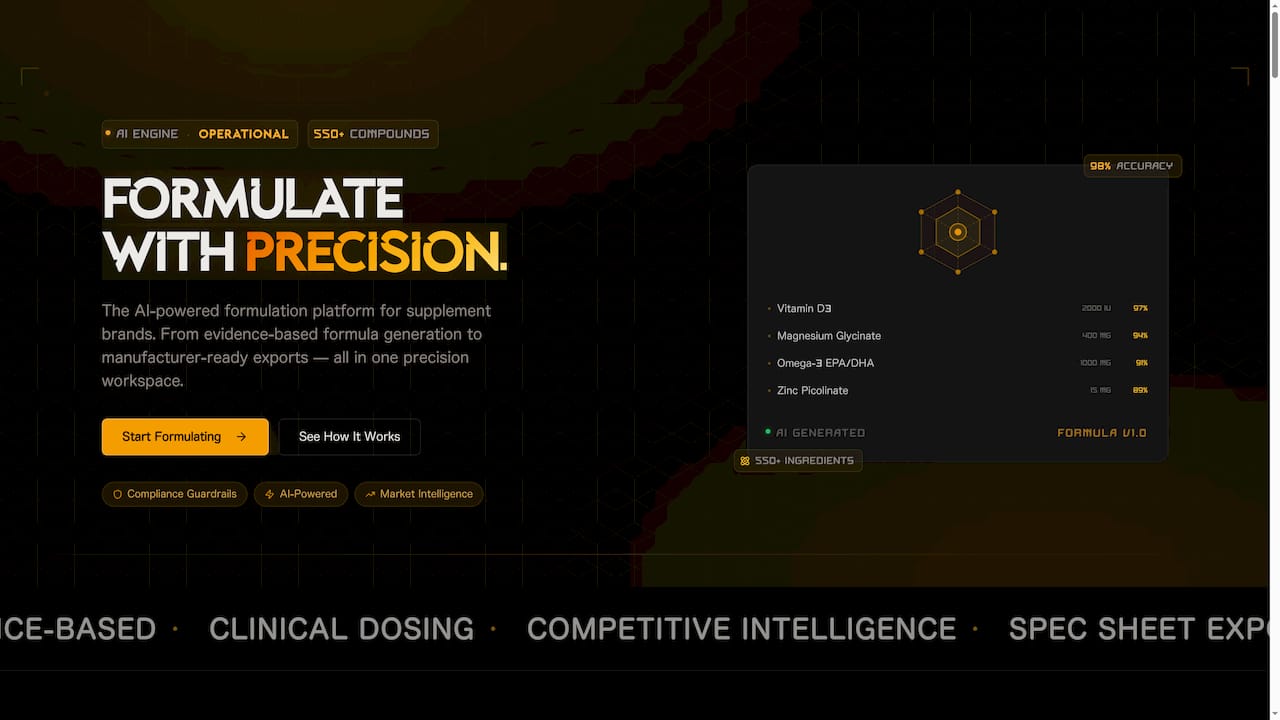
The platform's compliance tools align directly with FDA and DSHEA documentation requirements, and the formulation export function generates records your manufacturer can act on immediately. If you're building or reformulating a supplement line and want your ingredient functionality map embedded in the process from day one, start a Formlypro subscription at formlypro.com.
Primary references and further reading
- FDA Dietary Supplements Guidance — primary source for DSHEA requirements, NDI notifications, structure/function claim rules, and GRAS pathways; best for compliance teams
- AZTI: Ingredients with Technological Functionality — covers measurement methods (rheology, texture, dispersibility, thermal stability) and novel ingredient assessment; best for formulation and QA teams
- FSTDESK: Ingredient Functionality Mapping — practical framework for mapping ingredients to process exposures and measurable outcomes; best for R&D leads building or auditing their functionality documents
- Annual Reviews: Functional Foods — Efficacy Testing and Safety — peer-reviewed overview of evidence standards for health claims; best for regulatory and medical affairs teams
- Functional Foods: Boosting Wellness and Performance — accessible background on functional food categories and regulatory context; useful for brand and marketing teams aligning claims with formulation intent
- Kansas State University: Ingredient Function — foundational reference for carbohydrate, protein, lipid, and water functionality in food systems; best for teams onboarding new formulation staff