

TL;DR:
- Preventable compliance failures can lead to costly recalls and damage consumer trust.
- Building a dynamic, regularly reviewed compliance system is essential for ongoing regulatory readiness.
- Using platforms like FormlyPro can streamline documentation, supplier management, and hazard control processes.
Imagine investing 18 months developing a new product, only to have it pulled from retail shelves because of a missing allergen declaration or an outdated nutrition facts panel. Food recalls due to compliance errors can cost a brand millions and permanently damage consumer trust. The good news is that most compliance failures are preventable with the right structured approach. This guide walks you through every phase of a food product compliance checklist, from pre-launch documentation to supplier traceability, so you can go to market with confidence and avoid the costly surprises that catch brands off guard.
Table of Contents
- Preparing your compliance checklist: Key requirements before you start
- Step-by-step: Food safety and hazard controls
- Labeling compliance: From ingredients to allergens
- Supplier management and traceability: Controlling risk across your supply chain
- Why most checklists fail: The case for dynamic, living compliance processes
- Streamline compliance with FormlyPro
- Frequently asked questions
Key Takeaways
| Point | Details |
|---|---|
| Start with clear roles | Assign responsibility for compliance to a qualified individual before building your checklist. |
| Update your Food Safety Plan | Revisit your safety plan annually or after major changes to stay legally compliant. |
| Labeling matters | Get every detail right on your label to avoid costly recalls or market delays. |
| Traceability is a must | Keep lot-level records and supplier approvals to handle recalls efficiently. |
| Evolve your checklist | Make your compliance process a living document that adapts to new regulations and risks. |
Preparing your compliance checklist: Key requirements before you start
Before you open a spreadsheet or assign tasks, you need to build the structural foundation that makes a compliance checklist actually work. Without it, even the most detailed list becomes a box-ticking exercise that misses the real risks.
Assign your PCQI first. The Preventive Controls Qualified Individual (PCQI) is the person legally responsible for overseeing your Food Safety Plan. This role must be held by someone who has completed FDA-recognized training or has equivalent job experience. Everything flows through this person, so identify them before any other compliance activity begins.
Next, set up your documentation infrastructure. You will need organized spaces for:
- Supplier qualification records and Certificates of Analysis (COAs)
- Labeling templates and version history
- Sanitation and environmental monitoring logs
- Employee training records
- Recall and corrective action procedures
Cloud-based shared folders or compliance management software work best here because your team can update records in real time without version confusion.
Understanding regulatory compliance essentials is non-negotiable at this stage. FDA compliance under 21 CFR Part 117 Subpart B covers Current Good Manufacturing Practices (CGMPs) for human food, and these requirements affect nearly every operational area: facility sanitation, equipment maintenance, pest control, and employee hygiene. Every person on your production floor needs to understand what CGMPs require of their role.
Here is a quick snapshot of the key compliance categories and the tools you need for each:
| Compliance category | Required documentation | Recommended tool |
|---|---|---|
| Food Safety Plan | Hazard analysis, preventive controls | Shared doc or compliance app |
| CGMPs | Sanitation SOPs, training logs | Spreadsheet or quality system |
| Labeling | Label templates, approval records | Design software with version control |
| Supplier management | COAs, supplier agreements | Supplier qualification database |
| Traceability | Lot records, receiving logs | ERP or dedicated tracking system |
For a practical starting point, the small manufacturer FDA checklist from Bright Path Associates walks through facility-level expectations clearly.
Pro Tip: Build your compliance checklist in a shared cloud document from day one. When every team member can see current status, update their sections, and flag issues in real time, you eliminate the email chains and outdated PDFs that lead to compliance gaps at the worst possible moment.
Step-by-step: Food safety and hazard controls
Once your documentation framework is in place, the next priority is writing a Food Safety Plan that actually covers the hazards your product faces. This is not a formality. It is the backbone of your regulatory defense.
Your hazard analysis must be thorough and product-specific. Cover all four hazard categories:
- Biological hazards such as Listeria, Salmonella, and E. coli
- Chemical hazards including pesticide residues, cleaning chemical carryover, and mycotoxins
- Physical hazards like metal fragments, glass, or bone
- Allergen hazards covering cross-contact and undeclared allergens
For each identified hazard, your written plan must document the preventive control, the monitoring procedure, the corrective action if a deviation occurs, and verification activities. A written Food Safety Plan must include hazard analysis, preventive controls, and a recall plan as mandated by FDA.
One area that trips up many brands is understanding where HARPC (Hazard Analysis and Risk-Based Preventive Controls) differs from the older HACCP framework. HARPC under FSMA is broader than HACCP and requires supply chain controls, recall plans, and preventive controls for allergens and sanitation, not just critical control points. If your team was trained on HACCP, make sure they understand the FSMA additions.
For deeper guidance on integrating safety planning into your launch process, product development compliance resources can help you map controls to each development phase.
Warning: Relying solely on downstream controls, such as finished product testing, is not sufficient under FSMA. Preventive controls must be implemented throughout the process, not just at the end. Disclosure of hazards without documented mitigation is not a valid compliance strategy.
| Feature | HACCP | HARPC (FSMA) |
|---|---|---|
| Scope | Critical control points only | All hazards requiring control |
| Allergen controls | Optional | Required |
| Supply chain controls | Not required | Required |
| Review frequency | Varies | Every 3 years minimum |
Pro Tip: Schedule your Food Safety Plan review on your team calendar every three years at minimum, and flag it for immediate review any time you change a supplier, process, or facility. Regulatory auditors will ask for the date of your last reanalysis.
Labeling compliance: From ingredients to allergens
Labeling errors are the single most common driver of food product recalls. A missing allergen statement or an incorrect net weight can trigger a Class I or Class II recall, both of which are public, visible, and damaging. Getting your labels right before launch is essential.
Here is what every compliant food label must include, in order of priority:
- Statement of identity (what the product is)
- Net quantity of contents (weight, volume, or count)
- Ingredient list (in descending order by weight)
- Allergen declaration for all 9 major allergens
- Manufacturer, packer, or distributor contact information
- Nutrition Facts Panel (format must meet 21 CFR Part 101)
Food labels must include identity, net quantity, ingredient list, allergen declaration, manufacturer info, and Nutrition Facts per FDA guidance. Missing even one element can result in a hold or recall.

The nine major allergens you must declare in 2026 are milk, eggs, fish, crustacean shellfish, tree nuts, peanuts, wheat, soybeans, and sesame. Sesame was added as the ninth major allergen in January 2023, and many brands still have outdated label templates that do not include it.
Front-of-package labeling is also worth tracking closely. FDA has proposed new front-of-package labeling rules that would require standardized indicators for saturated fat, sodium, and added sugars. Implementation timelines have shifted, but proactive brands are already designing label layouts that can accommodate these additions.
Understanding the importance of label compliance before you finalize packaging artwork can save you from expensive reprints and launch delays.
Quick label do's and don'ts:
- Do verify allergen statements against your formulation after every ingredient change
- Do use the FDA's standardized Nutrition Facts Panel format exactly
- Don't use health claims without substantiation or authorized claim language
- Don't place net weight in a location other than the principal display panel
- Don't use fonts below the minimum size requirements for required label elements
Labeling accounts for more than 50% of all Class I food recalls in recent years, which makes this section of your checklist the most audit-sensitive area you will manage.
Supplier management and traceability: Controlling risk across your supply chain
Your product is only as compliant as its weakest ingredient source. Supplier management is where many brands cut corners and where auditors find the most issues.
For foods on the FDA's Food Traceability List (FTL), which includes leafy greens, shell eggs, nut butters, and certain cheeses, maintaining FTL records for receiving, transformation, and shipping with Key Data Elements is required to enable rapid mock recalls. These records must be retrievable within 24 hours of an FDA request.
For all other ingredients, a risk-based supplier qualification program is the standard expectation. Ingredient compliance for outsourced manufacturing requires approval, specification verification, risk-based supplier management, and traceability documentation. Here are the core steps:
- Collect and review current COAs for every ingredient before first use
- Verify supplier food safety certifications (SQF, BRC, FSSC 22000, or equivalent)
- Document your supplier approval decision with a written justification
- Align co-packer specifications with your own product spec sheet
- Maintain chain-of-custody records with lot numbers for every incoming shipment
See how this fits into your broader market-ready formulation steps to ensure supplier decisions tie back to your product goals.
| Record type | Minimum requirement | Common gap |
|---|---|---|
| Supplier COA | Current, product-specific | Using outdated or generic COAs |
| Lot traceability | Lot number linked to each batch | No lot-level receiving log |
| Supplier requalification | Annual review recommended | Set-and-forget approvals |
| Change management log | Document every spec change | Missing when co-packer substitutes ingredient |
The most common mistake brands make is approving a supplier once and never revisiting the qualification. Formulas change, suppliers change their own processes, and ingredients get substituted without notification. Build a requalification schedule into your checklist, and require written notification from co-packers for any ingredient substitution.
Why most checklists fail: The case for dynamic, living compliance processes
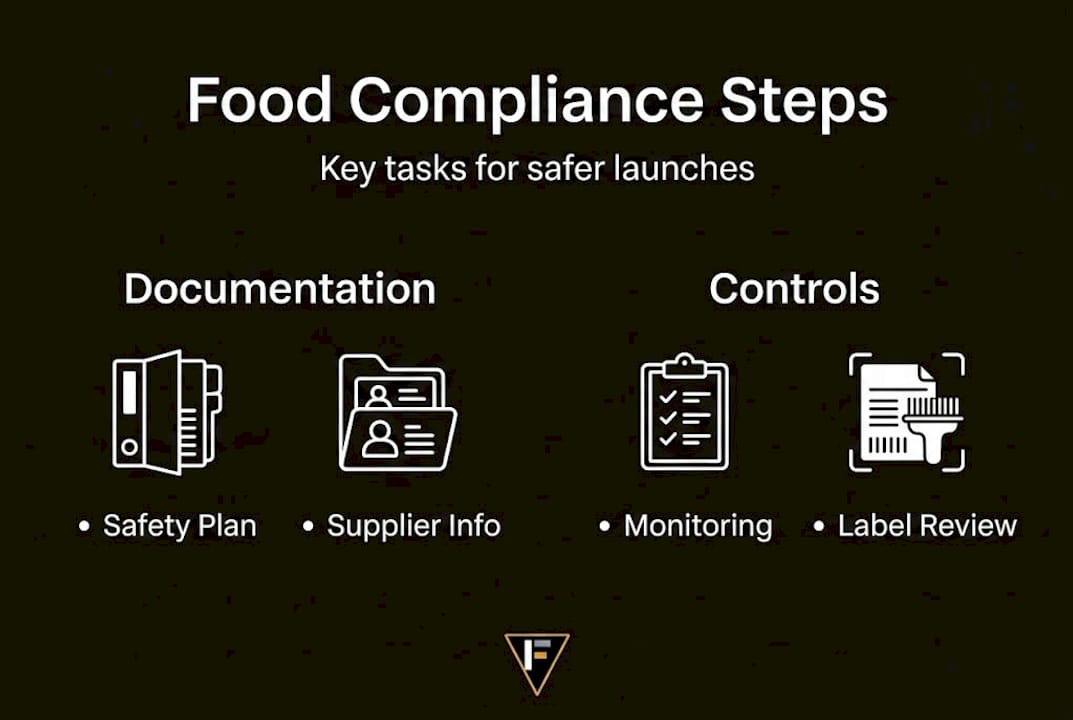
Here is the hard truth most compliance guides won't say out loud: a static checklist is almost useless in a regulatory environment that changes as frequently as food safety law does. Front-of-package labeling proposals, the sesame allergen addition, new FTL requirements, FSMA updates, all of these emerged after brands had already printed checklists and assumed they were done.
The brands that stay audit-ready don't rely on a document they built two years ago. They treat their compliance checklist as a living system, one that gets reviewed every six months at minimum and updated immediately when a new regulatory advisory drops or a supplier sends a change notice. Tying checklist reviews to specific business triggers, like new supplier onboarding, formula changes, or facility audits, keeps compliance from becoming reactive.
This is also a team ownership issue. When one person owns the checklist, everyone else ignores it. When every department head has a section they are accountable for reviewing, compliance culture spreads across the organization. Consumer goods compliance standards reinforce this point consistently. The brands that get recalled are rarely the ones that had no checklist. They are the ones that had a checklist no one updated.
Streamline compliance with FormlyPro
Building and maintaining a living compliance system from scratch takes serious time and technical knowledge that most brand teams simply don't have on hand. That's where FormlyPro comes in.
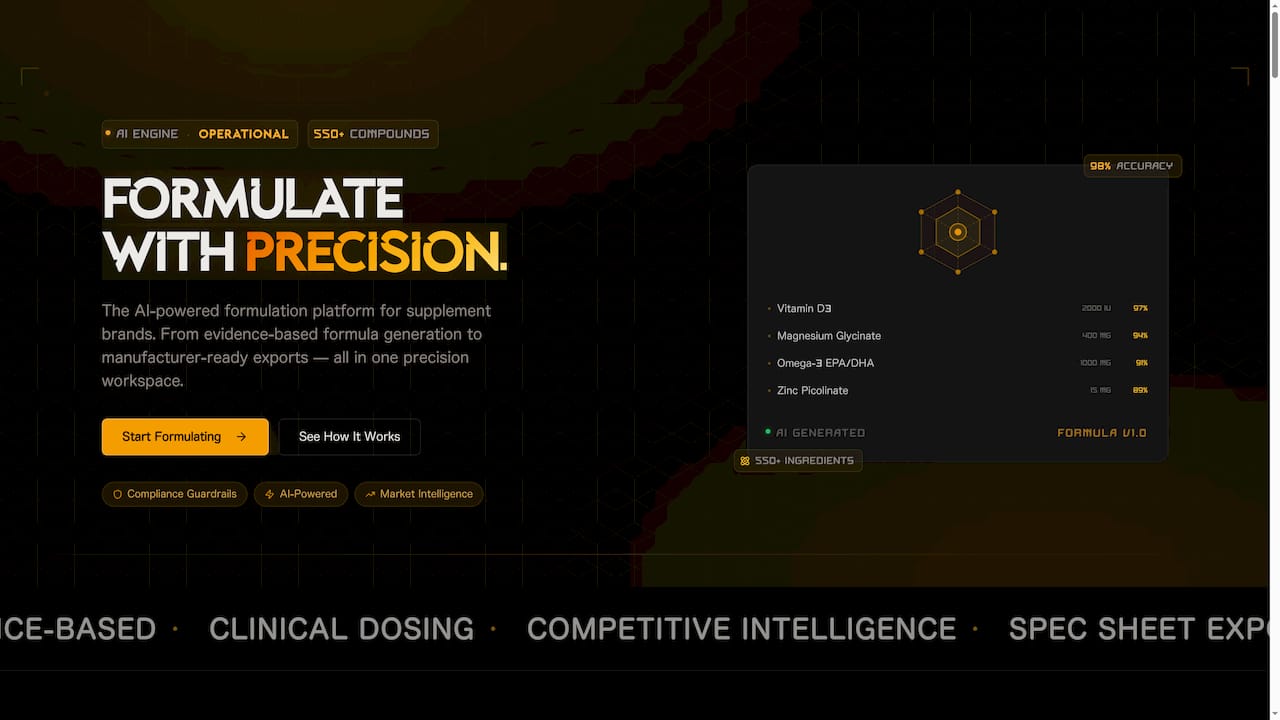
FormlyPro gives food brand managers and product developers pre-built compliance templates, digital recordkeeping workflows, and supplier management tools designed specifically for FDA requirements. The platform's 8-phase product development system guides you from ideation through formulation, labeling, and production, so nothing falls through the cracks. Whether you're starting with a practical product compliance guide or ready to automate your full compliance workflow, FormlyPro has a subscription tier built for where you are right now.
Frequently asked questions
What are the top 3 things to check before launching a new food product?
Verify your label meets FDA requirements, confirm all suppliers are approved and documented, and ensure your Food Safety Plan is written and current. These three items catch the majority of issues flagged during pre-market reviews.
How often should we re-analyze our Food Safety Plan?
Review and update your Food Safety Plan at least every three years, or after any significant process, ingredient, or supplier change. Waiting for the three-year mark after a major operational shift is a compliance risk.
Which allergens must be listed on U.S. food labels in 2026?
Milk, eggs, fish, crustacean shellfish, tree nuts, peanuts, wheat, soybeans, and sesame must all be declared as major allergens on labels. Sesame became the ninth required allergen in January 2023.
Are there special FDA requirements for traceability of certain foods?
Yes. Foods on the FDA Food Traceability List require detailed record-keeping for critical tracking events to support rapid recalls within 24 hours of an FDA request.