

Value proposition design (VPD) is a structured method for matching what you offer to what a specific customer actually needs, using the Value Proposition Canvas as your primary tool. Start right now by picking one customer segment and writing down the single most important job they are trying to get done. The canvas has two halves: a Customer Profile (Jobs, Pains, Gains) on the right and a Value Map (Products & Services, Pain Relievers, Gain Creators) on the left. Your goal is to make those two halves fit.
Table of Contents
- How a value proposition differs from a tagline or positioning statement
- What is the Value Proposition Canvas and how does it create fit?
- How to map your customer profile: jobs, pains, and gains
- How do you test and validate fit between your canvas halves?
- How to run a 90–120 minute Value Proposition Design workshop
- Common mistakes teams make when designing value propositions
- How the Value Proposition Canvas fits with the Business Model Canvas
- Your practical starter kit: templates, scoring, and the hypothesis cheat sheet
- Key Takeaways
- The canvas works best when it becomes a habit, not a one-time event
- Authoritative sources and further reading
How a value proposition differs from a tagline or positioning statement
A value proposition is a clear statement of the benefit a customer gets, the problem it solves, and why you are the right choice over alternatives. It is written for a specific customer segment, not for the general public. A tagline is a short, memorable phrase designed for brand recall ("Just Do It"). A positioning statement is an internal strategic document that defines your place in the competitive market. All three are related, but they serve different purposes and different audiences.
Two short examples show the difference:
Product-level example: A project management tool's value proposition might read: "For distributed engineering teams, our tool cuts meeting time by replacing status updates with automated progress tracking, so engineers stay in flow and managers always have a live view." That is specific, job-focused, and tied to a measurable outcome. The tagline for the same product might be "Work without interruption." The tagline is memorable; the value proposition is useful for product decisions.
Brand-level example: A supplement brand's value proposition could be: "We formulate clinically dosed, third-party tested products for serious athletes who are tired of proprietary blends hiding underdosed ingredients." The positioning statement behind it might read: "In the performance nutrition category, we occupy the transparency and efficacy position for evidence-driven athletes." Same brand, different documents, different jobs.
Effective value propositions share five qualities:
- Differentiation: It explains why you, not a generic alternative, as supported by competitive analytics.
According to Shopify's value proposition guide, the most practical layout is a headline, a short explanation, and three to five concrete benefits. That structure forces specificity and makes proof easy to add.
What is the Value Proposition Canvas and how does it create fit?
The Value Proposition Canvas is a one-page visual tool that maps your customer's reality on one side and your offer's response on the other. Strategyzer's library describes it as a tactical zoom-in on the Business Model Canvas, designed specifically to expose gaps between what customers need and what a product delivers.
The Customer Profile (drawn as a circle) captures three things: the jobs customers are trying to accomplish, the pains they experience while trying, and the gains they hope to achieve. The Value Map (drawn as a square) captures three corresponding things: the products and services you offer, the pain relievers those offerings provide, and the gain creators they enable.
Fit happens when your Value Map directly addresses the most important jobs, pains, and gains in the Customer Profile. You know fit is present when customers recognize their own situation in your messaging, when they convert without heavy persuasion, and when they stay because the product keeps delivering on the promise. Teams look for three signals: unprompted customer language that mirrors the canvas entries, measurable behavior change (conversion, retention, referral), and willingness to pay without a discount.
A printed or digital canvas template makes this concrete. The Interaction Design Foundation's VPC overview includes downloadable templates and annotated diagrams. Strategyzer also offers official canvas PDFs at strategyzer.com/canvas/value-proposition-canvas.
How to map your customer profile: jobs, pains, and gains
The Customer Profile is only as good as the research behind it. Skipping primary research and filling the canvas from internal assumptions is the single most common failure mode in VPD work. Start with interviews, then validate patterns with observation or survey data.
Interview and observation prompts
Use these during discovery interviews to surface real pains and gains:
- "Walk me through the last time you tried to do [job]. What happened?"
- "What was the most frustrating part of that process?"
- "What would make this feel effortless?"
- "What does success look like for you after this is done?"
- "What would make you trust a new solution enough to switch?"
Observation prompts: watch where customers pause, backtrack, or ask for help during a task. Those friction points are pains the customer may not articulate in an interview.
Pro Tip: Prioritize jobs, pains, and gains using a simple rule: frequency × severity × evidence. A pain that happens daily, causes significant cost or frustration, and appears in at least three separate interviews ranks higher than a pain that is theoretically severe but rarely mentioned. Build your Value Map around the top two or three entries, not the full list.
Mapping exercise example
Suppose your customer interview reveals this pain: "I spend two hours every Friday compiling a status report from five different tools, and it's always out of date by the time leadership reads it."
The pain reliever hypothesis: "Our platform pulls live data from your existing tools and generates a formatted status report in under three minutes, so leadership always sees current numbers."
The hypothesis template to test it: "We believe that [customer segment] will [desired behavior] because [pain reliever or gain creator]. We will know this is true when [measurable outcome]."
Applied: "We believe that distributed engineering managers will book a demo after seeing the auto-report feature because it directly removes their Friday reporting pain. We will know this is true when demo-to-trial conversion shows a meaningful increase."
How do you test and validate fit between your canvas halves?
Strategyzer cautions that VPD is an iterative, test-driven discipline. Mapping the canvas is not the finish line; it is the starting line for a series of experiments that prove or disprove fit. Teams that treat the canvas as a final deliverable rather than a hypothesis board consistently miss the point.
| Experiment | What it proves | Sample metric |
|---|---|---|
| Customer discovery interview | Whether the job, pain, or gain is real and prioritized | Pain mentioned unprompted by 3+ of 5 interviewees |
| Concierge test | Whether customers will pay for the outcome, even manually delivered | Willingness to pay confirmed by 2+ paying pilots |
| Landing page A/B test | Whether the proposition resonates enough to drive action | Click-through or sign-up rate above baseline |
| Usability task test | Whether the product actually relieves the pain in practice | Task completion rate, time-on-task, error count |
| Retention cohort analysis | Whether customers return because the gain is real | Week-4 retention above category benchmark |
North-star signals for fit: conversion without heavy discounting, organic referral from existing customers, and retention that holds after the initial novelty period. Leading indicators tied directly to canvas entries include the percentage of customers who cite a specific pain in onboarding surveys, feature adoption rates for the pain-relieving feature, and net promoter score segmented by job type.
Investopedia's value proposition guide emphasizes using research-backed proof when refining messaging. Metrics like conversion lift, retention rate, and willingness to pay are the clearest proof that your proposition is working. Track them from the first experiment, not after launch.
For supplement and wellness brands, data-driven formulation decisions follow the same logic: the hypothesis is the formulation claim, and the experiment is the market response.
How to run a 90–120 minute Value Proposition Design workshop
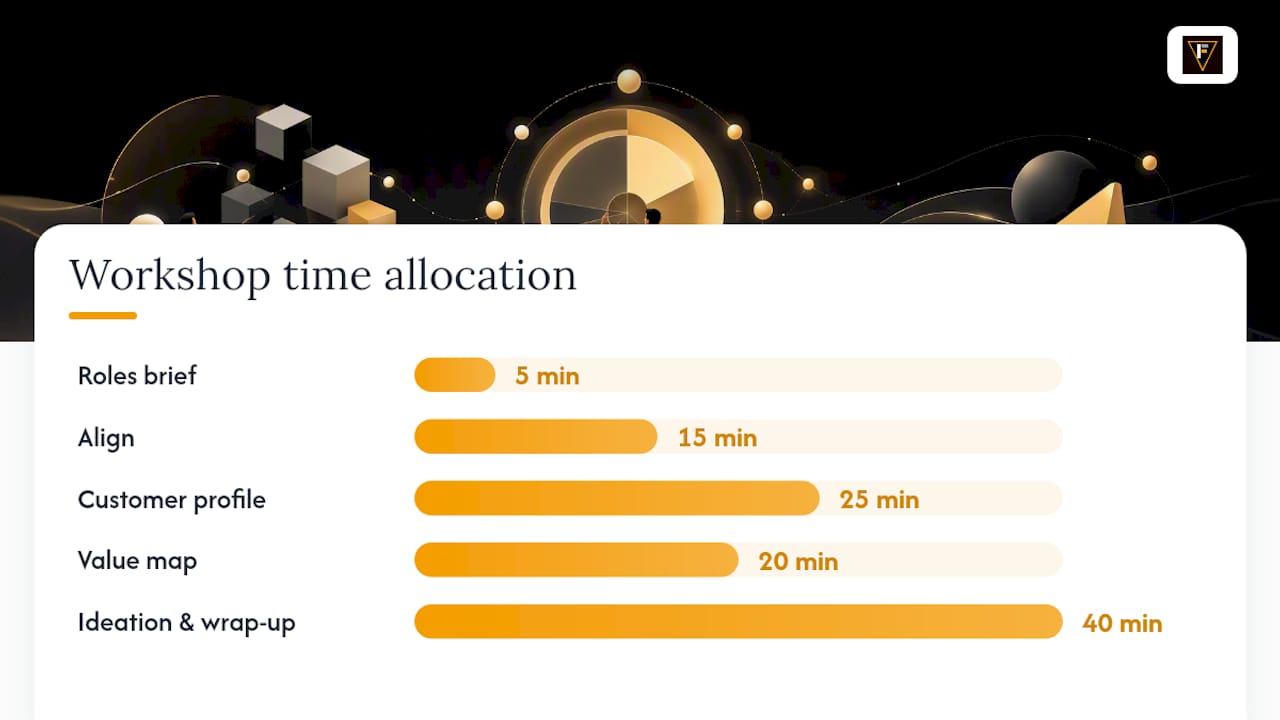
A well-run workshop turns a blank canvas into three testable hypotheses and a clear next experiment. Here is a timed agenda that works for teams of four to eight people.
Roles to assign before the session:
- Facilitator: Keeps time, prevents groupthink, and pushes for specificity.
- Note-taker: Captures exact customer language from research shared in the session.
- Domain expert: Brings customer interview data, usage analytics, or sales call recordings.
- Decider: Has authority to prioritize when the group disagrees.
Brief each role in five minutes before the session starts. The facilitator should remind the group that the canvas is a hypothesis board, not a strategy document.
Workshop agenda:
-
Align (15 minutes): Share the customer segment, the research evidence, and the one job the team is designing for. The domain expert presents three to five customer quotes or behavioral data points. The decider confirms the segment is the right one to focus on.
-
Map the Customer Profile (25 minutes): Working individually for ten minutes, each participant writes jobs, pains, and gains on sticky notes (one per note). Cluster and deduplicate as a group for fifteen minutes. Vote on the top three in each category.
-
Map the Value Map (20 minutes): Map existing or proposed products and services to the prioritized pains and gains. Identify gaps where no current offering addresses a top pain or gain.
-
Ideate and prioritize (15 minutes): Generate pain relievers and gain creators for the gaps. Use the frequency × severity × ease-of-test rule to rank them.
-
Write hypotheses (15 minutes): Convert the top three pain relievers or gain creators into testable hypothesis statements using the template from Section 6.
-
Assign next steps (10 minutes): Agree on one experiment per hypothesis, name the person responsible, and set a two-week deadline.
Deliverables checklist:
- Completed canvas with prioritized jobs, pains, gains, pain relievers, and gain creators
- Three written hypotheses in the "We believe / We will know" format
- One assigned experiment per hypothesis with a named owner and deadline
For teams moving from a validated proposition into formulation or product development, market-ready formulation steps provide a practical handoff from hypothesis to production.
Common mistakes teams make when designing value propositions
Even experienced product teams fall into predictable traps. Knowing them in advance is faster than discovering them mid-sprint.
Common mistakes:
- Treating VPD as a copywriting exercise. The canvas is a research and hypothesis tool. Writing better marketing copy is a downstream output, not the goal.
- Trying to solve every pain on the canvas. A value proposition that addresses twelve pains addresses none of them credibly. Focus on the top two.
- Relying entirely on internal assumptions. If the team fills the Customer Profile without a single customer interview, the canvas reflects the team's beliefs, not the customer's reality.
- Confusing features with pain relievers. "We have an API" is a feature. "You can connect your existing tools without rebuilding your workflow" is a pain reliever.
- Declaring fit too early. Positive feedback in a demo is not fit. Fit is proven by behavior: payment, retention, referral.
Quick practical tips:
- Limit each canvas to one customer segment and one to two primary jobs. Multiple segments on one canvas produce a blurred proposition.
- Test the smallest, riskiest assumption first. If the core job is not real, nothing else on the canvas matters.
- Use exact customer language in your proposition, not internal jargon. If a customer said "I'm drowning in spreadsheets," that phrase belongs in your messaging.
- Revisit the canvas every quarter. Customer priorities shift, and a proposition that fit six months ago may not fit today.
Pro Tip: The most common failure mode is skipping primary research and building the canvas from internal opinions. One rule prevents it: no canvas entry is valid unless it came from a customer's mouth or a customer's behavior. If you cannot cite the source of a job, pain, or gain, remove it from the canvas.
How the Value Proposition Canvas fits with the Business Model Canvas
The VPC and the Business Model Canvas (BMC) are designed to work together, not compete. Strategyzer positions the VPC as a zoom-in on two of the BMC's nine blocks: the Value Proposition block and the Customer Segment block. Once you have proven fit at the canvas level, you hand off to the BMC to design the business model that delivers and captures value at scale.
| Dimension | Value Proposition Canvas | Business Model Canvas |
|---|---|---|
| Primary question | Does our offer fit what this customer needs? | Can we build a viable business around this offer? |
| Primary outputs | Prioritized jobs, pains, gains; testable hypotheses | Revenue streams, cost structure, key partners, channels |
| When to use it | Discovery, early validation, repositioning | After fit is proven; scaling and business model design |
| Risk it addresses | Customer fit risk | Business model and financial viability risk |
| Switch trigger | When fit is validated by customer behavior | When the business model needs stress-testing before scaling |
The recommended handoff sequence: run the VPC first to validate customer fit, then move to the BMC to design the delivery and capture model, then run experiments at the business model level before committing to scale. Skipping the VPC and going straight to the BMC is common and expensive: teams build a complete business model around a proposition nobody has validated.
For supplement and wellness brands, cost-saving formulation tactics become relevant at the BMC stage, when operational feasibility needs to match the validated proposition.
Your practical starter kit: templates, scoring, and the hypothesis cheat sheet
You do not need to build materials from scratch. Here is what to gather before your first session.
Templates to download:
- Official Value Proposition Canvas: — Available at strategyzer.com/canvas/value-proposition-canvas as a free PDF. Print it at A0 or use the digital version in Miro or MURAL.
- One-page hypothesis template: The YourTenet VPD guide includes a hypothesis sheet format. Alternatively, use the "We believe / We will know" structure from Section 6 directly in a shared doc.
Prioritization scoring:
Use this formula before the workshop to rank which jobs, pains, and gains to focus on:
Priority score = Frequency × Severity × Ease of test. Focus the workshop on the top two or three scores. Anything below the median can wait.
One-page hypothesis template: what to capture
A good hypothesis sheet captures six fields:
Filling all six fields forces the team to be specific. A hypothesis with a vague success metric is not a hypothesis; it is a wish. Investopedia's guidance on credible value propositions makes the same point: proof elements and measurable outcomes are what separate a strong proposition from a marketing claim.
For teams that want a faster path from hypothesis to validated proposition, consumer insights strategy provides a framework for integrating research into brand decisions from the start. Brand positioning approaches and startup marketing tactics can also sharpen how you translate a validated canvas into go-to-market messaging.
Key Takeaways
Value proposition design works when teams treat the canvas as a hypothesis board, run primary customer research before mapping, and validate fit through experiments before scaling.
| Point | Details |
|---|---|
| Start with one job | Pick one customer segment and one primary job before filling any other canvas section. |
| Research before mapping | Every canvas entry needs a source: a customer quote, an interview, or observed behavior. |
| Fit requires evidence | Positive demo feedback is not fit; payment, retention, and referral are the real signals. |
| VPC before BMC | Validate customer fit with the canvas first, then design the business model around proven hypotheses. |
| Hypotheses need metrics | Every hypothesis needs a specific, observable success metric before the experiment starts. |
The canvas works best when it becomes a habit, not a one-time event
Most teams run a VPD workshop once, file the canvas, and never return to it. That is the wrong way to use the tool. Customer priorities shift, markets move, and a proposition that fit your segment twelve months ago may be losing ground to a competitor who ran three more experiments while you were executing on the original plan.
The teams that get the most from value proposition design treat the canvas as a living document. They revisit it at the start of every product cycle, update it when customer interviews surface new language, and use it to pressure-test feature decisions before committing engineering time. The canvas is not a strategy artifact; it is a thinking tool, and thinking tools work only when you use them regularly.
There is also a subtler point worth making: the canvas forces a discipline that most product conversations lack, which is the discipline of separating what you believe from what you know. "We believe customers hate manual reporting" is a hypothesis. "Three of five interviewed managers said they spend two hours every Friday on status reports they consider low-value" is evidence. The canvas makes that distinction visible and uncomfortable in the best possible way.
For supplement and wellness brands running this process, Formlypro's 8-phase product workflow, built-in competitor analysis, and compliance guidance compress the gap between a validated proposition and a market-ready product. If your hypothesis is proven and you need to move fast from formulation to launch, Formlypro is built for exactly that handoff.
Authoritative sources and further reading
- Value proposition: win customers & drive business growth
- Value proposition canvas: a tool to understand what customers really want — Strategyzer library
- Creating a value proposition - HBS Online
- Value Proposition: How To Write One and Examples (2026) - Shopify
- Value proposition — Wikipedia
- How to Create a Compelling Value Proposition, With Examples - Investopedia
- What is The Value Proposition Canvas — updated 2025 | IxDF
- Value proposition design: The complete guide to creating products customers actually want