

TL;DR:
- Many brands fail to validate consumer demand before large investments, leading to costly failures. Concept validation tests early ideas with target audiences to prevent building products that lack genuine market interest. Implementing structured, evidence-based validation processes reduces risk, saves resources, and increases the likelihood of market success.
Most founders and brand owners believe a great idea is enough. It isn't. Some of the most well-funded consumer goods launches in history have flopped not because of poor execution, but because nobody confirmed real demand before committing millions to production, distribution, and marketing. Concept validation exists precisely to close this gap: it tests early ideas with actual target consumers to check resonance and purchase intent before significant development investment is made. This guide breaks down what validation really is, why it belongs at the front of your process, and exactly how to do it in a way that produces actionable learning rather than false confidence.
Table of Contents
- What is product concept validation?
- Why validation matters: Avoiding costly mistakes
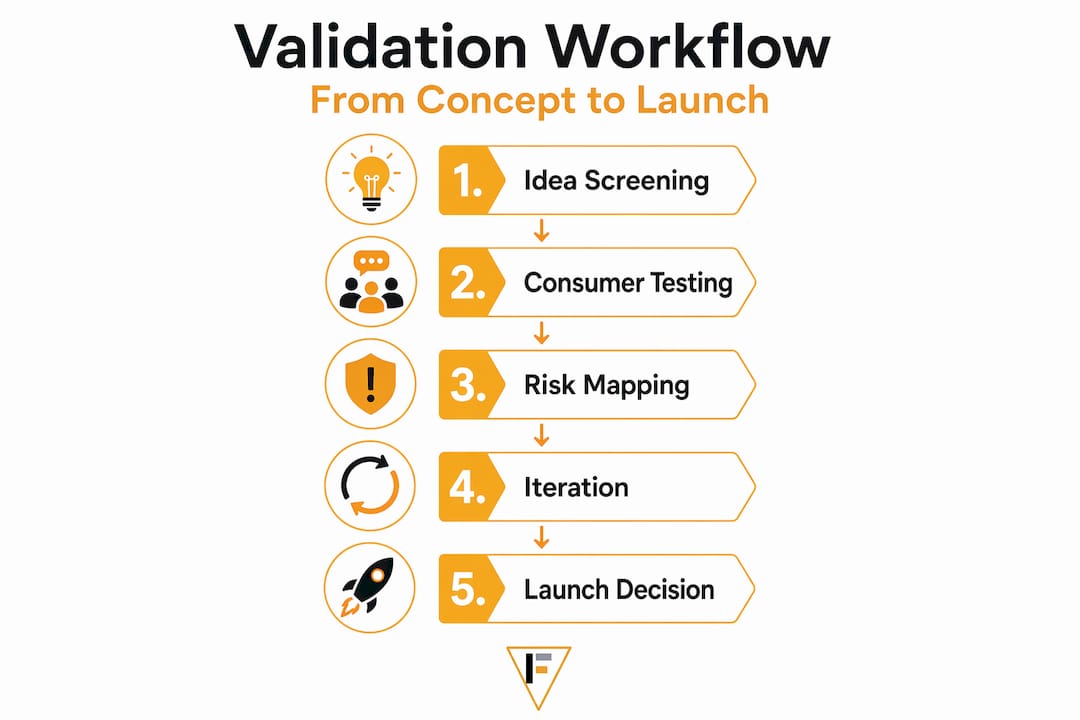
- Frameworks for validation: From idea to launch
- What to validate (and how): Keys for consumer goods%3A-keys-for-consumer-goods)
- Turning validation into better decisions
- A better way: How to make validation truly work for your brand
- Supercharge your concept validation with FormlyPro
- Frequently asked questions
Key Takeaways
| Point | Details |
|---|---|
| Early validation reduces risk | Testing with consumers up front prevents costly missteps before major investments are made. |
| Validate real behaviors | Surveys are not enough—test if people will actually buy or switch for your concept. |
| Frameworks improve results | Stage-Gate and similar frameworks ensure validation is systematic and decision-based. |
| Test all key elements | Claims, packaging, positioning, and price must each be validated, not just the product’s look. |
| Validation guides next steps | A failed test reveals what to fix or pivot, helping you iterate towards a winning solution. |
What is product concept validation?
Product concept validation is the process of exposing an early product idea to your target consumer and measuring whether it solves a real need, generates genuine interest, and creates purchase intent. It is not the same as formulation testing, packaging focus groups, or post-launch consumer surveys. Those activities serve a different purpose: optimizing something you've already decided to build. Validation asks a harder, earlier question: Should we build this at all?
According to concept validation principles, the goal is to evaluate ideas with target users to check resonance and purchase intent in a low-risk early stage, helping teams avoid building the wrong thing. The emphasis on low-risk is critical. At the concept stage, nothing is locked in. You haven't finalized your claims, committed to a manufacturer, or designed your retail packaging. That openness is exactly what makes this stage so valuable for testing.
Here's a quick breakdown of where concept validation fits relative to other research types:
| Research type | When it happens | Core question |
|---|---|---|
| Concept validation | Pre-development | Should we build this? |
| Formulation testing | Mid-development | Does this formula perform well? |
| Packaging research | Late development | Does this packaging communicate the right message? |
| Post-launch tracking | After launch | Are consumers buying and staying loyal? |
What separates leading brands from brands that burn through R&D budgets is how early they validate. Validation should happen before you make major commitments to:
- Formulation ingredients or manufacturing agreements
- Label claims and regulatory positioning
- Pricing strategy and channel fit
- Brand narrative and packaging hierarchy
Formal product innovation systems such as Stage-Gate models codify this thinking. They organize development into defined stages with structured "gates" at each transition point. Passing through a gate requires evidence, including consumer validation data, that justifies proceeding to the next, more expensive phase. This approach treats validation not as a nice-to-have, but as a systematic risk management tool built directly into the process of creating market-ready formulations.
Why validation matters: Avoiding costly mistakes
The consumer packaged goods industry is brutal. Retail shelf space is competitive, consumer attention is scarce, and product failure rates remain stubbornly high. The consequences of skipping validation are not abstract; they show up as wasted R&D spend, unsold inventory sitting in warehouses, and distribution deals that quietly disappear after poor velocity.
"Validate product concepts to reduce the risk and waste of investing in ideas that do not resonate with the target audience, before significant development investment."
Think about a CPG brand that spends nine months developing a premium functional beverage, builds out co-manufacturing relationships, designs a full packaging suite, and only then puts it in front of consumers. The response is lukewarm. Shoppers don't understand what problem it solves. The price point feels high relative to the perceived benefit. The brand has to discount, repackage, or exit. Every one of these outcomes was foreseeable with four weeks of structured concept testing upfront.
The most common types of avoidable waste include:
- Excess R&D spend on formulations that don't align with what consumers actually want
- Manufacturing investment in tooling, minimums, and setup costs for products nobody buys
- Marketing spend used to push a product into a market that simply doesn't want it
- Distribution pipeline waste when retail placement doesn't convert to sales velocity
- Team time and morale lost on projects that validation would have redirected earlier
The leverage point is timing. Consumer concept testing is especially powerful early on because packaging, claims, positioning, and pricing decisions are not yet locked in. You can pivot a concept based on consumer feedback for almost zero cost. You cannot pivot a fully developed product at the same cost.
Pro Tip: Map your concept validation to your highest-risk assumptions, not your most exciting ones. What does your idea need to be true to succeed? Test those first. Learn more about how common product development mistakes often trace back to skipped validation steps.
Frameworks for validation: From idea to launch
Understanding why validation matters is only part of the picture. You also need a process that structures when and how it happens. This is where formal frameworks earn their keep.
Stage-Gate-based innovation frameworks organize product development into sequential stages separated by decision checkpoints called gates. At each gate, a cross-functional team reviews available evidence and decides whether to continue, pause, or kill the project. Concept validation data is one of the primary inputs at early gates.

Here's how this contrasts with ad hoc approaches that many early-stage brands default to:
| Factor | Ad hoc process | Stage-Gate process |
|---|---|---|
| Validation timing | After development begins | Before each major investment |
| Decision criteria | Internal enthusiasm | Consumer and market evidence |
| Kill/pivot decisions | Rare and emotional | Structured and evidence-based |
| Resource allocation | Front-loaded on favorites | Distributed across validated concepts |
| Compliance integration | Late or reactive | Built in at each gate |
The numbered milestones inside a structured validation process typically look like this:
- Define core assumptions about who the consumer is, what problem exists, and why your concept is the best solution
- Develop concept stimuli (concept boards, descriptions, or rough mockups) that communicate the idea without over-engineering it
- Run consumer research including surveys, focus groups, or one-on-one interviews with your target segment
- Score against gate criteria such as purchase intent thresholds, need-gap scores, and uniqueness ratings
- Conduct a gate review with clear go, kill, or recycle outcomes tied to the evidence
- Iterate or advance based on findings, either refining the concept or progressing to prototype development
When your validation process is this structured, it also becomes far easier to build in successful product compliance strategies from the start rather than discovering regulatory obstacles after formulation is complete.
What to validate (and how): Keys for consumer goods
Not everything about a product concept needs validation at once. Knowing what to test and in what sequence is what separates productive validation from research theater.
The most critical elements to test in consumer goods include:
- Consumer need and relevance: Does your target customer recognize this problem as real and important in their life?
- Key claims: Which claims resonate most and which fall flat or create skepticism?
- Packaging hierarchy: What information do consumers read first, and does it match what matters to the purchase decision?
- Price threshold: What price range feels acceptable, and where does perceived value break down?
- Differentiation: Does the concept feel distinct from existing alternatives, or is it seen as "just another" option?
- Purchase intent and switching potential: Would consumers actually buy this, and would they switch from their current choice?
CPG concept testing should measure more than just "liking." Liking is a vanity metric in consumer research. What you actually need is purchase intent data, switching behavior signals, and positioning clarity relative to what already exists in the category.
This brings up one of the most underappreciated risks in concept validation: the false positive. Survey-only validation can be misleading if it captures social approval or internal optimism rather than real commitment behavior like paying or purchasing. Consumers are naturally polite in surveys. They say they'd buy things they'd never actually pick off a shelf.
Pro Tip: Design your validation tests to prove yourself wrong, not to get approval. If your concept can't survive a skeptical consumer panel or a real-money pre-order test, it cannot survive a retail shelf. Connect this thinking to innovation-driven product ideation to ensure every idea you validate is built on a solid strategic foundation.
The real signal comes from behavioral tests: willingness to pay a specific dollar amount, interest in pre-ordering, or preference in a forced-choice comparison against competitive products already on the market.
Turning validation into better decisions
What happens when a concept fails validation? This is where most teams go wrong. They either kill the concept entirely without understanding why it failed, or they dismiss the research and proceed anyway because internal enthusiasm is high. Both responses waste the signal.
Post-mortem consumer research after a failed concept should diagnose which specific failure mode occurred, whether it was a competitive gap, a commercial model problem, or a communication failure, and identify the additional probes needed such as explicit competitive comparison, price threshold testing, or channel fit assessment. Repeating the same internal narrative without diagnosing the failure mode is how brands get stuck in expensive loops.
Here's how to turn a failed validation into a useful decision:
- Identify the failure mode: Was it a pricing problem, a communication problem, or a real need problem? These require very different responses.
- Reframe the positioning: If the need is real but the message isn't landing, retest with a revised concept statement before abandoning the idea.
- Test competitive context: Show consumers your concept alongside real competitor products and measure preference, not just stand-alone appeal.
- Establish a price floor and ceiling: Use price sensitivity questions to identify where value and cost align for your segment.
- Pivot the format or channel: Sometimes the concept is sound but the format (size, packaging type, retail vs. DTC channel) is what's misaligned.
Pro Tip: Use consumer research not only for green lights but as a compass toward your next best move. Even a failed concept should tell you something specific about what your target consumer does want. Use that signal to inform your next iteration rather than starting from scratch. A strong food market research guide will help you structure these probes systematically across product categories.
Prioritizing investment in concepts that show clear, actionable demand is how capital-efficient brands outperform larger competitors with bigger budgets. Validation is a filter, not a formality.
A better way: How to make validation truly work for your brand
Here's an uncomfortable truth most validation guides won't say out loud: a lot of "concept validation" that brands run is structurally designed to produce confirmation, not learning. Internal teams present the idea, consumers nod politely, and the brand proceeds with its original plan. Nothing was actually tested. A concept study that cannot produce a "no" outcome isn't validation. It's theater.
Real validation requires real stakes or outcomes. The test must be designed in a way that could actually force a team to abandon or fundamentally change their concept. If the research design has no mechanism for that outcome, the results are meaningless regardless of how large or expensive the study was.
The brands we see succeed over the long term are the ones that have genuinely internalized being proven wrong early as a competitive advantage. They learn faster. They spend less on misaligned development. And they enter the market with sharper concepts because they've already stress-tested them against real consumer skepticism.
Vanity metrics are the enemy here. High "overall liking" scores on concept boards have almost no predictive value for retail success if they're not paired with specific purchase intent, price acceptance, and switching behavior data. Teams that celebrate a 75% liking score and treat it as validation are measuring the wrong thing.
Treat every validation study as a hypothesis test. Write down the explicit assumption your concept depends on. Design the research to test that assumption directly. If it holds, advance with genuine confidence. If it fails, look at our guide on pitfalls to avoid in validation and reframe before spending another dollar on development.
The best brands treat validation as a learning tool, not a launch hurdle. That mindset shift is worth more than any individual research study.
Supercharge your concept validation with FormlyPro
Concept validation is only powerful when you have the right data, structure, and tools to act on it quickly.
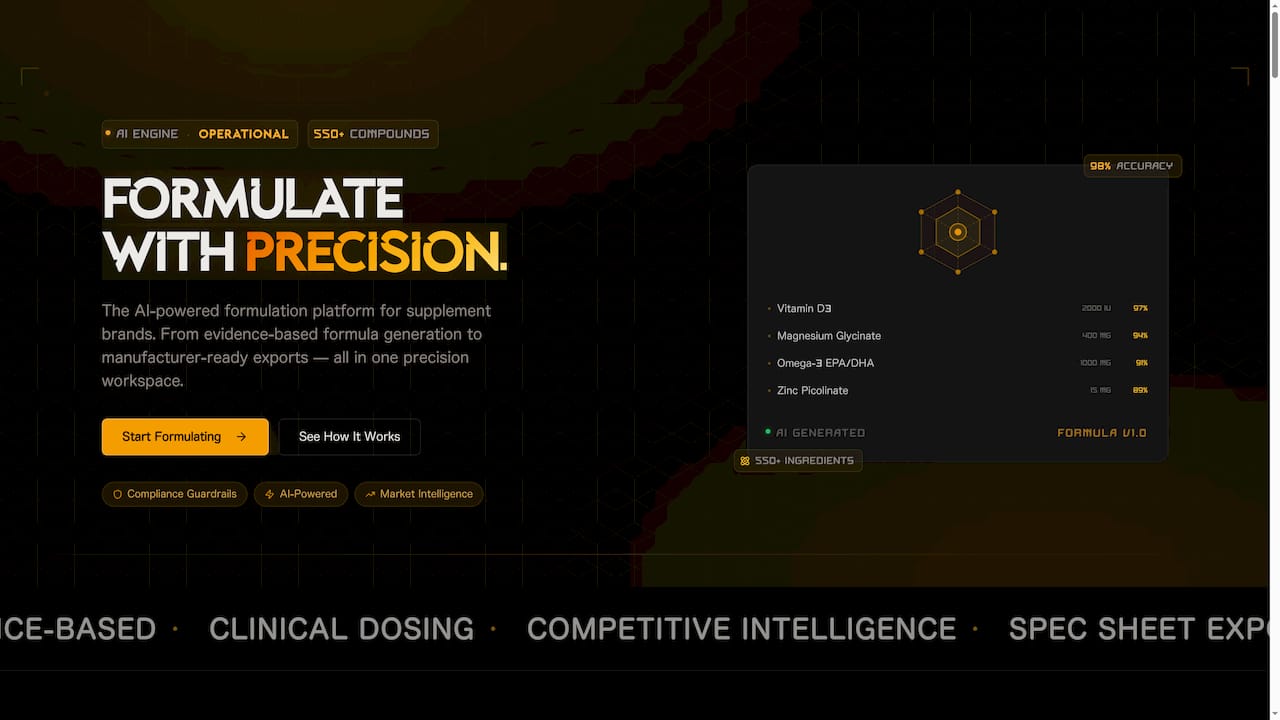
FormlyPro gives brand owners and product developers an integrated platform that covers every stage of the validation and development process. From built-in market research and competitor analysis tools that show you what's actually selling and what those formulations contain, to an 8-phase product development roadmap that takes you from ideation through compliance, prototyping, and production. FormlyPro also includes an AI Mockup designer for custom packaging so you can visualize and refine your concept before committing to anything. Stop validating with guesswork and start launching with the data-backed confidence that separates products that sell from products that sit.
Frequently asked questions
What is the main purpose of validating a product concept?
The main purpose is to reduce risk and confirm your idea resonates with the target audience before committing to heavy development investment. It filters out weak concepts while they can still be changed or killed at low cost.
How does validation differ from product testing?
Validation asks whether you should build the idea at all, while product testing focuses on optimizing an idea already in development. They serve different stages and different strategic questions.
Which aspects of a consumer product should be validated?
You should validate claims, packaging hierarchy, pricing thresholds, and overall consumer need, not just surface-level interest. Packaging and claims are especially critical to test early because they're costly to change later.
Are surveys alone enough to validate a concept?
No. Survey-only validation can capture social approval rather than real purchasing behavior, leading to false positives. True validation incorporates behavioral signals like willingness to pay a specific price or forced-choice comparisons with real alternatives.