

TL;DR:
- Consumer insights go beyond data to reveal the reasons behind customer behavior and inform strategic decisions.
- They prevent product failures by understanding unmet needs and emotional drivers, directly impacting revenue growth.
- Effective integration of insights into decision workflows ensures that validated findings actively shape product development and marketing strategies.
Most marketing teams think they understand their customers. They have dashboards, quarterly reports, and CRM data that confirms what they already believe. But that is not consumer insight. The role of consumer insights goes far deeper than data collection. It is the practice of interpreting why customers behave the way they do, and translating that understanding into decisions that actually move a business forward. If your team treats insights as reports to be filed rather than decisions to be made, this article is going to change how you think about that.
Table of Contents
- Key takeaways
- The real role of consumer insights in your strategy
- The consumer insights analyst as decision partner
- Modern tools and data sources for consumer insights
- Embedding insights into decision-making workflows
- Applying consumer insights to product and marketing outcomes
- My honest take on where most teams go wrong
- How Formlypro puts consumer insights to work for your brand
- FAQ
Key takeaways
| Point | Details |
|---|---|
| Insights reveal the "why" | Consumer insights explain motivations behind behavior, not just what customers do. |
| Poor insights kill products | Nearly 30,000 products vanish from shelves annually because brands skipped validated consumer input. |
| Analysts are decision partners | The modern insights analyst connects raw data to business recommendations, not just research reports. |
| AI changes the speed equation | Generative AI enables continuous, smaller research cycles that replace slow, expensive annual studies. |
| Execution gaps waste insights | Validated insights that never reach decision-makers deliver zero return on investment. |
The real role of consumer insights in your strategy
Consumer insights are not a synonym for market research, and that distinction matters more than most brand teams realize. Market research tells you what is happening. Consumer insights tell you why it is happening and what to do about it. Consumer insights reveal the "why" behind customer actions, functioning as a decision engine that drives product development, messaging strategy, and retention.
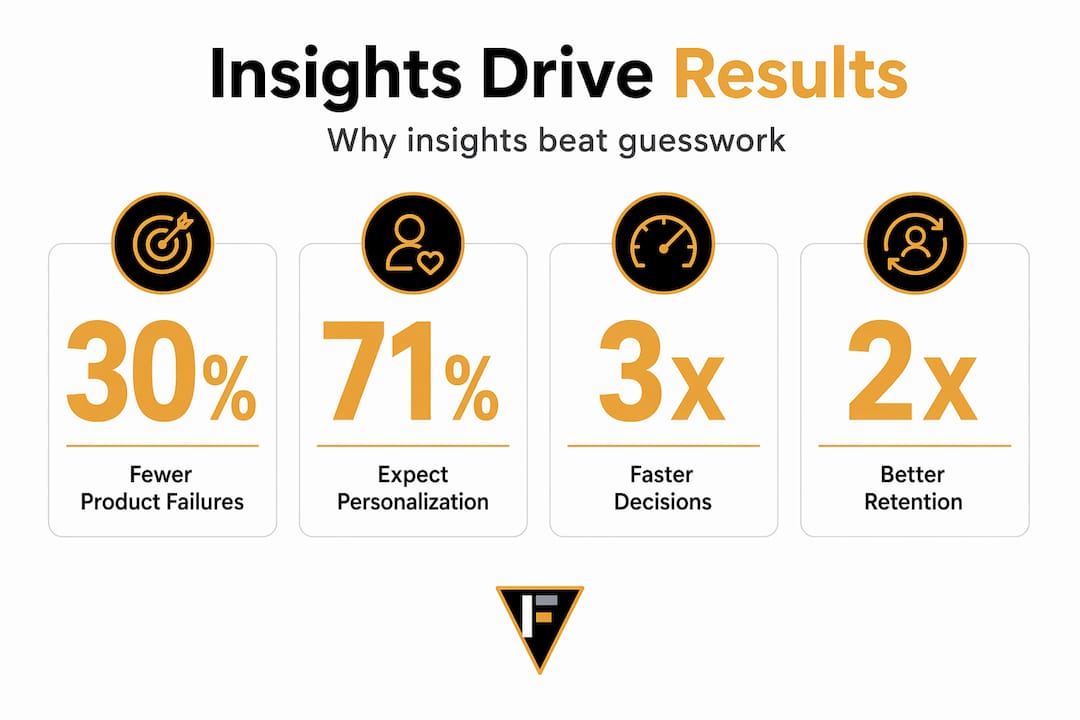
The importance of consumer insights becomes obvious when you look at failure rates. Nearly 30,000 new products disappear annually because brands launched without understanding what their customers actually needed. That is not a supply chain problem or a distribution problem. It is an insight problem. Brands moved forward on assumptions instead of validated understanding.
The advantages of consumer insights show up directly in revenue performance. Companies with mature insights capabilities grow revenue 2.5x faster than their peers. That gap is not explained by bigger budgets or better products alone. It is explained by the quality of decisions those companies make before a product ever ships or a campaign ever runs.
Here is what good consumer behavior analysis actually catches:
- Unmet needs that customers cannot yet articulate, which is where the most defensible product opportunities live
- Friction points in the purchase journey that suppress conversion without triggering obvious complaints
- Emotional drivers behind loyalty and churn that no satisfaction survey will surface on its own
- Segment-level variation in how different groups respond to the same product or message
Pro Tip: 71% of consumers expect personalized interactions, which means understanding customer needs at the segment level is no longer a differentiator. It is the baseline expectation your marketing has to meet.
The impact of consumer insights also works defensively. Early insight tracking can identify churn risks before customers disengage, giving your retention team a window to act. By the time a customer stops buying, the signal was already in the data weeks earlier.
The consumer insights analyst as decision partner
The consumer insights analyst role has changed significantly in the past five years, and most organizations have not caught up with what that role actually requires. This is not a data analyst who builds dashboards. It is not a traditional market researcher who designs surveys and writes topline reports. Consumer insights analysts connect data to decisions, reducing the cost of error and enabling confident business action.
The core workflow for a high-performing analyst looks like this:
- Observe. Pull from multiple data sources simultaneously. A single source is almost always misleading. CRM behavior, social sentiment, search data, and direct qualitative feedback paint a picture that no individual source can.
- Interpret. Identify patterns that are non-obvious. The insight is the distance between what the data shows and what it means for the business. Anyone can read a table. The analyst's job is to explain what the table means for next quarter's product roadmap.
- Recommend. Translate interpretation into a specific business action. Not "consumers prefer simpler packaging" but "reducing the label element count by 30% on our core SKU is likely to increase first-time conversion in the 25-34 segment based on usability testing."
- Validate. Consumer insight validation follows a scientific method: form a question, generate a hypothesis, reach a conclusion, and then actively attempt to disprove it. Mid-project validation separates real insights from working assumptions.
Pro Tip: The most common failure mode for insights teams is delivering findings to the wrong stakeholder in the wrong format. A product manager needs a specific recommendation, not a 40-slide deck. Tailor your output by audience, not by how much work you did to produce it.
Where analysts also add underappreciated value is in bias mitigation. Every dataset has a perspective embedded in how it was collected. An experienced analyst triangulates across methods and sources, flagging when a finding might reflect a design artifact rather than genuine consumer behavior. That skepticism is what separates data-driven decisions from data-justified ones.

Modern tools and data sources for consumer insights
Understanding customer needs used to mean commissioning a major study every 18 months and hoping the findings were still relevant by the time the report landed. That model is functionally obsolete. The modern consumer insights strategy runs on continuous data streams and faster research cycles.
The available data ecosystem now spans a wide range of sources:
| Source type | Examples | Best for |
|---|---|---|
| Behavioral data | CRM, ecommerce analytics, app usage | Identifying what customers actually do |
| Attitudinal data | Surveys, interviews, focus groups | Understanding motivations and preferences |
| Social and listening data | Social sentiment, review analysis | Spotting emerging trends and friction |
| Search and intent data | Keyword research, search trends | Measuring category interest and unmet need |
| Passive behavioral data | Heat maps, session recordings | Finding friction in user journeys |
Multiple data sources provide the broadest and most reliable insights, and fluency across this ecosystem is what separates a capable insights function from one that is perpetually behind the curve. The right source depends on the question, not on the tool your team knows how to use.
The bigger shift is AI. Generative AI enables faster research cycles with smaller, continuous experiments that reduce cost while increasing speed. AI-moderated interviews can now conduct qualitative conversations at a scale that would have required dozens of human moderators two years ago. AI-human hybrid qualitative analysis consistently uncovers more unique insights than either method alone, freeing senior researchers to focus on business questions rather than data processing.
Consumer digital twins, a relatively new concept, create simulated consumer profiles trained on behavioral data that can model how a specific segment might respond to a new product feature or pricing change. This is still early, but the brands building this capability now will have a compounding advantage in product development speed within the next three years.
Embedding insights into decision-making workflows
Generating good consumer insights is only half the problem. The harder challenge is making sure those insights actually change decisions. 40 to 60% of major decisions lack adequate consumer input due to delivery format and timing issues. This is where most insights functions leave significant value on the table.
The practical steps to close that gap look like this:
- Centralize your insights repository. When findings live in individual inboxes or scattered slide decks, they might as well not exist. A shared knowledge management system makes prior research findable before someone commissions a duplicate study.
- Establish a continuous learning agenda. Rather than reactive one-off studies, define the standing questions your organization needs to track over time. Product satisfaction, purchase intent, and segment sentiment should have recurring measurement cadences.
- Embed researchers in business units. Successful insights functions are proactive, continuous learning organizations embedded within teams rather than centralized service providers. Proximity to decision-makers shortens the lag between insight and action.
- Expose executives to raw consumer voices. Filtered summaries lose texture. Executives who hear or read actual customer language make different decisions than those who read synthesized bullet points.
Pro Tip: Build explicit checkpoints into your product and campaign development processes where insights must be reviewed before the next phase begins. Without a structural forcing function, even the best research gets skipped when deadlines get tight.
Without integration into decision-making processes, validated consumer insights risk being unused entirely. The goal of a consumer insights strategy is not a repository of interesting findings. It is a measurable impact on the quality of decisions your organization makes every week.
Applying consumer insights to product and marketing outcomes
The clearest proof of the impact of consumer insights is not in frameworks. It is in the specific decisions those insights change. In consumer goods and health and wellness categories, this plays out in several predictable places.
Product development is the most obvious application. When your formulation decisions start from validated consumer need rather than internal assumptions, you reduce the risk of market-ready product failures and accelerate time to fit. Insights on ingredient preferences, format preferences, and dosage expectations should feed directly into formulation briefs.
In marketing, consumer behavior analysis reshapes how you position and message. Consider these applications:
- Ingredient transparency as a trust signal. Consumers in the supplement and beauty categories increasingly expect brands to explain what is in their products and why. Ingredient transparency builds brand trust and drives growth when the insight behind your formulation is visible and credible.
- Competitive differentiation. Knowing what competing products contain and how consumers perceive them gives your team a precise brief for product positioning rather than a generic "better quality" claim.
- Compliance as a consumer signal. In regulated categories, understanding compliance requirements is not only a legal obligation. It is a consumer insight in itself. Shoppers in health-conscious segments interpret regulatory rigor as a quality signal.
- Trend tracking for formulation. Market trend monitoring translates into smarter food and beverage decisions when those trends are filtered through the lens of your specific consumer segment rather than the category as a whole.
The brands that consistently outperform their category are not necessarily the ones with better products at launch. They are the ones whose product decisions were made closer to validated consumer reality.
My honest take on where most teams go wrong
I have seen insights functions at a range of organizations. Some produce exceptional work. Most produce good research that never gets used. The pattern is almost always the same.
The team builds a rigorous study, delivers a polished presentation, and then moves on to the next project. The report lands in a shared folder. Six months later, a product manager makes a decision that the research directly contradicted, and no one connects the dots.
The uncomfortable truth I have learned about the role of consumer insights is that the quality of the research matters far less than the quality of the relationships between the insights team and the decision-makers. A decent insight delivered at the right moment to the right person with a clear recommendation will outperform a brilliant study delivered too late or to the wrong audience.
The AI tools being built right now are genuinely exciting. The ability to run continuous qualitative research at scale changes what is possible. But the organizations that will actually benefit are the ones that have already solved the execution problem. If your insights do not currently reach decisions, faster research generation just accelerates the production of content nobody acts on.
My suggestion: before adding new tools or methodologies, map where your current insights actually go after delivery. Count how many decisions in the last quarter referenced a piece of consumer research. That number will tell you more about your insights function's maturity than any tool stack ever will.
— Ben
How Formlypro puts consumer insights to work for your brand
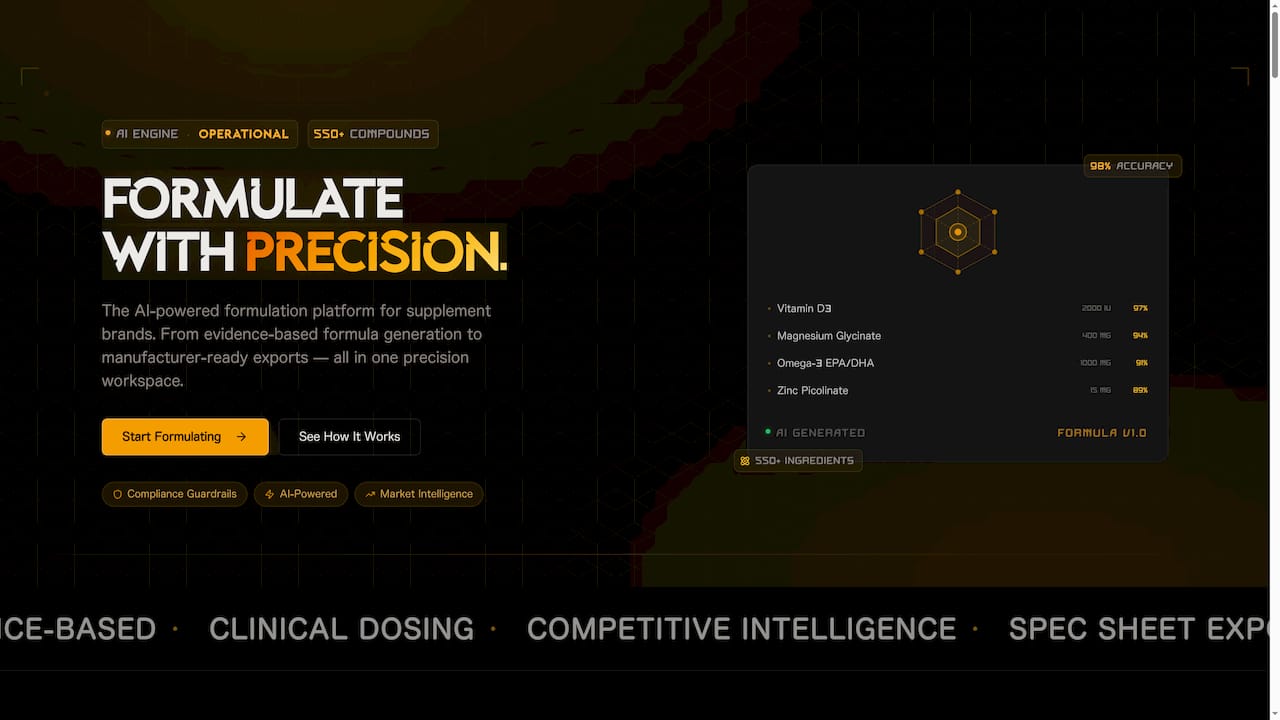
Formlypro is built for exactly the kind of insight-driven product development this article describes. The platform gives brands access to market research, competitor formulation analysis, and an 8-phase development plan that takes a product from ideation through compliance and production. Every phase is grounded in real data, not guesswork. If you are building in consumer goods, supplements, or health and beauty, Formlypro's formulation platform gives you the research infrastructure to make decisions with the same confidence as teams with dedicated insights functions. The integrated AI packaging designer and compliance guidance mean your insights do not just inform your formula. They shape your entire go-to-market approach.
FAQ
What is the role of consumer insights in marketing?
Consumer insights explain the motivations behind customer behavior, allowing marketing teams to build more targeted messaging, personalize campaigns by segment, and make product decisions grounded in validated consumer need rather than assumption.
How do consumer insights differ from market research?
Market research identifies what is happening in a category. Consumer insights go further by explaining why customers behave that way and translating that understanding into specific business recommendations.
What are the main advantages of consumer insights?
The primary advantages include reduced product launch failure risk, faster identification of unmet needs, more effective personalization, and better decision quality across product development and marketing. Companies with mature insights capabilities grow 2.5x faster than those without.
How do you gather consumer insights effectively?
Effective consumer insight generation uses multiple data sources simultaneously, including CRM data, direct surveys, social sentiment, and search behavior analysis, validated through a structured process of hypothesis testing before informing major decisions.
Why do consumer insights often fail to impact decisions?
40 to 60% of major decisions lack adequate consumer input because insights are delivered in the wrong format, at the wrong time, or to the wrong stakeholders. Embedding insights teams directly within business units and building structured review checkpoints significantly reduces this gap.