

TL;DR:
- Modern analytics enable food chemists to predict market trends and optimize formulations proactively.
- Integrating AI, big data, and sensory tools improves compliance, consumer insight, and product differentiation.
- Workflow integration and continuous data signals are critical for developing successful, market-ready products.
Most food chemists still rely on periodic consumer surveys and internal taste panels to gauge market fit. That worked fine a decade ago. But in 2026, with US employment for food scientists projected to grow 7% through 2034, faster than nearly every other science profession, the gap between teams using AI-driven analytics and those still guessing has never been wider. Formulation decisions tied to outdated market signals lead to compliance gaps, missed consumer trends, and products that stall before launch. The good news: modern analytics methods give food product developers and brand managers a clear, objective path from ideation to shelf.
Table of Contents
- Why market analytics matters for food chemists
- Key methodologies: AI, big data, and objective sensory tools
- Integrating market analytics with regulatory compliance
- Putting analytics to work: practical strategies for brand managers
- What most guides miss about market analytics for food chemists
- Leverage market analytics with FormlyPro
- Frequently asked questions
Key Takeaways
| Point | Details |
|---|---|
| Modern analytics drive product success | Food chemists who use advanced analytics outperform in formulation, compliance, and market positioning. |
| AI and sensory tools work best together | Integrating objective sensory and AI-driven analytics ensures reliable results and consumer acceptance. |
| Compliance and innovation are inseparable | Market analytics empower fast adaptation to regulations, ingredient trends, and brand demands. |
| Practical integration is key | Success comes from embedding analytics into daily workflows, not just dashboards. |
Why market analytics matters for food chemists
The role of a food chemist has quietly expanded. You are no longer just responsible for making a product safe and stable. You are expected to make it competitive. That means understanding what consumers want before they know they want it, positioning your brand against a crowded shelf, and staying ahead of regulatory shifts that can invalidate a formulation overnight.
Market analytics sits at the center of all three. When you connect formulation data to market signals, you stop reacting and start predicting. You know which ingredients are gaining traction in plant-based categories. You can spot a compliance risk before it becomes a recall. And you can build a brand story that resonates with buyers because it is grounded in real consumer behavior, not assumptions.
Here is what modern analytics actually touches in a food chemist's workflow:
- Formulation optimization: Ingredient performance data mapped against consumer acceptance scores
- Brand differentiation: Competitive benchmarking to identify white space in saturated categories
- Compliance tracking: Real-time monitoring of regulatory updates across markets
- Demand forecasting: Predictive models that flag ingredient trends 6 to 12 months out
- Safety validation: Analytical data linked to toxicology and labeling requirements
The importance of compliance in this workflow cannot be overstated. Brands that treat compliance as an afterthought routinely face reformulation costs that dwarf the original development budget.
"The most dangerous assumption in food product development is that a formula that passed last year's compliance check will pass this year's."
The food chemist job statistics tell a clear story about where the profession is heading. Roles that blend analytical chemistry with market intelligence command significantly higher compensation. The median salary of $78,000 to $82,900 for food scientists and technologists climbs sharply for professionals who can translate data into product strategy. Analytics fluency is no longer a bonus skill. It is the baseline expectation for anyone building or managing a food brand in 2026.
Misconceptions about traditional analysis also hold teams back. Many brand managers believe that sensory panels and historical sales data are sufficient for positioning decisions. They are not. Traditional methods capture what happened. Modern analytics tells you what is about to happen.
Key methodologies: AI, big data, and objective sensory tools
Not all analytics methods are created equal, and the best food chemists know how to match the right tool to the right problem. The current landscape includes three broad categories: AI and machine learning platforms, big data analytics pipelines, and objective sensory measurement systems.
AI and machine learning methods power predictive modeling for ingredient interactions, demand forecasting, and automated compliance flagging. Big data pipelines aggregate consumer behavior, retail sales, and ingredient sourcing data at a scale no human analyst can replicate manually. Objective sensory tools, including texture profile analysis (TPA), CIELAB color measurement, and electronic nose and tongue systems, remove the subjectivity that plagues traditional taste panels.

Here is a comparison of the core methodologies:
| Method | Primary use | Strength | Limitation |
|---|---|---|---|
| AI/ML platforms | Predictive modeling, trend forecasting | Speed, scale, pattern recognition | Edge cases, interpretability |
| Big data analytics | Consumer behavior, demand signals | Breadth of insight | Data quality dependency |
| HPLC/GC-MS/NMR | Formulation accuracy, safety validation | High precision | Lab-intensive, slower throughput |
| CIELAB/TPA/E-nose | Sensory objectivity, texture, aroma | Removes panel bias | Equipment cost |
| Traditional sensory panels | Consumer preference, hedonic scoring | Real human response | Subjective, variable |
For most product development teams, the winning approach combines instrumental precision with AI-driven market intelligence. Here is a practical sequence:
- Use big data platforms to identify emerging ingredient trends and consumer demand shifts
- Apply AI/ML models to forecast formulation performance and flag compliance risks early
- Validate formulations using HPLC, GC-MS, or NMR for safety and label accuracy
- Confirm consumer acceptance with objective sensory tools before final prototype sign-off
- Loop market feedback into the next formulation cycle continuously
Pro Tip: Do not wait until prototype stage to run compliance checks. Feed regulatory data into your AI platform at the ideation phase so disqualifying ingredients never make it into a formula.
Packaging decisions also benefit from this integrated approach. Reviewing packaging tips for food chemists alongside sensory and compliance data ensures that your label claims align with what is actually inside the product.
Integrating market analytics with regulatory compliance
Analytics without compliance integration is just interesting data. The real value comes when your analytical workflow actively prevents regulatory problems rather than discovering them after the fact.
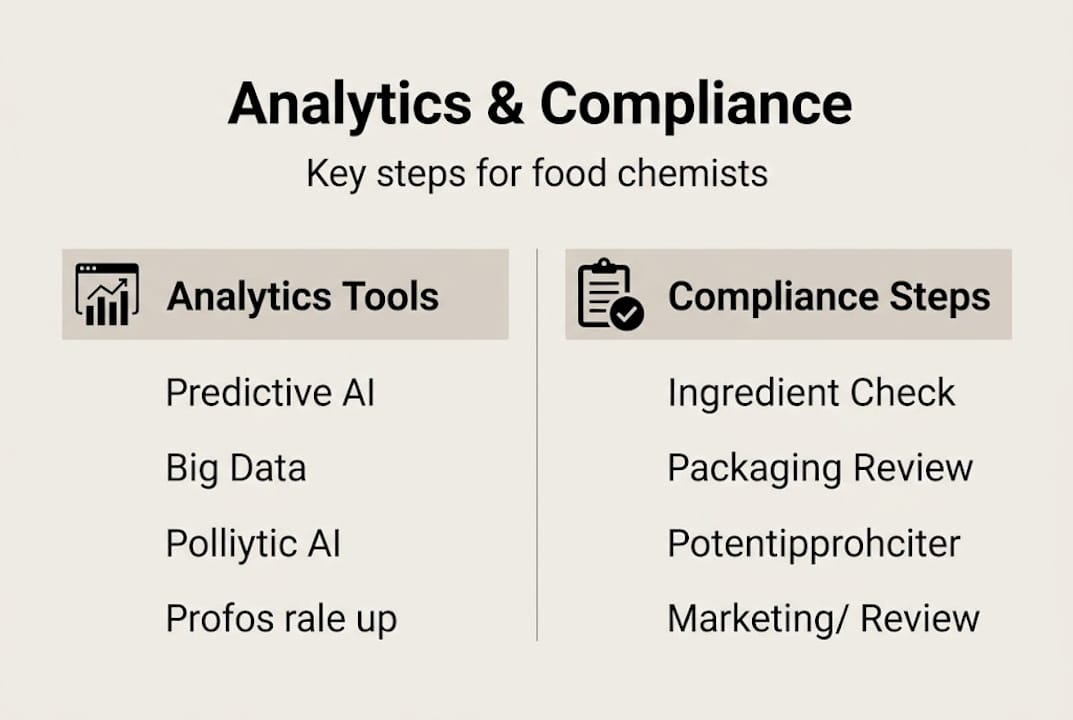
Big data and AI tools ease compliance tracking by continuously scanning regulatory databases, flagging ingredient status changes, and validating label claims against current standards. But edge cases require careful model interpretation. An AI system trained on historical compliance data may not immediately account for a novel ingredient that regulators reclassified last quarter.
The key regulatory challenges food chemists face in 2026 center on three areas:
- Novel ingredients: Regulatory status for new bioactives and synthetic biology-derived compounds is shifting rapidly
- Sustainability claims: "Clean label" and environmental claims face increasing scrutiny and require substantiated data
- Labeling accuracy: Nutrient declarations and allergen statements are the most common sources of recall
Here is a practical compliance framework for brand managers:
| Phase | Action | Analytics tool |
|---|---|---|
| Ideation | Screen ingredients against current regulatory databases | AI compliance scanner |
| Formulation | Validate ingredient interactions and safety thresholds | HPLC, GC-MS, NMR |
| Labeling | Cross-check nutrient claims with analytical results | Big data validation |
| Launch | Monitor post-market regulatory updates | Automated alert systems |
| Post-launch | Track consumer complaints and adverse event signals | Sentiment analytics |
Following a structured compliance checklist at each phase reduces recall risk significantly. Teams that integrate analytics into product development compliance workflows from day one spend far less time on reformulation. Staying current with consumer goods compliance standards is also non-negotiable as global market access increasingly depends on harmonized regulatory alignment.
Data bias is a real concern. If your training data overrepresents one market or demographic, your compliance predictions will reflect that gap. The fix is straightforward: audit your data sources quarterly and validate AI outputs against manual regulatory review for any ingredient that sits in a gray area.
Putting analytics to work: practical strategies for brand managers
Knowing the methodologies is one thing. Embedding them into a repeatable product development workflow is where most teams either accelerate or stall. Here is how high-performing brand managers actually operationalize analytics.
- Start with competitive intelligence: Before formulating anything, map the competitive landscape. Identify which products are gaining shelf velocity, what ingredients they feature, and where the gaps are in the current market.
- Define your compliance boundaries early: Use AI compliance tools to establish a list of approved ingredients before your chemists begin formulation work. This eliminates costly late-stage pivots.
- Run parallel validation: Do not sequence AI analysis and traditional sensory evaluation. Run them simultaneously to catch discrepancies early.
- Build a feedback loop: Connect post-launch consumer data back to your formulation database so every new product benefits from accumulated market intelligence.
- Prioritize plant-based and natural categories: Demand for plant-based and natural ingredients is surging, and analytics platforms that track ingredient-level consumer sentiment give you a real edge in these high-growth segments.
Pro Tip: The most common workflow pitfall is treating analytics as a one-time input at the start of development. The teams that win treat it as a continuous signal that informs every phase from ideation through post-launch.
Following market-ready formulation steps that embed analytics checkpoints at each phase keeps your team aligned and reduces the risk of launching a product that is technically sound but commercially misaligned. Reviewing formulation examples from successful brands also reveals how analytics-informed decisions show up in real product architecture.
The plant-based and functional food categories are particularly instructive. Brands that used predictive analytics to anticipate the shift toward fermented protein sources and adaptogenic ingredients captured market share before competitors even recognized the trend.
What most guides miss about market analytics for food chemists
Most articles about market analytics for food chemists focus on tools and dashboards. They walk you through platform features and data visualization options as if the technology itself is the solution. It is not.
The real challenge is workflow integration. An analytics dashboard that sits outside your formulation process does not improve your products. It just adds another screen to check. The food chemists and brand managers who get the most value from analytics are the ones who have embedded data signals directly into their decision points, not bolted them on as a reporting layer.
There is also a persistent blind spot around real-time compliance. Most guides treat compliance as a static checklist. But AI-powered analytics must account for edge cases and interpretability challenges that static checklists will never catch. Regulatory environments shift mid-cycle. Novel ingredients get reclassified. A compliance signal that was green in January can turn amber by March.
The chemists who consistently build successful products combine advanced analytics with hands-on validation and cross-functional collaboration. They do not outsource judgment to an algorithm. They use analytics to sharpen their judgment. That distinction matters enormously when you are navigating a novel ingredient category or a new market. Reviewing brand formulation insights from teams that have done this well reinforces how much the human layer still matters.
Leverage market analytics with FormlyPro
The strategies in this article are only as powerful as the platform you use to execute them. Food chemists and brand managers need a single environment where market analytics, formulation data, competitive intelligence, and compliance guidance all connect.
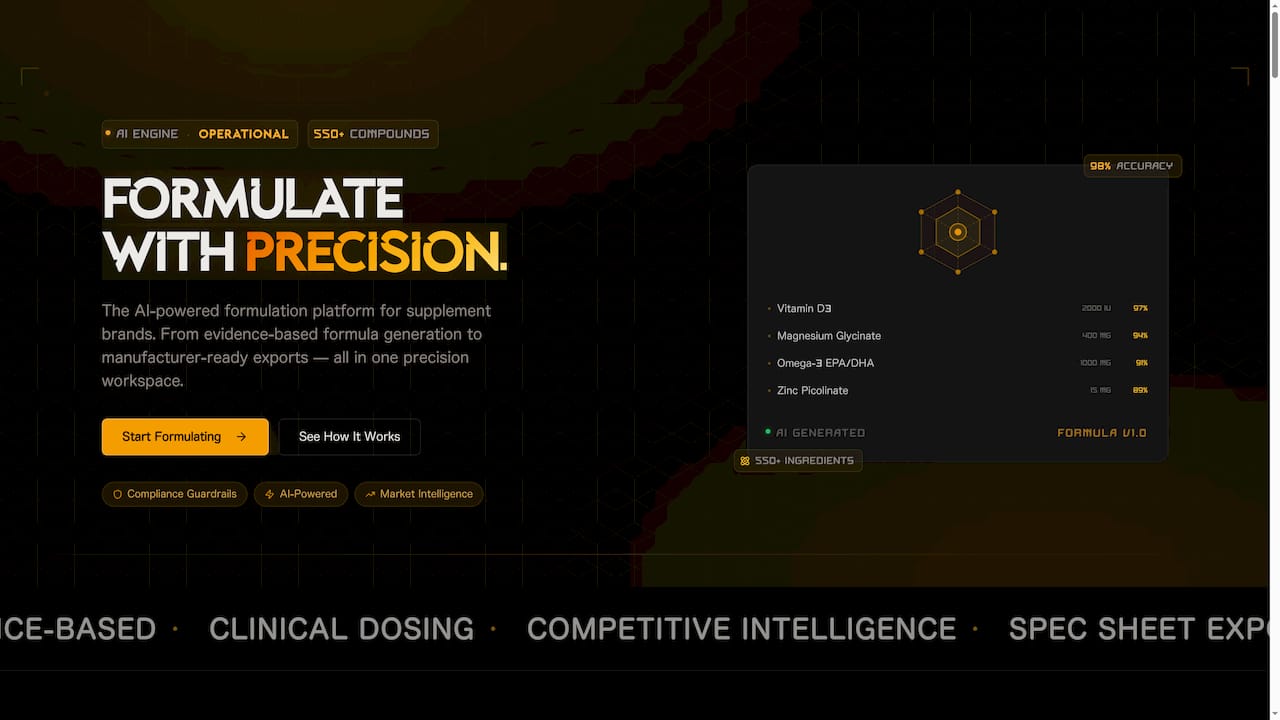
FormlyPro is built specifically for this workflow. From an 8-phase product development plan that takes your idea from ideation through production, to AI-powered packaging mockups, competitor formulation analysis, and real-time compliance guidance, everything your team needs is in one place. If you are ready to stop managing analytics in disconnected tools and start building products that are both market-ready and compliance-sound, FormlyPro is the next step.
Frequently asked questions
What are the most effective market analytics tools for food chemists?
Big data analytics, AI/ML platforms, and instrumental methods including HPLC, GC-MS, and NMR are the core toolkit for formulation accuracy and compliance validation. The strongest results come from combining all three rather than relying on any single approach.
How do market analytics help with regulatory compliance?
Analytics platforms enable proactive compliance tracking by scanning regulatory databases continuously, flagging ingredient status changes, and validating label claims against current standards before a product reaches market.
What is the median salary for food chemists using advanced analytics?
The median US salary ranges from $78,000 to $82,900 for food scientists and technologists, with compensation rising significantly for professionals who combine analytical chemistry expertise with market intelligence and compliance skills.
Are AI and big data replacing traditional sensory methods?
AI and big data complement traditional sensory methods rather than replacing them. Reliable validation requires integrating both instrumental precision and human sensory evaluation to catch what either approach alone would miss.