

TL;DR:
- Consumer demand for ingredient transparency is increasing, making it a key business strategy.
- Building trust through clear communication and substantiated claims drives long-term loyalty and premium pricing.
- Operational, regulatory, and communication challenges require proactive, well-documented sourcing, testing, and messaging.
When 92% of consumers care about ingredient lists and 68% actively avoid products based on what they read on the packaging, ingredient transparency stops being a nice-to-have and becomes a core business strategy. For food and beverage founders, this is not about ticking compliance boxes or adding a "clean label" badge to your packaging. It is about building the kind of brand that earns real loyalty, commands premium pricing, and survives the growing wave of consumer skepticism. This article breaks down why transparency matters, what it actually costs to deliver it, and how you can make it a genuine growth driver.
Table of Contents
- The rising demand for transparency
- How ingredient transparency builds trust and loyalty
- Operational and regulatory challenges for brands
- Practical strategies for delivering true ingredient transparency
- Our take: The uncomfortable truth about ingredient transparency
- Drive your growth with smarter formulation transparency
- Frequently asked questions
Key Takeaways
| Point | Details |
|---|---|
| Consumer influence | Transparency is directly tied to purchase decisions and trust among modern consumers. |
| Regulatory challenges | Fragmented rules and complex supply chains can complicate transparency efforts for brands. |
| Practical strategies | Supplier engagement, audits, and honest communication are keys to sustainable transparency. |
| Balance is crucial | Perfect transparency isn’t always feasible; smart brands aim for clarity and credibility. |
The rising demand for transparency
Consumer behavior around ingredient labels has shifted dramatically. Shoppers are not just glancing at the front of the pack anymore. They are flipping products over, reading the fine print, and making purchasing decisions based on what they find. This is not a niche trend among wellness enthusiasts. It is mainstream.
58% of shoppers read labels all or most of the time before buying new items. That is more than half of your potential customers actively scrutinizing your ingredient list before they ever try your product. And the trend is accelerating. 58% of global consumers are paying more attention to ingredients than they were just two years ago.
Here is what is driving that shift:
- Health concerns: Consumers are connecting diet to chronic disease at a higher rate than ever before.
- Allergen awareness: With food allergies on the rise, label reading is a safety habit for millions.
- Distrust of additives: Ingredients with chemical-sounding names trigger avoidance, regardless of their actual safety profile.
- Social media influence: Viral posts calling out specific ingredients have made consumers more vigilant and more skeptical.
- Access to information: Apps and online databases make it easy to look up any ingredient in seconds.
"Consumers are not just reading labels. They are researching them. Brands that treat ingredient lists as an afterthought are leaving trust on the table."
For founders, this creates both a challenge and an opportunity. The challenge is that you cannot hide behind vague claims anymore. The opportunity is that transparency in food brands is still not universal, which means the brands that get it right stand out sharply.
Simple, readable ingredient lists are now a competitive advantage. Consumers associate shorter lists with cleaner products, even when that is not always technically accurate. Getting your packaging for ingredient clarity right is not just a design decision. It is a trust signal that influences purchase behavior before a customer ever tastes your product.
How ingredient transparency builds trust and loyalty
Transparency is not just about listing ingredients. It is about how you communicate them. Two brands can use identical formulations and generate completely different levels of consumer trust based on how they present that information.

Simplified ingredient lists and specific claims build trust and drive sales, but reformulating to achieve them requires balancing sensory quality using biology-based solutions. That is a real tension founders face. Removing a preservative might make your label cleaner, but it could also shorten shelf life or alter flavor in ways that hurt the product.
Here is where consumer perception and expert opinion often diverge:
| Topic | Consumer view | Expert view |
|---|---|---|
| Ultra-processed foods | Seen as harmful and deceptive | Processing serves functional purposes |
| Additives and preservatives | Distrusted, avoided when possible | Often necessary for safety and stability |
| "Natural" claims | Signals cleaner, healthier product | Poorly defined, can mislead |
| Short ingredient lists | Equals better quality | Not always true, context matters |
| Federal vs. state rules | Confusing and inconsistent | Uniform federal oversight preferred |
The gap between how consumers interpret ingredients and how scientists understand them is significant. Founders who ignore this gap risk either losing sales by using ingredients consumers distrust or misleading customers with oversimplified claims that cannot hold up to scrutiny.
Pro Tip: When you reformulate to remove a flagged ingredient, communicate the change proactively. Tell your customers what you changed, why you changed it, and what you replaced it with. That kind of honesty builds more loyalty than a clean label alone.
The brands winning on transparency right now are not just removing ingredients. They are creating transparent formulations backed by evidence and then communicating that evidence clearly. They use specific, substantiated claims instead of vague buzzwords. They show transparent ingredient examples that educate rather than just reassure. That combination of honesty and education is what turns first-time buyers into loyal advocates.
Operational and regulatory challenges for brands
Delivering genuine ingredient transparency is harder than it sounds. The operational and regulatory landscape is a real obstacle course, especially for smaller brands without large compliance teams.
Transparency demands can create operational chaos through layered regulations, reformulation costs, and supply chain strain. Experts also warn against oversimplifying processing as inherently harmful, which adds a communication challenge on top of the operational one.
Here are the four biggest pain points founders face:
- Regulatory patchwork: State-by-state ingredient bans create a confusing and costly environment. What is legal in one state may be restricted in another, forcing brands to either maintain multiple formulations or default to the strictest standard across the board.
- Traceability demands: Consumers and retailers increasingly want to know where every ingredient comes from. Building that traceability into your supply chain requires supplier agreements, documentation systems, and ongoing audits.
- Reformulation costs: Swapping out an ingredient is rarely a simple substitution. It can trigger a cascade of changes to texture, flavor, color, and shelf stability, each of which requires testing and validation.
- Communication complexity: Even after you have done the hard work of reformulating, explaining those changes to consumers without creating confusion or alarm is its own challenge.
| Challenge | Impact on small brands | Mitigation approach |
|---|---|---|
| State-level ingredient bans | Higher compliance costs | Adopt strictest standard proactively |
| Supply chain traceability | Time-intensive documentation | Use digital traceability tools |
| Reformulation testing | Delays and R&D expense | Phase changes with prototype testing |
| Consumer communication | Risk of backlash if mishandled | Transparent, proactive messaging |
Using a solid regulatory compliance checklist from the start of product development saves significant time and money later. Brands that treat compliance as a final step rather than a design principle consistently run into expensive rework. The compliance standards guide for consumer goods makes clear that proactive compliance is always cheaper than reactive fixes.
Practical strategies for delivering true ingredient transparency
Knowing the challenges is useful. Knowing how to work through them is what actually moves your brand forward. Here is what the most effective founders are doing right now.
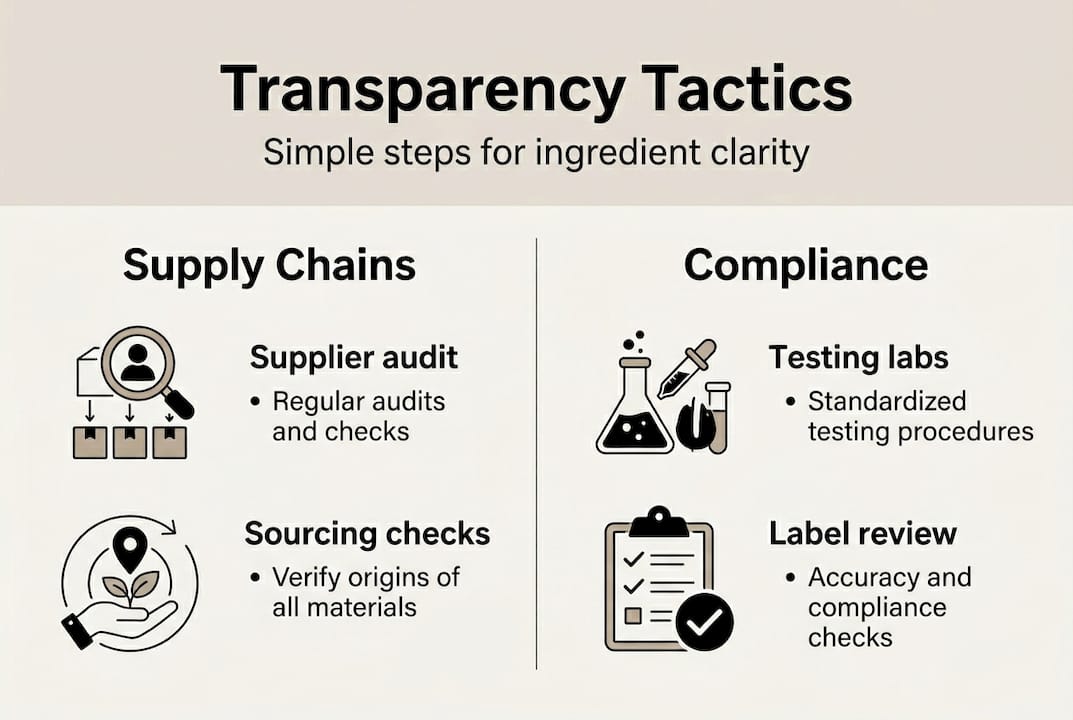
Conduct supplier audits. Your ingredient transparency is only as strong as your supply chain. If a supplier cannot tell you exactly what is in the raw material they are selling you, that uncertainty ends up on your label. Regular supplier audits, combined with certificates of analysis, give you the documentation you need to make credible claims.
Use validated testing methods. HPLC testing for natural claims and other analytical methods substantiate what you put on your label. If you claim a specific level of an active ingredient, you need the data to back it up. This is not optional if you want to avoid regulatory action or consumer backlash.
Pro Tip: Build testing into your production schedule, not just your launch process. Batch-to-batch consistency is what separates brands that earn long-term trust from those that get a one-time pass.
Here is a practical transparency action list for founders:
- Map every ingredient back to its source and document the supply chain.
- Require certificates of analysis from all suppliers for every batch.
- Test finished products using validated methods before making label claims.
- Review your labels against current federal and state requirements at least twice a year.
- Communicate any formulation changes to your customers before they notice them.
- Use your market-ready formulation steps to build transparency in from the start.
Founders who integrate ensuring formulation compliance into their development process rather than bolting it on at the end consistently launch cleaner, more defensible products. Transparency is not a final edit. It is a design principle.
Our take: The uncomfortable truth about ingredient transparency
Here is what most guides on this topic will not tell you. Chasing perfect transparency can actually hurt your brand if you do it without a strategy.
Consumers want transparency, but they do not always have the scientific literacy to interpret what they are reading. When a brand strips out a functional additive to shorten its ingredient list and the product then fails on shelf or tastes different, the backlash is real. You have traded a perceived problem for an actual one.
The brands that lead on transparency are not the ones with the shortest ingredient lists. They are the ones that use formulation analytics to make smart decisions and then communicate those decisions with clarity and confidence. They guide their customers rather than just reacting to consumer fear.
Real transparency leadership means being honest about what is in your product and why it is there. It means educating your audience instead of oversimplifying for them. That is harder than removing an ingredient. It is also far more durable as a brand strategy.
Drive your growth with smarter formulation transparency
Ingredient transparency is one of the most powerful levers you have for building a brand that consumers trust and return to. But executing it well requires more than good intentions. It requires the right tools, the right data, and a clear process from formulation through to the shelf.

The FormlyPro platform gives food and beverage founders everything they need to build transparent, compliant, and market-ready products. From competitor formulation analysis and research-backed ingredient sourcing to compliance guidance and AI-powered packaging design, FormlyPro turns transparency from a compliance headache into a genuine growth advantage. If you are serious about building a brand that earns lasting consumer trust, this is where you start.
Frequently asked questions
What does ingredient transparency mean for food and beverage brands?
It means providing consumers with clear, accurate details about every ingredient and processing aid used in a product. 92% of consumers care about ingredient lists, and 68% avoid purchases based on packaging information, making this a direct sales issue.
Why do consumers care so much about ingredient transparency?
Consumers worry about health risks, allergens, and hidden additives, so transparent labels help them make informed choices. 65% of consumers are concerned about hidden ingredients, and that concern is growing year over year.
Is ingredient transparency required by law in the United States?
Certain disclosures are mandated, but requirements vary significantly. State-by-state ingredient bans create a patchwork of rules that confuse consumers and raise costs for brands operating across multiple markets.
How can small brands manage ingredient transparency without huge costs?
Investing in supplier audits, using digital compliance tools, and communicating proactively can minimize risks and expenses. Transparency strains small brands most when it is reactive rather than built into the product development process from day one.