

TL;DR:
- Compliance for health products involves ingredient safety, labeling, NDI notifications, and GMPs.
- Thorough documentation and regular updates are essential for successful market launch and ongoing compliance.
- Treating compliance as a strategic asset enhances brand trust, retailer relationships, and growth opportunities.
Getting a new health or wellness product to market is one of the most rewarding things you can do as a brand owner. It's also one of the most regulated. Between ingredient approvals, label requirements, Good Manufacturing Practices, and pre-market notifications, the compliance landscape is genuinely complex. Missing compliance requirements can halt your launch entirely, or worse, trigger legal action after you've already invested in production. This article walks you through a practical, structured compliance requirements list so you can move from formulation to market with clarity and confidence.
Table of Contents
- Understanding compliance: Key concepts and criteria
- Ingredient safety and New Dietary Ingredient (NDI) notification-notification)
- Labeling, claims, and packaging regulations
- Manufacturing standards and documentation
- Keeping up: Ongoing compliance and preparing for audits
- Our take: Compliance lists are powerful tools for growth, not just risk
- Get expert help with compliance: Faster, easier, and always up to date
- Frequently asked questions
Key Takeaways
| Point | Details |
|---|---|
| Start with a complete checklist | A full compliance list ensures your brand covers every regulatory step from ingredient review to labeling and documentation. |
| NDI notification is essential | If using new dietary ingredients, submit safety evidence and notifications to the FDA well before launching. |
| Label and document meticulously | Accurate labels and complete records are your best defense during audits and regulatory reviews. |
| Compliance is continuous | Update your requirements list regularly, as regulations and audit expectations evolve. |
Understanding compliance: Key concepts and criteria
When we talk about a compliance requirements list in the health and supplement space, we're referring to a structured set of regulatory obligations your product must satisfy before it can legally reach consumers. This isn't a general best-practices guide. It's the actual framework regulators expect you to follow.
The primary authority in the US is the Food and Drug Administration (FDA), which governs dietary supplements under the Dietary Supplement Health and Education Act (DSHEA) of 1994. Depending on your product type, additional oversight may come from the Federal Trade Commission (FTC) for advertising, or state-level agencies for specific markets.
Compliance breaks down into four critical categories:
- Ingredient safety: Every ingredient must be safe for its intended use, with documentation to prove it.
- Labeling standards: Your product label must meet precise FDA requirements for content, format, and claims.
- New Dietary Ingredient (NDI) notifications: Novel ingredients require pre-market notification to the FDA.
- Good Manufacturing Practices (GMPs): Your production environment, processes, and records must meet federal standards.
None of these categories are optional. Missing even one puts your entire launch at risk. As the compliance checklist for product success makes clear, a structured approach is the only reliable way to catch every obligation before you go to market.
"Compliance isn't just about passing inspections. It's the foundation that allows your product to exist in the market at all." Understanding why compliance matters is the first step toward building a brand that lasts.
| Compliance category | Key requirement | Who enforces it |
|---|---|---|
| Ingredient safety | Safety documentation for all ingredients | FDA |
| Labeling | Supplement Facts panel, claims, warnings | FDA / FTC |
| NDI notification | 75-day pre-market submission for novel ingredients | FDA |
| GMPs | Manufacturing standards and record-keeping | FDA |
Pro Tip: Build your compliance list before you finalize your formulation. Trying to retrofit documentation after the fact almost always costs more time and money.
Ingredient safety and New Dietary Ingredient (NDI) notification
Ingredient safety is the most scrutinized part of compliance, and for good reason. Consumers are trusting you with their health. Regulators know that, and they expect you to know it too.
A New Dietary Ingredient is any dietary ingredient not marketed in the United States before October 15, 1994. If your formula includes one, NDI notification process requires you to submit safety evidence to the FDA at least 75 days before bringing the product to market. This isn't a rubber stamp. The FDA reviews your submission and may respond with objections or requests for additional data.
Here's what the submission process looks like in practice:
- Confirm NDI status. Determine whether your ingredient was marketed in the US before October 15, 1994. If it wasn't, you need an NDIN.
- Compile safety evidence. This includes history of use data, published studies, clinical trials, or a combination. The FDA expects you to show reasonable safety at the intended dose.
- Prepare identity documentation. Your submission must include a precise description of the ingredient, including its source, form, and chemical characterization.
- Submit to FDA. File your New Dietary Ingredient Notification (NDIN) through the FDA's submission portal at least 75 days before market launch.
- Respond to any FDA feedback. The FDA may request more information. You have a limited window to respond, and the confidentiality period on your submission is 90 days after the FDA responds.
One of the most common pitfalls brands run into is submitting safety evidence that's too narrow. If your notification only covers one specific dose or population, the FDA may object to broader use claims. Be as specific and thorough as possible from the start.
For a broader view of how this connects to your overall product readiness, see the market-ready formulation steps that leading brands use to align ingredient decisions with regulatory timelines.
Pro Tip: Batch your safety documentation work. If you're formulating a product line with multiple novel ingredients, preparing all documentation at once saves significant time and reduces the chance of inconsistencies between submissions.
Labeling, claims, and packaging regulations
With ingredients covered, next up is making sure your product's outside is as compliant as what's inside. Label compliance is where many brands get surprised, because the requirements are detailed and the consequences of errors are serious.
Every dietary supplement label must include:
- Product name and statement of identity
- Net quantity of contents
- Supplement Facts panel with serving size, servings per container, and ingredient amounts
- Other ingredients list for non-active components
- Directions for use
- Warnings where applicable (e.g., "Keep out of reach of children")
- Manufacturer name and address
Beyond the format requirements, claims are where brands most often create legal exposure. Labels must not be false or misleading and must follow strict FDA guidelines. Structure/function claims (e.g., "Supports immune health") are permitted, but must be truthful, substantiated, and accompanied by a disclaimer. Disease claims (e.g., "Treats arthritis") are prohibited without FDA drug approval.
Making an unauthorized disease claim doesn't just invite a warning letter. It can reclassify your supplement as an unapproved drug, which triggers an entirely different regulatory process.
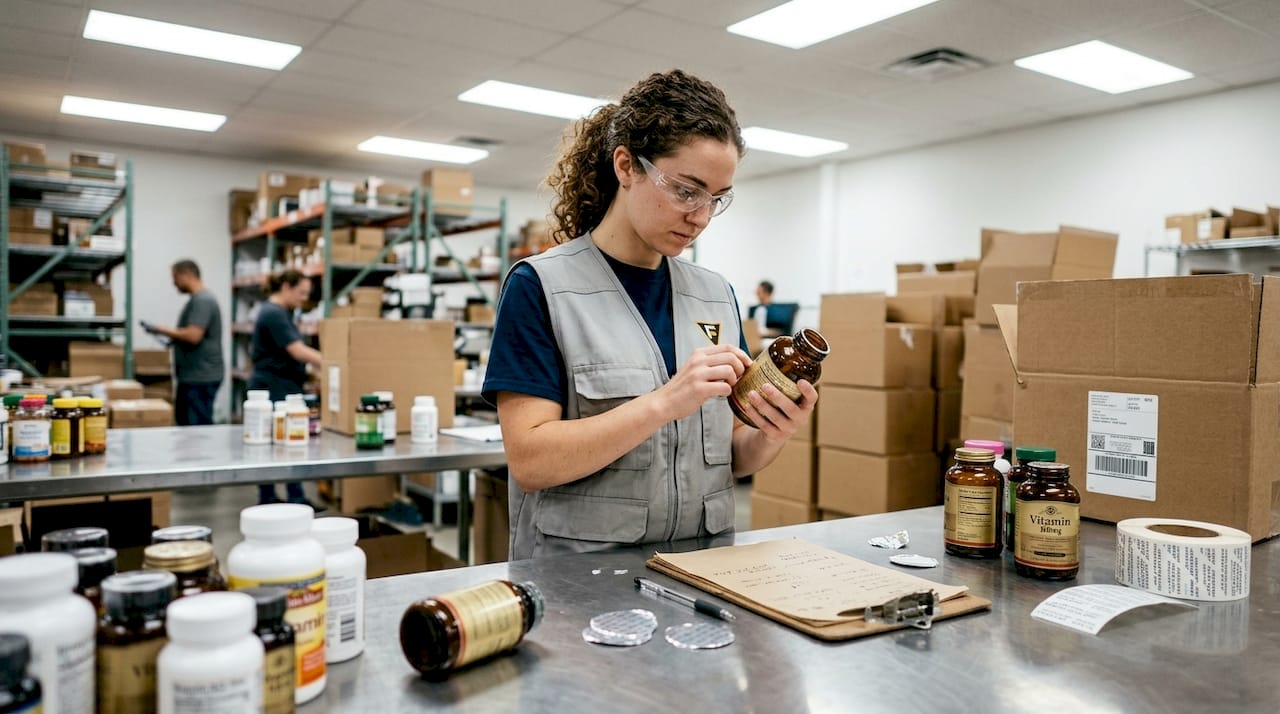
Packaging compliance goes beyond what's printed on the label. Container materials, tamper evidence, and child-resistant closures all have their own standards. The packaging tips for brand compliance cover common mistakes that trip up even experienced teams.
| Claim type | Permitted? | Requirements |
|---|---|---|
| Structure/function claim | Yes | Substantiated, with FDA disclaimer |
| Nutrient content claim | Yes | Must meet FDA definitions |
| Disease claim | No | Requires drug approval |
| Health claim | Conditional | FDA authorization required |
The brand formulation guide walks through how to position your product's benefits compliantly without crossing into prohibited territory.
Manufacturing standards and documentation
Strong labeling helps, but regulatory scrutiny often comes down to what happens behind the scenes: your manufacturing environment and the records you keep. GMPs are not optional for dietary supplement products. They're federal law under 21 CFR Part 111.
GMPs cover everything from facility design and sanitation to employee training and equipment calibration. The goal is to ensure every batch of your product is consistently manufactured to the same quality standard. Auditors aren't just checking whether you know the rules. They're checking whether you follow them consistently, and whether you have the paperwork to prove it.
Required documentation includes:
- Batch production records for every production run, including ingredient weights, equipment used, and operator sign-offs.
- Certificates of Analysis (CoAs) from your ingredient suppliers and finished product testing.
- Standard Operating Procedures (SOPs) for every manufacturing process.
- Training records showing that all personnel have been trained on relevant SOPs.
- Deviation and corrective action reports documenting any process issues and how they were resolved.
| Document type | Purpose | Audit risk if missing |
|---|---|---|
| Batch records | Traceability per production run | High |
| CoAs | Ingredient and product purity | High |
| SOPs | Process consistency | Medium |
| Training records | Staff competency | Medium |
| Deviation reports | Continuous improvement evidence | High |
The product development compliance guide outlines how documentation failures are one of the top reasons brands fail audits, even when their products are actually safe and well-made. The industry compliance standards for 2026 reinforce that documentation rigor is only increasing.
Pro Tip: Digitalize your records from day one. Paper-based systems create gaps, make audits harder, and slow down any corrective action process. A centralized digital system means you can pull any record in minutes, not days.
Keeping up: Ongoing compliance and preparing for audits
The best-prepared brands know that compliance isn't a checklist you check once. It's a routine process that requires active management as regulations evolve and your product line grows.
The FDA updates guidance regularly. Ingredient status can change. New labeling requirements can roll out with short notice. Brands that treat compliance as a launch task rather than an operational function get caught flat-footed when those changes arrive.
Regular tasks to stay audit-ready include:
- Monthly: Review any FDA guidance updates, FTC enforcement actions, or state-level regulatory changes relevant to your product category.
- Quarterly: Conduct internal record audits to catch gaps in batch records, CoAs, or training documentation before an external auditor does.
- Annually: Full SOP review and employee retraining on any updated procedures.
- On formulation changes: Reassess NDI status and label compliance for any ingredient substitutions or formula updates.
As compliance best practices confirm, compliance is an ongoing process, not a one-off checkpoint. Brands that build this rhythm into their operations avoid the reactive scramble that happens when an audit or warning letter arrives without warning.
Pro Tip: Schedule a mock audit every six months. Assign someone internally to act as the auditor, request documents as a real auditor would, and document every gap found. It's the most effective way to stress-test your compliance readiness without actual regulatory stakes.
Our take: Compliance lists are powerful tools for growth, not just risk
Most brands approach compliance the wrong way. They treat it as a cost center, something to minimize and check off so they can get back to the "real" work of building a brand. That framing is costing them.
The brands we've seen scale fastest share one trait: they treat airtight compliance as a competitive asset. When your documentation is complete, your labels are accurate, and your manufacturing records are clean, you become the kind of partner that major retailers and distribution networks actively want to work with. Retail buyers ask for CoAs. Contract manufacturers want to see your SOPs. Investors ask about audit history.
Brand reputation and compliance are more connected than most early-stage brands realize. Transparent compliance builds the kind of consumer trust that paid advertising can't replicate. A brand that can say "here's our full ingredient documentation" and back it up wins more loyal customers than one with a bigger marketing budget but shaky records.
Compliance isn't the ceiling on your ambition. It's the floor that makes everything above it possible.
Get expert help with compliance: Faster, easier, and always up to date
Managing compliance solo is one of the most resource-intensive things a growing brand can take on. Between tracking regulation updates, managing documentation, and preparing for audits, it's easy for critical steps to fall through the cracks.
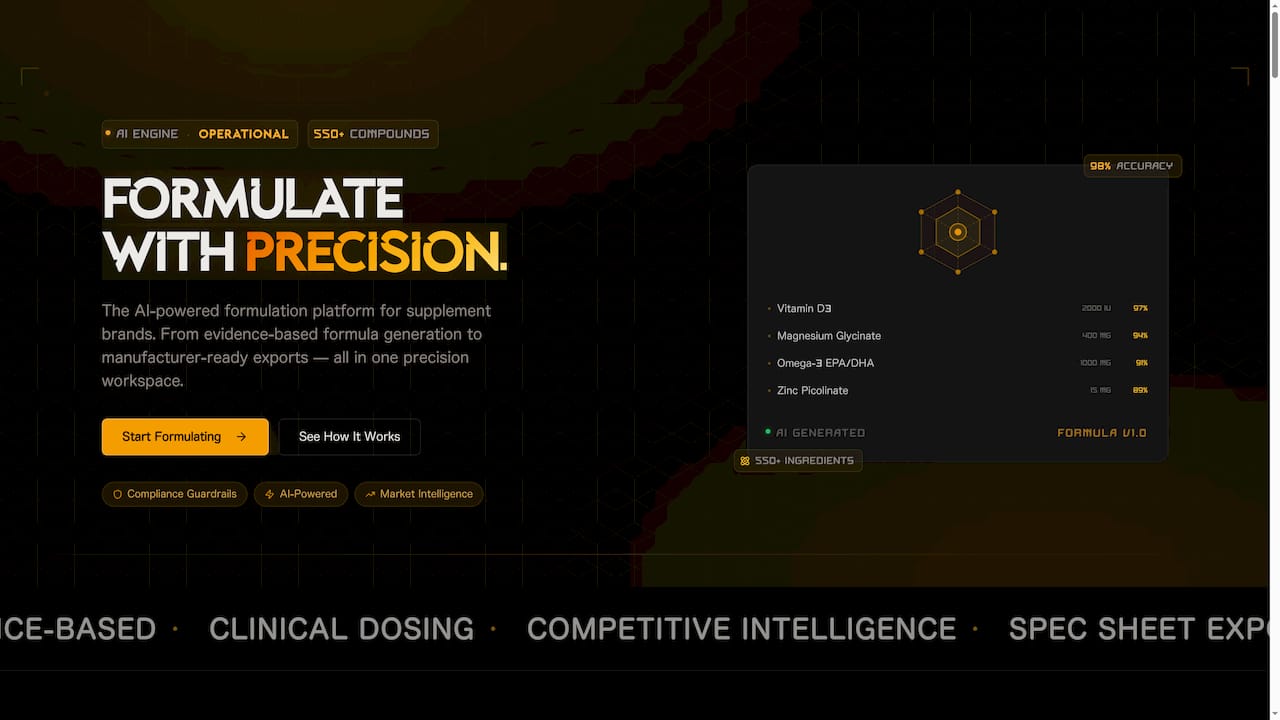
FormlyPro compliance solutions give brand owners and product developers a structured, automated path through every stage of the compliance process. From ingredient documentation and NDI tracking to label review checklists and audit-ready record storage, the platform is built to remove the guesswork. FormlyPro's 8-phase product development system means compliance is integrated from ideation through production, not bolted on at the end. If you're ready to stop managing compliance on spreadsheets and start building with confidence, FormlyPro is where that process begins.
Frequently asked questions
What is a compliance requirements list for supplement brands?
It's a step-by-step checklist covering ingredient safety, labeling, documentation, and notifications needed to legally launch a health or supplement product. A full checklist covers ingredient safety, labeling, and all required documentation.
When is an NDI notification required by the FDA?
Any dietary ingredient not marketed before October 15, 1994 needs an NDI notification with safety evidence submitted at least 75 days before selling.
What are the most common compliance mistakes for new brands?
The most frequent errors are incomplete ingredient identity information, missing required label elements, and failing to maintain audit-ready records. Incomplete identity info and documentation gaps are the top reasons FDA objections are issued.
How can brands stay up to date with changing compliance requirements?
Brands should set a compliance calendar, schedule regular regulation reviews, and use automated tools to stay audit-ready. Ongoing compliance is a continuous operational function, not a single task at launch.