

TL;DR:
- Competitive analytics involves strategic evaluation of competitor data to identify market gaps and guide product development. It differs from ongoing competitor monitoring by synthesizing data into actionable insights for positioning and growth. Implementing regular, structured analysis with AI tools enhances response speed, market forecasting, and decision-making.
Competitive analytics is the structured, strategic process of evaluating competitor data to sharpen brand positioning and guide product development decisions. For marketing professionals and business strategists, the role of competitive analytics goes far beyond tracking what rivals are doing. It translates raw market intelligence into decisions that move your brand forward. AI tools now shorten deal cycles by 30–50% and improve market response speed by 40%. That kind of speed advantage separates brands that lead from brands that react.
What is competitive analytics and how does it differ from competitor monitoring?
Competitive analytics is a periodic, strategic evaluation of competitor data. Competitor monitoring is ongoing and tactical; competitive analysis synthesizes that monitoring data into strategic recommendations for positioning and growth. The distinction matters more than most teams realize.
Most companies mistakenly equate monitoring with analysis, which creates blind spots. Monitoring tells you what a competitor posted on LinkedIn last Tuesday. Analysis tells you whether their product pivot signals a gap you can own.
Here is how the two functions differ in practice:
- Competitor monitoring: Daily or weekly tracking of pricing changes, social activity, ad spend, and product updates
- Competitive analytics: Quarterly or annual synthesis of that data into strategic insights about market position, customer alignment, and growth opportunities
- Monitoring output: A dashboard or alert feed
- Analytics output: A strategic recommendation that changes a budget, a product roadmap, or a positioning statement
The goal of competitive analysis is to find positions where your brand can win, not to copy what competitors are doing. That distinction defines whether your team produces intelligence or just noise.
Pro Tip: Set up a shared monitoring feed using tools like Semrush or Crayon, then schedule a formal analysis session every quarter to convert that raw data into strategic decisions. Never let monitoring replace analysis.
What are the core elements and frameworks in competitive analytics?
A comprehensive competitive framework covers five core assessment categories: market share, competitor strengths and weaknesses, target market alignment, barriers to entry, and indirect competitors. Each category reveals a different dimension of competitive risk and opportunity.

Most marketing teams focus only on direct competitors. Indirect competitors, meaning brands solving the same customer problem through a different product category, are where the real surprises come from. A supplement brand, for example, competes not just with other supplement brands but with functional food companies, wellness apps, and prescription alternatives.
The table below compares the most widely used competitive analysis frameworks and what each one is best suited for:
| Framework | Best used for | Core output |
|---|---|---|
| Porter's Five Forces | Structural industry analysis | Identifies competitive pressure sources |
| SWOT analysis | Internal vs. external positioning | Highlights gaps and opportunities |
| Perceptual mapping | Brand positioning vs. competitors | Visual gap identification |
| Jobs-to-be-done | Customer motivation alignment | Reveals unmet needs competitors miss |
Porter's Five Forces is the most cited framework for structural analysis. It examines supplier power, buyer power, threat of substitutes, threat of new entrants, and competitive rivalry. Used alongside a SWOT analysis, it gives marketing teams both a macro view of industry dynamics and a micro view of their own positioning gaps.
Pro Tip: Run a perceptual map every six months by plotting your brand and three to five competitors on two axes that matter most to your buyers, such as price versus quality or clinical backing versus convenience. The white space on that map is your next positioning opportunity.
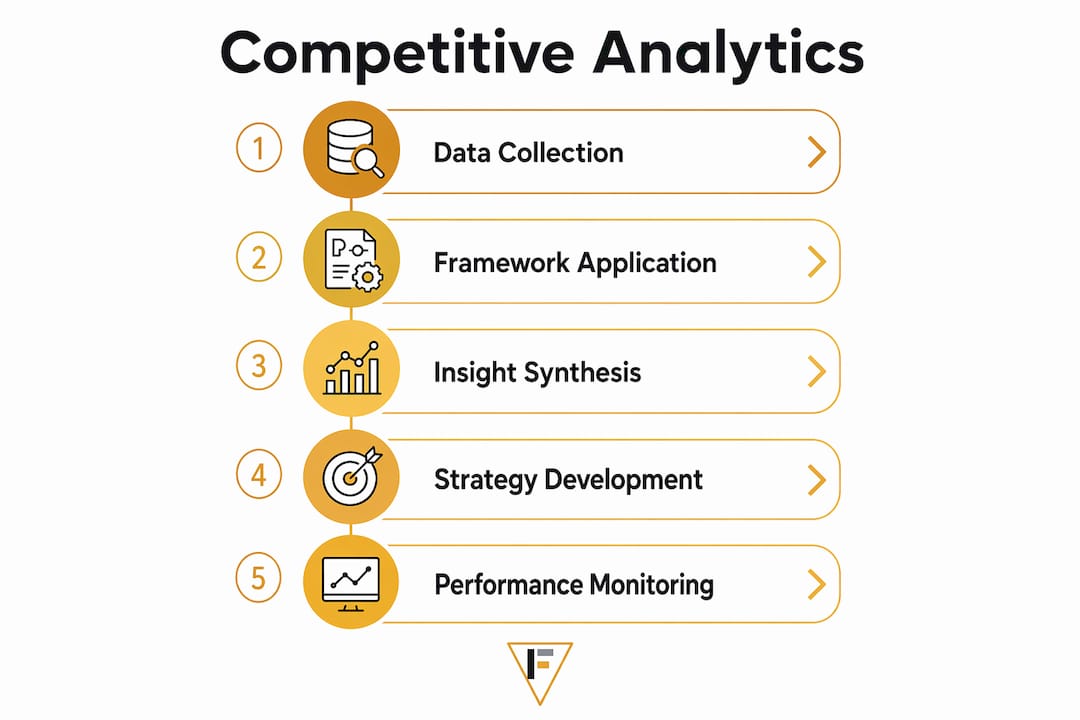
Periodic competitive analysis also reveals emerging trends earlier than internal data alone. Internal metrics tell you how your brand is performing. Competitive analytics tells you whether the entire category is shifting beneath you.
What are the benefits and business impacts of competitive analytics?
The benefits of competitive analysis compound over time. The first cycle gives you a snapshot. The third cycle gives you a trend line. By the fifth cycle, you have a predictive model of where your market is heading.
The most concrete business impacts include:
- Sharper brand differentiation: You stop competing on features and start competing on meaning. When you know exactly where competitors are weak, you can own the positioning they have abandoned.
- Smarter budget allocation: Competitive insights identify underserved customer segments and competitor weaknesses, so you concentrate spend where it generates the highest return rather than spreading it across every channel.
- Faster market response: Teams using structured competitive intelligence improve response speed by 40%. That means your product team hears about a competitor's new feature and has a counter-strategy in weeks, not quarters.
- Anticipation of market shifts: Periodic analysis reveals emerging trends before they show up in your own sales data, giving you time to act rather than react.
- Better product decisions: When you know what formulations, features, or claims competitors are leading with, your R&D team builds toward gaps rather than duplicates.
The importance of competitive analytics becomes clearest when a brand skips it. Teams that rely on informal impressions of the market consistently underestimate new entrants and overestimate their own differentiation. Competitive intelligence is most valuable when it leads to actual strategy changes, not just confirmation of what you already believed.
Effective competitive analytics links directly to decision-making processes, avoiding the trap of static reports that never influence strategy. The deliverable is not a document. The deliverable is a decision.
How is technology transforming competitive analytics?
AI has changed the speed and scope of competitive intelligence in three specific ways. First, it automates data collection across sources that would take human analysts weeks to compile. Second, it surfaces pattern recognition across large competitor datasets that humans miss. Third, it has introduced an entirely new competitive dimension: AI visibility.
Competitors' presence or absence in AI-generated answers now directly impacts customer decisions. Buyers on platforms like ChatGPT, Perplexity, and Google's AI Overviews form opinions before they ever visit a brand's website. If your competitor appears in those answers and you do not, you have lost the consideration phase entirely.
Modern competitive analytics strategies must account for this shift. The practical implications for marketing teams include:
- Auditing which competitors appear in AI-generated answers for your core category keywords
- Tracking whether your brand's claims and positioning are reflected accurately in AI summaries
- Building content that earns citations in AI platforms, not just rankings in traditional search
Tools like Semrush now include AI visibility tracking alongside traditional rank monitoring. This is not a future capability. It is a current competitive gap that most brands have not yet addressed.
For product development teams, AI-powered platforms also accelerate the analysis of competitor formulations, ingredient trends, and industry trends in product development. What once required a full market research cycle can now be completed in days. The role of AI in packaging and product positioning has expanded to the point where brands without AI-assisted competitive intelligence are operating at a structural disadvantage.
What practical strategies should marketing professionals use for competitive analytics?
The most effective competitive analytics strategies share one characteristic: they produce decisions, not reports. Here is a repeatable process for executing competitive analytics that actually changes strategy.
- Define your competitor set. Include direct competitors, indirect competitors, and aspirational competitors. A direct competitor targets the same buyer with the same solution. An indirect competitor solves the same problem differently. An aspirational competitor is the brand your customers compare you to, even if the products differ.
- Select your frameworks. Choose two to three frameworks based on your strategic question. Use Porter's Five Forces for industry structure, SWOT for positioning gaps, and perceptual mapping for brand differentiation.
- Collect data systematically. Pull from public sources: competitor websites, product listings, customer reviews, job postings, press releases, and AI-generated search results. Job postings alone reveal where a competitor is investing next.
- Synthesize into insights. Convert raw data into three to five strategic findings. Each finding should answer: "What does this mean for our brand?"
- Assign decisions. Every insight must map to a decision owner and a deadline. If an insight does not change a budget, a roadmap, or a message, it is not an insight. It is trivia.
- Schedule the next cycle. Structured competitive analysis should be performed at least quarterly to stay current with competitor shifts. Annual analysis is the minimum for stable markets. Quarterly is the standard for fast-moving categories.
Pro Tip: The most overlooked source in competitive analytics is competitor customer reviews. Read the one-star and two-star reviews on Amazon, G2, or Trustpilot for your top three competitors. The complaints customers leave are the gaps your brand should fill.
Connecting competitive analytics to industry benchmarking gives your findings a reference point. Without benchmarks, you know what competitors are doing. With benchmarks, you know whether the entire category is underperforming a standard you can exceed.
Product analytics and competitive analytics work best together. Product analytics tells you how your customers behave. Competitive analytics tells you why they might choose someone else.
Key takeaways
Competitive advantage comes from speed and precision in turning intelligence into decisions, not from accumulating more data than your competitors.
| Point | Details |
|---|---|
| Analytics vs. monitoring | Competitive analytics synthesizes monitoring data into strategic decisions; they are not the same function. |
| Five core categories | Assess market share, strengths and weaknesses, target alignment, barriers to entry, and indirect competitors every cycle. |
| AI visibility is now a factor | Competitors appearing in AI-generated answers influence buyers before a website visit occurs. |
| Frequency matters | Run formal competitive analysis at least quarterly; annual cycles are the minimum for stable markets. |
| Decisions, not documents | Every competitive insight must map to a decision owner and a deadline or it has no strategic value. |
Why most brands are still doing this wrong
I have reviewed competitive analysis processes across dozens of brands, and the pattern is consistent. Teams invest real time in monitoring, build detailed dashboards, and then present findings in a quarterly slide deck that no one acts on. The analysis becomes a ritual rather than a tool.
The shift I have seen work is treating competitive analytics as a decision trigger, not a reporting exercise. When a finding does not have a named decision attached to it, it gets cut from the deliverable. That discipline forces teams to think about what they are actually trying to decide before they start collecting data.
The other mistake I see constantly is ignoring indirect competitors until they become direct ones. A supplement brand that only watches other supplement brands will be blindsided by a functional beverage company that enters their category with better distribution and a lower price point. Competitive analytics strategies that include indirect competitors catch these moves 12 to 18 months earlier.
The technology shift around AI visibility is the most underestimated change in competitive intelligence right now. Most brands are still measuring SEO rankings while their competitors are being recommended by ChatGPT to buyers who never open a search results page. That gap is widening every month.
Treat competitive analytics as a living input to your strategy, not a periodic audit. The brands that win are the ones that have already decided what they will do when a competitor makes a specific move.
— Ben
How Formlypro builds competitive analytics into every product launch
Formlypro is built for brands that need competitive intelligence and formulation strategy in one place, not two separate workflows.
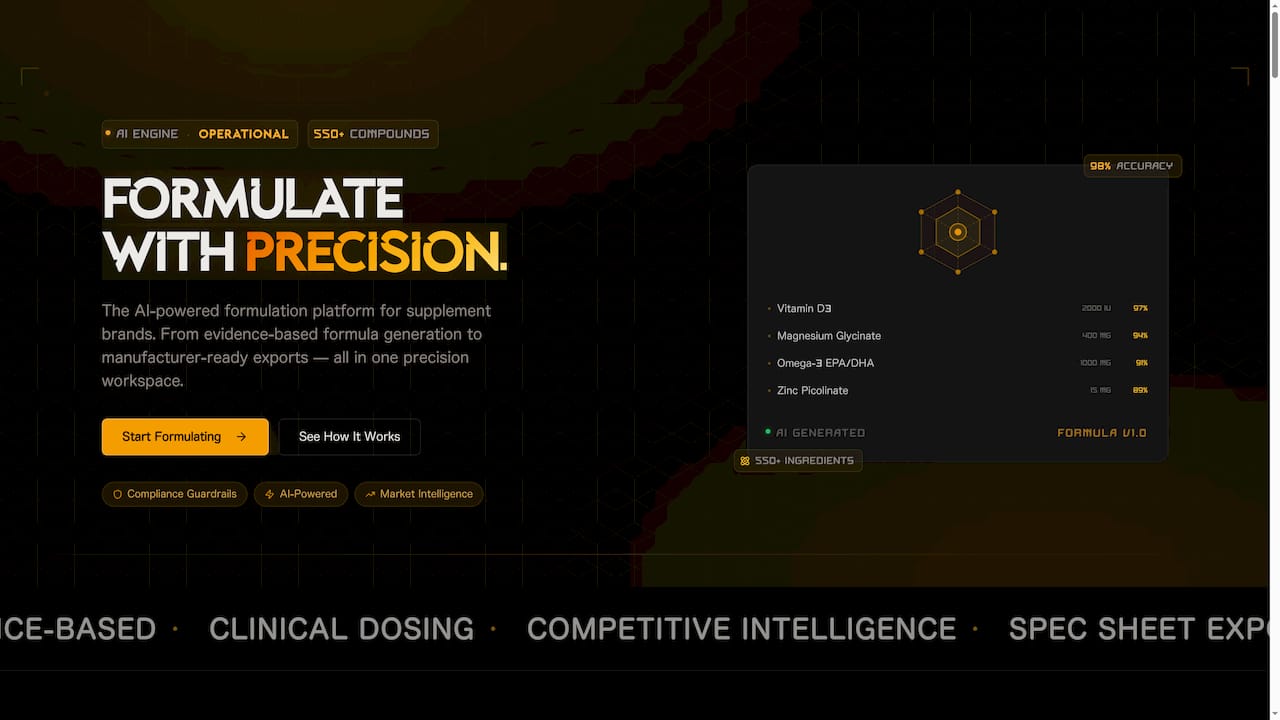
The Formlypro platform includes a full competitor analysis module that shows which products are selling, what those brands put in their formulations, and where the market gaps are. Its 8-phase product development plan takes a new product from ideation through formulation, prototyping, compliance, and production, with market and competitive analytics embedded at every stage. You get AI-assisted positioning guidance, custom packaging design with an integrated mockup tool, and compliance support built in. For supplement and consumer product brands that want to move from insight to launch without losing intelligence along the way, Formlypro removes the gap between knowing what the market needs and building it.
FAQ
What is competitive analytics?
Competitive analytics is the periodic, strategic evaluation of competitor data to identify market gaps, sharpen brand positioning, and inform product development. It differs from competitor monitoring, which tracks daily activity without synthesizing it into strategy.
How often should you perform competitive analysis?
Formal competitive analysis should run at least quarterly, with annual cycles as the minimum for stable markets. Fast-moving categories like supplements or consumer tech require more frequent cycles.
What are the main benefits of competitive analysis?
The core benefits include sharper brand differentiation, smarter budget allocation, faster market response, and earlier detection of market shifts. Teams using structured competitive intelligence improve response speed by 40%.
How does AI change competitive analytics strategies?
AI tools shorten deal cycles and automate data collection, but the most significant shift is AI visibility. Competitors appearing in AI-generated answers on platforms like ChatGPT and Perplexity now influence buyer decisions before a brand website is ever visited.
What frameworks are used in competitive market analysis?
The most widely used frameworks are Porter's Five Forces for industry structure, SWOT analysis for positioning gaps, and perceptual mapping for brand differentiation. The SBA recommends five core assessment categories: market share, strengths and weaknesses, target alignment, barriers to entry, and indirect competitors.