

TL;DR:
- AI fundamentally transforms packaging by streamlining artwork management, compliance, and material optimization, reducing timelines by up to 50%. It offers operational benefits such as improved defect detection, SKU adaptation, and faster speed to market, providing a competitive edge for brands. However, human expertise remains essential to ensure accuracy, quality, and compliance, with AI acting as a powerful tool to augment creative and technical decision-making.
The role of AI in packaging is fundamentally misunderstood by most brand owners. Too many still think of it as a manufacturing floor tool — robots sealing boxes faster. The real story is happening upstream: in artwork management, regulatory compliance, material optimization, and consumer-facing design. If you are building a product in the consumer packaged goods sector right now and not actively evaluating artificial intelligence in packaging, you are already behind the brands that are.
Table of Contents
- How AI transforms packaging design and artwork management
- Operational and commercial benefits of AI adoption in packaging
- AI's role in sustainable packaging design and supply chain innovation
- How brand owners and product developers can successfully integrate AI in packaging
- Why relying solely on AI without human expertise risks your packaging's success
- Leverage FormlyPro's packaging innovation platform powered by AI
- Frequently asked questions
Key Takeaways
| Point | Details |
|---|---|
| AI accelerates artwork workflows | AI reduces packaging artwork timelines by up to 50% through automated compliance and adaptation. |
| Substantial efficiency and cost savings | Implementing AI in packaging can improve operational efficiency by 30% and reduce production costs by 25%. |
| Sustainability through simulation | AI enables simulation-based design to optimize materials for sustainability from early packaging stages. |
| Balanced AI and human expertise | Human oversight remains crucial for ensuring print and brand quality alongside AI automation. |
| Growing market adoption | AI adoption among brand owners and product developers is rapidly expanding, signaling strong future growth. |
How AI transforms packaging design and artwork management
Packaging artwork has historically been one of the most labor-intensive bottlenecks in the entire product launch cycle. You have compliance copy, ingredient declarations, barcode placement, allergen callouts, and brand assets all living in the same file, and every revision touches all of them. One misplaced period in a regulatory statement can trigger a full review cycle. AI changes that dynamic completely.
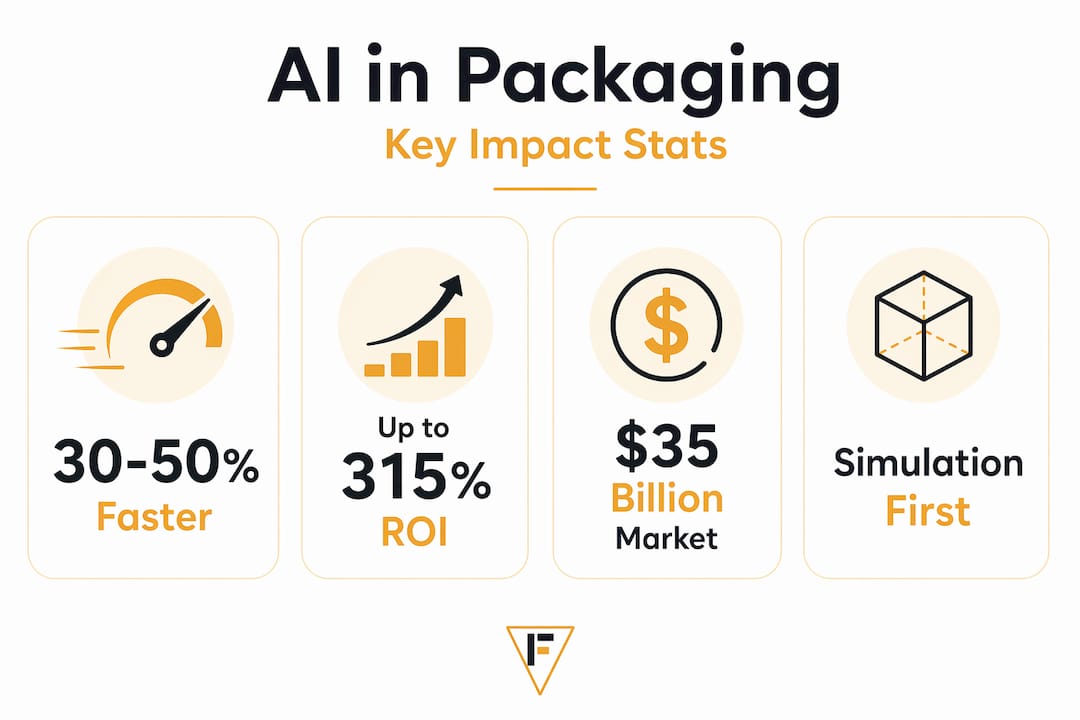
AI-enabled packaging artwork workflows compress timelines by 30 to 50% through automated compliance checks, proofreading, and intelligent adaptation across SKUs. Instead of a human proofreader manually cross-referencing a 40-item artwork checklist, an AI system scans the file, compares it against a pre-approved master, and flags every discrepancy in seconds. Barcode validity, font size minimums, regulatory text accuracy, color registration — all checked simultaneously.
What makes this particularly valuable for brands managing large product portfolios is intelligent SKU adaptation. When you update a formulation and need to propagate that change across 12 size variants and 3 regional label versions, AI handles the adaptation automatically. That work used to eat weeks of studio time. Now it takes hours.
Key areas where AI is reshaping packaging design and artwork:
- Automated proofreading that catches errors in regulatory text, nutritional panels, and ingredient lists before they reach print
- Compliance screening that checks against jurisdiction-specific requirements for label copy, font sizing, and mandatory disclosures
- Smart template adaptation that reformats artwork across multiple SKUs while maintaining brand consistency
- Version control and audit trails that reduce back-and-forth between brand, regulatory, and print production teams
Pro Tip: Before selecting an AI artwork management tool, map your current revision cycle and count the average number of rounds per SKU. That number becomes your baseline for measuring ROI after implementation.
Getting custom packaging compliance right from the first draft is where AI delivers its clearest return. Fewer revision cycles mean faster approvals, faster to shelf, and less money spent on studio revisions that should have been caught automatically.

Operational and commercial benefits of AI adoption in packaging
The numbers behind AI in packaging adoption are no longer speculative projections. They are being measured on production floors and in finance teams right now.
The AI in packaging market is valued at $10.5 billion in 2025 and projected to reach $35 billion by 2032, with brands in food and beverage reporting up to 30% efficiency gains and 25% production cost reductions. Those are not incremental improvements. In a sector where margins are under constant pressure from input costs and retailer requirements, a 25% reduction in production cost is a structural competitive advantage.
Pharmaceutical packaging illustrates the highest-stakes version of this story. AI quality control systems deliver 315% ROI, 99.8% defect detection accuracy, and reduce manual labor by 72% in pharma packaging lines. Even if your products are not pharmaceuticals, the technology transfer is real. Vision systems trained on defect detection for blister packs are being adapted for cosmetic cartons, food pouches, and personal care tubes.
Here is a practical comparison of what AI-driven packaging optimization delivers versus traditional approaches:
| Capability | Traditional approach | AI-driven approach |
|---|---|---|
| Artwork proofreading | Manual review, multiple rounds | Automated scan, single review cycle |
| Defect detection | Spot sampling, human inspectors | 100% line inspection, 99.8% accuracy |
| SKU adaptation | Studio rework per variant | Automated template adaptation |
| Compliance checks | Regulatory team review | Real-time, jurisdiction-specific screening |
| Speed to market | 8 to 16 weeks typical | 4 to 8 weeks with AI support |
The four operational priorities where AI delivers measurable ROI fastest:
- Quality control automation on production lines, reducing defect escape rates and recall risk
- Artwork management across multi-SKU portfolios to reduce revision cycles and studio costs
- Compliance screening for packaging entering multiple regulatory jurisdictions
- Demand-driven production planning that matches packaging inventory to actual retail movement
"The brands winning shelf space in 2026 are not just those with the best product formulations. They are the ones who can get compliant, well-designed packaging to market faster and more accurately than their competition."
Getting your product compliance mastery right is no longer optional, and AI is the mechanism that makes it scalable. Pairing that with formulation risk strategies that account for ingredient and packaging interactions gives brand owners a genuinely defensible position.
AI's role in sustainable packaging design and supply chain innovation
Sustainability in packaging used to mean iterative physical prototyping: make a sample, test it, modify it, repeat. That cycle is expensive, slow, and material-intensive. AI is changing the design process at the source.
AI shifts packaging design from repeated physical prototyping to simulation-based evaluation, allowing brands to optimize material use and sustainability decisions from the earliest design stages. Instead of building five rounds of corrugated samples to find the right structural configuration, you run parametric simulations that test thousands of material and geometry combinations in hours. You arrive at a physical prototype already knowing it performs.
The supply chain dimension is equally significant. AI and IoT integration in packaging improve supply chain transparency and operational efficiency by 30% in the food and beverage sector. When your packaging communicates real-time data through smart packaging solutions, the downstream effects include reduced overproduction, better inventory matching, and measurable reductions in waste from expired or damaged product.
How AI drives sustainability across the packaging lifecycle:
- Material optimization modeling that identifies the minimum viable material weight for a given structural requirement
- End-of-life labeling compliance that ensures recycling and disposal instructions meet regional requirements automatically
- Carbon footprint simulation during design phase before any material is ordered
- Smart packaging integration (QR codes, NFC tags) that enable real-time product tracking and authentication
Pro Tip: When evaluating AI tools for sustainable packaging design, ask vendors specifically about their material database breadth. A simulation is only as good as the material properties it draws from. Narrow databases produce recommendations that do not survive contact with real supplier options.
If you are working in food and beverage, the intersection of food and beverage trends with smart packaging is where the next wave of brand differentiation is being built. Consumers are increasingly making purchase decisions based on sourcing transparency, and your packaging is the interface for that conversation.
How brand owners and product developers can successfully integrate AI in packaging
The adoption curve for AI in packaging is steeper than most brand owners expect, but the barriers are practical rather than technical. Knowing where to start is the real challenge.
84% of U.S. brand owners are already aware of AI for product development, with 74% having adopted it in some form, and that number is expected to reach 88% in marketing applications by 2028. You are not evaluating an emerging technology. You are catching up with what the majority of your competitive set is already doing.
The practical steps for effective integration:
- Define the specific business problem first. Do not buy an AI tool and then find a use for it. Start with your biggest bottleneck: artwork revision cycles, compliance failures, defect rates, or slow time to market.
- Audit your existing data and workflows. AI performs best when it has clean, structured inputs. If your master artwork files are inconsistent or your supplier data is fragmented, fix those foundations first.
- Verify supplier and printer compatibility. Successful AI packaging tool use requires confirming that your print production partners can accept and process AI-generated files at your required specifications.
- Plan for a human review layer. AI handles 80% of packaging design ideation and iteration, but final print specifications require expert human input for brand quality.
- Measure before and after. Set clear KPIs: revision rounds per SKU, time from brief to approved artwork, defect rate per production run.
Common pitfalls to avoid when adopting AI in packaging:
- Treating AI output as print-ready without expert review
- Skipping change management and assuming teams will self-adopt
- Selecting tools that handle design but ignore compliance requirements
- Underinvesting in training for the humans who work alongside the AI system
Understanding how compliance automation benefits your broader brand operations puts the packaging-specific gains in context. And staying current on compliance standards in 2026 ensures your AI tool is screening against requirements that are actually enforced.
Why relying solely on AI without human expertise risks your packaging's success
Here is the part most AI-in-packaging articles skip: the failure mode is not AI being incompetent. The failure mode is brand owners treating AI output as finished work.
AI handles 80% of design ideation efficiently, but that final 20%, the handoff to human experts for print specs and premium quality, is where brand value either holds or collapses. An AI mockup tool will generate a visually convincing result. It will not know that your brand's Pantone color shifts significantly when printed on kraft paper with a matte laminate, or that your die-cut tolerance requires a specific conversation with your printer about substrate grain direction.
These are not edge cases. They are standard professional concerns that experienced packaging designers carry in their heads, built from years of failed print runs and client feedback. AI does not have those years. You have to bring them.
The brands we see getting the most value from AI in packaging are the ones who use it to eliminate the low-value iteration work, freeing their human experts to focus on the decisions that actually require judgment. Generate 40 structural concepts in an afternoon using AI. Have one experienced designer evaluate the shortlist against real-world print constraints. That division of labor is where the competitive advantage lives.
A hybrid approach also protects you from the compliance risk that purely AI-generated packaging can introduce. Color accuracy for regulatory borders, minimum print sizes for warning text, and country-specific mandatory disclosures all require a human who understands the consequences of getting it wrong. AI can flag issues. It takes human responsibility to resolve them correctly.
The best use of AI in custom packaging quality processes is as a force multiplier for your team, not a replacement for it.
Leverage FormlyPro's packaging innovation platform powered by AI
You now understand how artificial intelligence in packaging changes the design, compliance, and production timeline for consumer brands. The question becomes: how do you access those capabilities without assembling a patchwork of disconnected tools?
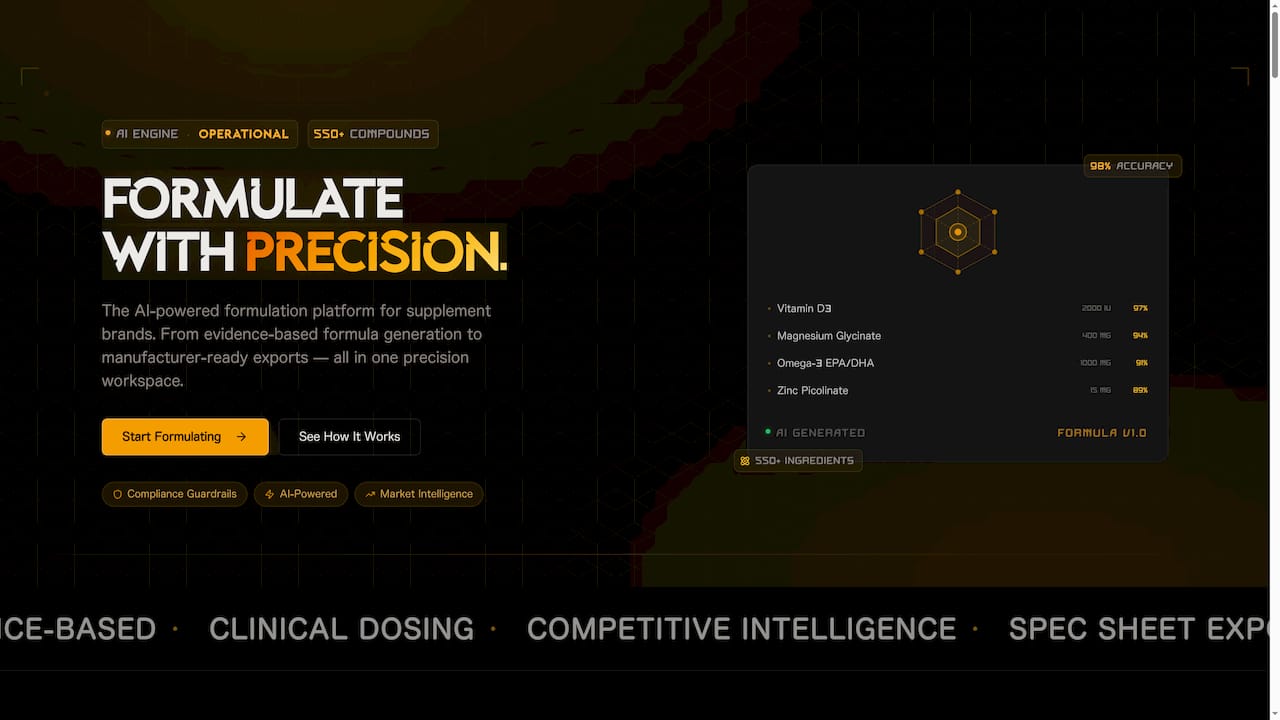
FormlyPro integrates AI-powered packaging design directly into a product development platform built specifically for brand owners and product developers. The system's AI Mockup designer lets you build and visualize custom packaging inside the same environment where you manage formulation, compliance screening, and market research. Every phase connects, from initial concept through production-ready files, with compliance checks running throughout. Instead of managing five separate tools and hoping they talk to each other, you work inside a single system designed for the entire journey.
Frequently asked questions
How does AI improve accuracy in packaging artwork management?
AI automates inspections by comparing artwork to approved master copies, detecting errors in regulatory text, barcodes, and brand elements, which cuts revision cycles and compliance risk significantly. AI-powered inspection systems catch errors at the source with near-total accuracy, before anything reaches print production.
What operational benefits can brand owners expect from AI in packaging?
Brands can achieve up to 30% efficiency gains and 25% production cost reductions through AI automation, with the strongest results in food and beverage and pharmaceutical packaging operations.
Can AI replace human expertise in packaging design?
No. AI handles roughly 80% of design ideation and iteration, but human experts are essential for final print specifications, color accuracy, and quality control decisions that protect brand integrity.
What is the future growth outlook for AI in packaging?
The AI in packaging market is projected to grow from $10.5 billion in 2025 to $35 billion by 2032, reflecting an 18.5% compound annual growth rate driven by expanding adoption across food, pharma, and consumer goods sectors.