

TL;DR:
- Compliance automation transforms compliance from a reactive cost into a proactive growth tool.
- It streamlines tasks like label verification, allergen tracking, and audit trails, reducing errors and time.
- Integrating compliance into product development accelerates market launch and enhances strategic decision-making.
Most brand owners treat compliance as a tax you pay to stay in business. You hire someone to handle labels, you file the right paperwork, and you hope nothing gets flagged. That mindset is costing you more than time and money. It's costing you speed to market, product quality, and competitive advantage. Automation is flipping this model entirely, turning compliance from a reactive cost center into a proactive growth engine. This guide breaks down what compliance automation actually does, the real business benefits it delivers, how it changes the way you develop products, and where it can still fall short.
Table of Contents
- What is compliance automation?
- Top benefits of compliance automation for brands
- How compliance automation transforms product formulation
- Potential challenges and how to overcome them
- Why most brands misunderstand compliance automation
- Take the next step with compliance automation
- Frequently asked questions
Key Takeaways
| Point | Details |
|---|---|
| Automation boosts efficiency | Compliance automation dramatically reduces recall risks and record retrieval times. |
| Strategic innovation enabler | Integrated automation shifts compliance from a barrier to a driver of innovation and speed. |
| Audit-ready in minutes | Automated systems provide instant audit trails, supporting 100% compliance and fast FDA checks. |
| Human judgment remains critical | Automation excels in consistency, but strategic oversight still requires expert input. |
What is compliance automation?
Compliance automation is the use of software systems to handle regulatory checks, documentation, and verification tasks that would otherwise require manual review. In the consumer goods world, this means the system does the heavy lifting of cross-referencing your formulation data, ingredient lists, labeling claims, and packaging details against the applicable regulations for your target market.
At its core, compliance automation works across several interconnected areas:
Label verification checks that your product labels meet all format, font, language, and regulatory claim requirements before production runs. Allergen tracking ensures that every ingredient in your formulation is accurately flagged, cross-contamination risks are documented, and that disclosures match what's in the product. Audit trails create a real-time, searchable digital record of every change, approval, and regulatory check your product goes through. Regulatory checks scan your product data against current rules from agencies like the FDA, FTC, and international equivalents.
According to food packaging compliance research, automation verifies labels, allergens, and track-and-trace at line speed, reducing recall risks and ensuring GMP adherence across the production process.
Here's what automated compliance systems typically handle in consumer goods brands:
- Ingredient safety screening against regulatory databases
- Claim substantiation checks for health, wellness, and performance statements
- Country-specific labeling requirements across multiple markets
- Packaging compliance verification including material disclosures
- Traceability documentation from raw ingredient to finished product
- Version control for formulation changes and associated regulatory impacts
- Digital recordkeeping for supplier certifications and certificates of analysis
Compare that to the manual approach: one person or a small team manually checking each ingredient against printed regulatory guidance, updating spreadsheets, emailing suppliers for documentation, and hoping nothing slips through a version change. For a brand managing even three or four SKUs across two markets, that process becomes a full-time job that crowds out innovation entirely. A strong product development compliance guide shows just how many interconnected checkpoints exist across a single product launch.
Top benefits of compliance automation for brands
With a clear picture of what compliance automation covers, the business case for adopting it becomes much easier to see. The gains aren't just operational. They're strategic.
| Area | Manual process | Automated process |
|---|---|---|
| Label review time | 2 to 5 days per SKU | Minutes per SKU |
| Audit record retrieval | Hours to days | Under 4 minutes |
| Regulatory update response | Weeks to months | Real time |
| Error rate | High, human-dependent | Significantly reduced |
| Cost per compliance check | High labor cost | Scales without headcount |
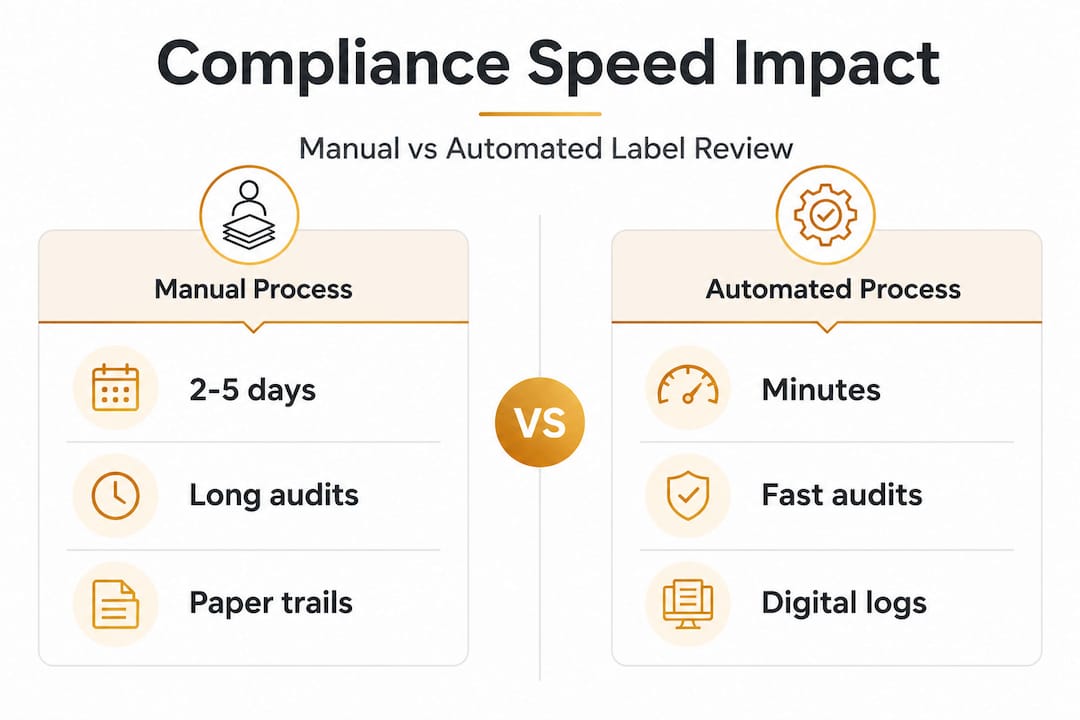
The audit readiness improvement alone is worth the investment. One dairy plant case study showed 100% HACCP and SQF compliance achieved within months of implementing automated maintenance tracking and audit trails, with records retrievable in under 4 minutes and zero findings in subsequent FDA audits. That kind of result doesn't come from working harder on compliance. It comes from building a system that makes compliance automatic.
Recall risk reduction is another area where the numbers are hard to ignore. Product recalls in food, supplement, and personal care categories consistently trace back to labeling errors, undisclosed allergens, and documentation failures. These are exactly the tasks that automation handles at scale without fatigue.
Beyond the risk side, there are real productivity benefits:
- R&D teams spend less time on compliance review and more time on formulation improvement
- Regulatory affairs staff shift from data entry to strategic guidance
- QA teams can focus on quality standards instead of paperwork compliance
- Leadership gets real-time compliance dashboards instead of periodic reports
Understanding why food and supplement compliance matters to your brand's longevity puts the productivity gains in sharper context. When your team isn't buried in manual checks, they're building better products. The compliance checklist for product success outlines just how many steps exist across a product launch, and automation handles the majority of them without adding headcount.

Pro Tip: Use the time automation frees up to run more formulation iterations and conduct more thorough market testing. Brands that launch faster with cleaner compliance records consistently outperform competitors who treat compliance as an end-of-process bottleneck.
How compliance automation transforms product formulation
Efficiency gains are valuable. But the deeper shift automation creates is in how your team actually develops new products. When compliance data feeds directly into your R&D workflow, you stop treating compliance as a final gate and start treating it as an early-stage design input. That changes everything.
Here's how integrated compliance automation reshapes the formulation process in practice:
- Ingredient screening at ideation means that when your formulation team selects an ingredient, they immediately see its regulatory status, known restrictions, and labeling implications. There are no surprises at the end.
- Real-time claim validation checks health and marketing claims against substantiation requirements as your copywriters draft them, not after legal reviews a final document.
- Multi-market compliance mapping allows you to see simultaneously which formulation variants work for the US market, EU requirements, and other jurisdictions, so you can design a global product rather than retrofitting one.
- Automated change impact analysis means that when a supplier changes an ingredient specification, the system immediately flags every SKU that uses that ingredient and every label that may need updating.
- Documentation auto-generation builds your compliance dossier as you develop the product, so by the time you're ready to launch, the paperwork is already done.
"Compliance automation shifts the function from a bottleneck to an enabler. But that only happens when automation is integrated with formulation data, not just applied at the labeling stage. When compliance is baked into the development process, teams move faster and with more confidence."
This integrated model is exactly what AI transforms product compliance in ways that go far beyond traditional regulatory management.
The result is faster, more confident product launches. Teams that integrate compliance into formulation workflows typically reduce time to market because they're eliminating the back-and-forth between R&D and regulatory that traditionally delays launch. The market-ready formulation steps process becomes far more linear when compliance data travels with the product from day one instead of arriving as a last-minute obstacle. And the formulation analytics benefits compound over time as your system learns which ingredient combinations consistently pass compliance checks in your target markets.
Potential challenges and how to overcome them
Compliance automation is genuinely powerful, but it's not a switch you flip and walk away from. Several real challenges can undermine adoption if you go in without a clear strategy.
Common pitfalls brands run into:
- Over-reliance on automation for gray areas. Regulatory gray areas, novel ingredients, new health claim territory, and emerging market rules require human judgment. The system can flag an issue, but a qualified regulatory professional needs to interpret it.
- Poor data quality at input. Automation is only as good as the data you feed it. If your ingredient specifications are inconsistent or your supplier documentation is incomplete, the system will miss things.
- Compliance scope creep. Some teams try to automate everything at once and end up with a complex system nobody uses correctly. Starting broad without a clear workflow map leads to adoption problems.
- Assuming one system covers all markets. Different regulatory jurisdictions have nuanced requirements. A system calibrated only for FDA compliance may miss EU or APAC-specific issues entirely.
- Neglecting change management. Your team needs to understand what the system does, where its limits are, and how to handle exceptions. Without training, automation creates false confidence.
Strategic AI compliance approaches consistently emphasize that while automation excels at scale and consistency, human judgment remains essential for gray areas and that pilots and workflow mapping are critical before full adoption.
Pro Tip: Before you commit to a full automation rollout, run a workflow mapping exercise. List every compliance task your team performs today, who owns it, how long it takes, and where errors most frequently occur. Then identify which of those tasks are rules-based and repeatable, because those are your highest-value automation targets. Pilot with one product category before scaling.
Questions to guide your initial workflow mapping:
- Which compliance tasks currently create the most bottlenecks in our product development timeline?
- Where have errors or near-misses occurred in the last 12 months?
- What regulatory markets do we operate in now, and where are we planning to expand?
- How does formulation data currently flow from R&D to regulatory to production?
- Do we have a single source of truth for ingredient specifications and supplier documentation?
Brands navigating cosmetics formulation compliance face a particularly layered landscape of ingredient restrictions, claim rules, and labeling requirements across markets. That makes the workflow mapping step even more important before automating. The broader consumer goods compliance guide is a useful reference for understanding the full compliance surface area your brand is managing before you start deciding what to automate.
Why most brands misunderstand compliance automation
Here's the perspective most compliance articles won't give you: brands that adopt compliance automation primarily to reduce their regulatory risk are leaving most of the value on the table. They're optimizing for "not getting in trouble" when they should be optimizing for "getting to market better."
The brands we see winning with automation aren't the ones who set it up to generate audit reports faster. They're the ones who connected compliance data to their formulation decisions, their market positioning, and their competitive strategy. They used compliance as a filtering mechanism to identify which ingredients and claims their competitors were constrained by, and then built formulations that could credibly go further.
Think about what it means to know in real time that a competitor's best-selling product is built on an ingredient combination that the EU is moving to restrict. Or that a health claim your brand wants to make is substantiated by more clinical evidence than anything your direct competitors are currently using. Compliance data, when connected to using formulation analytics, becomes competitive intelligence. That's the 10x value most brands never touch.
The other big misunderstanding is that compliance automation is primarily for large companies. In reality, smaller brands benefit more proportionally because they can't afford the large regulatory teams that big companies use to brute-force compliance manually. Automation levels the playing field. A two-person brand team with the right system can launch into multiple markets with the same compliance confidence as a company with a dedicated regulatory department.
Re-think compliance not as a process you manage but as a strategic capability you build. That shift in mindset is what separates brands that scale from brands that stall.
Take the next step with compliance automation
You've seen why compliance automation matters and what it can realistically do for your brand. The logical next step is finding a system that actually connects compliance to your formulation, packaging, and market strategy rather than treating it as a standalone checklist. That's a harder problem to solve than most compliance tools are built to address.
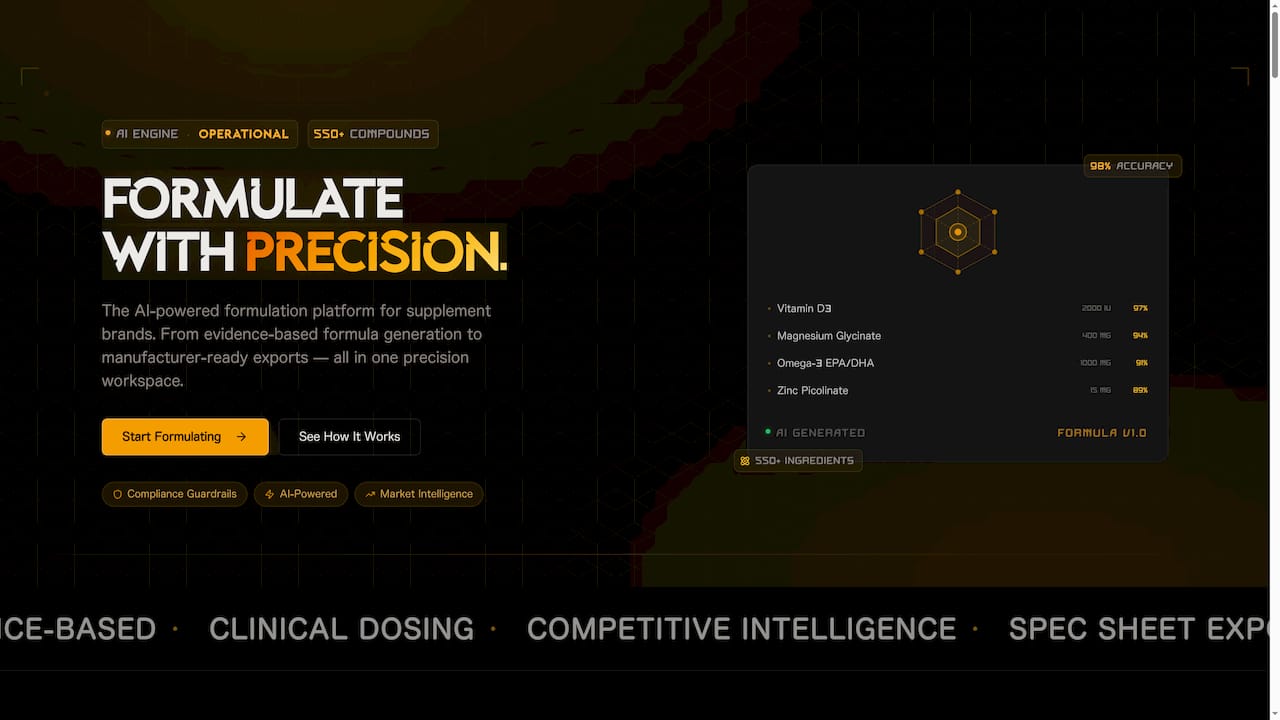
FormlyPro is built specifically for brand owners and product developers who want compliance integrated into the entire product development lifecycle, from ideation through formulation, packaging design, and market launch. The platform covers regulatory compliance alongside competitor analysis, formulation analytics, custom AI-powered packaging mockups, and an 8-phase new product development framework. If you're serious about turning compliance into a brand advantage rather than just a cost, it's worth exploring what a fully integrated system looks like for your category.
Frequently asked questions
What tasks can compliance automation handle in consumer goods?
Automation can verify labels, check allergens, manage traceability, and create digital audit trails at line speed, significantly reducing recall risks and ensuring GMP adherence across production.
How does compliance automation improve audit readiness?
Automated systems allow instant record retrieval and maintain complete audit trails, enabling teams to pull documentation in under 4 minutes and demonstrating full compliance history during regulatory reviews.
Is human expertise still needed with compliance automation?
Yes, absolutely. Human judgment remains essential for gray areas, novel ingredient assessments, and workflow design. Automation enhances expert oversight but doesn't replace the strategic thinking that qualified regulatory professionals provide.
Can compliance automation help with product innovation?
Integrating compliance checks into your formulation data workflows means your team catches regulatory issues at the ideation stage rather than at launch, giving you the confidence to iterate faster and explore more formulation possibilities.