

TL;DR:
- Packaging for regulated products serves as a legal document, brand ambassador, and market tool, requiring early compliance integration. Proper customization includes material choice, structural design, graphics, and mandatory labeling, all aligned to regulatory standards to avoid costly redesigns. Combining compliance with design enhances consumer trust and market success, supported by integrated processes like those offered by FormlyPro.
Packaging is no longer just the box your product ships in. For brand managers and entrepreneurs in regulated categories like supplements, health and beauty, and specialty chemicals, the package is a legal document, a brand ambassador, and a market positioning tool all at once. Get it wrong and you face recalls, rejected shipments, and lost shelf space. Get it right and you have a customer acquisition asset that works 24 hours a day. This guide walks you through everything you need to build packaging that performs on both counts.
Table of Contents
- The core elements of packaging customization
- Why compliance transforms customization for regulated products
- Integrating market trends and consumer appeal into packaging customization
- From design to delivery: Real-world steps for effective custom packaging
- Our take: Why most brands undervalue regulatory-driven packaging design
- Enhance your packaging customization with FormlyPro
- Frequently asked questions
Key Takeaways
| Point | Details |
|---|---|
| Build compliance in early | By addressing compliance at the start, you avoid costly redesigns and regulatory issues. |
| Link trends with legalities | Successful packaging customization connects consumer trends to regulatory essentials for better market impact. |
| Leverage compliance for trust | Use regulatory features like labeling and pictograms to reinforce your brand’s responsible image. |
| Stepwise development matters | Following a defined process from design to delivery minimizes errors and accelerates launch. |
The core elements of packaging customization
Most brands enter the packaging process thinking about colors, fonts, and logo placement. That's a reasonable starting point, but it barely scratches the surface of what customization actually involves. True packaging customization covers every decision that shapes how a product is presented, protected, and communicated to the world.
Customizable packaging features fall into several categories:
- Material selection: Glass, HDPE plastic, biodegradable paperboard, aluminum, and mylar each send a different brand signal and carry different compliance implications for regulated contents.
- Structural design: Shape, size, closure type, and child-resistant mechanisms all affect both consumer experience and regulatory standing.
- Graphics and typography: Color systems, imagery, and font choices that build brand recognition and shelf visibility.
- Regulatory labeling: Mandatory text, signal words, pictograms, and ingredient disclosures required by law for your product category.
- Secondary packaging: Boxes, shipper cartons, inserts, and tissue that carry branding into the unboxing experience.
Here's where most brands lose time and money: they finalize the design and then hand it over to a compliance team as an afterthought. By that point, mandatory labeling requirements can completely disrupt the visual layout, forcing expensive redesigns. You can read more on packaging tips for brand appeal to understand how design and compliance can coexist from day one.
For regulated products specifically, GHS/OSHA HazCom requires that packaging follow key communication and labeling rules, including standardized hazard communication elements that cannot be reduced in size or hidden.
| Typical customization only | Compliant customization |
|---|---|
| Brand colors and logo | Brand colors applied within label hierarchy rules |
| Marketing copy | Marketing copy balanced with required safety statements |
| Ingredient list added late | Ingredient list planned as core design element |
| Font chosen for style | Font chosen for legibility and regulatory minimums |
| Pictograms added if space allows | Pictograms required and sized to specification |
| No regulatory review in design phase | Compliance review integrated at concept stage |
Pro Tip: Assemble your design, compliance, and marketing teams in the same kickoff meeting. When these three functions operate in silos, every team produces work that conflicts with someone else's requirements, and you end up cycling through multiple costly revision rounds.
Why compliance transforms customization for regulated products
Once you see the full scope of customization, the compliance dimension becomes impossible to ignore. For supplements, topicals, specialty cleaners, and any product touching health claims or chemical content, the package label is a legal artifact. Regulators inspect it. Retailers require it. Consumers increasingly read it.
Different product categories trigger different requirements. Dietary supplements fall under FDA guidelines for structure and function claims. Cosmetics and personal care products must comply with labeling requirements covering ingredient disclosure and net content. Regulated chemical products, including many cleaning and personal care formulas, must meet lab compliance standards that extend to how hazard information is displayed.
For GHS-regulated products specifically, here's what must appear on every label:
- Product identifier: The chemical name, trade name, or mixture identification that connects the label to the safety data sheet.
- Signal word: Either "Danger" or "Warning," depending on the severity of the hazard category.
- Hazard statements: Standardized phrases that describe the nature of the hazard.
- Precautionary statements: Instructions covering prevention, response, storage, and disposal.
- Pictograms: Standardized symbols inside a red diamond border indicating hazard type.
- Supplier information: Name, address, and phone number of the manufacturer, importer, or responsible party.
"GHS-compliant labels must include product identifier, signal word, hazard and precautionary statements, pictograms, and supplier information — all six elements are mandatory, not optional." — GHS Label Compliance Guide
To see how this applies practically, consider a real scenario. A supplement brand launched a new pre-workout formula with a striking all-black label. The designer placed the ingredient panel in light gray text on a dark background to preserve the aesthetic. The font passed brand review. It failed FDA readability standards. The entire SKU had to be relabeled before it could enter distribution, costing the brand several weeks of launch delay and significant reprint expense.
The compliance checklist for product success and understanding product compliance standards before you finalize any design would have caught that issue in hour one of the project.
Pro Tip: Set a calendar reminder to review regulatory updates for each of your target markets every January. Labeling rules for supplements and regulated products do change, and a label that was compliant at launch may fall out of conformity within 18 months.
Integrating market trends and consumer appeal into packaging customization
With compliance as your foundation, the real creative opportunity opens up. Modern consumers are not just buying a product. They are buying a set of values, a health philosophy, and in many cases, a community identity. Your packaging communicates all of that before the lid ever comes off.

The trends shaping consumer packaging expectations right now include sustainability, minimalist design, and radical transparency. Sustainability means material choices that reduce plastic, use post-consumer recycled content, or can be composted. Minimalist design means clean negative space, restrained color palettes, and typography that breathes. Transparency means putting ingredient information, sourcing details, and manufacturing claims front and center rather than buried in fine print.
Here's the counter-intuitive insight most brand managers miss: compliance elements, handled well, actually reinforce all three of these trends. Pictograms and labeling are not just compliance tools. They offer visual cues consumers look for, signaling safety and responsible manufacturing. A well-designed product identifier block reads as confidence, not bureaucracy. Required precautionary statements, formatted cleanly, become proof of transparency rather than a visual liability.
| Market trend | Consumer expectation | Regulatory parallel |
|---|---|---|
| Sustainability | Recyclable or compostable materials | Material disclosures for certain chemical products |
| Clean design | Minimal visual clutter | Clear label hierarchy required by GHS |
| Transparency | Full ingredient visibility | Mandatory ingredient disclosure |
| Safety signaling | Certifications and quality marks | Required pictograms and hazard statements |
| Responsible sourcing | Country of origin, ethical supply | Supplier identification requirements |
Practical packaging tweaks that produce outsize consumer impact include:
- Switching to matte finish labels, which consistently test higher on perceived premium quality in consumer research.
- Adding a QR code linked to your full certificate of analysis or sourcing story, which satisfies transparency expectations without crowding the physical label.
- Using embossed or soft-touch coating on secondary packaging to create a tactile signal of quality at the point of unboxing.
- Choosing amber or dark glass for health and beauty products, which signals ingredient preservation and formulation integrity.
- Aligning your required safety pictograms with your overall icon design system so they feel designed-in rather than stamped on.
If you're in custom formulation for health and beauty, understanding how your formulation choices interact with your packaging material is critical. Certain actives will degrade in clear packaging. Some preservative systems require specific closure types to maintain stability. The formulation and packaging decisions are not independent, and treating them as separate projects is a setup for quality problems down the line. Following lab best practices helps ensure that your packaging works in harmony with your product chemistry from the very beginning.
From design to delivery: Real-world steps for effective custom packaging
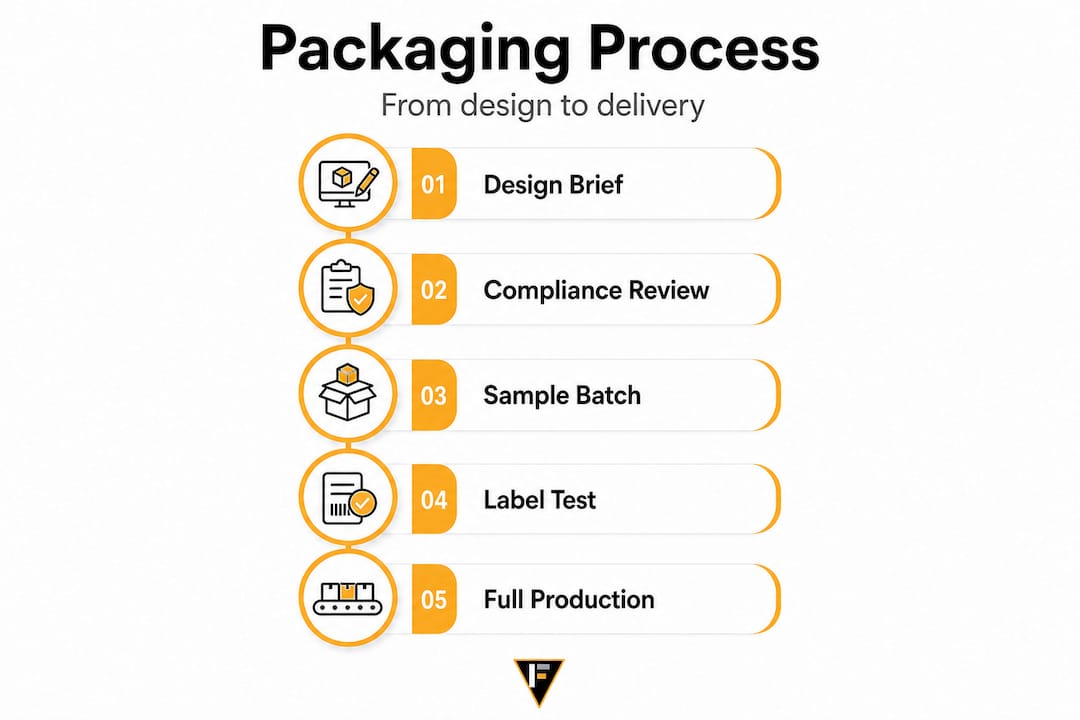
Understanding the principles is one thing. Building a repeatable, compliant, market-ready packaging process is something else entirely. Here is the sequence that consistently produces launches that clear regulatory review and land with consumers.
-
Ideation with constraints in mind. Define your brand positioning, target consumer, and market category before a single design element is chosen. Identify your regulatory requirements at this stage, not later, so that the entire creative brief is built around a compliant outcome.
-
Concurrent design and compliance mapping. Develop your visual design and your label compliance checklist in parallel. Use a compliance framework to define the mandatory label zones — where required text must live, minimum font sizes, and required pictogram dimensions — and build your creative layout around those zones.
-
First regulatory review before polish. Run a draft label through a compliance review before you invest in high-resolution artwork or specialty finishes. Catching a missing signal word or an undersized pictogram at the wireframe stage costs almost nothing. Catching it after artwork is approved can cost thousands.
-
Prototyping and materials validation. Produce physical samples of the packaging with actual labels applied. Check adhesion, legibility under different lighting conditions, and how the material interacts with your formula during stability testing. Supplier information and hazard communication details must appear clearly and legibly on the final physical package, not just look good on screen.
-
Supplier validation and print quality check. Verify that your packaging supplier can consistently reproduce your design within color tolerance, label registration accuracy, and material specification. Request a production sample run before committing to full volume.
-
Launch readiness review. Do a final cross-functional sign-off that includes design, compliance, sales, and operations. Confirm that the package as produced matches the approved specification on every element before releasing to distribution.
For a practical breakdown of the formulation side of this process, the step-by-step guide to market-ready formulations covers how product development and packaging alignment work together to meet market requirements.
Safe handling at the lab and supplier validation stage also matters. Reviewing a lab safety handling guide ensures your prototype production meets the same standards you'll eventually be communicating on your label.
Pro Tip: Run a small pilot batch with your final label applied before committing to a full production run. A 200-unit pilot print exposes legibility issues, color drift, and adhesion problems that digital proofing simply cannot replicate. It is the cheapest insurance you will ever buy against a full-scale labeling failure.
Our take: Why most brands undervalue regulatory-driven packaging design
Here's the uncomfortable truth we see repeatedly with brands across supplements, personal care, and specialty health products. Most brand managers treat compliance as a filter at the end of the design process rather than a design driver at the beginning. The result is predictable: late-stage redesigns, launch delays, regulatory rejections, and in the worst cases, market recalls.
But there's a deeper problem than just process sequence. Brands that separate compliance from brand strategy are leaving a genuine differentiation opportunity on the table. When compliance is baked into the creative brief from day one, something interesting happens. The required elements stop fighting the design and start reinforcing it. A well-structured hazard communication block reads as precision and expertise. A mandatory ingredient disclosure panel positioned prominently signals confidence in your formula. These are not concessions to regulators. They are brand statements.
We've seen brands launch with packaging that was beautifully designed but quietly non-compliant, and the aftermath is never small. Beyond the cost of relabeling, there's the retailer trust that gets damaged when a product has to be pulled, the consumer confusion when the package changes mid-cycle, and the internal credibility hit that slows down the next launch.
Early integration of compliance and market analysis produces better outcomes, consistently. Brands that review their compliance requirements for wellness brands before the first design brief is written launch faster, not slower, because they eliminate the revision cycles that otherwise pile up at the end of the process.
The brands winning on shelf right now are not the ones with the flashiest packaging. They're the ones whose packaging communicates trust at a glance. Compliance, done well, is how you build that trust without saying a word.
Enhance your packaging customization with FormlyPro
Bridging the gap between regulatory-ready and visually compelling packaging is exactly where most brands stall out. If you're ready to move past the trial-and-error cycle, FormlyPro was built for this specific challenge.
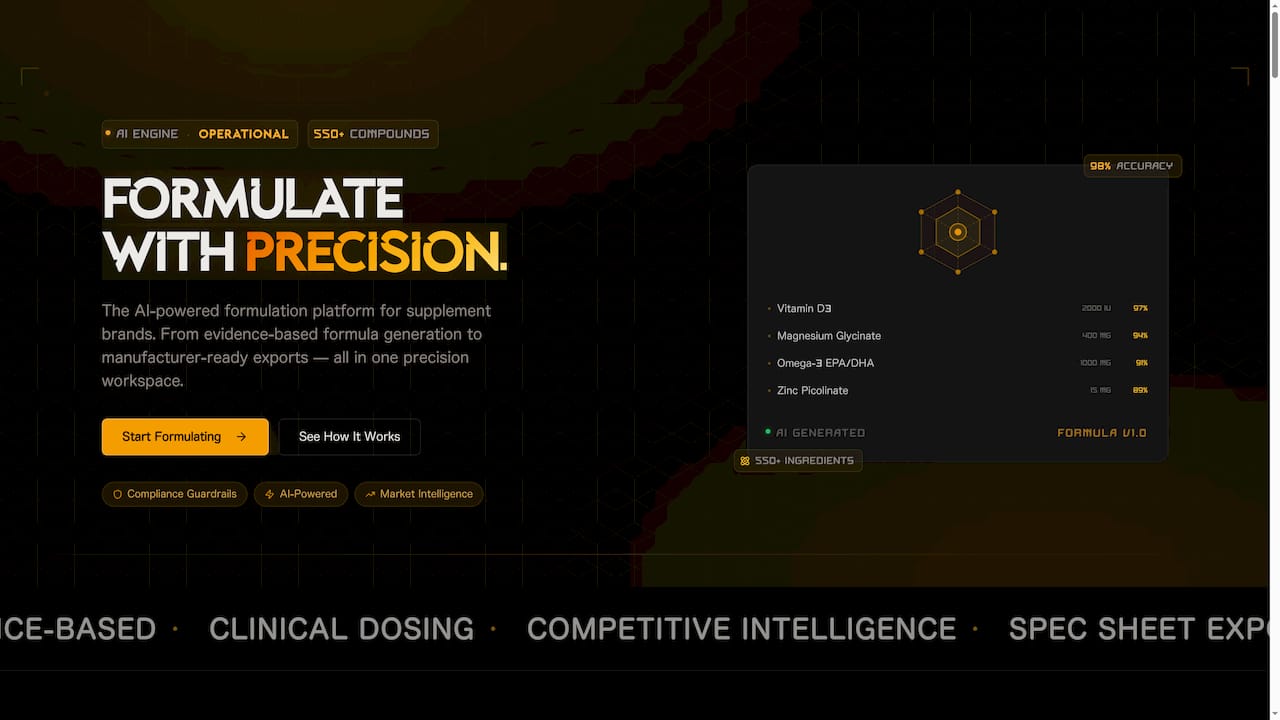
FormlyPro gives brand managers and entrepreneurs an integrated platform covering every phase of product development, from formulation and compliance guidance to market research, competitor analysis, and an AI-powered packaging mockup designer that lets you visualize your custom packaging with compliance elements built in. The 8-phase product launch system takes you from ideation through production with full regulatory and market intelligence at every step, so your packaging isn't designed in a vacuum but informed by real data on what's selling and what compliance standards apply to your category. Stop guessing. Start building with a system that connects every piece of the process.
Frequently asked questions
What are the must-have elements on packaging for regulated products?
Regulated products must include a product identifier, signal word, hazard and precautionary statements, pictograms, and supplier information, as GHS/OSHA HazCom standards require all six communication elements to be present and properly formatted on the label.
How can I balance regulatory compliance with attractive packaging?
Use compliance-required elements like pictograms and clear labeling as intentional design features that signal safety and quality, turning regulatory mandates into visual trust builders rather than visual liabilities.
What tools or resources help ensure my packaging design meets compliance standards?
Consult structured compliance checklists and use physical mock-ups or label testing before committing to full production runs, since label prototyping catches sizing errors, missing elements, and legibility issues that digital proofing misses.
Are there compliance differences by market or country?
Yes, regulations vary globally and must be reviewed for each target market, as labeling standards for supplements, cosmetics, and regulated chemical products can differ significantly between the US, EU, and other regions.