

TL;DR:
- Food product compliance includes safety programs, ingredient approvals, facility protocols, and labeling.
- Proper classification, documentation, and proactive systems are crucial to avoid recalls and market access issues.
- Treating compliance as a strategic process enhances market positioning and worldwide expansion.
Most food and beverage brands assume that getting the label right is the finish line. It isn't. Labeling is only one aspect of food product compliance, which also covers safety programs, ingredient approvals, facility protocols, and supplier accountability. Miss any of these, and you risk a warning letter, a market access block, or worse, a recall that quietly ends your brand's momentum before it ever builds. This guide breaks down what food product compliance actually requires in 2026, where brands most commonly get tripped up, and how to build a system that protects your investment and positions your brand for long-term growth.
Table of Contents
- What is food product compliance? Key definitions and frameworks
- Core mechanics: Classification, labeling, and ingredient safety
- Navigating US vs EU compliance: Key contrasts and why they matter
- Edge cases and pitfalls: Ambiguities, new ingredients, trending risks
- From compliance to competitive edge: Tools and benchmarks for well-positioned brands
- Our take: Why most brands misunderstand compliance—and how to fix it
- Move beyond compliance: How FormlyPro can streamline your next launch
- Frequently asked questions
Key Takeaways
| Point | Details |
|---|---|
| Start with classification | Properly classifying your product sets the course for its legal requirements and compliance pathway. |
| Master the basics | Accurate labeling, safe ingredients, and solid recordkeeping are non-negotiable for regulatory approval. |
| Bridging US and EU | Understanding both FDA and EU frameworks is crucial for brands planning international expansion. |
| Stay proactive | Regular audits and digital compliance tools catch pitfalls before they become costly violations. |
| Leverage compliance for growth | Transforming compliance from a checkbox into a brand asset can unlock premium markets and consumer trust. |
What is food product compliance? Key definitions and frameworks
Food product compliance is the full set of legal and regulatory requirements a brand must meet to manufacture, label, and sell food in a given market. In the US, FDA regulations under FD&C Act, FSMA, and 21 CFR form the core framework every brand must understand before a single unit ships.
These aren't separate rulebooks. They work together. The Federal Food, Drug, and Cosmetic Act sets the overarching authority. FSMA operationalizes it with specific requirements like preventive controls, produce safety rules, and foreign supplier verification. Title 21 of the Code of Federal Regulations then fills in the details, covering everything from labeling standards to food additive approvals.
"Compliance isn't about passing an audit. It's about building a system that couldn't fail one."
Here's a quick reference to the primary compliance pillars every brand needs to account for:
| Compliance area | Governing rule | What it covers |
|---|---|---|
| Facility registration | 21 CFR Part 1 | Required before manufacturing or importing food |
| Good Manufacturing Practices | 21 CFR Part 117 | Sanitation, personnel, equipment standards |
| Preventive controls | FSMA (2011) | Hazard analysis and risk-based plans |
| Labeling | 21 CFR Parts 101-105 | Nutrition Facts, allergens, claims |
| Food additives | 21 CFR Parts 170-199 | GRAS status and approved additives |
| Allergen management | FALCPA / FASTER Act | Identification and cross-contact prevention |
HACCP (Hazard Analysis and Critical Control Points) sits underneath much of this. It's a preventive framework requiring you to identify biological, chemical, and physical hazards in your production process and put controls in place before a problem occurs. Preventive controls under FSMA are essentially a modernized, risk-tiered version of HACCP. If you're sourcing ingredients from multiple suppliers or co-manufacturing with a third party, allergen management becomes especially critical. Using a solid compliance checklist at the outset of any new product development cycle helps you map all of these layers before they become costly surprises.
Getting these definitions right up front isn't academic. It shapes every decision downstream, from how you register your facility to what language you can legally use on your packaging.
Core mechanics: Classification, labeling, and ingredient safety
With the foundations laid out, let's break down the mechanics every brand must master.
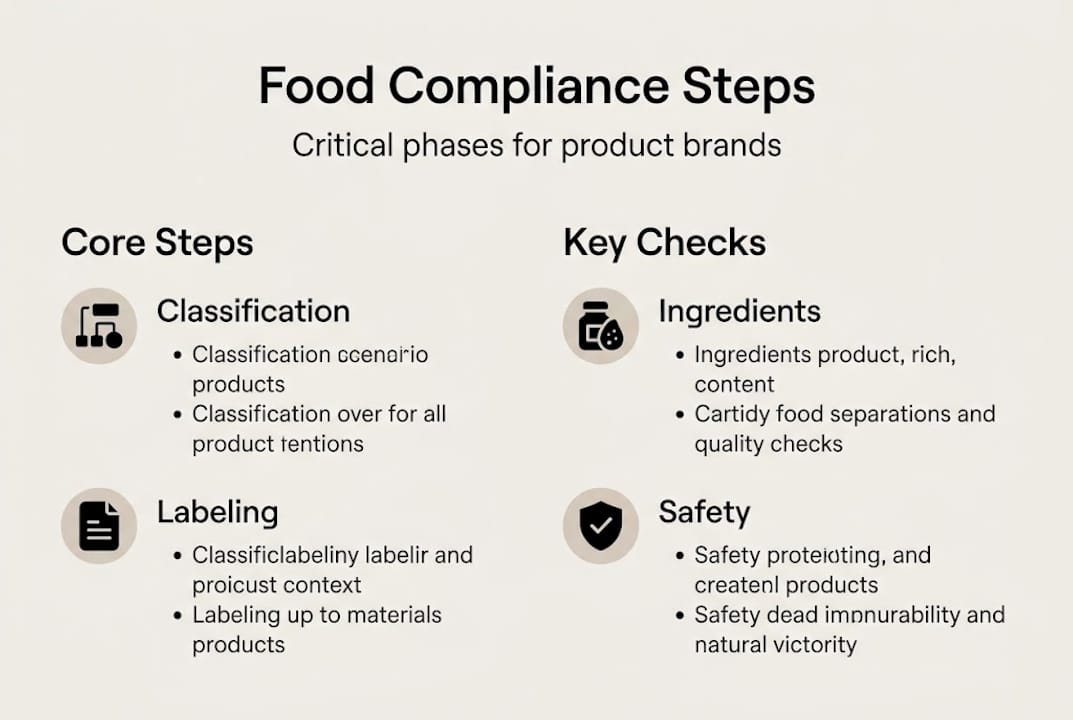
The first step is classifying your product correctly. Is it a conventional food, a dietary supplement, or a medical food? Classification determines which set of rules applies. A product marketed as "supporting immune health" could be a conventional food or a dietary supplement depending on its formulation and intended use claims. Getting this wrong from day one means your entire labeling, ingredient selection, and regulatory pathway is built on a false premise.
Core mechanics include classification, labeling accuracy, ingredient safety, and food contact materials, and each one carries its own documentation burden. Here's how they break down:
- Product classification: Determine whether your product falls under FDA, USDA, or a dual-jurisdiction category.
- Labeling review: Confirm your Nutrition Facts panel, ingredient list, allergen declarations, net weight, and principal display panel all meet current requirements.
- Ingredient safety: Every ingredient must either have approved food additive status or a GRAS (Generally Recognized as Safe) determination under GRAS guidelines.
- Claims audit: Structure/function claims, qualified health claims, and nutrient content claims each carry specific substantiation requirements. Mixing them up is a common enforcement trigger.
- Packaging materials: Food contact materials must comply with applicable 21 CFR regulations. Migration testing may be required for certain materials.
| Label element | Requirement | Common mistake |
|---|---|---|
| Allergen declaration | Major allergens listed by common name | Outdated tree nut groupings |
| Nutrition Facts | Serving size based on RACC | Incorrect RACC reference |
| Health claims | FDA-authorized language only | Using unapproved structure/function claims |
| Net quantity | Mandatory on PDP | Wrong placement or format |
Pro Tip: When reviewing labeling and packaging tips, pay close attention to the new allergen specificity requirements. Tree nuts now require individual species identification (almond, cashew, walnut) rather than a blanket "tree nuts" declaration.
Building strong practical compliance in product development means treating classification and labeling as the starting gate, not a final checklist item. Both inform formulation, which is why skipping them early always costs more to fix later.
Navigating US vs EU compliance: Key contrasts and why they matter
Once you're solid on US frameworks, expanding or packaging for other markets adds a new layer of complexity.

US and EU food regulations share the same goal but use fundamentally different approaches to get there. EU contrasts with FDA in three major ways: stricter positive lists for approved substances, EFSA pre-market assessments instead of the FDA's GRAS process, and more rigorous packaging migration standards.
In the US, a brand can self-affirm GRAS status for a new ingredient, meaning your own scientific review can clear it for use without FDA sign-off. The EU does not have an equivalent pathway. Every novel substance requires formal EFSA assessment before it can legally enter a food product. This single difference can add 12 to 24 months to a product launch timeline if you're expanding internationally.
Here are the key compliance contrasts brands targeting both markets need to track:
- Ingredient approvals: FDA allows GRAS self-affirmation; EU requires EFSA pre-approval for novel ingredients.
- Packaging materials: The EU uses positive lists (only listed materials are permitted); US relies on functional standards with more manufacturer flexibility. EU packaging compliance has become significantly stricter in recent years.
- Health claims: Both markets regulate health claims tightly, but the specific authorized claims and required substantiation levels differ substantially.
- Additives: Many additives approved in the US are restricted or banned in the EU, and vice versa. Your formulation team needs country-specific ingredient approval matrices.
- Labeling formats: Front-of-pack labeling requirements differ significantly. The EU is moving toward mandatory Nutri-Score labeling in several member states.
Pro Tip: When building a product meant for international markets, map your formulation against both US and EU industry compliance standards simultaneously. Retrofitting a US formulation for EU approval is far more expensive than designing dual-compliant from the start.
Chile's regulatory framework is worth noting as a regional benchmark. Its front-of-pack warning label system has influenced regulatory direction across Latin America and is increasingly cited in global packaging policy discussions.
Edge cases and pitfalls: Ambiguities, new ingredients, trending risks
Even with strong systems, emerging areas and regulatory changes still pose real risks.
Some of the most expensive compliance failures come from categories that appear straightforward but contain regulatory tripwires. A product with 2% meat content falls under FDA jurisdiction. At 3% or more, USDA takes over, with entirely different labeling, facility, and inspection requirements. That one percentage point triggers a completely different regulatory pathway.
Classification ambiguities, novel ingredients, allergen naming specificity, and the end of GRAS self-affirmation are among the most active risk areas heading into 2026. Here's where brands are getting caught:
- NDI notifications: New Dietary Ingredients require a formal notification to FDA at least 75 days before marketing. Many brands skip this step entirely, assuming prior industry use creates de facto approval.
- Tree nut allergen updates: The FASTER Act now requires individual tree nut species to be named on labels. Brands still using legacy "tree nuts" language are out of compliance.
- Recycled packaging: New state-level and federal requirements around post-consumer recycled materials in food contact packaging are evolving rapidly and vary by jurisdiction.
- GRAS self-affirmation: FDA has been signaling reduced tolerance for unpublished GRAS self-affirmations. Expect increased scrutiny on ingredients with no formal FDA review.
- Digital recordkeeping gaps: Labeling violations consistently top FDA enforcement actions. Brands without digital tracking systems often cannot demonstrate label version control during audits.
Labeling violations are the single most common trigger for FDA warning letters. Brands that understand why compliance matters treat their label version history with the same rigor as their financial records. If you can't show an auditor exactly which label was on which batch, you have a documentation problem that no amount of correct information can fix.
The compliance pitfalls for CPG brands often come down to moving too fast and assuming industry norms are the same as regulatory requirements. They aren't.
From compliance to competitive edge: Tools and benchmarks for well-positioned brands
Turning compliance from a cost into a value generator requires the right strategies and tools.
The strongest brands don't think of compliance as something that happens at the end of a project. They build it into the process from day one. There's a real operational payoff to this. Facilities achieving 100% HACCP/SQF compliance via digital tracking have run FDA audits with zero non-conformances, demonstrating that audit-readiness is a direct function of documentation quality, not luck.
Here's a practical roadmap for turning compliance into a competitive asset:
- Digitize your documentation: Move away from spreadsheets and paper-based SOPs. Digital systems allow real-time version control, audit trails, and batch-level traceability.
- Build a supplier audit program: Your co-packers and ingredient suppliers are extensions of your compliance posture. A supplier that fails an FDA inspection becomes your problem too.
- Run proactive HACCP reviews: A proactive hazard analysis before launch catches 80% of potential failure points. Reactive corrective actions after a recall cost exponentially more.
- Use compliance to unlock premium claims: Verified non-GMO, allergen-free, or organic claims require documented compliance programs but open access to premium retail channels and price points.
- Track international benchmarks: Chilean compliance benchmarks on high-sugar food reformulation show how regulatory environments drive reformulation decisions that ultimately improve product quality and market access.
"Audit-ready brands don't scramble when regulators show up. They hand over a folder."
If your market-ready formulation steps don't include compliance checkpoints at each phase, you're building a product that may be great on paper but vulnerable in practice.
Our take: Why most brands misunderstand compliance—and how to fix it
Here's something most compliance articles won't tell you: the brands that treat compliance as a strategic input rather than a regulatory tax consistently outperform the ones that treat it as a final review step. That isn't opinion. It shows up in recall rates, market access, and premium shelf placement.
The short-term thinking pattern looks like this: compliance is a cost center, something to minimize and hand off to a consultant right before launch. The result is usually a product that clears its first launch but accumulates risk with every line extension, every new market, and every reformulation that doesn't go back through a proper review.
Leaders approach mastering product compliance as an integrated function, not an afterthought. They use it to justify premium positioning, to open global distribution channels, and to build consumer trust that generic brands can't replicate.
If your compliance program isn't actively informing your product roadmap, it's only doing half its job.
Move beyond compliance: How FormlyPro can streamline your next launch
If you've made it this far, you already understand that compliance isn't a single task. It's a system. FormlyPro is built for exactly this.
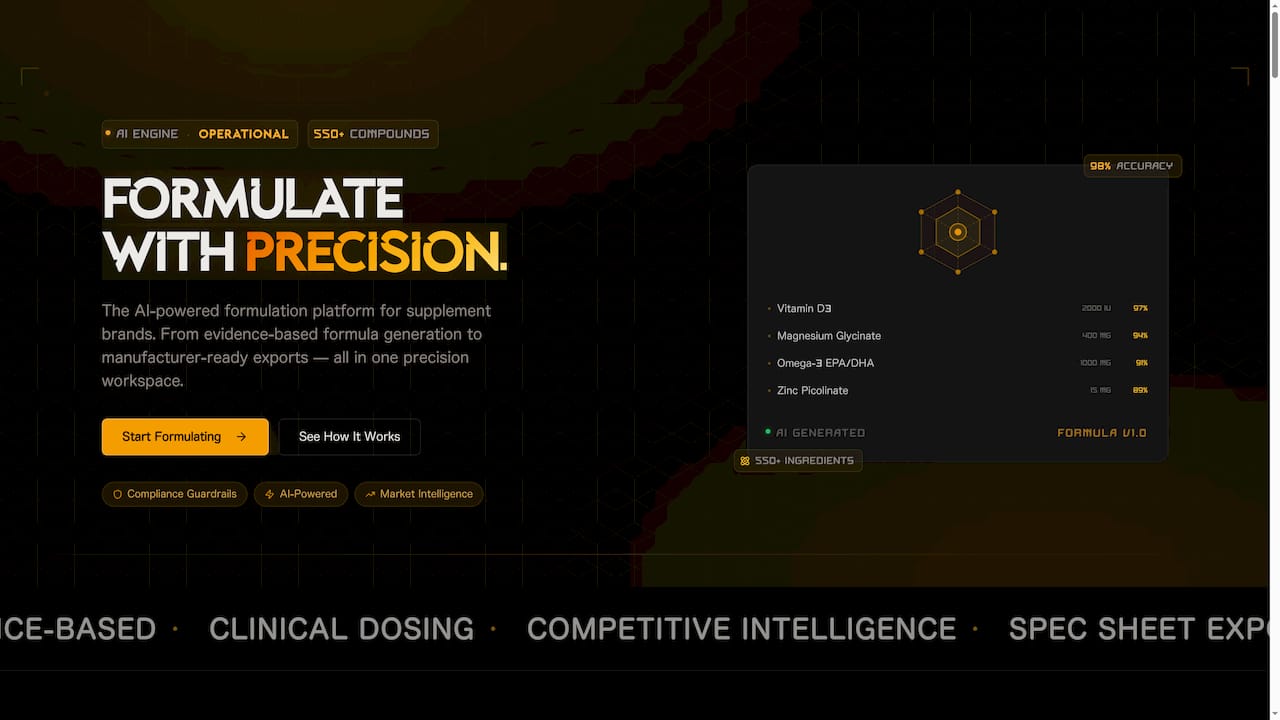
The FormlyPro compliance platform gives food and beverage brands a structured 8-phase product development system that integrates compliance checkpoints from ideation through production. You get built-in labeling guidance, formulation tools backed by real market and competitor data, and an AI-powered packaging mockup designer so your brand looks as good as it performs on the shelf. Whether you're navigating a first launch or scaling into international markets, FormlyPro connects the dots between a compliant formula and a market-ready product.
Frequently asked questions
What are the core requirements of food product compliance in the US?
Food product compliance involves facility registration, cGMPs, HACCP or preventive controls, accurate labeling, and approved additives under 21 CFR and FSMA. Each requirement is enforced independently, so a gap in any one area creates exposure even if the others are solid.
How do FDA and EU food regulations differ?
The FDA permits GRAS self-affirmation and offers more flexibility on packaging materials, while the EU relies on EFSA pre-approval and stricter positive lists for both ingredients and food contact materials. This difference makes simultaneous US and EU product development significantly more complex.
What are common pitfalls that lead to compliance failures?
Misclassification, unverified claims, and poor documentation are the top causes of non-compliance for food and beverage brands. Brands that lack digital recordkeeping often can't demonstrate control during audits, which turns minor issues into major enforcement actions.
Does compliance improve market positioning?
Yes. Compliance enables premium claims like allergen-free and non-GMO verified, which support higher price points and access to premium retail channels, while also reducing the risk profile that global buyers assess before listing your product.
What should I do first when launching a new food product?
Start by classifying your product correctly under FDA or USDA jurisdiction, then build a compliance checklist that maps labeling, ingredient, and facility requirements for every target market. Getting classification wrong at the start cascades into costly corrections across every other compliance layer.