

TL;DR:
- Market trends influence formulation by guiding ingredient choices aligned with consumer health and regulatory demands.
- Reactive trend chasing risks product failure and short lifecycles, emphasizing the need for strategic validation.
- Integrating predictive analytics and a structured process improves trend adoption, speed, and formulation success.
When Snapple launched its line of all-natural beverages in the early 1990s, it rode a wave of consumer demand for transparency before most brands even saw it coming. Brands that spotted that shift early built lasting equity. Those that missed it scrambled to catch up years later. Market trends drive formulation through consumer demands for functional nutrition, premium convenience, and health-focused reformulations. For brand managers and product developers, understanding how to translate those signals into real formulation decisions is the difference between a product that earns shelf space and one that never leaves the warehouse.
Table of Contents
- Understanding the impact of market trends on product formulation
- Methodologies for spotting and applying trends in formulation
- Challenges and risks in trend-driven formulation
- From trend insight to market success: best practices
- Why following the crowd isn't enough: our take
- Strengthen your formulations with FormlyPro
- Frequently asked questions
Key Takeaways
| Point | Details |
|---|---|
| Consumer trends reshape formulation | Staying ahead of evolving preferences like health and convenience is essential for product success. |
| Predictive tools reduce risk | AI, analytics, and validation techniques lower innovation failure and speed up time-to-market. |
| Trend chasing has pitfalls | Balancing trend adoption with brand differentiation avoids oversaturation and product fatigue. |
| Smart execution wins | Best-practice frameworks turn trend data into measurable, marketable product outcomes. |
Understanding the impact of market trends on product formulation
Market trends are sustained shifts in consumer preferences, regulatory priorities, and competitive dynamics that change what people buy and why. They are not fads. A fad spikes and vanishes. A trend builds, reshapes category expectations, and forces brands to rethink what goes inside their products. Recent examples include the pivot toward reduced sugar and sodium content, the rise of functional ingredients like adaptogens and postbiotics, and the growing demand for clean labels with minimal processing.
Consumer behavior is the loudest signal. When shoppers start reading ingredient panels and comparing protein claims across competing products, brands that have not reformulated face real shelf pressure. Regulatory changes add a second layer of urgency. Sugar taxes, front-of-pack labeling mandates, and evolving health claim restrictions mean that what was compliant three years ago may now create legal risk.
Evolving health-driven formulations also reflect a deeper shift: consumers are no longer separating food from wellness. They expect products to do something for them, whether that is supporting digestion, improving energy, or reducing inflammation. Brands that embed these expectations into their formulation brief from day one are moving faster and wasting less R&D budget.
Protein claims are up 20% and over half of global consumers now link gut health directly to overall well-being, reshaping what goes into product formulations at scale.
Here is a snapshot of the top five formulation trends and the consumer data behind them:
| Trend | Consumer signal | Formulation impact |
|---|---|---|
| Gut health support | 50%+ link gut health to wellness | Added prebiotics, postbiotics, fiber blends |
| High protein | Protein claims up 20% | Whey, pea, rice protein inclusion |
| Sugar reduction | Demand for natural sweeteners | Stevia, allulose, monk fruit swaps |
| Clean label | 67% check ingredient lists | Shorter ingredient decks, no artificial additives |
| Functional convenience | On-the-go health expectations | RTD formats with active ingredient delivery |
Key drivers reshaping formulation strategies today include:
- Health and wellness: Consumers want products that actively support specific health outcomes
- Convenience: Busy lifestyles push demand for ready-to-drink and portable formats
- Premiumization: Higher-income consumers will pay more for science-backed, ingredient-forward products
- Regulatory compliance: Tightening rules on health claims and ingredient restrictions create reformulation pressure
- Transparency: Consumers and retailers expect clear, honest ingredient communication
Looking at formulation case studies across categories confirms that brands winning today are not just tracking these trends. They are building them into their development process from the first brief. With that context in mind, let's break down how specific market trends reshape your formulation approach.
Methodologies for spotting and applying trends in formulation
Now that you know what to look for, how can you efficiently capture and operationalize these trends? The answer is not just reading industry reports once a quarter. It requires a layered methodology that combines predictive tools with human validation.
The contrast between traditional and predictive approaches is sharp:
| Method | Speed | Accuracy | Cost | Best use case |
|---|---|---|---|---|
| Retrospective reports | Slow | Moderate | Low | Category reviews |
| Consumer surveys | Medium | High | Medium | Concept validation |
| Social listening | Fast | Variable | Low to medium | Early signal detection |
| AI predictive analytics | Very fast | High | Medium to high | Innovation pipeline planning |
| Sensory testing panels | Medium | Very high | High | Final formulation validation |
Trend forecasting with AI and predictive analytics, combined with digital surveys and parallel validation phases, can reduce innovation risk by up to 90% compared to retrospective methods alone.
Here is how to build a working trend integration process:
- Signal capture: Pull data from social platforms, search trends, retailer sales analytics, and emerging brand launches simultaneously
- Relevance filtering: Cross-reference signals against your brand's existing equity, target consumer profile, and regulatory environment
- Predictive modeling: Use AI tools to assess whether the signal represents a growing trend or a short-cycle spike
- Rapid prototyping: Build low-cost bench samples to test the formulation concept before committing full R&D resources
- Consumer validation: Run targeted panels or digital surveys with your actual target demographic, not a generic population
- Iteration: Use sensory and digital feedback to refine the formulation before scaling
Using formulation analytics to layer these methods creates a compounding advantage. Each cycle teaches you more about which trends your specific consumer base is actually responding to, not just which ones dominate the industry press.
Building market-ready formulations depends on disciplined methodology, not just creative instinct.
Pro Tip: Avoid the trend echo chamber. If every trade publication, competitor, and supplier is talking about the same ingredient, you may be entering a trend at peak saturation rather than at growth. Validate whether the trend has pricing power and consumer staying power before committing formulation resources.
Challenges and risks in trend-driven formulation
Even with the best methodologies, every trend-driven strategy faces major pitfalls. Understanding them upfront saves significant cost and brand equity down the line.
The most common trap is reactive trend chasing. A brand sees a competitor launch a product with a trending ingredient, rushes to match it, and ends up with a formula that compromises taste or texture to accommodate the functional claim. Consumers notice. They may try it once, but they do not come back.
Up to 75% of new products fail in trend-driven categories, and product lifecycles are shortening as rapid trend cycles and oversaturation accelerate consumer fatigue.
The first-mover advantage is real, but it has a ceiling. If you are first with a credible formulation, you capture early adopters and set category expectations. If you are third or fourth with an undifferentiated product, you are spending marketing budget to support someone else's trend.
Major risks and how to address them:
- Trend oversaturation: Validate market timing before committing; assess how many SKUs already carry the claim
- Taste and texture trade-offs: Prioritize sensory quality even when adding functional ingredients; consumers will not sacrifice enjoyment long-term
- Supply chain volatility: Trendy ingredients often face supply constraints; build secondary supplier relationships early
- Regulatory misalignment: Health claims require substantiation; run formulation compliance checks before finalizing packaging
- Brand dilution: Adding every trending ingredient can confuse your brand positioning; stay focused on what your core consumer expects
Improving product fit requires knowing when to follow a trend and when to hold your positioning steady.

Pro Tip: Build a brand guardrail document before your next formulation brief. Define which ingredient categories are on-brand, which are acceptable with modification, and which are off-limits regardless of trend momentum. This prevents reactive pivots that dilute your equity.
From trend insight to market success: best practices
Success depends not just on recognizing trends, but on how you act on them. The brands that consistently win are the ones with a repeatable process from discovery to launch, not a one-off reaction to a trade show conversation.
Parallel validation phases from ideation through launch increase launch success rates and reduce costly late-stage pivots. That means running consumer validation and regulatory review at the same time as bench formulation, not sequentially.
Follow this process for consistent results:
- Discover: Use layered analytics to identify trends with genuine staying power
- Validate: Test the trend's relevance against your specific brand and consumer profile
- Prototype: Build rapid bench samples and gather early sensory feedback
- Comply: Run regulatory and label compliance checks in parallel, not at the end
- Launch: Enter the market with a validated, differentiated, compliant product
Best practices for iterative consumer validation include recruiting panels from your actual distribution channel, not just online survey populations. Your convenience store buyer thinks differently from your specialty grocer buyer. Both sets of feedback matter, but they should be weighted separately.
A compliance checklist built into your workflow catches issues early, before they become expensive reformulation projects post-launch.
Do's and don'ts for effective trend application:
- Do build supply flexibility into contracts for trending ingredients before you scale
- Do use competitor intelligence to understand what formulations are already winning
- Do not launch a trend-driven SKU without a clear plan for what happens if the trend peaks in 18 months
- Do not compromise sensory quality to add a trending ingredient at a visible dose
Review the CPG guide for additional category-level context on where functional and premium segments are heading in 2026.
Pro Tip: When data shows a trend is growing in your category but your sales data does not yet reflect it, that is usually the ideal entry window. If your sales are already moving with the trend, you are on time. If they are lagging, move faster on validation.
Also consider custom formulation strategies that allow your brand to own a variant of a trend rather than replicate what others have already done.
Why following the crowd isn't enough: our take
These best practices set you up for success, but there is a missing piece most guides skip entirely. Trend-aware formulation is table stakes now. Every mid-sized and large brand has access to the same reports, the same Nielsen data, and the same supplier ingredient pitches. So if following trends is what everyone is doing, it can not be the source of competitive advantage on its own.
The brands that build lasting equity do the opposite of reactive trend adoption. They use trend data selectively, as input rather than instruction. They ask not "what is growing" but "what is growing that we can own better than anyone else." That requires genuine brand clarity and a willingness to pass on trends that do not fit, even when they are profitable in the short term.
Regulation drives reformulation and consumer demand for functional attributes reshapes competitive positioning, while affordability and premiumization remain in tension across categories. Brands that try to serve all of these pressures simultaneously end up serving none of them well.
The smartest move is to anchor your formulation strategy in what your brand stands for, then use market trend data to sharpen the edges. Packaging differentiation is one underrated way to signal trend alignment without overhauling your core formula. Brand longevity comes from selective adoption, not reflexive reaction.
Strengthen your formulations with FormlyPro
Looking to apply these insights directly in your formulation workflow? The gap between spotting a trend and turning it into a compliant, market-ready product is where most brands lose time and money.
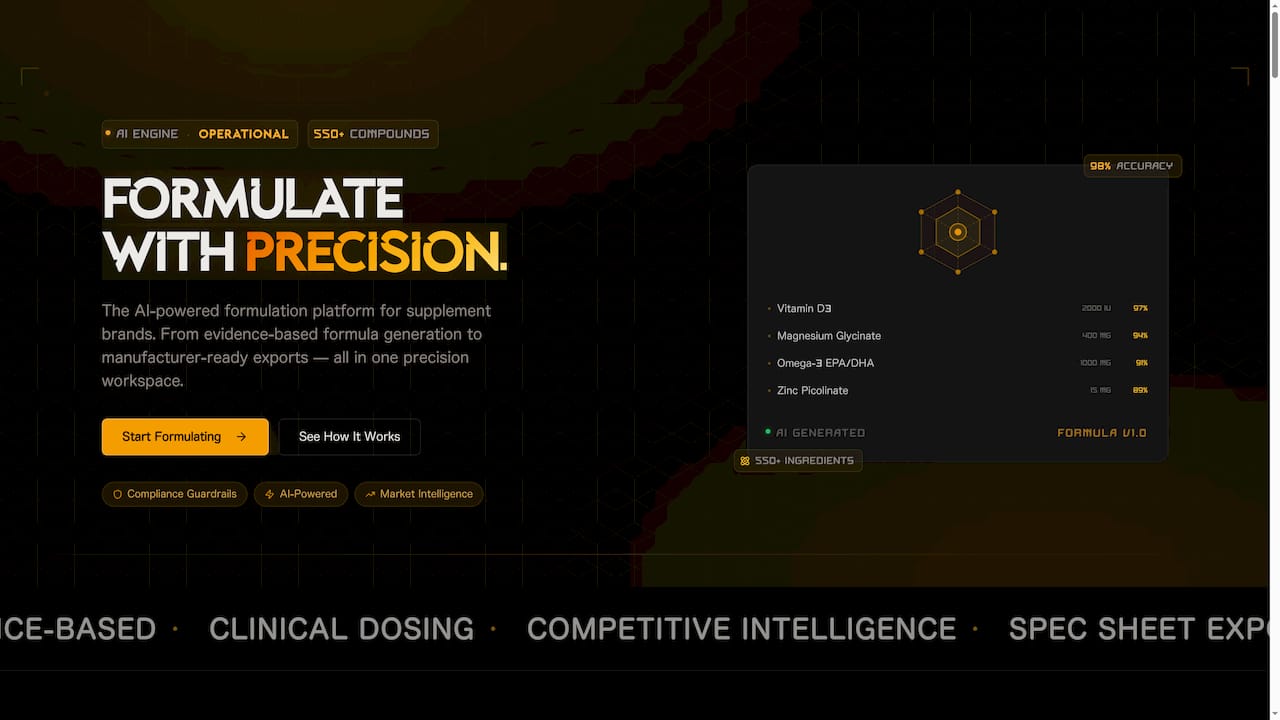
The FormlyPro platform gives brand managers and product developers a structured 8-phase product development system that integrates market trend analytics, competitor formulation intelligence, regulatory compliance guidance, and AI-powered packaging mockups in one place. Whether you are validating a new ingredient or positioning a reformulated SKU, FormlyPro brings your entire development process under one roof so you move faster without cutting corners.
Frequently asked questions
How do market trends influence ingredient selection in food and beverage formulation?
Market trends directly guide which ingredients are prioritized, such as functional fibers or alternative proteins, to meet rising consumer demand and regulatory expectations. Consumer trends in gut health and protein are actively reshaping what brand developers put on their formulation briefs in 2026.
What is the risk of following market trends too closely in new product development?
Chasing trends can create oversaturation, short product lifecycles, and a higher likelihood of launch failures if not balanced with brand values. Up to 75% of new products fail in trend-driven categories, and lifecycles are shortening as category noise increases.
How can predictive analytics reduce innovation risk in formulation?
Predictive analytics helps brands validate trends early, reducing risk by up to 90% compared to retrospective methods. Early trend validation gives product developers the confidence to commit R&D resources before competitors saturate the space.
Is regulatory pressure or consumer demand a bigger driver for formulation changes?
Both play key roles. Regulation sparks reformulation in many categories, but consumer demand for functional and novel attributes is what shapes competitive positioning over time.