

TL;DR:
- Benchmarking is a systematic process that compares your operations against best-in-class standards to identify improvement opportunities, not to copy competitors.
- It enhances strategic decision-making, operational efficiency, and innovation by revealing gaps and learning from industry leaders across various functions and industries.
Most business professionals treat benchmarking like competitive spying with a spreadsheet. That framing is not just wrong. It actively limits what benchmarking can do for you. The role of industry benchmarking extends well beyond tracking what your competitors are doing. It is a systematic method for identifying where your operations, products, and decisions fall short of what is genuinely possible, and for learning the specific practices that create the gap. This guide breaks down how benchmarking actually works, when to use it, and how brand managers can turn raw comparisons into real competitive advantage.
Table of Contents
- Key takeaways
- The role of industry benchmarking defined
- How benchmarking drives performance and competitive positioning
- Best practices for conducting benchmarking effectively
- Benchmarking versus competitive analysis and other tools
- Translating benchmarks into brand strategy
- My take on what benchmarking actually requires
- How Formlypro turns benchmarking into a product advantage
- FAQ
Key takeaways
| Point | Details |
|---|---|
| Benchmarking is not spying | It measures your processes against best-in-class standards to identify improvement opportunities, not copy competitors. |
| Data alone is not strategy | Benchmarks show where you stand; your team must determine what to do about it based on your specific context. |
| Start internally first | Beginning with internal benchmarking surfaces quick wins before you spend resources on external data collection. |
| Use multiple data sources | Cross-checking at least two sources improves accuracy and prevents decisions built on distorted numbers. |
| Refresh your data regularly | Benchmarks stale in fast-moving markets; quarterly or monthly updates keep your comparisons relevant and useful. |
The role of industry benchmarking defined
The word "benchmarking" gets used loosely. Before it can work for you, you need to know exactly what it covers. Benchmarking systematically compares processes and practices to best-in-class organizations to identify gaps and learn. The operative word is "learn." This is not about copying what a competitor did last quarter.
There are four main types, each suited to different objectives.
- Internal benchmarking: Comparing performance across departments, teams, or product lines within your own organization. Best for spotting internal inconsistencies and quick wins.
- Competitive benchmarking: Measuring your performance against direct competitors using available data. Useful for market positioning but limited by what competitors actually disclose.
- Functional benchmarking: Comparing specific functions (like customer service or supply chain) to industry leaders, even outside your sector. A consumer goods brand studying Amazon's fulfillment model is doing functional benchmarking.
- Generic benchmarking: Looking at world-class processes regardless of industry. This is where the most surprising improvements often come from.
The key distinction that most brand managers miss: competitive analysis asks "What are they doing?" Benchmarking asks "How well are we doing it, and who does it better?" One is observational. The other is diagnostic. Both matter, but they answer different questions.
Pro Tip: When starting out, pick one function you know is underperforming before running a broad benchmarking program. Focused benchmarking delivers faster, cleaner insights than trying to measure everything at once.
Benchmarks should also focus on processes, not just metric outcomes, to understand how superior performance is actually achieved. A number tells you there is a gap. The process tells you why.
How benchmarking drives performance and competitive positioning
The importance of industry benchmarking becomes clearest when you look at what happens to businesses that skip it. Companies using data-driven assessment with benchmarking achieve 73% higher ROI and are 3.2 times less likely to fail on major initiatives. Those are not marginal gains. They reflect what happens when decisions are anchored in objective evidence rather than internal assumptions.
Industry benchmarking benefits show up across three performance dimensions.
| Benchmarking Impact Area | What It Improves | Measurable Outcome |
|---|---|---|
| Operational efficiency | Process gaps vs. industry leaders | Reduced cost per unit, faster cycle times |
| Strategic decision-making | Data-backed investment priorities | Higher project success rates |
| Innovation pipeline | White space identification | New product and feature development |
| Risk management | Early warning on underperformance | Fewer costly surprises |
| Market positioning | Objective competitive ranking | Clearer brand differentiation |
Beyond ROI, industry benchmarking improves performance by providing objective position assessment, best practice identification, and learning across industry boundaries. That last point matters more than most brands realize. Benchmarking goes beyond direct competitors by comparing to best-in-class organizations even in different industries for genuinely breakthrough insights. A supplement brand studying loyalty mechanics from a software subscription company might find ideas its entire category has overlooked.

Industry benchmarking also provides a wider strategic perspective beyond competitive analysis. It measures performance against market standards rather than just rivals. That distinction matters when your whole category is underperforming an adjacent one.
Pro Tip: Never copy a benchmark leader's approach without understanding why it works in their context. What works for a company with 500 employees and a mature distribution network may actively harm a brand at an earlier stage. Adaptation beats imitation every time.
Best practices for conducting benchmarking effectively
Knowing why is benchmarking important is one thing. Executing it well is another. Most failed benchmarking programs stumble not from bad data but from poor process design. Here is how to do it right.
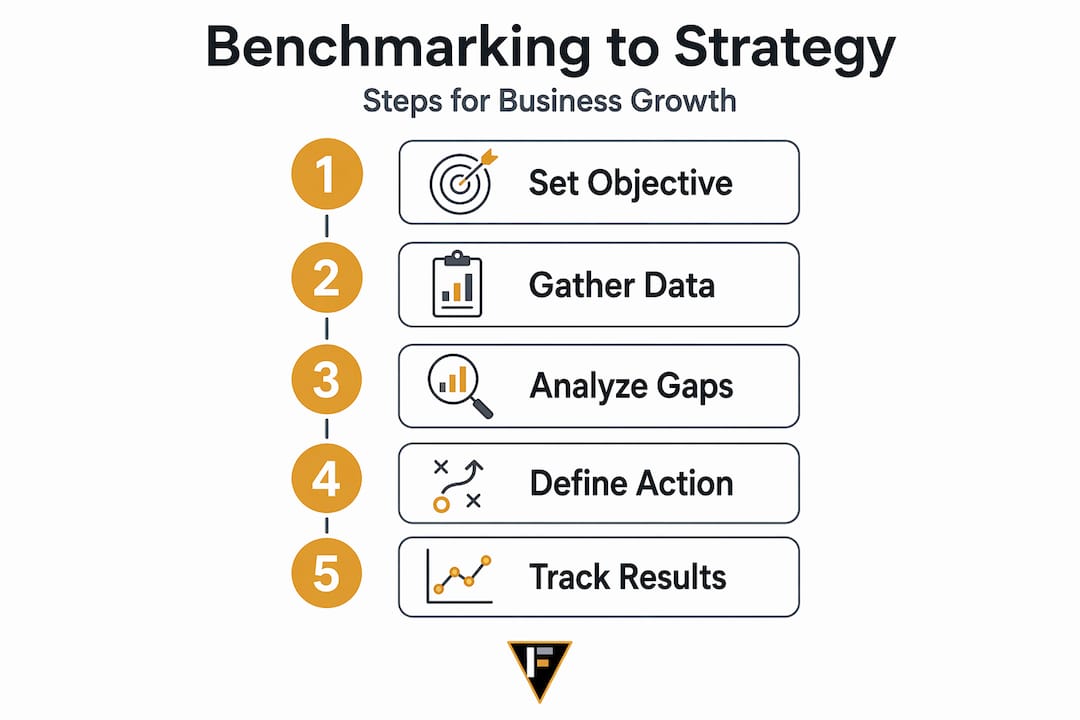
The four stages of a sound benchmarking program
- Plan: Define exactly what you are benchmarking and why. Which process, metric, or function? What decision will this data inform? Without a clear scope, you collect data that never becomes insight.
- Collect: Gather data from at least two sources. Cross-checking at least two data sources improves benchmarking accuracy and prevents decisions built on distorted numbers. Use industry reports, trade association data, and your own internal records in parallel.
- Analyze: Normalize your financial statements and operational data before comparing. Normalized financial statements are essential for accurate benchmarking, adjusting for owner compensation and non-recurring expenses that would otherwise skew comparisons.
- Implement: Translate findings into specific process changes with owners, timelines, and success metrics attached. Benchmarking without implementation is just an expensive research project.
Starting in the right place
Starting with internal benchmarking allows immediate, low-risk improvements before external data collection begins. Map your own performance variation first. If your east region closes deals 30% faster than your west region with the same product, that gap is worth understanding before you look outside.
Best practices for benchmarking that experienced teams follow:
- Set benchmarks on leading indicators (process metrics) not just lagging ones (financial results)
- Document the methodology so comparisons remain consistent across reporting periods
- Involve frontline teams in interpreting findings. They often know why gaps exist
- Assign clear ownership to each benchmarked area so insights have someone accountable for acting on them
- Refresh your benchmarks regularly. Benchmarking data should be refreshed quarterly or monthly to remain relevant in fast-moving markets
Common metrics worth tracking in a product-focused benchmarking program include customer acquisition cost, average revenue per user, product return rates, formulation cost per unit, time to market, and compliance incident rates. Track industry trends in product development alongside these numbers to see where the category is heading, not just where it stands today.
Benchmarking versus competitive analysis and other tools
Brand managers frequently conflate benchmarking with competitive analysis. They are related, but they serve different purposes and answer different questions.
| Tool | Primary Question | Focus | Best Used When |
|---|---|---|---|
| Industry benchmarking | How well are we performing vs. best practice? | Processes and operational metrics | Improving efficiency, identifying gaps |
| Competitive analysis | What are competitors doing? | Products, pricing, positioning | Market entry, repositioning |
| Strategic planning | Where should we go? | Long-term direction and resource allocation | Annual planning, pivots |
| Customer research | What do customers want? | Perception, satisfaction, unmet needs | Product development, messaging |
Competitive analysis tells you what rivals are building. Benchmarking tells you how efficiently you are operating compared to the best in any relevant category. Strategic planning tells you where to direct resources. These tools are complementary. Using only one of them creates blind spots.
The most sophisticated brand managers use benchmarking to establish an objective operational baseline, then layer competitive analysis on top to understand the market context, and finally use both datasets to inform strategic decisions. That sequence matters. If you skip the operational baseline, your competitive analysis has no anchor.
Benchmarking is also specifically about learning across industry boundaries. Global benchmarking exposes organizations to international standards, facilitating continuous evolution that purely local competitive analysis cannot provide.
Knowing how to benchmark industries correctly means recognizing when benchmarking is not the right tool. If your core question is about customer emotion or brand perception, qualitative research will serve you better. Benchmarking is a quantitative, process-oriented discipline. Use it accordingly.
Translating benchmarks into brand strategy
The industry performance comparison data sitting in your benchmarking report means nothing until someone decides what to do with it. Here is how brand managers turn findings into positioning and growth.
Identifying white space: When your benchmarks reveal that your category consistently underperforms on a metric that customers actually care about, that gap is an opportunity. If every brand in your space has a 12-week average time to market and you can cut that to six weeks, that becomes a brand differentiator.
Informing product decisions: Ingredient benchmarking is one concrete application. Comparing your formulation choices against what category leaders are using, and what is actually selling, gives you an evidence base for reformulation decisions that gut instinct alone cannot provide.
Building the internal case: Benchmarking data speaks a language that gets budget approved. When you can show that your customer retention rate sits 18 percentage points below the industry leader and map that gap to a specific process weakness, you have a funding argument. Raw data from a single internal source rarely carries that weight.
Key ways to use benchmarking data effectively within your organization:
- Present findings in terms of revenue impact, not just percentage gaps
- Tie each benchmark gap to a specific team, process, or product decision
- Use the data to set realistic improvement targets rather than aspirational ones with no basis
- Share progress quarterly to maintain momentum and organizational buy-in
Pro Tip: Align your benchmarking program to a specific business objective before collecting a single data point. Benchmarking for product quality improvement requires different metrics than benchmarking for customer acquisition efficiency. Misaligned programs generate interesting reports and no action.
Understanding industry compliance standards is part of benchmarking for brand managers in regulated categories. Your operational benchmarks need to account for compliance costs and constraints, or the comparisons will mislead rather than guide.
My take on what benchmarking actually requires
I've worked with enough business teams to know that benchmarking fails most often not because of bad data, but because of bad interpretation. People see a gap and immediately want to close it by copying whoever sits above them. That instinct is understandable. It is also how brands end up looking identical to each other.
What I've learned is that benchmarking is a diagnostic tool, not a strategy prescription. Blind copying leads to mediocrity. The data shows you where the gap is. Your judgment, your customer knowledge, and your organizational context determine what to do about it.
In my experience, the most valuable benchmarking outcomes are the ones that surface uncomfortable truths. Not "our margins are below average" but "our formulation process takes three times longer than the category leader and we have never questioned it." That kind of discovery only happens when you benchmark processes, not just headline metrics.
The mindset shift I'd encourage every brand manager to make: treat benchmarking as a continuous learning practice, not a quarterly reporting obligation. The companies that use it best build it into how they think, not just what they measure.
— Ben
How Formlypro turns benchmarking into a product advantage
If you have read this far, you already understand that good benchmarking requires the right data, the right process, and a clear connection to action. That is exactly what Formlypro is built to support.

Formlypro gives brand managers a structured environment to act on benchmarking insights at the product level. The platform provides competitor formulation analysis, market research, and compliance guidance in one place. You can see what products are selling, what is inside them, and where your own formulation stands in comparison. The 8-phase product development plan walks your brand from ideation through production, with market and competitive analytics embedded at every stage. The Formlypro platform also includes an AI-powered packaging mockup tool, so your benchmarking work translates directly into product and brand execution without switching tools.
FAQ
What is the role of industry benchmarking in business?
Industry benchmarking helps businesses identify performance gaps, adopt best practices, and make evidence-based decisions by comparing their operations and metrics against industry leaders or standards.
Why is benchmarking important for brand managers?
Benchmarking gives brand managers an objective baseline for product quality, operational efficiency, and market positioning, which removes guesswork from decisions that affect competitiveness and growth.
How do you start benchmarking your industry performance?
Begin with internal benchmarking to identify performance variation within your own organization, then layer in external data from at least two independent sources to validate and contextualize your findings.
What is the difference between benchmarking and competitive analysis?
Competitive analysis examines what rivals are doing in the market. Benchmarking measures how effectively your own processes perform against best-in-class standards, regardless of whether those leaders are direct competitors.
How often should benchmarking data be updated?
Benchmarking data should be refreshed quarterly or monthly in fast-moving markets to remain accurate and genuinely useful for decision-making.