

TL;DR:
- Manufacturers often mistakenly assume standards apply universally, but compliance requirements vary by product category and jurisdiction.
- Building a robust compliance system requires understanding specific regulations, quality frameworks, and effective benchmarking.
- Operational excellence is achieved when standards are integrated into daily processes, not just checked during audits, to ensure market confidence and trust.
Manufacturers and brand developers routinely assume that once they understand the rules in one product category, they can apply the same framework everywhere. That assumption leads to costly mistakes. Requirements differ by product category and jurisdiction, which means a food brand's compliance roadmap looks nothing like a cosmetics brand's, and both look nothing like a household goods brand's. This guide cuts through that confusion by mapping the actual landscape of regulatory and quality standards, explaining how performance benchmarks really work, and giving you a practical path to embedding compliance into your day-to-day operations.
Table of Contents
- Why 'industry standards' aren't one-size-fits-all
- Core regulatory and quality standards you need to know
- How performance metrics and benchmarking really work
- Steps to build compliance into your operations
- What most manufacturers get wrong about industry standards
- Level up compliance and manufacturing with FormlyPro
- Frequently asked questions
Key Takeaways
| Point | Details |
|---|---|
| Standards are category-specific | Manufacturing requirements depend on product type and local regulations. |
| Know your frameworks | FSMA, ISO 9001, and other standards have unique roles in compliance and quality. |
| Benchmarking pitfalls | Beware of inflated performance data from self-reporting methods. |
| Build compliance in | Proactive systems and clear steps make ongoing compliance a business advantage. |
| Leverage compliance for market trust | Treat compliance as a value driver, not just a checklist. |
Why 'industry standards' aren't one-size-fits-all
The phrase "industry standards" gets thrown around as if it describes a single, unified rulebook. It doesn't. In practice, standards split into at least two distinct categories: regulatory requirements enforced by government agencies, and voluntary quality frameworks adopted by manufacturers to demonstrate operational excellence. Both matter, but they function very differently and carry different consequences for non-compliance.
Regulatory requirements are legally binding. For a food brand selling in the United States, the FDA sets the rules. For a cosmetics brand selling in the European Union, the EU Cosmetics Regulation governs your formulations, labeling, and safety assessments. Sell the same product in both markets and you face two separate compliance systems, each with its own documentation demands, ingredient restrictions, and enforcement mechanisms. Getting navigating compliance standards right from the start saves you from costly reformulations down the line.
Quality frameworks like ISO 9001 are different. They are voluntary, but market pressure and retailer requirements often make them functionally mandatory. A large retail buyer may refuse to stock your product unless your facility holds ISO 9001 certification. A co-manufacturer might require it before taking on your brand. The certification signals process rigor, but it doesn't replace regulatory compliance.
"Requirements differ by product category and jurisdiction, so brands typically treat standards as category-specific compliance systems." This is the key nuance that separates manufacturers who build sustainable operations from those who constantly scramble to fix compliance gaps.
This distinction shapes every decision you make, from ingredient selection to facility design. Here is a quick checklist of core considerations when choosing which standards apply to your brand:
- Product category: Food, dietary supplement, cosmetic, OTC drug, or household good? Each triggers a different regulatory body.
- Target market geography: U.S., EU, Canada, and Australia each have distinct legal frameworks.
- Distribution channel: Direct-to-consumer, retail, or clinical? Channel affects labeling and claims requirements.
- Manufacturing model: In-house production or contract manufacturing? Both parties carry compliance obligations.
- Claims you want to make: Structure/function claims, organic certifications, and clinical claims each open additional layers of scrutiny.
You can read a fuller breakdown of how these layers interact in our compliance standards guide. The core takeaway: build your compliance architecture around your category first, then layer on quality frameworks.
Core regulatory and quality standards you need to know
Once you understand why standards are not universal, you need a working knowledge of the frameworks most likely to affect your operations. The ones below cover the majority of consumer goods categories, but each has meaningful nuances you must dig into for your specific product.
FSMA (Food Safety Modernization Act): For any brand manufacturing or co-manufacturing food products sold in the U.S., FSMA's preventive-controls model is your baseline. FSMA requires you to conduct a hazard analysis, establish preventive controls, implement monitoring procedures, maintain detailed records, and verify that your controls are actually working. The rules are tiered, meaning not every FSMA rule applies to every facility, but you need to understand the triggers. Small businesses have different deadlines and some exemptions, but those exemptions are narrow. If you sell a food product into a major retailer, assume full FSMA applicability and work backward from there. Our food product compliance guide gives you a category-by-category breakdown of these requirements.
ISO 9001: This is the dominant quality management standard across virtually every manufacturing sector. ISO 9001 centers on process control and continuous improvement, assessed through regular internal and external audits. Achieving certification means demonstrating that your quality management system (QMS) is documented, implemented, and actively reviewed. The standard does not prescribe specific outputs, it prescribes a system for consistently achieving your defined outputs. That distinction is critical. You define the quality targets; ISO 9001 tells you how to build the management system around them.

GMPs (Good Manufacturing Practices): GMPs appear across food, dietary supplements, pharmaceuticals, and cosmetics. They are the minimum manufacturing conditions required by law in most markets. For supplements in the U.S., FDA 21 CFR Part 111 sets the cGMP requirements. For cosmetics, the FDA recently aligned U.S. cosmetic GMPs closer to ISO 22716. For health and beauty brands specifically, our guide on health and beauty compliance covers the specific GMP obligations you need to meet.
Dental and oral care products: This is a specialized category that bridges cosmetics and OTC drugs depending on the claims made. Products like whitening toothpastes or fluoride-containing mouthwashes may trigger OTC drug requirements. Dental product safety standards include both ingredient safety assessments and clinical claim requirements.
Here's a comparison of the core frameworks at a glance:
| Standard | Structure | Primary focus | Who it applies to |
|---|---|---|---|
| FSMA | Regulatory, U.S. law | Food safety, hazard prevention | U.S. food manufacturers and importers |
| ISO 9001 | Voluntary, internationally recognized | Quality management system | Any manufacturing sector globally |
| FDA cGMPs | Regulatory, U.S. law | Production and process controls | Food, supplements, pharma, cosmetics |
| EU Cosmetics Regulation | Regulatory, EU law | Safety assessment, labeling | Cosmetics sold in the EU |
| ISO 22716 | Voluntary, internationally recognized | Cosmetic GMP | Cosmetic manufacturers globally |
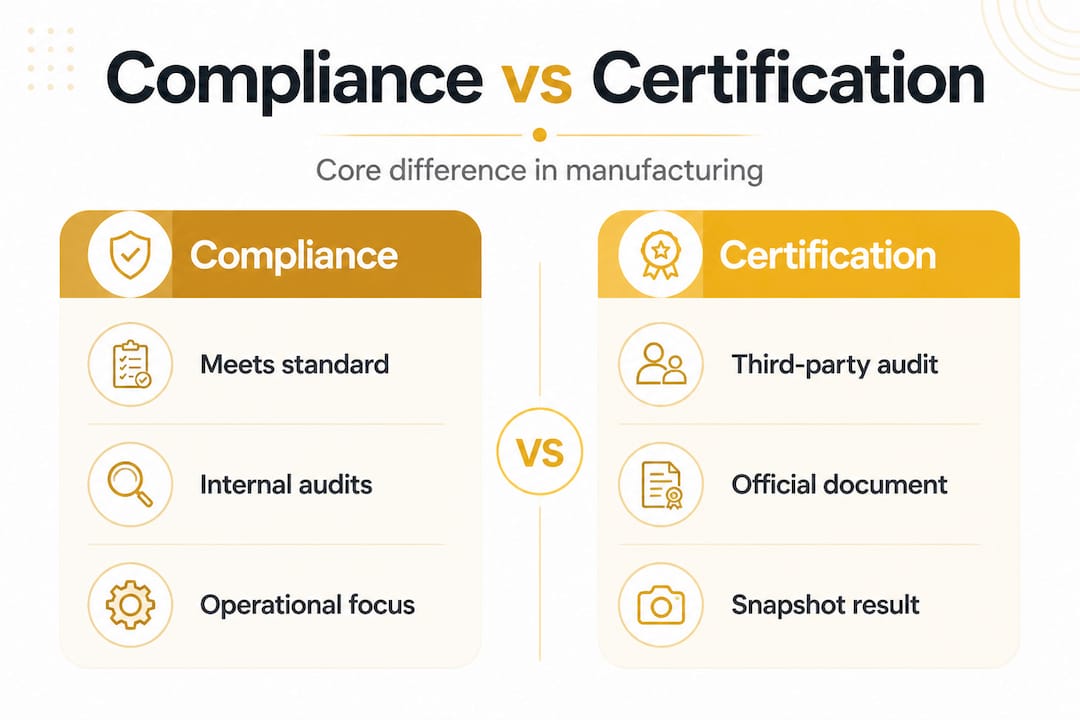
Pro Tip: Compliance and certification are not the same thing. You can be compliant with ISO 9001 principles without holding formal certification. Certification requires a third-party audit and carries ongoing surveillance costs. For many small brands, demonstrating compliance through documented systems is sufficient until retail buyers demand formal certification.
Common pitfalls in this phase: selecting a quality standard designed for a different industry, assuming a co-manufacturer's certifications cover your brand's regulatory obligations, and confusing ingredient safety databases with full regulatory compliance. Each of these mistakes creates real liability.
How performance metrics and benchmarking really work
Understanding which standards apply is one challenge. Knowing how well your facility or your contract manufacturer actually performs against those standards is a separate, often harder, challenge. This is where performance benchmarking comes in, and where a lot of brands get misled.
Overall Equipment Effectiveness (OEE) is the most widely used cross-industry metric for manufacturing performance. It is calculated as Availability multiplied by Performance multiplied by Quality. Each component represents a distinct type of loss: unplanned downtime, speed loss, and defect-related rework or scrap. A facility running at 85% OEE is considered world-class in most sectors. Most facilities sit between 60% and 75% when measured rigorously.
The problem is that most OEE figures you encounter in industry benchmarks are not measured rigorously. OEE benchmarking data shows that measurement methodology and how production stops are categorized can materially change the reported number. A facility that counts planned maintenance downtime as planned time rather than availability loss will report a significantly higher OEE than one that counts the same time as a loss.
"Self-reported OEE is typically 10 to 18 percentage points higher than measured OEE." That gap is not a rounding error. It represents a fundamental difference between how facilities want to look and how they actually perform.
Here's what that gap looks like in practice:
| Measurement method | Reported OEE | Measured OEE | Gap |
|---|---|---|---|
| Self-reported benchmark | 78% | 62% | 16 points |
| Industry peer survey | 74% | 59% | 15 points |
| Direct sensor measurement | 65% | 65% | 0 points |
The implications for brand developers are significant. When a co-manufacturer tells you they run at 80% OEE, ask them how they measure it. Ask whether that figure comes from a direct sensor system, a manual log, or an ERP estimate. The answer tells you whether that benchmark is a reliable indicator of their operational capability or a marketing number. For successful formulation compliance, your manufacturing partner's real operational performance matters as much as their certifications.
Pro Tip: Always clarify the methodology behind any industry benchmark before using it to evaluate your operations or a potential manufacturing partner. Ask specifically: "Is this measured or self-reported, and what stop categorization system do you use?" A manufacturer who can answer that question confidently is one who actually understands their own operations.
Steps to build compliance into your operations
Knowing the standards and understanding the benchmarks gives you the map. Building compliance into daily operations is the actual journey. Here is a structured sequence that works for consumer goods manufacturers at every scale:
- Conduct a hazard and risk analysis: Before you can control anything, you need to know what can go wrong. FSMA compliance starts with hazard evaluation, including biological, chemical, and physical hazards relevant to your product and process. Apply the same logic to quality risks, not just food safety risks.
- Design and document preventive controls: For each significant hazard or quality risk, establish a written control. This includes critical limits, monitoring procedures, and the specific corrective actions to take when something falls outside those limits.
- Assign ownership: Every control needs a named owner. Compliance gaps almost always trace back to unclear accountability. Your QA team, regulatory affairs lead, and operations manager need defined responsibilities that are written down, not assumed.
- Implement a records system: Paper logs still work for small operations, but digital systems dramatically reduce error rates and make audits faster. Whichever system you use, records need to be date-stamped, reviewable, and retained for the periods required by your applicable regulations.
- Build a verification and audit schedule: Internal audits are not optional extras. They are the mechanism by which you find problems before a regulator or retailer does. Schedule them, complete them, and act on the findings.
- Establish corrective action processes: When something goes wrong, you need a written process for investigating the root cause, fixing it, and verifying the fix worked. Corrective action records are frequently requested during FDA inspections and third-party audits.
- Review and update regularly: Standards change. Regulations get amended. Your product line evolves. Build a formal review cycle, at minimum annually, to ensure your compliance system stays current.
The teams and tools you need to involve at each step:
- Quality assurance leads for control design and audit management
- Regulatory affairs specialists for jurisdiction-specific requirements
- Operations managers for GMP implementation and records management
- Supply chain teams for ingredient and supplier compliance verification
- Legal counsel for labeling review and claims substantiation
Our regulatory compliance checklist and food product compliance checklist give you pre-built frameworks for each of these steps. For brands developing products with allergen claims or intolerance-specific positioning, reviewing UK intolerance testing standards provides useful benchmarks even for non-UK operations.
What most manufacturers get wrong about industry standards
Here is the uncomfortable reality: most manufacturers who pursue compliance do the minimum required to pass an audit, then treat that as the end goal. It isn't. It's the starting point.
Certification is a snapshot. An ISO 9001 certificate tells you that on the day of the audit, your documented systems met the requirements. It says nothing about what happens on day 200 after that audit. Brands that treat certification as a badge to display rather than a system to operate are the ones that fail re-certification, receive FDA warning letters between audits, or discover quality failures at scale.
The benchmarking problem is equally common. We see brands and manufacturers compare their OEE or defect rates against industry averages without ever questioning how those averages were calculated. A self-reported benchmark that inflates performance by 15 percentage points gives you false confidence exactly when you can least afford it. Measure your own performance rigorously, then compare it against benchmarks you understand.
The biggest opportunity most brands miss is using compliance as a market positioning tool. Consumers and retail buyers are increasingly sophisticated. A brand that can articulate its hazard controls, audit cadence, and corrective action history is a brand that earns trust faster than competitors who simply display a certification logo. Make your compliance story part of your brand story. Train your sales team to talk about it. Put it in your retail presentations.
The brands that out-execute competitors are the ones that operationalize standards beyond audits. They run compliance systems the way they run production systems: with metrics, accountability, and continuous improvement embedded in every workday.
Level up compliance and manufacturing with FormlyPro
Every step in this guide requires the right data, the right frameworks, and the right tools to execute consistently. That's exactly what FormlyPro is built to deliver.

FormlyPro gives consumer goods brands and manufacturers a platform that integrates compliance guidance, formulation research, and market positioning into a single workflow. From the 8-phase product development plan that takes your idea from concept through production, to the AI-powered packaging mockup designer and competitor formulation analysis, FormlyPro removes the guesswork from building a compliant, market-ready product. Whether you need a step-by-step regulatory checklist for your category or a full competitive analysis to position your brand, the platform puts everything in one place so your team can move faster with fewer compliance gaps and greater market confidence.
Frequently asked questions
What is the difference between compliance and certification in manufacturing?
Compliance means your operations meet the requirements of a given standard, while certification means a third-party auditor has formally verified that compliance through an ISO 9001-style audit process. You can be compliant without being certified, but certification provides external validation that buyers and regulators recognize.
Which industry standard is most common for manufacturing quality?
ISO 9001 is the most widely recognized quality management standard globally, built around process control and continuous improvement across virtually every manufacturing sector.
What does FSMA require for U.S. food manufacturers?
FSMA requires hazard analysis, preventive controls, monitoring procedures, recordkeeping, verification activities, and documented corrective actions for any identified food safety hazard.
How can I benchmark my manufacturing performance accurately?
Use direct measurement tools and sensor-based systems for metrics like OEE instead of relying on self-reported figures, since self-reported OEE runs 10 to 18 points higher than independently measured OEE on average.
Are industry standards the same across different jurisdictions?
No. Requirements differ by product category and jurisdiction, meaning the same product may face entirely different regulatory frameworks depending on which country or region you are selling into.
Recommended
- Industry compliance standards for consumer goods: 2026 guide
- Mastering compliance in product development: a guide
- Compliance requirements list for health & wellness brands
- Navigate product compliance standards for safer market entry
- Quality Control in CNC Machining for Chinese Manufacturers
- Industry Standards for Spray Booth Films: Ensuring Compliance and Superior Finishes