

TL;DR:
- Regulatory compliance ensures legal market entry by meeting safety, labeling, and manufacturing standards across regions.
- Key regulations differ by region, with the US, EU, and Japan each having specific notification and safety assessment requirements.
- Treating compliance as a strategic asset streamlines market expansion, builds consumer trust, and prevents costly reformulations.
A product can be perfectly safe and still be illegal to sell. That's the reality many health and beauty brand owners discover too late, often after investing thousands in formulation and packaging. Regulatory compliance isn't just about avoiding harm; it's the legal ticket to market entry in every region you want to sell. This guide breaks down what compliance actually means for cosmetic and personal care brands, which frameworks matter most, where brands consistently stumble, and how to build a practical path from product idea to compliant launch.
Table of Contents
- What regulatory compliance means in health and beauty
- Key regulations: US, EU, and international frameworks
- Common pitfalls and edge cases in compliance
- A step-by-step roadmap to achieving compliance
- Our perspective: What brands miss about compliance in practice
- Ready to streamline compliance? FormlyPro helps brands launch right
- Frequently asked questions
Key Takeaways
| Point | Details |
|---|---|
| Compliance is market access | Regulatory compliance is essential for selling health and beauty products legally and successfully. |
| Frameworks vary globally | US, EU, and other regions have different compliance requirements that brands must research closely. |
| Claims can risk reclassification | Marketing language can change a product's legal status and increase compliance obligations. |
| Documentation is critical | Meticulous records and readiness for inspection are key to passing regulatory checks anywhere. |
What regulatory compliance means in health and beauty
Regulatory compliance in health and beauty isn't a single rule. It's a layered system of laws, standards, and requirements that your product must satisfy before it can legally reach consumers. At its core, cosmetics compliance means adherence to laws ensuring product safety, proper labeling, and manufacturing standards for market entry, and those requirements vary significantly by region.
Think of compliance as three load-bearing pillars:
- Safety: Your formulation must be substantiated as safe for its intended use. This means safety assessments, toxicology reviews, and documented evidence.
- Labeling: Every claim, ingredient list, and usage instruction must meet the legal requirements of the market where you're selling.
- Manufacturing: How your product is made matters. Good Manufacturing Practices (GMP) set the baseline for facility standards, quality control, and batch documentation.
These pillars connect directly to industry compliance standards that govern how consumer goods reach the market. Where brands go wrong is treating each pillar as a separate checklist item rather than an integrated system. A product with a flawless formula can still fail compliance if the label makes an unsupported claim.
Global standards add another layer of complexity. The US operates under the Federal Food, Drug, and Cosmetic Act (FD&C Act), updated significantly by MoCRA in 2022. The EU follows EU Cosmetics Regulation 1223/2009, which is considerably more prescriptive. Japan, Canada, and Southeast Asian markets each have their own distinct requirements.
"Compliance isn't a destination. It's the foundation your brand is built on. Get it right from the start, and every market becomes more accessible."
Using a compliance checklist for product success early in development is one of the most practical ways to avoid costly reformulations or labeling overhauls later.
Key regulations: US, EU, and international frameworks
Knowing which rules apply to your product depends entirely on where you plan to sell. Here's how the major frameworks break down.
United States: MoCRA (2022) The Modernization of Cosmetics Regulation Act changed the compliance landscape for US brands. MoCRA requirements now include mandatory facility registration, product listing with the FDA, safety substantiation, and adverse event reporting. Fragrance allergen disclosure and Good Manufacturing Practice regulations are also part of the updated framework. These are not optional; non-compliance can result in product recalls or market removal.
European Union: Regulation 1223/2009 The EU model is more centralized. Every product needs a Responsible Person (RP) based in the EU, a complete Product Information File (PIF), and notification through the Cosmetic Products Notification Portal (CPNP). Importantly, pre-market approval is not required in the US except for color additives, while the EU requires CPNP notification before any product goes on sale. The EU laws for cosmetics also maintain a strict list of prohibited and restricted substances.
Comparison: US vs. EU vs. Japan
| Requirement | United States | European Union | Japan |
|---|---|---|---|
| Pre-market approval | Not required | Not required (CPNP notification) | Required for quasi-drugs |
| Responsible Person | Not required | Required (EU-based) | Required (local importer) |
| Ingredient list | Required | Required | Required |
| Safety assessment | Required (MoCRA) | Required (CPSR in PIF) | Required |
| Prohibited substances list | Yes (FDA) | Yes (Annexes) | Yes (MHLW) |
Other key markets:
- Canada: Health Canada regulates cosmetics under the Food and Drugs Act; a Cosmetic Notification Form (CNF) must be filed within 10 days of first sale.
- Australia: NICNAS/AICIS governs industrial chemicals; cosmetic claims are regulated by the ACCC.
- China: One of the most complex markets, requiring registration or filing through NMPA, with mandatory animal testing rules currently under revision.
For brands working toward formulation compliance for cosmetics, understanding these frameworks upfront prevents expensive reformulation after the fact.
First steps for compliance by region:
- Identify your target market and the governing regulatory body.
- Review the prohibited and restricted ingredient lists for that region.
- Confirm whether pre-market notification or registration is required.
- Appoint a local Responsible Person or agent where legally required.
- Build your documentation package before production begins.
Common pitfalls and edge cases in compliance
Regulations set the rules. Real-world compliance failures usually come from edge cases that aren't immediately obvious.

The drug classification trap This is the most common and costly mistake. When your marketing copy says a product "treats acne," "heals eczema," or "stimulates hair regrowth," you've crossed from cosmetic into drug territory. Drug-like claims reclassify your product and trigger a completely different, far more demanding regulatory pathway. This isn't a gray area; the FDA and EU regulators are explicit about it.
Red-flag phrases to avoid on cosmetic labels and marketing:
- "Treats," "cures," "heals," or "repairs" (implies drug action)
- "Clinically proven to reduce" (without OTC drug approval)
- "Stimulates collagen production" (physiological claim)
- "Kills bacteria" (antimicrobial drug claim)
- "Reduces inflammation" (therapeutic claim)
Ingredient-level traps Color additives in the US require specific FDA approval; using an unapproved colorant is a compliance violation regardless of how safe it is. In the EU, fragrance allergens above certain concentrations must be individually listed on the label. Nanomaterials trigger additional notification requirements under EU law. These aren't obscure rules; they're enforced regularly.
State-level complexity in the US California's Proposition 65 requires warning labels for products containing chemicals known to cause cancer or reproductive harm above specific thresholds. The California Cosmetics Fragrance and Flavor Ingredient Right to Know Act adds further disclosure requirements. Brands selling nationally in the US need to account for state-level rules, not just federal ones.
For brands in adjacent categories, the same logic applies. Understanding compliance for supplement brands shows how regulatory classification shapes every downstream decision.
Pro Tip: Before finalizing any product claims, run them through the FDA's intended use framework. If your claim describes what the product does to the body rather than how it affects appearance, it likely needs drug classification review.
A step-by-step roadmap to achieving compliance
Compliance isn't something you bolt on at the end of development. It needs to be woven into every phase, from concept to launch.
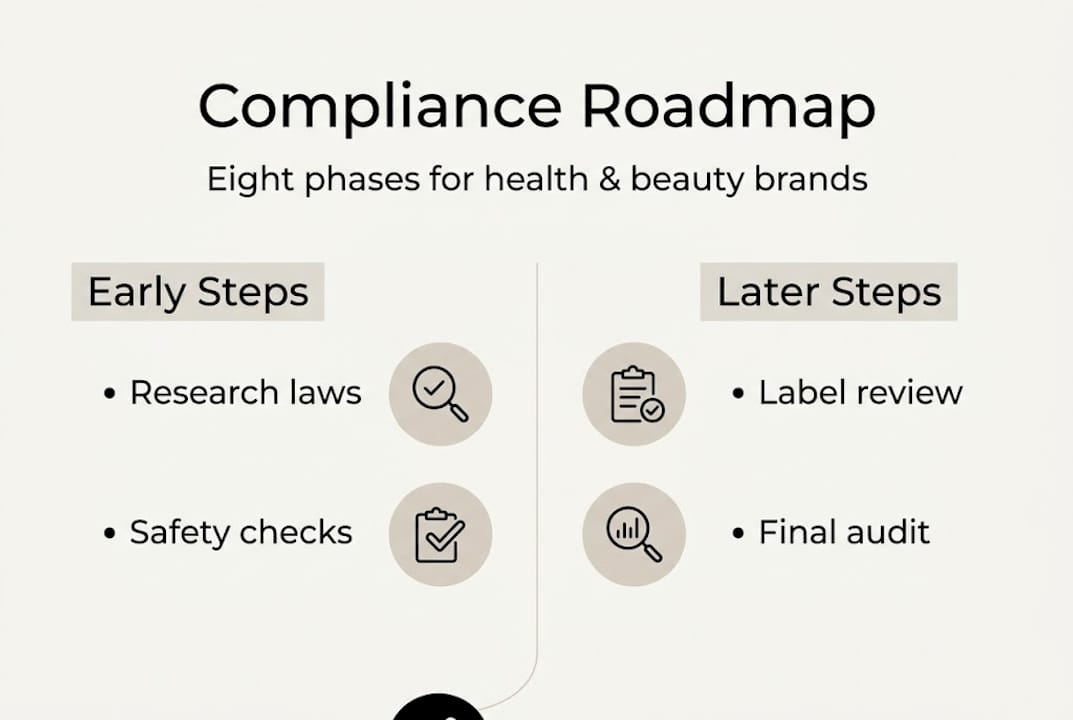
Step-by-step compliance roadmap:
- Define your market first. Know exactly where you plan to sell before you finalize any formulation or claim. Your target market determines every subsequent compliance decision.
- Screen ingredients early. Cross-reference your formula against prohibited and restricted substance lists for each target market. Fix ingredient issues before scale-up, not after.
- Build compliant labeling from day one. Work with a regulatory specialist or use a compliance platform to draft labels that meet all regional requirements simultaneously.
- Commission a safety assessment. Safety substantiation is required in both the US and EU. A qualified safety assessor must review your formula and sign off before market entry.
- Register and notify. In the US, register your facility and list your product with the FDA under MoCRA. In the EU, submit your notification through CPNP with your Responsible Person.
- Compile your documentation. Build your Product Information File (PIF) or equivalent documentation package. This is your compliance evidence if regulators ever ask.
- Review and update regularly. Regulations change. Build a calendar review into your compliance process.
Documentation required by market:
| Document | United States | European Union | Japan |
|---|---|---|---|
| Safety substantiation | Required | Required (CPSR) | Required |
| Product listing/notification | FDA listing (MoCRA) | CPNP notification | MHLW registration |
| Product Information File | Recommended | Mandatory | Equivalent required |
| GMP documentation | Required | Required | Required |
| Responsible Person designation | Not required | Mandatory | Local importer |
For a deeper look at how compliance integrates into the full development cycle, compliance in product development walks through each phase in practical terms. And if you're working on formulations simultaneously, market-ready formulations covers how to align your formula with both market demand and regulatory requirements.
Pro Tip: Don't wait until your product is finalized to start your PIF. Build it as you develop. Every decision you document during formulation becomes evidence of due diligence later.
Our perspective: What brands miss about compliance in practice
Most brands treat compliance as a bureaucratic hurdle, something to clear before launch and then forget. That mindset is expensive.
The brands that build lasting market presence treat compliance as a strategic asset. When your product is fully documented, safety-substantiated, and registered across multiple markets, you can move faster when opportunities arise. A retailer in Germany asks for your PIF? It's ready. A distributor in Japan wants to list your product? You have the documentation. Compliance-ready brands don't scramble; they scale.
There's also a trust dimension that's easy to underestimate. Consumers and retail buyers are increasingly scrutinizing ingredient transparency and safety claims. A brand with rigorous compliance practices can market that rigor honestly, and that's a real differentiator.
Shortcutting compliance doesn't save time. It borrows it. The brands we see struggling most are those that launched fast and then spent months fixing labels, reformulating, and dealing with regulatory queries that a proper upfront process would have prevented. Building your brand formulation strategies around compliance from the start is the only approach that actually saves time and money at scale.
Ready to streamline compliance? FormlyPro helps brands launch right
Compliance is complex, but it doesn't have to be chaotic. FormlyPro was built specifically for brand owners and product developers who need to move from idea to compliant launch without missing critical steps.
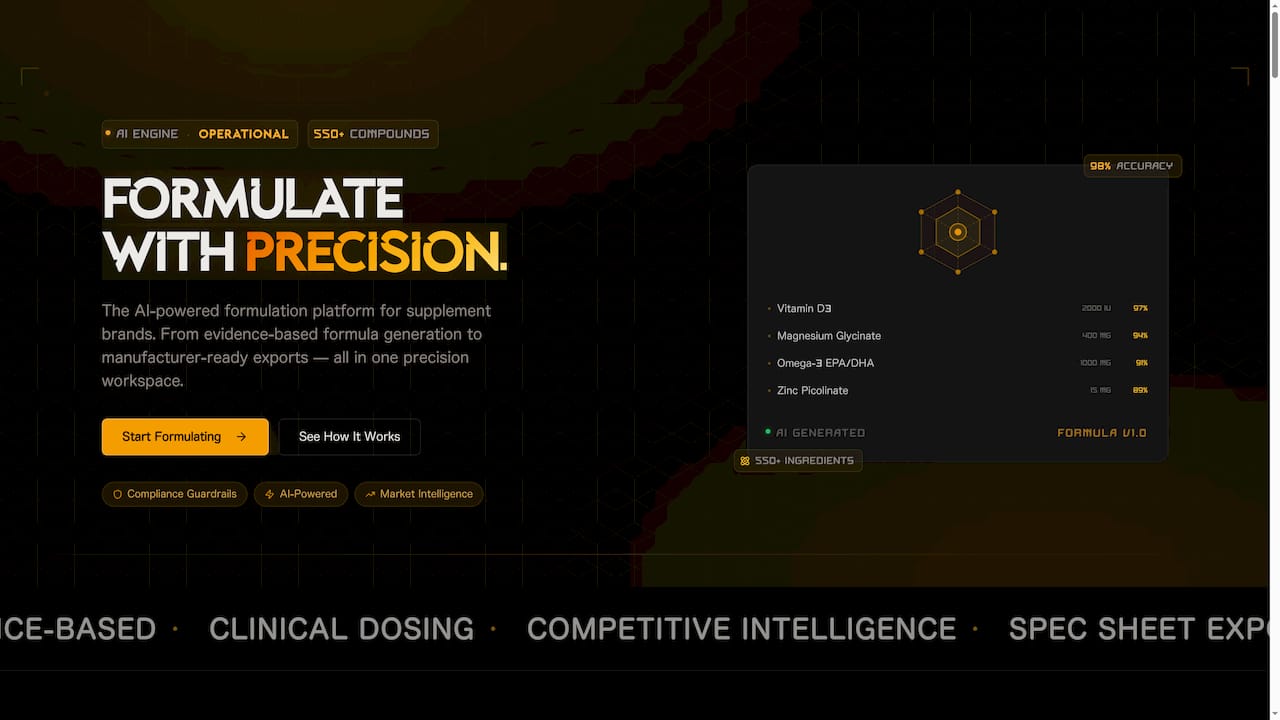
The FormlyPro compliance platform guides you through an 8-phase product development process that integrates compliance at every stage, from formulation and safety substantiation to labeling, registration, and production. You get built-in market research, competitor analysis, AI-powered packaging design, and a compliance framework that keeps your product aligned with US, EU, and international requirements. If you're serious about launching a brand that lasts, FormlyPro gives you the structure to do it right.
Frequently asked questions
Do I need FDA approval for my cosmetic products in the US?
No. Most cosmetics must meet FDA standards but don't require pre-market approval, with the exception of color additives, which must be specifically approved before use.
What triggers reclassification of a cosmetic into a drug?
Drug-like claims such as "treats acne" or "heals skin" can reclassify your product as a drug, triggering a separate and far more demanding regulatory approval process.
Are there special labeling rules in the EU for fragrances and allergens?
Yes. The EU fragrance allergen rules require that specific allergens above defined concentration thresholds be individually named on the product label.
What documentation is essential for compliance in the EU?
Every product sold in the EU requires a complete Product Information File and a Cosmetic Product Safety Report (CPSR) signed by a qualified safety assessor before it can be placed on the market.