

TL;DR:
- Data-driven formulations use AI and centralized data to significantly reduce development time and costs while improving consistency and compliance. They enable faster market entry through predictive modeling, material savings, and automated workflows that scale efficiently. Most brands overlook these benefits due to data silos and the misconception that manual processes are sufficient, despite substantial efficiency gains.
Data-driven formulations are defined as product development processes that use predictive modeling, AI, and centralized data platforms to replace trial-and-error with evidence-based decisions. The benefits of data-driven formulations are concrete and measurable: faster development cycles, lower material costs, greater consistency, and sharper market alignment. A 2026 Nature Communications study reported a ~60% development-time reduction using a digital formulator and automated tableting platform. Dassault Systèmes documented an 80% drop in review time when R&D teams centralized formulation data. For brands and product developers, these are not incremental gains. They represent a structural shift in how products get built, tested, and launched.
1. Benefits of data-driven formulations: faster time to market
The most immediate advantage of data-driven formulation is speed. Predictive engines suggest starting formulations from historical data, shortening the iteration loop by beginning 50% closer to the ideal formula. That means your team spends fewer cycles on blind trials and more time refining a formula that already has a high probability of success.
Digital labs reduce the manual work that typically bogs down R&D. Dassault Systèmes reports that centralizing formulation data cuts aggregation time by 70% and review time by 80%. Those reductions translate directly into weeks saved per product cycle, which compounds across a full product portfolio.
The Nature Communications 2026 study is the clearest benchmark available. A digital formulator combined with a self-driving tableting platform completed tablet development in 6 hours, compared to weeks using conventional methods. That is not a marginal improvement. It is a category-level change in what R&D throughput looks like.
- Predictive models start 50% closer to the target formula, cutting early-stage iteration
- Digital aggregation reduces data review time by up to 70%
- Automated tableting platforms compress full development cycles to hours, not weeks
- Cross-team data sharing removes handoff delays between R&D, compliance, and marketing
Pro Tip: Build your formulation database from day one. Every experiment, including failed ones, feeds the predictive model and shortens future development cycles. Dark data from past failures is one of the most underused assets in formulation R&D.
2. Material and cost savings through predictive screening
The financial case for data-informed product development is built on one core mechanism: fewer physical experiments. Predictive formulation tools digitally screen thousands of ingredient combinations before a single physical trial begins. This approach cuts physical trials by up to 60%, which directly reduces reagent costs, lab time, and failed-batch write-offs.
The material savings at the active pharmaceutical ingredient level are particularly striking. The Nature Communications 2026 study reported a 65% reduction in API material use compared to conventional development methods. For supplement and health product brands, where premium ingredients drive a significant portion of cost-of-goods, that figure changes the economics of new product development entirely.
Dassault Systèmes adds another dimension: centralized data reuse. When past formulation experiments are stored and accessible, teams avoid repeating work that has already been done. This practice alone accounts for a 30% reduction in material waste across formulation projects. The environmental benefit is real, but the cost benefit is what drives adoption.
- 65% less API material used with digital formulator platforms
- 60% fewer physical trials needed through predictive screening
- 30% material waste reduction from centralized data reuse
- Fewer failed batches mean lower write-off costs and faster profitability per SKU
For brands managing tight margins on new product launches, these savings are not theoretical. They show up directly in cost-of-goods calculations and launch budgets. Explore cost-saving formulation tactics that apply these principles to consumer product development.
3. Improving consistency and scalability with automated rulesets
Consistency is the most underrated benefit of data-driven design. When formulation logic is encoded into structured, rule-based workflows rather than relying on individual expertise, the output becomes reproducible at scale. DataNorth AI's 2026 case study found that replacing manual AI prompting with automated node-based logic reduced manual touchpoints by 75% and cut output variance by 30%, while achieving 100% formulation accuracy.

That last number deserves attention. 100% accuracy is not achievable through manual processes at high throughput. It requires encoding the rules that experienced formulators already follow into a system that applies them without exception. The result is a formulation engine that non-technical users can operate reliably, which matters enormously for brands that need to scale without hiring a full R&D team.
Scaling formulations also requires linking raw material attributes to quality outputs through predictive modeling. Ingredient selection alone is not sufficient. The model needs to understand how each variable behaves under production conditions before manufacturing begins. Dassault Systèmes notes that simulating production scale in digital labs before manufacturing catches consistency problems early, when they are cheap to fix.
Here is how a structured, automated formulation workflow improves scalability in practice:
- Encode formulation rules aligned with industry standards into the system before any output is generated
- Use closed-loop feedback to feed physical test results back into the model for continuous refinement
- Apply standardized templates so non-technical team members can execute formulations without introducing variability
- Simulate production-scale conditions digitally before committing to a physical manufacturing run
- Track every formulation decision in a centralized log to support licensing, audits, and future product iterations
Pro Tip: Treat your formulation ruleset as a living document. As your product portfolio grows, update the encoded rules to reflect new regulatory requirements and ingredient learnings. A static ruleset becomes a liability; a maintained one becomes a competitive asset.
Review the formulation scalability checklist to see how these steps apply to your specific product category.
4. Enhancing market relevance and compliance through data integration
The advantages of data-driven design extend well beyond the lab. When formulation data is connected to downstream performance metrics, regulatory databases, and consumer trend signals, the product you develop is far more likely to succeed in market. Nature Communications confirms that linking formulation variables to commercial KPIs, including stability and manufacturability, produces models that support business outcomes, not just lab metrics.
Regulatory compliance is one of the highest-cost friction points in product development. Digital labs enable real-time regulatory screening during formulation, not after. Dassault Systèmes documents that standardizing specifications reduces recalls and speeds approval by catching compliance gaps before they reach manufacturing. For brands operating across multiple markets, this capability alone justifies the investment in a data-driven platform.
Reformulation speed is another direct benefit. When a regulatory change or consumer trend requires a recipe adjustment, predictive formulation tools complete that work in days rather than months. Bassetti Group reports that rapid reformulation under new constraints is one of the clearest competitive advantages data-driven approaches provide. Brands that can respond to market shifts in days while competitors take quarters have a structural edge.
| Traditional formulation | Data-driven formulation |
|---|---|
| Compliance checked post-development | Real-time regulatory screening during formulation |
| Reformulation takes months | Reformulation completed in days |
| R&D, marketing, and compliance work in silos | Centralized data aligns all teams simultaneously |
| Decisions based on experience and intuition | Decisions based on historical data and predictive models |
Centralized digital labs also solve the alignment problem that slows most product launches. When R&D, marketing, and compliance teams all work from the same data environment, the handoff delays and miscommunications that typically add weeks to a launch cycle disappear. For brands building health and beauty formulations, this cross-functional alignment is often the difference between a clean launch and a costly delay.
Key takeaways
Data-driven formulations deliver measurable advantages in speed, cost, consistency, and compliance by replacing intuition-based processes with predictive models and centralized data systems.
| Point | Details |
|---|---|
| Speed to market | Predictive models and digital platforms cut development time by up to 60%, compressing cycles from months to days. |
| Material cost reduction | Virtual screening and data reuse reduce API material use by 65% and cut physical trials by up to 60%. |
| Consistency at scale | Automated rulesets achieve 100% formulation accuracy and reduce output variance by 30% across high-volume production. |
| Compliance integration | Real-time regulatory screening during formulation reduces recalls and speeds market approval across multiple regions. |
| Cross-team alignment | Centralized data environments eliminate silos between R&D, marketing, and compliance, removing handoff delays from launch cycles. |
Why I think most brands are still leaving data on the table
I have worked with enough product developers to know that the biggest barrier to adopting data-driven formulation is not technology. It is the assumption that the current process is "good enough." Teams that have launched products successfully through manual iteration often underestimate how much time and money they are leaving behind. The 65% material savings and 60% trial reduction documented in the Nature Communications study are not edge cases. They are what happens when you stop treating formulation as an art and start treating it as an engineering problem.
The second barrier is data silos. Most brands have formulation data scattered across spreadsheets, email threads, and individual scientists' notebooks. That data has value, but only if it is centralized and structured. The brands I have seen get the most out of predictive formulation tools are the ones that invested in data governance before they invested in AI. The model is only as good as what you feed it.
My honest advice: think of AI as a digital co-pilot, not a replacement for your formulator. The predictive formulation tools that work best are the ones that augment human expertise rather than trying to automate it entirely. Your formulator's intuition about ingredient interactions is exactly the kind of knowledge that should be encoded into the system, not bypassed by it.
Prioritize platforms that unify your data, enforce your formulation rules, and give your team confidence in every decision. Scalability and data governance are not features you add later. They are the foundation that determines whether your data-driven investment pays off at launch or breaks down at scale.
— Ben
Build your next product with Formlypro
Formlypro is built specifically for brands and product developers who want the benefits of data-driven formulations without building the infrastructure from scratch.
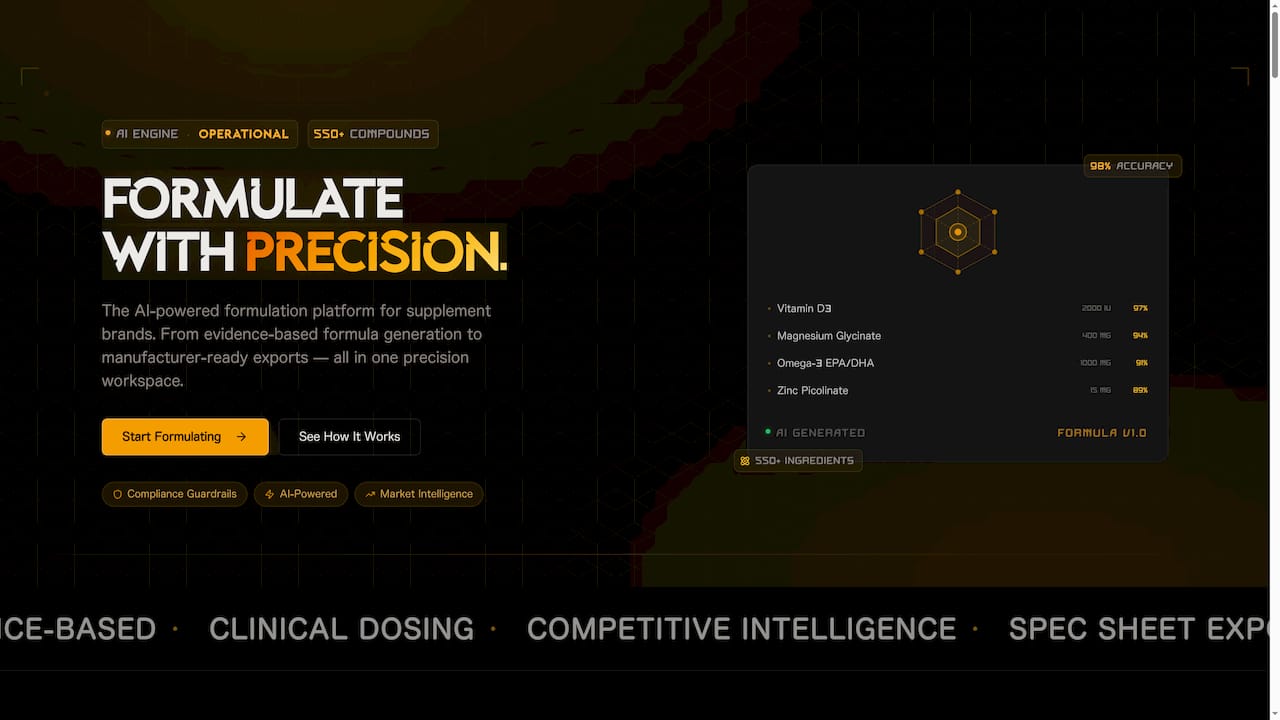
The platform combines research-backed formulation tools, competitor analysis, market positioning guidance, and an 8-phase product development plan that takes you from ideation through production. Built-in compliance guidance, a packaging section with an AI mockup designer, and full market analytics mean every decision you make is grounded in data. Whether you are launching your first SKU or scaling an existing line, Formlypro gives you the structure to move faster, spend less, and launch with confidence.
FAQ
What are the main benefits of data-driven formulations?
Data-driven formulations reduce development time by up to 60%, cut material costs by as much as 65%, improve consistency through automated rulesets, and enable real-time compliance screening. These benefits apply across supplement, pharmaceutical, and consumer packaged goods development.
How does predictive formulation reduce material waste?
Predictive tools digitally screen thousands of ingredient combinations before physical trials begin, cutting the number of physical experiments by up to 60%. Centralized data reuse adds a further 30% reduction in material waste by preventing teams from repeating past experiments.
Can data-driven formulation tools help with regulatory compliance?
Yes. Digital labs enable real-time regulatory screening during the formulation process itself, not after development is complete. Dassault Systèmes reports that standardizing specifications through centralized data reduces recalls and accelerates market approval.
How quickly can a data-driven approach reformulate a product?
Predictive formulation platforms can complete reformulation in days rather than months when regulatory or market conditions change. This speed comes from the model's ability to screen new constraints against existing ingredient and performance data without starting from scratch.
Is data-driven formulation only for large R&D teams?
No. Structured AI environments and automated rulesets lower the technical barrier significantly, allowing non-technical users to operate formulation tools reliably. DataNorth AI's case study shows that automated node-based logic achieves 100% formulation accuracy without requiring deep scientific expertise from every user.