

TL;DR:
- Most brand failures stem from fragmented and overly complex compliance systems.
- Building a continuous, integrated workflow with automated checks and clear ownership reduces risk and audit time.
- Simplifying checklists, embedding compliance into daily routines, and leveraging automation ensures sustainable compliance management.
Missing a single compliance step in consumer goods can trigger a product recall, block market entry, or permanently damage your brand's reputation with retailers. One mislabeled ingredient, one missing safety substantiation, or one unapproved claim is all it takes. Yet most brand managers still treat compliance as a checkpoint rather than a continuous system woven into every stage of development. This guide walks you through building a brand compliance workflow that runs every day, catches problems early, and keeps your team audit-ready without drowning in manual processes.
Table of Contents
- What is a brand compliance workflow and why does it matter?
- Key ingredients and prerequisites for building an always-on workflow
- Step-by-step: Setting up and executing your brand compliance workflow
- Monitoring, troubleshooting, and continuous improvement
- Fresh perspective: Why most brands still get compliance workflows wrong
- Take your compliance workflow further
- Frequently asked questions
Key Takeaways
| Point | Details |
|---|---|
| Always-on workflow | Integrating short daily checks delivers consistent, efficient brand compliance. |
| Automate escalation | Set up automatic alerts so failed checks reach the right team instantly. |
| Document for audit | Centralized, auditable records simplify proving compliance and passing inspections. |
| Continuously improve | Track, remediate, and refine compliance processes to reduce risk and manual effort. |
| Leverage technology | Smart tools and platforms streamline workflow steps and minimize audit complexity. |
What is a brand compliance workflow and why does it matter?
A brand compliance workflow is the structured, repeatable system your team uses to ensure every product, package, label, and marketing claim meets both internal brand standards and external regulatory requirements, consistently and provably. It is not a one-time review before launch. It is not a once-a-year audit. It is an ongoing, integrated process that touches formulation, packaging, marketing, and supply chain at the same time.
Two distinct layers exist within this system. External compliance covers regulatory requirements from bodies like the FDA, FTC, or CPSC, as well as industry standards and retailer mandates. Internal compliance covers your own brand guidelines: approved claims lists, visual identity rules, ingredient restrictions, and internal approval workflows. Marketing compliance in consumer goods must combine both layers, including proof of substantiation for claims and full documentation for auditability.
When brands separate these layers or manage them in silos, gaps appear. A marketing team may approve a claim that the regulatory team never cleared. A supply chain update may change an ingredient without triggering a label review. These are not rare edge cases. They are predictable failures of a fragmented process.
The business stakes are real:
- Product recalls in the US cost an average of $10 million per incident, excluding brand damage
- Retailers increasingly require documented compliance before shelf placement
- Regulatory fines for labeling violations can reach hundreds of thousands of dollars per violation
"The foundation of any brand compliance workflow is documentation and auditability. If you cannot prove a claim was substantiated or a checklist was completed, it does not exist in the eyes of a regulator."
Understanding compliance in product development from the earliest stage, not just at the finish line, is what separates brands that scale reliably from brands that stall at retail gates. The same logic applies when you set industry compliance standards for your category, where knowing the thresholds before you formulate saves you from reformulating after the fact.
Key ingredients and prerequisites for building an always-on workflow
Before you can run a compliance workflow, you need the right people, tools, and habits in place. Most compliance failures are not caused by bad intentions. They happen because teams lack clear ownership, use inconsistent tools, or treat compliance as someone else's job.
Who needs a seat at the table:
- Compliance lead — owns the overall system, updates requirements, and manages escalation
- QA/Quality manager — executes product-level checks, photo documentation, and sign-off
- Marketing and creative — flags new claims and submits content for approval before publishing
- Regulatory affairs — interprets agency guidance and maintains substantiation files
- Supply chain and procurement — triggers compliance reviews when ingredients or suppliers change
| Role | Primary task | Required tool |
|---|---|---|
| Compliance lead | Maintain master checklist and escalation rules | Routing platform, SOP library |
| QA/Quality manager | Daily pass/fail checks, photo proof | Mobile checklist app, image log |
| Marketing/creative | Submit content for pre-approval | Approval workflow software |
| Regulatory affairs | Substantiate claims, file documentation | Document management system |
| Supply chain | Flag ingredient or supplier changes | Change-management trigger system |
Tools that make the system work:
- Digital checklists with pass/fail logic and photo capture
- Automated routing to assign failed items to the right owner immediately
- A centralized documentation system that stores audit trails, approval records, and substantiation files
- Scheduled check reminders integrated into existing team workflows (Slack, email, project management tools)
An always-on compliance system is not a once-a-year or once-per-campaign gate. It uses short daily checks, simple pass/fail criteria, photo proof when needed, and automatic routing to the right owners.
The biggest operational shift most teams need to make is embedding compliance into their existing daily routines rather than scheduling separate compliance meetings. When a QA manager already walks the production floor every morning, the compliance check goes with that walk, not into a separate calendar slot.

Pro Tip: Build automated escalation rules from day one. If a failed check is not acknowledged within two hours, it automatically routes up to the compliance lead. This removes the bottleneck of managers chasing updates and cuts resolution time significantly.
Leveraging formulation analytics benefits alongside your compliance system also gives your team early warning signals. When ingredient data feeds directly into your compliance layer, you catch formula-level risks before they reach production.
Step-by-step: Setting up and executing your brand compliance workflow
With your team and tools in place, here is how to actually build and run the workflow from the ground up.
1. Map all compliance requirements before you do anything else. List every regulatory body, retailer standard, and internal guideline that applies to your product category. Segment them by product type, market, and channel. This becomes your master requirements document and the backbone of every checklist you create.
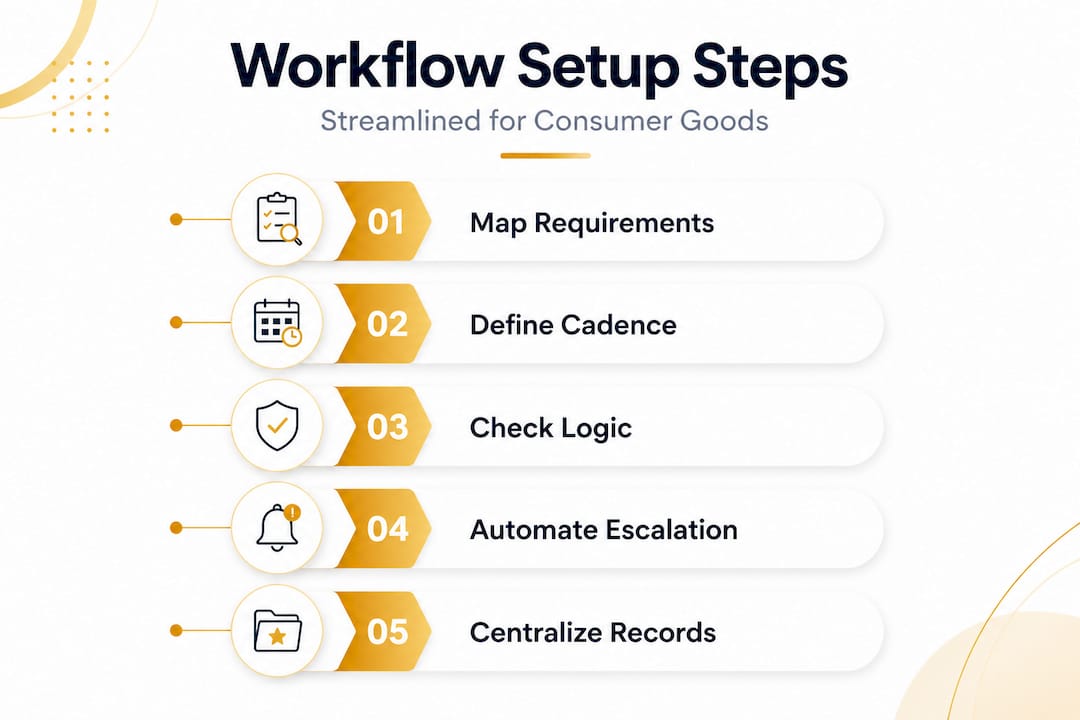
2. Define daily, weekly, and milestone check cadences. Daily checks cover production-floor standards, active claim reviews, and supplier flags. Weekly checks cover label accuracy, social content approvals, and open escalations. Milestone checks occur at key phases: formulation lock, pre-production, label proof, and pre-shipment.
3. Set up pass/fail logic with photo evidence triggers. Best-practice mechanics include embedding checks into existing routines, requiring photos only when something fails or needs judgment, keeping daily checks under about 10 minutes, and using automated escalation so failed items reach the responsible team immediately. A check that takes 20 minutes gets skipped. Keep it fast.
4. Automate escalation pathways. Every failed check should have a named owner, a response window, and a backup if the primary owner is unresponsive. Automated escalation is not optional. It is the mechanism that ensures nothing falls through the cracks between teams.
5. Maintain centralized, auditable records. Every check result, photo, approval, and remediation note should live in one searchable system. When a retailer or regulator asks for documentation, your team should be able to pull it within minutes. Scattered spreadsheets and email chains are not audit-ready.
| Workflow type | Daily check time | Documentation method | Escalation speed |
|---|---|---|---|
| Standard manual workflow | 20 to 40 minutes | Email and shared drives | Hours to days |
| AI-assisted workflow | 5 to 10 minutes | Auto-logged in platform | Minutes |
Supplier and sustainability compliance now follows a full audit lifecycle: from audits to remediation to improvement tracking, with standardized severity scoring mapped to your brand's code of conduct. Applying the same lifecycle structure to your internal compliance workflow creates consistency across every compliance dimension.
Following market-ready formulation steps in parallel with your compliance workflow ensures that formulation decisions and regulatory requirements stay synchronized throughout development. This is especially important in categories like cosmetics and personal care, where ingredient restrictions change frequently and vary by market.
Pro Tip: Keep daily compliance checks under 10 minutes to drive team adoption. If the check feels like a burden, it gets deprioritized. Short, well-designed checklists with clear pass/fail criteria consistently outperform long-form review documents.
Monitoring, troubleshooting, and continuous improvement
Launching the workflow is only half the work. The other half is keeping it sharp over time. Without active monitoring and regular refinement, even well-designed compliance systems drift.
Set KPIs from the start. Track metrics like check completion rate, average escalation response time, open issues by category, and recurring failure types. These numbers tell you where the system is working and where it is breaking down. A weekly review of these metrics takes 15 minutes and prevents months of accumulated risk.
Build an audit lifecycle, not just an audit event. Supplier compliance workflows that treat compliance as a full lifecycle with severity scoring and improvement tracking reduce audit complexity and manual reconciliation significantly. Apply this same logic internally: every failed check should trigger a remediation task with a deadline and a follow-up verification, not just a note in a log.
Common issues and how to fix them:
- Low check completion rates: Simplify the checklist, reduce check time, or reassign to a more appropriate team member
- Repeated failures in the same category: Root cause analysis needed, likely a process or training gap rather than an individual error
- Slow escalation response: Review escalation rules, confirm ownership, and tighten the response window
- Documentation gaps: Audit your storage system and make submission mandatory before a check is marked complete
- Supplier-triggered label changes going undetected: Add a supplier change notification to your intake system with an automatic compliance review trigger
"The brands that reduce audit workload fastest are those that stop treating compliance as a series of events and start treating it as a continuous data stream with clear owners at every stage."
Understanding the importance of compliance especially for supplement and food brands where regulatory scrutiny is high, reinforces why continuous monitoring is worth the investment. Even small gaps in compliance documentation can result in FDA warning letters or retailer delisting. Pairing your compliance monitoring with smart packaging tips for compliance means your external presentation stays aligned with your internal systems.
Continuous improvement also means updating your master requirements document whenever regulations change, new markets open, or your product line expands. A compliance workflow that was built for one SKU in one market needs deliberate scaling as your catalog grows.
Fresh perspective: Why most brands still get compliance workflows wrong
Here is the uncomfortable truth: most brand compliance failures are not caused by a lack of rules. They are caused by an excess of them. Teams that build 50-point checklists, hold quarterly compliance reviews, and treat every document as sacred end up creating systems so rigid and time-consuming that people work around them.
The irony is that complexity creates risk. When a checklist takes 45 minutes to complete, people batch them weekly instead of running them daily. When a compliance review requires three manager sign-offs, teams submit claims they know will be approved and quietly avoid the ones they are unsure about. The system designed to prevent failures becomes the system that enables them.
What experienced brands do differently is almost counterintuitive: they make compliance easier, not harder. They cut checklists to the critical few. They design workflows so that a daily check feels as natural as checking email. They train teams to escalate freely without fear of criticism, because catching an issue early is always celebrated, never punished.
The other major gap is automation. Most brands still rely on email for escalation, shared drives for documentation, and spreadsheets for tracking. These tools are not wrong. They are just too slow and too dependent on individual discipline. The moment someone forgets to CC the right person or saves a file in the wrong folder, the audit trail breaks.
The brands that scale compliance successfully are the ones that invest in brand formulation strategies that integrate compliance from the formulation stage itself, rather than layering it on top later. Compliance is not a department. It is a design principle.
If you want a culture where compliance runs without constant management intervention, you need low-friction systems, visible accountability, and a team that sees compliance as a competitive advantage, not a burden. That shift in mindset is harder to build than any checklist, but it is the only thing that makes the rest of the system sustainable.
Take your compliance workflow further
Building a reliable brand compliance workflow from scratch takes time, cross-functional coordination, and the right tools. If you are managing formulation development, regulatory documentation, packaging approvals, and market positioning simultaneously, the complexity compounds fast.
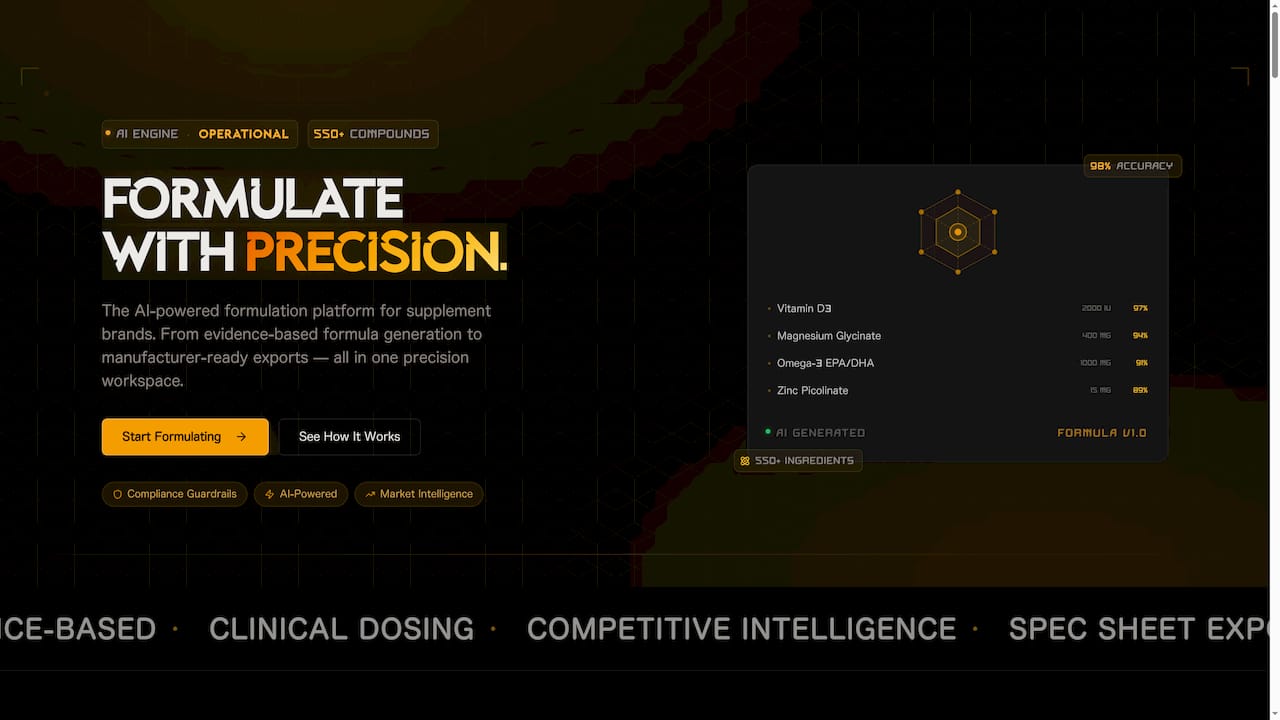
FormlyPro is built specifically to help consumer goods brands operationalize exactly this kind of workflow. From research-backed formulation development and competitor analysis to integrated compliance guidance and AI-powered packaging design, the platform supports every phase of your product journey. The 8-phase product development plan takes your brand from ideation through production with compliance checkpoints built into every stage, so nothing slips through. If you are ready to stop managing compliance manually and start running it as an automated compliance solution, FormlyPro gives your team the infrastructure to do it at scale.
Frequently asked questions
What's the difference between brand compliance and regulatory compliance?
Brand compliance covers internal guidelines for consistency in messaging, visuals, and claims, while regulatory compliance ensures you meet outside legal and industry requirements. Both must work together in a complete consumer goods compliance workflow.
How often should brand compliance checks occur in consumer goods?
Short compliance checks should happen daily as part of team routines, embedded into existing workflows, not just once per project or campaign launch.
What is automated escalation in a brand compliance workflow?
Automated escalation means that failed checks immediately alert the responsible team member for fast resolution, eliminating delays caused by manual follow-up or missed notifications.
How can brands reduce compliance audit workload?
Centralizing audits, remediation, and improvement tracking with automation and standardized severity scoring cuts complexity and reduces the manual reconciliation work that consumes team time during audit periods.