

An integrated brand strategy, in the supplement and wellness context, is the end-to-end product-and-brand system that aligns formulation, ingredient intelligence, regulatory compliance, packaging design, market positioning, and launch planning into a single coordinated workflow. Success looks like three things: a producible hero SKU with potency-to-claim alignment, a finalized Supplement Facts panel that has cleared FDA/DSHEA compliance gates, and pilot-run stability data confirming shelf-life before you commit to a full production run.
- Formulation and claims must match. A product that promises functional benefits without sufficient active dosing drives returns and kills repeat purchase rates.
- Compliance is not a final step. Under FDA 21 CFR Part 111, manufacturing practices must be validated before production, not after.
- Stability testing is non-negotiable for retail. Accelerated studies take about 3 months, while real-time studies last 12–24 months.
Table of Contents
- What are the six core components of an integrated brand strategy?
- How do you map those components into an 8-phase product-development workflow?
- A practical 8–12 week checklist to launch your first hero SKU
- What does it actually cost and how long does it take?
- Common pitfalls that derail supplement launches
- How Formlypro operationalizes an integrated brand strategy
- Key Takeaways
- The mistake most supplement founders make too early
- Formlypro gives you the full 8-phase workflow in one platform
- Authoritative sources and further reading
What are the six core components of an integrated brand strategy?
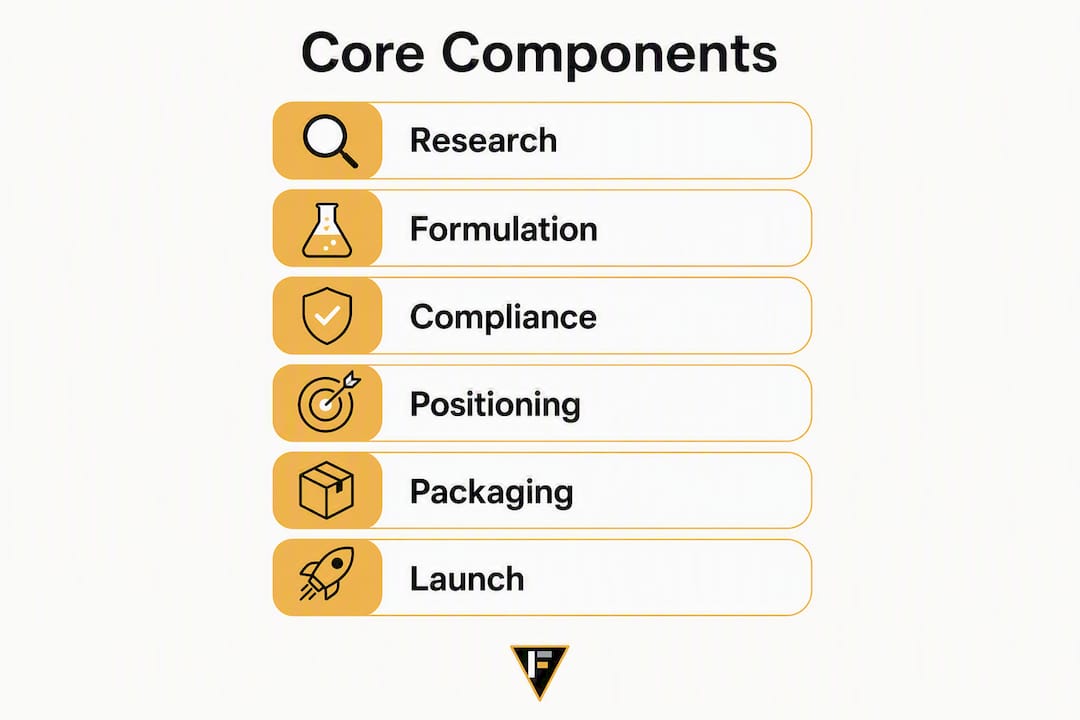
Every supplement launch depends on six systems working together. When one is out of sync, the others break down. The Supplement Facts panel, for example, fixes serving size, which determines capsule count, which drives bottle size, which sets your packaging dieline dimensions and shipping costs. Pull one thread and the whole garment shifts.
Ingredient transparency is a brand asset, not just a compliance checkbox. Brands that foreground it in packaging and messaging can command premium pricing over private-label alternatives.
Positioning built from ranked buyer segments consistently outperforms broad descriptors. Targeting three or four precise segments, rather than "health-conscious adults," sharpens conversion and retention. Research shows that many supplement brands fail to differentiate because they rely on vague positioning instead.
| Component | Deliverable | Timing trigger |
|---|---|---|
| Research-backed formulation | Formula spec with active amounts, excipients, dosage form | After hero SKU brief is locked |
| Ingredient intelligence | Ingredient sourcing matrix, COA requirements | Before formula brief |
| Regulatory compliance | Supplement Facts panel, NDI/claim clearance | Before pilot run |
| Packaging design | Label copy, dieline, AI mockup | After Supplement Facts finalized |
| Market positioning | Positioning statement, ranked buyer segments | Parallel to formulation |
| Launch planning | Channel plan, MOQ targets, launch KPIs | After pilot run approval |
How do you map those components into an 8-phase product-development workflow?
The formulation process is not linear in practice, but it needs a linear gate structure to prevent expensive backtracking. Each phase below has one owner accountable for the gate decision.

| Phase | Main deliverable | Typical duration | Primary owner | Gate to advance |
|---|---|---|---|---|
| 1. Ideation | Hero SKU brief, buyer segments | 1–2 weeks | Founder / PM | Brief signed off |
| 2. Formula brief | Ingredient list, target potency, format | 1–2 weeks | PM + Formulator | Brief approved |
| 3. Formulation & stability | Formula spec, accelerated stability plan | 4–8 weeks | Formulator | Spec locked |
| 4. Pilot run | Prototype samples, COA | 2–4 weeks | Manufacturer QA | COA pass |
| 5. Compliance review | Supplement Facts, claim clearance | 2–3 weeks | Regulatory consultant | Label approved |
| 6. Packaging design | Dieline, label artwork, mockup | 2–3 weeks | Designer / PM | Artwork approved |
| 7. Pilot packout | Packaged samples, shelf-life confirmation | 2–4 weeks | Manufacturer QA | Stability confirmed |
| 8. Launch & scale | Channel-ready inventory, launch plan | Ongoing | PM / Founder | KPI targets set |
Responsibility matrix guideline: the PM owns gate decisions; the founder approves budget at phases 1, 4, and 8; the formulator owns phases 2–3; manufacturer QA owns phases 4 and 7; the regulatory consultant owns phase 5.
Running compliance checks in parallel with formulation, rather than after pilot production, is the single highest-leverage change a product team can make. Reformulating after a pilot run typically costs more in time and money than the compliance review itself.
Integrating compliance as a pre-production validation step, not a post-production check, reduces reformulation risk and speeds scale. For brands with multi-market ambitions, NDI status screening) and market-specific documentation should be added as a gate in phase 5.
A practical 8–12 week checklist to launch your first hero SKU
Weeks 1–2: Lock the brief
- Define one hero SKU with a specific outcome, format, and target customer.
- Rank three to four buyer segments by conversion potential.
- Draft the ingredient list and target potency ranges.
- Confirm channel (DTC, Amazon, retail) and MOQ expectations with at least two manufacturers.
Weeks 3–4: Formulation and compliance prep
- Submit formula brief to formulator; request COA requirements upfront.
- Run a potency-to-claim check against clinical evidence for each active ingredient.
- Draft Supplement Facts panel and submit for regulatory pre-review.
- Screen for NDI status on any ingredient added to the food supply after October 15, 1994.
Weeks 5–8: Pilot and packaging
- Receive prototype samples; initiate accelerated stability testing.
- Finalize label copy and packaging dieline based on confirmed bottle size.
- Run a compliance simulation: check claim language, ingredient eligibility, and label format against FDA requirements.
Weeks 9–12: Packout and launch prep
- Complete pilot packout; confirm COA pass rate target of 100%.
- Set launch KPIs: reorder rate, return rate, potency retention at 6 months, COA pass rate.
- Flag and pause if: COA fails on potency, stability data shows degradation above 10%, or supplier substitutes an ingredient without notice.
Supplier questions to ask before signing:
- What is your COA testing protocol and which third-party lab do you use?
- Can you provide stability data for this formula or a comparable one?
- What is your substitution policy if a raw material becomes unavailable?
- What is your minimum pilot run quantity and lead time?
What does it actually cost and how long does it take?
Timeline and cost vary by formulation complexity and the path you choose: private-label (fastest, least custom), modified stock, or fully custom. Custom formulations take longer and cost more, but they give you defensible differentiation.
| Development stage | Typical duration | Key cost driver |
|---|---|---|
| Formula development | a few weeks | Complexity, number of actives |
| Prototype samples | a few weeks | Sample quantity, dosage form |
| Pilot run (MOQ) | a few weeks | MOQ, packaging type |
| Stability testing | several months or longer | Number of SKUs, test conditions |
| Regulatory review | a few weeks | Claim complexity, NDI screening |
Team you need: a PM or founder driving decisions, a formulator (contract or in-house), a manufacturer with QA capability, a regulatory consultant for label review, and a designer for packaging. Most early-stage brands run this with three to four people plus vendors.
Common pitfalls that derail supplement launches
Most launch failures trace back to decisions made in the first two weeks, not the last two.
- Vague buyer segments. Broad targets like "active adults" produce unfocused claims and weak conversion. Fix: rank three to four specific segments before writing a single line of copy.
- Claim-to-potency mismatch. Brands that promise functional benefits without sufficient active dosing face higher return rates and lower repeat purchase. Fix: run a potency-to-claim check before finalizing the formula spec.
- Skipping stability testing. Accelerated stability data (typically available after 3 months) is required for Amazon and most retail buyers. Skipping it delays listing and exposes you to returns if potency degrades on shelf.
- Late compliance checks. Discovering a label claim violation after a pilot run means reformulating or reprinting, both expensive. Fix: run a compliance simulation before final formula sign-off.
- Ingredient instability at scale. Some actives degrade under heat or humidity during manufacturing. Red flag: changing COA results between pilot and production batches. Remediation: require the manufacturer to document process controls and retest.
- Supplier substitution. A supplier swapping an ingredient without notice can invalidate your COA and your claims. Fix: add a written substitution-notification clause to every supplier agreement.
Pro Tip: Run a compliance simulation before you finalize the formula. Screen for NDI status, label claim risk, and ingredient eligibility in one pass. Finding a problem at this stage costs a conversation; finding it after a pilot run costs a reformulation.
How Formlypro operationalizes an integrated brand strategy
Formlypro maps directly to the 8-phase workflow above. Each platform module corresponds to a phase gate, so product teams move through development without switching tools or losing context.
- Formulation workspace (phases 2–3): research-backed formula generation with ingredient intelligence, active dosing guidance, and manufacturer-ready export.
- Compliance pre-checks (phase 5): NDI and claim guardrails built into the workflow so label issues surface before pilot, not after.
- AI packaging mockup designer (phase 6): custom dieline and label mockups generated inside the platform, tied to the finalized Supplement Facts.
- Pipeline planner (phases 1–8): tracks deliverables, owners, and gate status across the full product lifecycle.
- Market and competitive analytics (phases 1–2): competitor formulation data and market positioning intelligence to sharpen buyer-segment targeting.
Ingredient transparency is a brand asset, not just a compliance checkbox. Brands that foreground it in packaging and messaging can attain premium pricing over private-label alternatives — and Formlypro's ingredient intelligence module is built to surface that data at the formulation stage, not as an afterthought.
Formulation transparency built into the product record means your packaging and positioning team works from the same source of truth as your formulator. That alignment is what prevents the claim mismatches that drive returns.
Key Takeaways
An integrated brand strategy for supplement brands works only when formulation, compliance, packaging, and positioning are developed as one connected system, not as sequential handoffs.
| Point | Details |
|---|---|
| Lock the hero SKU first | One defined product with a specific outcome determines formula, claims, packaging, and timeline. |
| Run compliance before pilot | A compliance simulation before formula sign-off prevents expensive post-pilot reformulations. |
| Stability testing is mandatory | Accelerated studies take about 3 months; skipping them blocks retail and Amazon listings. |
| Potency must match claims | Claim-to-potency mismatches are the leading driver of returns and poor repeat purchase rates. |
| Formlypro covers all 8 phases | The platform connects formulation, compliance pre-checks, AI packaging mockups, and pipeline planning in one workflow. |
The mistake most supplement founders make too early
The most consistent pattern in early-stage supplement launches is not a bad formula. It is a vague specification paired with compliance checks that happen too late. A founder locks a formula, runs a pilot, and then discovers a label claim that does not clear FDA review. The reformulation costs more than the pilot run did.
The second pattern is treating the Supplement Facts panel as a final step rather than a strategic input. The panel fixes serving size, which determines capsule count, which sets bottle dimensions, which drives packaging and shipping costs. Finalizing it late means reprints, margin erosion, and delays.
Working with a formulator who understands compliance from the start, rather than treating it as a separate workstream, is the single change that compresses timelines most reliably.
If you want to move faster without adding headcount, the next section covers how Formlypro supports each phase.
Formlypro gives you the full 8-phase workflow in one platform
Most supplement brands piece together their product development across spreadsheets, contract formulators, a separate compliance consultant, a designer, and a manufacturer. That fragmentation is where timelines slip and claim mismatches happen.
Formlypro consolidates the entire workflow: research-backed formulation, ingredient intelligence, compliance pre-checks with NDI and claim guardrails, an AI packaging mockup designer, and a pipeline planner that tracks every phase gate from ideation to launch. Competitive analytics and market positioning tools are built in, so your buyer-segment work and your formula brief live in the same system.
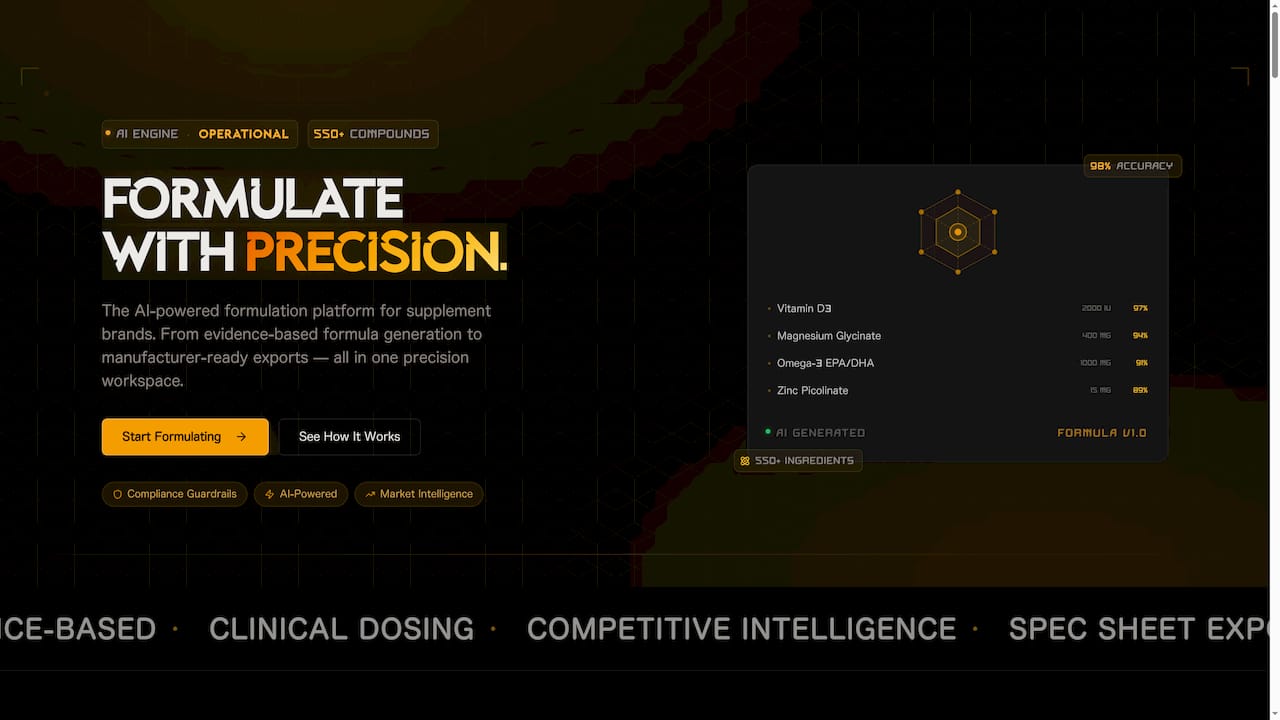
- Manufacturer-ready formula exports so your production partner gets exactly what they need.
- Claim guardrails that flag compliance issues before you commit to a pilot run.
- AI packaging mockups tied to your finalized Supplement Facts panel.
Formlypro runs on a subscription model with tiered monthly plans and à la carte add-ons for advanced reports and extra formulation credits. Start your first hero-SKU brief on Formlypro and run your compliance simulation before your next pilot run.
Authoritative sources and further reading
- FDA Current Good Manufacturing Practice (21 CFR Part 111): the governing standard for supplement manufacturing, packaging, labeling, and quality controls in the US.
- FDA New Dietary Ingredients (21 USC 350b)): the statutory basis for NDI notifications; required reading before finalizing any ingredient added to the food supply after October 15, 1994.
- How Supplement Formulation Works — Inventory Ready: practical guide covering formula specs, stability testing timelines, and pilot-run requirements.
- Supplement Brand Pre-Launch Checklist — Paragon Labs USA: a checklist covering Supplement Facts inputs, claims guardrails, packaging direction, and order expectations.
- Regulatory Compliance Guide — KS Supplements: covers compliance-in-parallel methodology, NDI screening, and multi-jurisdiction documentation.
- Launch a Supplement Brand Guide — NutraMarketers: buyer-segmentation strategy and positioning frameworks for new supplement brands.
This article is general information, not legal or regulatory advice. Confirm current FDA requirements and label compliance with a qualified regulatory consultant before finalizing your product.