

TL;DR:
- In-process quality control helps supplement brands catch deviations early and prevent batch failures. Implementing IPQC reduces rework costs, ensures compliance, and connects real-time data to formulation decisions. A structured IPQC program, integrated with digital records, enables continuous improvement and smoother FDA inspections.
In-process quality control (IPQC) catches deviations during production so you prevent defective supplement batches before they reach the warehouse, the retailer, or the consumer. For supplement and wellness brands operating under FDA cGMPs and DSHEA, that is not a nice operational detail — it is the difference between a clean audit and a recall.
- Core outcomes: fewer batch rejections, lower rework costs, faster time-to-release, and traceable audit records that hold up under FDA inspection.
- Where IPQC runs: during blending, encapsulation, filling, and packaging — not just at final release.
Formlypro integrates IPQC outputs directly with formulation data and digital batch records, so your quality checks and your product specs live in the same system.
Table of Contents
- Why does IPQC matter for supplement brands?
- What are the core in-process checks for supplements?
- How do sampling strategies and SPC work in practice?
- How does IPQC fit with QA, and who owns what?
- How do you turn IPQC data into yield gains?
- What are the most common IPQC implementation mistakes?
- What does a minimal viable IPQC program look like?
- When does automating IPQC make financial sense?
- Key Takeaways
- Why integrated IPQC changes formulation decisions
- Formlypro brings your IPQC and formulation data together
- Useful sources and further reading
Why does IPQC matter for supplement brands?
IPQC enables manufacturers to maintain consistent quality, reduce waste, and improve efficiency by addressing potential issues before they escalate into batch failures or regulatory findings. For supplement brands, that regulatory exposure is real: FDA cGMP regulations for dietary supplements (21 CFR Part 111) require manufacturers to establish and follow written procedures for in-process controls, including testing and examination of in-process materials.
The business case is equally direct. Catching a blend uniformity failure at the blending step costs a fraction of what it costs after encapsulation, labeling, and packaging are complete. Yield losses, rework labor, and destroyed inventory add up fast, especially for small brands running contract manufacturing with minimum batch commitments.
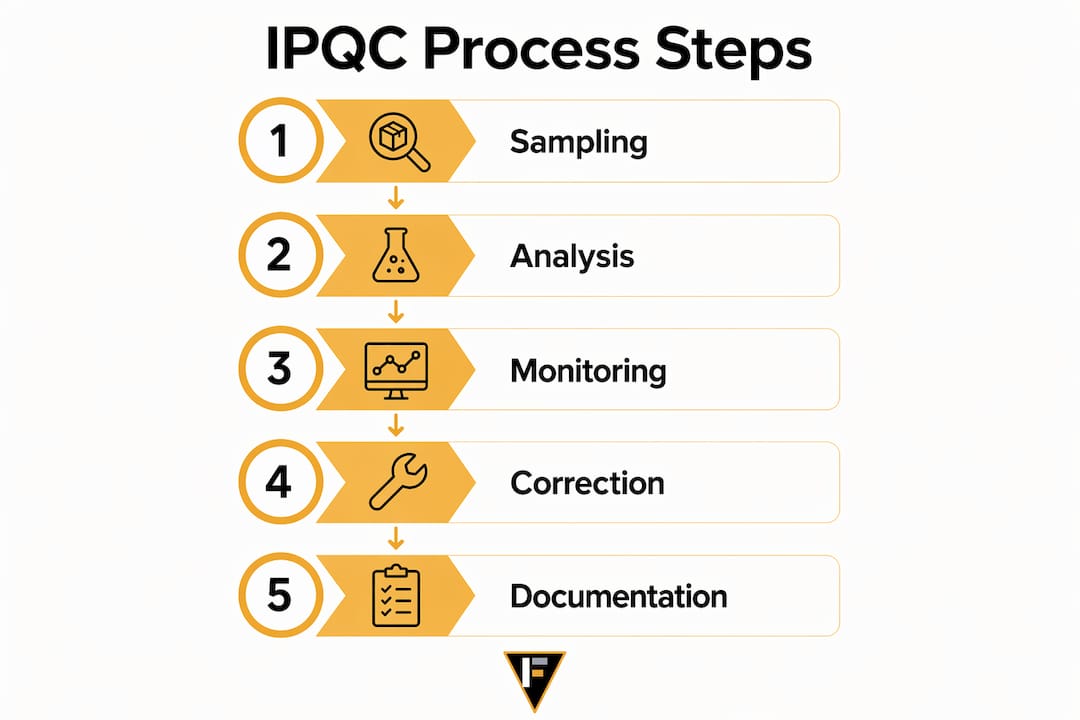
Quality requires organization-wide commitment — isolated QC teams are ineffective without cross-functional engagement. That means production operators, QA managers, and product managers all carry a share of ownership, not just the person holding the clipboard.
What are the core in-process checks for supplements?
The checks below cover the critical process steps where deviations most commonly occur. Patrol inspections and first-piece inspections are key IPQC activities and should be triggered by risk events: new product, new tooling, new material, or personnel changes.
- Raw material identity and COA verification: Before blending begins, confirm each ingredient against its certificate of analysis. Run first-piece checks on every new lot.
- Blend uniformity: Use assay sampling or near-infrared (NIR) as a proxy to confirm active ingredient distribution before encapsulation or tableting.
- Weight and volume checks: Run every 15–30 minutes on encapsulators and fillers; flag any unit outside ±3% of target.
- Moisture content: Critical for powders and hygroscopic ingredients; check after blending and before packaging.
- In-process potency sampling: Pull mid-batch samples for lab assay when batch size or ingredient cost justifies it.
- Microbial spot checks: Periodic environmental and in-process swabs, especially after equipment cleaning or changeover.
- In-line NIR/FTIR: Where applicable, continuous monitoring of blend composition or tablet coating thickness.
- Packaging and label verification: Confirm label accuracy, lot number, expiration date, and tamper-evidence seal integrity before sealing.
Pro Tip: Tailor patrol inspection frequency to process complexity. Manual blending and hand-fill encapsulation need checks every 15–20 minutes. Fully automated lines with sensor feedback can extend to 30–45 minutes between human patrols, provided sensor alarms are active.
How do sampling strategies and SPC work in practice?
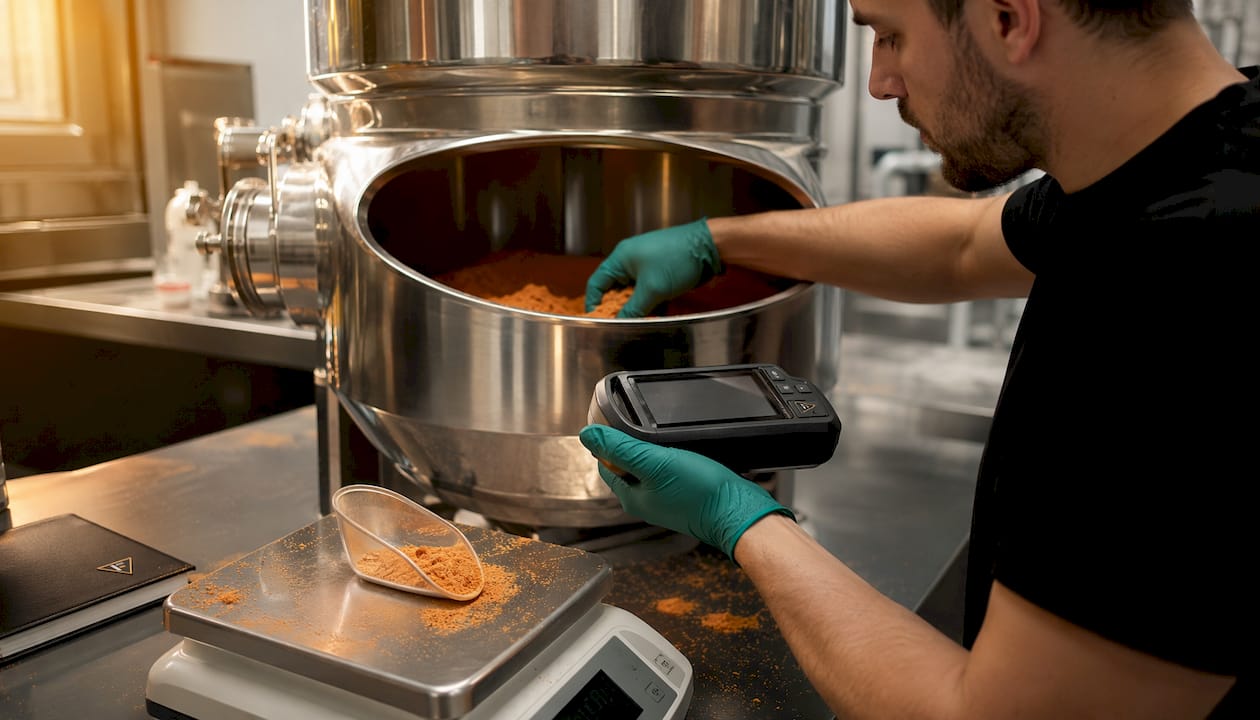
Sampling does not need to be complicated to be defensible. For small batches (under 10,000 units), a first-piece plus three mid-batch pulls plus a final-unit check gives you a reasonable spread. For larger batches, AQL-style sampling tables (ANSI/ASQ Z1.4) provide statistically grounded sample sizes tied to acceptable quality levels.
Statistical Process Control (SPC) adds the layer that turns individual data points into trends. A control chart plots each measurement against an upper control limit (UCL) and lower control limit (LCL), typically set at ±3 standard deviations from the process mean. The value is not catching the one unit that fails spec — it is catching the drift that predicts failures before they happen.
| Signal type | What it means | Required action |
|---|---|---|
| Single point outside UCL/LCL | Immediate out-of-spec risk | Stop line, quarantine units, investigate |
| Multiple consecutive points trending up or down | Process drift in progress | Immediate check, adjust process parameter |
| 2 of 3 points near a control limit | Early warning of instability | Increase patrol frequency, notify QA |
| Random scatter within limits | Process in control | Continue standard patrol schedule |
In-situ monitoring enables earlier corrective action and reduces the need for extensive post-process inspection when adopted correctly. Combining real-time sensor data with periodic lab assays lets you prioritize expensive tests and accelerate batch release.
How does IPQC fit with QA, and who owns what?
QA is proactive and process-oriented; QC is reactive and product-oriented.and_Quality_Control(QC)) Both are necessary, and confusing them is one of the most common structural errors in early-stage supplement brands.
- QA writes the SOPs, validates the processes, and sets the acceptance criteria. It is preventive.
- QC / IPQC runs the checks, records the results, and flags deviations. It is detective.
Ownership in practice looks like this:
- Production operators perform first-piece and routine patrol checks per written procedures.
- IPQC inspectors (or a QC technician at smaller brands) review results, escalate out-of-spec events, and maintain batch records.
- QA reviews completed batch records, approves or rejects batches, and owns the CAPA process.
- Product managers define the critical quality attributes (CQAs) and acceptable ranges in the product specification — that document is what QC checks against.
Pro Tip: Run same-day patrol-issue closure meetings. When an IPQC flag sits unresolved overnight, the next shift repeats the same failure. A 15-minute cross-functional standup at end-of-shift closes the loop and builds the quality culture that makes IPQC actually work.
How do you turn IPQC data into yield gains?
Treating monitoring as an extra cost rather than a strategic asset is a missed opportunity. Brands that use IPQC data systematically turn potential failure points into process improvements.
Track these KPIs from your IPQC program:
| KPI | Target direction | Why it matters |
|---|---|---|
| First-pass yield (%) | Maximize | Measures batches released without rework |
| Out-of-spec events per batch | Minimize | Tracks defect rate over time |
| Mean time to containment (minutes) | Minimize | Speed of response to a deviation |
| Batches requiring rework (%) | Minimize | Direct cost-of-quality indicator |
A practical example: if your NIR trend data shows potency readings drifting low over a three-week period, the corrective action might be a blend time extension of two minutes. Document the change, run a pilot batch, and compare first-pass yield before and after. That is continuous improvement driven by IPQC data, not guesswork.
What are the most common IPQC implementation mistakes?
Most IPQC failures are not technical. They are operational and cultural.
Recording without acting is the most damaging pattern. Issues must be closed the same day to avoid repeated batch failures. A log full of unresolved flags is worse than no log — it documents negligence.
Siloing QC from production means operators see inspectors as adversaries rather than partners. Fix it by having operators participate in first-piece checks and patrol documentation from day one.
Misreading SPC signals leads to over-adjustment, which adds variation rather than removing it. Train your team on the difference between common-cause variation (normal scatter) and special-cause signals (trends, runs, points outside limits) before you deploy control charts.
Pro Tip: Avoid over-automating before you understand your process. Automation amplifies bad data as fast as good data. Get your manual IPQC process stable and documented first, then automate the data capture.
What does a minimal viable IPQC program look like?
A small brand can build a functional IPQC program in 30–90 days without a large quality team.
- Days 1–10: Define your CQAs (potency, weight, moisture, microbial limits) and critical process parameters (blend time, fill speed, temperature) for each product.
- Days 11–20: Create first-piece and patrol inspection forms. Paper works, but a digital batch record saves rework later — start digital if you can.
- Days 21–30: Set sampling plans and acceptance criteria for each check. Document escalation paths (who to call, what to quarantine, when to stop the line).
- Days 31–60: Train production operators on the forms and escalation procedures. Run two pilot batches with full IPQC documentation and review results with QA.
- Days 61–90: Analyze pilot data, adjust sampling frequency or acceptance limits where needed, and establish your SPC baseline using the first 20–25 data points per parameter.
Budget pointers: lab assays for blend uniformity and potency run roughly $50–$200 per sample depending on the analyte and lab. Handheld NIR devices are available through rental or service agreements for brands not ready to purchase. IPQC inspector time for a small brand typically runs 4–8 hours per batch.
Pro Tip: Start with a digital batch record from day one. Paper records get lost, are hard to search during audits, and cannot feed trend analysis. A lightweight digital system pays for itself the first time an FDA investigator asks for batch history.
When does automating IPQC make financial sense?
The decision comes down to three factors: batch volume, cost of rework, and regulatory risk. If you are running more than 20 batches per month, losing more than $5,000 per rework event, or operating under a consent decree or warning letter, automation pays. Single-product, low-volume lines should stay manual initially and automate data capture first before adding sensor-based monitoring.
When evaluating a SaaS tool for IPQC support, look for these features:
- Audit trails with timestamped, user-attributed entries
- Digital batch records with e-signature capability
- Integration with LIMS, ERP, or formulation platforms
- Real-time SPC dashboards with configurable alert thresholds
- Customizable patrol inspection forms
- Role-based access controls
- Exportable audit-ready PDFs
Five questions to ask any vendor: (1) What is your data retention policy and how do I export my records? (2) Do you support API integration with my formulation or ERP system? (3) What validation documentation do you provide for 21 CFR Part 11 compliance? (4) How are user permissions and access logs managed? (5) Does your mobile app support offline data capture for manufacturing environments with limited connectivity?
When planning IPQC tool costs, treat software licensing, implementation, and training as a line item alongside lab and staffing costs — not an afterthought.
Key Takeaways
In-process quality control is the operational backbone of FDA cGMP compliance for supplement brands, and the brands that treat IPQC data as a continuous improvement asset consistently outperform those that treat it as a checkbox.
| Point | Details |
|---|---|
| IPQC catches deviations early | Running checks during blending, filling, and packaging prevents batch failures before they escalate. |
| Three highest-impact checks | Blend uniformity, weight/volume checks, and label verification cover the most common supplement failure modes. |
| SPC turns data into foresight | Control charts detect drift before spec failures occur, reducing rework and batch rejections. |
| Same-day closure is non-negotiable | Unresolved IPQC flags carry over to the next batch; cross-functional standup meetings stop the cycle. |
| Formlypro consolidates IPQC and formulation | Formlypro's digital batch records and compliance tools connect in-process data to your product specs in one platform. |
Why integrated IPQC changes formulation decisions
The conventional view is that formulation and quality control are sequential: you develop the formula, then QC checks the output. That separation is where most early-stage supplement brands lose money.
When IPQC data lives in the same system as your formula, you see the connection between ingredient choices and process behavior. A formula with a hygroscopic excipient that keeps triggering moisture failures during blending is telling you something about the formulation, not just the process. Catching that signal in batch records and connecting it back to the formula spec is what prevents the same problem from appearing in the next product you launch.
Formlypro's 8-phase product development workflow is built around exactly this feedback loop. IPQC outputs feed back into the formulation and compliance phases, so audit-ready records are not assembled after the fact — they accumulate as the product moves through development and production. One realistic scenario: a brand running pilot batches for a new magnesium glycinate capsule notices weight variation trending high in weeks two and three of production. Because the IPQC data is linked to the batch record and the formula spec, the product manager can see that the issue correlates with a new lot of excipient, not the active. That is a supplier qualification finding, not a formulation failure, and catching it early saves a full reformulation cycle.
Formlypro brings your IPQC and formulation data together
Getting IPQC right is harder when your batch records, formula specs, lab results, and compliance documentation live in separate spreadsheets and email threads. Formlypro solves that by putting all of it in one place.
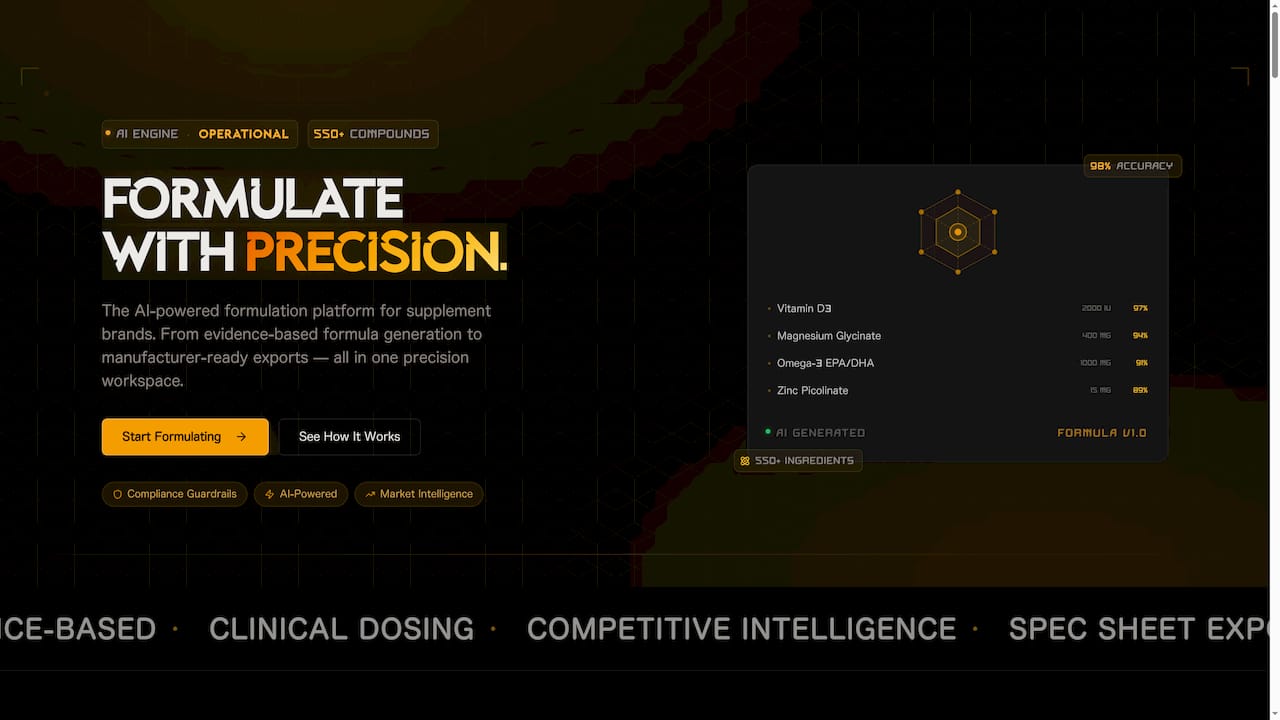
The platform gives supplement and wellness brands digital batch records with full audit trails, compliance guidance mapped to FDA cGMPs and DSHEA, and a product development workflow that connects formulation decisions to in-process quality data. You get SPC-ready analytics, manufacturer-ready exports, and the documentation structure that holds up under inspection — without building it from scratch.
- Faster batch release: audit-ready records are built as you go, not assembled at the end.
- Consolidated data: formulation specs, IPQC results, and compliance checks in one system.
- Clear next steps: Formlypro's 8-phase plan guides you from concept through production with quality built in at every stage.
Start with Formlypro and see how the platform supports your IPQC program from first-piece inspection through final batch release.
Useful sources and further reading
The references below are the primary sources for regulatory detail, SPC methods, and IPQC best practices covered in this guide.
- SafetyCulture: In-Process Quality Control Guide — Practical overview of IPQC definitions, patrol inspection triggers, and risk-based frequency guidance. Start here for operational basics.
- Biology LibreTexts: Principles of QA and QC in Biotechnology_and_Quality_Control_(QC)) — The clearest framework for distinguishing QA (preventive, process-level) from QC (detective, product-level) in a life sciences context.
- PTC: The Importance of Quality Control in Manufacturing — Makes the case for company-wide quality culture and cross-functional ownership; useful for building internal buy-in.
- IPQC Co: In-Process Quality Control Basics — Detailed breakdown of first-piece and patrol inspection mechanics, including closed-loop escalation requirements.
- FDA 21 CFR Part 111 — The governing regulation for dietary supplement cGMPs in the United States. Consult the FDA's official guidance for current requirements on in-process controls, batch records, and laboratory testing.
- ANSI/ASQ Z1.4 — The standard sampling table for attribute inspection; use it to set defensible sample sizes for your patrol inspections.
This article is general information, not regulatory or legal advice. Confirm current FDA cGMP and DSHEA requirements with a qualified regulatory professional for your specific products and manufacturing arrangements.