

TL;DR:
- Cloud-native SaaS platforms are the fastest and most affordable options for supplement brands needing quick formulation tools. They offer built-in compliance, guided workflows, and manufacturer-ready exports, ideal for rapid product launch. Enterprise solutions and lab integrators are better suited for large-scale, long-term manufacturing projects.
For supplement and wellness brands that need to move fast, cloud-native SaaS platforms are the strongest FormulationLab.ai alternatives to evaluate first. They offer low implementation friction, subscription pricing, and compliance features built specifically for FDA and DSHEA requirements. Enterprise digital-twin platforms and self-driving-lab integrators exist, but they're engineered for multi-year infrastructure projects, not founders trying to launch a product this quarter.
Here's a quick shortlist of alternative categories to consider:
- Cloud-native SaaS platforms — fastest time-to-value, subscription pricing, supplement-specific compliance guidance; best fit for most founders
- Self-driving-lab integrators — closed-loop, hardware-integrated experimentation; suited for R&D teams running physical lab automation
- Enterprise digital-twin platforms — deep ERP/MES integration, regulatory lifecycle management; built for large CPG manufacturers, not startups
- Lab-automation-first platforms — strong LIMS/ELN connectivity, reproducibility focus; valuable when traceability is the primary driver
- Consultative managed services — done-for-you formulation support; high cost, slow turnaround, no self-service analytics
Formlypro is the recommended cloud-native SaaS option for supplement and wellness brands, combining FDA/DSHEA compliance guidance, an 8-phase product development workflow, and manufacturer-ready exports under a subscription model.
Table of Contents
- How do these FormulationLab.ai alternatives compare at a glance?
- What does each alternative category actually offer?
- How do you pick the right formulation platform for your business?
- Why Formlypro is the recommended choice for supplement and wellness brands
- Short profiles: the named platforms the SERP covers
- Which tools fit supplement brands vs. industrial R&D?
- How does customer support differ across platform types?
- How do interfaces differ across formulation platforms?
- How well do these platforms integrate with lab and enterprise software?
- How scalable and customizable are these platforms?
- What should you know about data security and privacy?
- What trial and refund options are available?
- Key Takeaways
- The gap between what enterprise platforms promise and what founders actually need
- Formlypro is built for supplement brands that need to launch, not configure
How do these FormulationLab.ai alternatives compare at a glance?
| Category | Best for | Core AI capabilities | Integrations | Data requirements | Onboarding | Pricing signal | Compliance support | Trial/demo |
|---|---|---|---|---|---|---|---|---|
| Cloud-native SaaS | Supplement/wellness founders | Analytics + guided formulation | API, export tools | Low to moderate | Days to weeks | SMB-friendly | FDA/DSHEA-focused | Free trial or demo |
| Self-driving-lab integrators | R&D teams with lab hardware | Closed-loop, code-free agentic optimization | LIMS, robotics, ELN | Moderate to high | Weeks | Mid-market | General lab compliance | Demo available |
| Enterprise digital-twin platforms | Large CPG manufacturers | Digital-twin modeling, lifecycle management | ERP, MES, LIMS | High, structured | Months | Enterprise | Regulatory roll-ups, version control | Sales-led demo |
| Lab-automation-first platforms | Regulated manufacturers | Unified data models, AI validation | LIMS, ELN, lab instruments | High | Months | Enterprise | Pharma/CPG regulatory | Sales-led demo |
| Consultative managed services | Brands with no internal R&D | Human-led, not AI-native | Minimal | Low (you provide specs) | Weeks to months | Project-based | Variable | Proposal/quote |
Pro Tip: "Enterprise" pricing almost never means a published number. It means a sales cycle, a scoping call, implementation fees, and annual minimums. If a vendor won't quote a ballpark on a first call, budget at least six months before you're live.
What does each alternative category actually offer?
Cloud-native SaaS
This category is purpose-built for speed. You sign up, connect your product goals, and start generating formulations within days. The best platforms in this space ingest both successful and failed batch data, retrain models continuously, and surface AI-driven formulation benefits like faster R&D cycles and reduced physical testing. For supplement brands, the critical differentiator is built-in compliance guidance. Without it, you're running two parallel workflows.
- Pros: Low cost to start, fast onboarding, supplement-specific features, self-service analytics
- Cons: Less suited for deep hardware integration or multi-site manufacturing scale-up
- Red flags: No negative-data ingestion, no compliance module, no manufacturer-ready export
Self-driving-lab integrators
These platforms act as an autonomous decision layer. They propose the next experiment, hand candidates to your lab hardware over an API, and pull results back into the model. Atinary's SDLabs, for example, advertises code-free agentic optimization with optional robotics integration. The catch: you need actual lab hardware and a team that can configure the integration. For a founder without a physical lab, this category is overkill.
- Pros: Genuine closed-loop automation, hardware-agnostic, strong reproducibility
- Cons: Requires lab infrastructure, higher implementation effort, not supplement-compliance-focused
- Red flags: Vague hardware compatibility claims, no LIMS connector documented
Enterprise digital-twin platforms
Siemens and Dassault Systèmes BIOVIA sit in this tier. They model the full formula lifecycle, link formulation workbenches to LIMS and specification repositories, and support regulatory roll-ups for global manufacturers. Onboarding is measured in months, not weeks. Implementation fees can dwarf the software license itself.
- Pros: Unmatched depth for complex manufacturing environments, strong version control
- Cons: Long implementation, high cost, not designed for supplement startups
- Red flags: No self-service trial, multi-year contract requirements
Lab-automation-first platforms
Similar to enterprise digital-twin tools but with a stronger emphasis on lab instrument connectivity and experiment metadata capture. BIOVIA's unified data model accelerates validation and scale-up for manufacturers. Useful when traceability and audit trails are the primary regulatory driver, as in pharmaceutical formulation.

Consultative managed services
You hand over a brief, a contract research organization (CRO) or formulation consultancy does the work, and you get a formula back. No software to learn, but also no analytics, no iteration speed, and no institutional knowledge retained in-house. Costs scale with every revision.
How do you pick the right formulation platform for your business?
Time-to-value is the single most important criterion for startups. A platform that takes four months to implement costs you a product launch window, not just money.
Work through these questions before you book a demo:
Data maturity. What batch data do you already have, including failed runs? Platforms that train only on successes reproduce blind spots. Ask vendors directly whether their models ingest negative data and how that affects prediction accuracy.
Closed-loop capability. Do you need the platform to propose and execute experiments autonomously, or do you need guided formulation with human sign-off at each step? Most supplement founders need the latter.
Integration requirements. Are you connecting to a LIMS, an ELN, or a contract manufacturer's system? LIMS and robotic workflow integration matters most for regulated scale-up. For early-stage brands, API export to a manufacturer is usually enough.
Compliance coverage. Does the platform surface FDA and DSHEA requirements as part of the workflow, or do you have to manage compliance separately? For supplement brands, this is non-negotiable.
Total cost of ownership. Add implementation fees, services costs, and per-credit charges to the subscription price. Enterprise platforms routinely cost ten times their headline license fee once services are included.
Pro Tip: On every demo, ask the vendor to show you a manufacturer-ready export. If they can't produce one in the demo, you'll be building that output manually after you sign.
Six questions to ask on every demo:
- Can you show me a closed-loop workflow from experiment proposal to result ingestion?
- How does the platform handle failed batch data?
- What does a manufacturer-ready export look like, and which file formats do you support?
- What are your SLA terms for support, and is there a dedicated onboarding contact?
- How long does a typical customer take to generate their first validated formulation?
- What compliance features are built in for supplement brands, specifically FDA and DSHEA?
Watch for these red flags in sales conversations: vague onboarding timelines ("it depends on your environment"), no mention of negative-data ingestion, locked proprietary data models that prevent export, and compliance described as a future roadmap item rather than a current feature.
Why Formlypro is the recommended choice for supplement and wellness brands
Formlypro combines fast, subscription-based onboarding with supplement-specific compliance guidance and manufacturer-ready exports, making it the practical alternative for founders who need to launch quickly and stay compliant.
The platform's core capabilities map directly to what supplement brands actually need:
-
8-phase product development workflow from ideation through production
-
FDA and DSHEA compliance guidance built into the formulation process
-
Ingredient intelligence with research-backed formulation generation
-
Manufacturer-ready exports for direct handoff to contract manufacturers
-
Market and competitor analytics to identify gaps and position products
-
AI mockup packaging designer for custom packaging without a separate agency
-
Pipeline planner to manage multiple products across the development lifecycle
-
Subscription tiers with paid report add-ons for brands that need deeper analytics on demand
A supplement founder using Formlypro can move from concept to a manufacturer-ready formula quickly. The 8-phase workflow structures every step, compliance checks surface during formulation rather than after, and the competitor analytics module shows what's already selling before you finalize an ingredient stack. Compare that to an enterprise platform where the first three months are spent on data migration and IT scoping calls.
For brands working with peptide-based supplements, peptide formulation and stability guidance is worth reviewing alongside any platform evaluation to confirm lab workflow compatibility.

Enterprises with multi-year legacy integration needs and dedicated data engineering teams may still favor deeper integration vendors. But for the vast majority of supplement and wellness brands reading this, Formlypro's scope is exactly right.
Short profiles: the named platforms the SERP covers
These are the eight platforms most frequently cited when founders research AI formulation software. None of them are direct alternatives to Formlypro for supplement brands, but understanding what they do helps you rule them out quickly.
ChemCopilot targets chemical industry PLM workflows. Its strength is connecting formulation data to product lifecycle management for industrial and specialty chemical manufacturers. Supplement-specific compliance is not a documented focus.
Citrine Informatics is built for global materials manufacturers restructuring large enterprise data environments. It suits multi-national CPG firms with structured data teams and multi-year timelines, not agile supplement brands.
Uncountable replaces fragmented legacy lab architectures with a unified, machine-learning-powered platform. It's a strong fit for R&D-heavy organizations that already have LIMS and ELN infrastructure and want to consolidate it. Onboarding is measured in months.
Sunthetics focuses on chemical process optimization, particularly reaction and synthesis workflows. Its core use case is process chemistry, not consumer supplement formulation.
NobleAI applies AI to materials and chemical R&D, with an emphasis on predictive modeling for industrial applications. It's not positioned for supplement compliance or consumer wellness product development.
Schrödinger is the industry standard for first-principles molecular simulation, quantum mechanics, and drug discovery. If your work requires atomic-level simulation, it's the right tool. For supplement formulation, it's significant overkill.
Enthought helps chemical enterprises build proprietary internal software rather than purchasing off-the-shelf SaaS. It's a consulting-and-platform hybrid for organizations that want to own their tooling. High cost, long timeline.
Formlypro is the only platform in this group built specifically for supplement and wellness brands, with FDA/DSHEA compliance, market analytics, and manufacturer-ready exports under a subscription model.
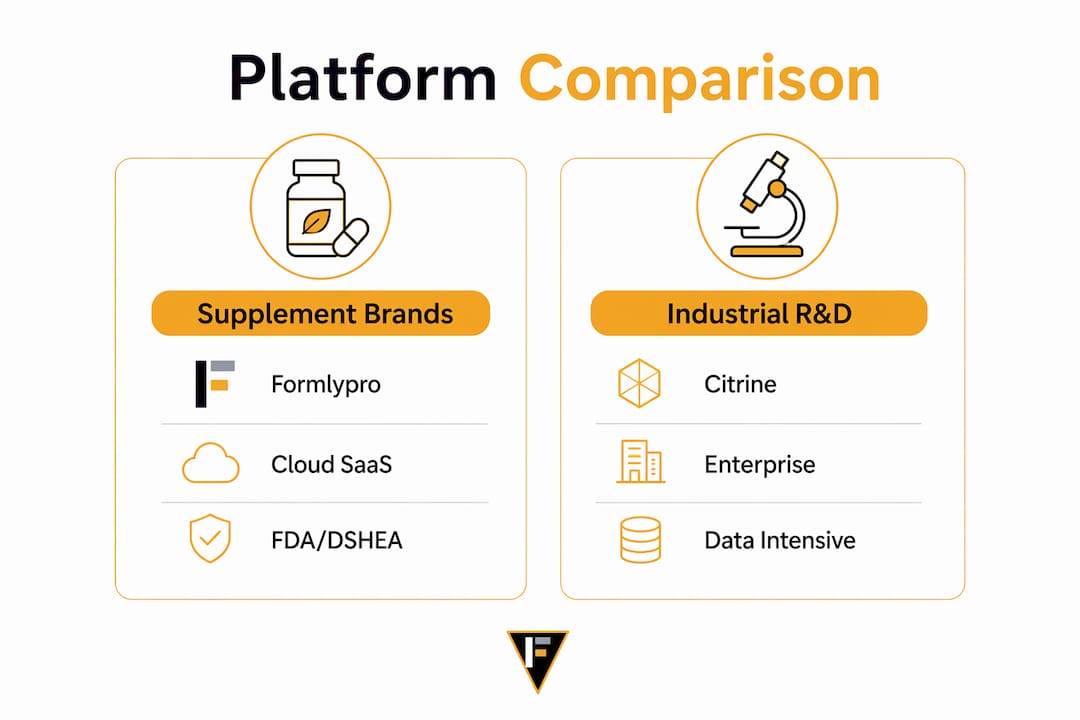
Which tools fit supplement brands vs. industrial R&D?
The divide is sharper than most comparison articles admit. Industrial and materials R&D platforms are optimized for structured data environments, long experiment cycles, and deep hardware integration. Supplement and wellness brands operate on different constraints: faster launch cycles, consumer-facing compliance requirements, and limited internal R&D infrastructure.
Platforms like Schrödinger, Citrine Informatics, and Enthought are built for the former. They assume you have data engineers, LIMS administrators, and multi-year project budgets. Formlypro is built for the latter, where the founder is also the product manager and the compliance officer.
For brands exploring formulation tool alternatives across healthcare, nutraceuticals, and wellness, the key filter is simple: does the platform surface regulatory requirements during formulation, or after? Platforms that treat compliance as a post-formulation checklist create rework. Platforms that embed it in the workflow don't.
How does customer support differ across platform types?
Cloud-native SaaS platforms typically offer tiered support: self-service documentation, in-app chat, and dedicated onboarding contacts for higher subscription tiers. Response times are usually measured in hours, not days.
Enterprise platforms run a different model. Support is bundled into services contracts, and your primary contact is often a customer success manager who coordinates with a technical team. Response times depend on your contract tier, and critical issues may require escalation through a formal ticketing process.
Consultative managed services offer the most hands-on support by definition, but it's billed by the hour or project. Every question costs money.
For supplement founders, the practical question is whether you can get a formulation question answered on a Tuesday afternoon without opening a support ticket. That's a SaaS-first experience, not an enterprise one.
How do interfaces differ across formulation platforms?
Enterprise platforms tend toward dense, data-rich interfaces designed for scientists and data engineers. They're powerful but require training. A new user without a chemistry or data science background will struggle to extract value quickly.
Cloud-native SaaS platforms prioritize guided workflows. The interface walks you through each decision point, surfaces relevant compliance information inline, and produces outputs in formats a non-scientist can act on. Formlypro's 8-phase workflow is a good example of this approach: each phase has a defined input and output, so you always know where you are and what comes next.
Self-driving-lab platforms sit in the middle. The optimization engine is often abstracted behind a clean interface, but configuring hardware integrations and data pipelines still requires technical skill.
How well do these platforms integrate with lab and enterprise software?
Integration depth varies dramatically by category. Enterprise digital-twin platforms like those from Siemens and Dassault Systèmes BIOVIA are built to connect with ERP, MES, and LIMS systems out of the box. That's their core value proposition for large manufacturers.
Self-driving-lab integrators like Atinary connect directly to robotics platforms and LIMS, keeping experiment metadata centralized and searchable. For brands that need stability testing workflows alongside formulation, confirming LIMS compatibility before signing is worth the extra due diligence.
Cloud-native SaaS platforms typically offer API access and export formats that connect to contract manufacturer workflows. Deep ERP integration is rarely available, but for most supplement brands, it's also rarely needed.
How scalable and customizable are these platforms?
Enterprise platforms win on raw customization depth. You can configure data models, build custom workflows, and integrate proprietary databases. The cost of that flexibility is implementation time and ongoing services fees.
Cloud-native SaaS platforms scale through subscription tiers and add-on modules. Formlypro's model of subscription tiers plus paid report add-ons is a good example: you start with core formulation and compliance features, then add deeper analytics as your product line grows. That's a sensible growth path for a brand launching its first two or three products.
Self-driving-lab platforms scale with your hardware footprint. More instruments, more automation, more data. The platform grows with your lab, not your product catalog.
What should you know about data security and privacy?
For supplement brands, the most sensitive data is your formula itself. Before signing with any platform, confirm how the vendor handles IP ownership, whether your formula data is used to train shared models, and what encryption standards apply to data at rest and in transit.
Enterprise platforms typically hold SOC 2 Type II certifications and offer private deployment options. Cloud-native SaaS platforms vary. Ask specifically about data isolation (whether your data is in a shared or dedicated environment), model training policies, and what happens to your data if you cancel.
A vendor that can't answer these questions clearly in a sales call is a vendor whose contract you should read very carefully before signing.
What trial and refund options are available?
Cloud-native SaaS platforms almost always offer a free trial, a freemium tier, or a demo walkthrough. Formlypro offers a demo and subscription tiers that let you evaluate the platform before committing to a full annual plan.
Enterprise platforms rarely offer self-service trials. You'll go through a sales cycle, a scoping call, and a proof-of-concept engagement before you see a real implementation. Refunds are governed by contract terms, not a standard policy.
Consultative managed services operate on project contracts. Refund terms depend entirely on the agreement. Always clarify milestone-based payment structures before work begins.
Key Takeaways
For supplement and wellness brands, cloud-native SaaS platforms with built-in FDA/DSHEA compliance guidance deliver the fastest time-to-value and the lowest total cost of ownership compared to enterprise or managed-service alternatives.
| Point | Details |
|---|---|
| Prioritize time-to-value | Startups should choose platforms that go live in days to weeks, not months. |
| Demand negative-data ingestion | Platforms that train only on successes reproduce blind spots; ask vendors directly. |
| Compliance must be built in | Supplement brands need FDA/DSHEA guidance during formulation, not as a post-step checklist. |
| Enterprise platforms carry hidden costs | Implementation fees and services often exceed the headline license price. |
| Formlypro fits supplement founders | Its 8-phase workflow, compliance guidance, and manufacturer-ready exports are built for fast product launches. |
The gap between what enterprise platforms promise and what founders actually need
The sales pitch for enterprise AI formulation platforms is compelling: unified data models, closed-loop automation, regulatory roll-ups across global markets. If you're running a multi-national CPG company with a dedicated data engineering team, that pitch is accurate.
For a supplement founder trying to launch a product in the next 90 days, it's a distraction. The honest trade-off is this: a platform that can do everything for a global manufacturer will spend your first three months doing nothing for you, because the implementation is still in progress. A platform built for your scale will have you generating formulations this week.
The founders who get this right tend to make the same call: pick the tool that fits your current stage, not the one that fits your hypothetical future scale. You can always migrate to a deeper integration platform when your data environment and team size actually justify it. You cannot get back the launch window you missed while waiting for an enterprise implementation to complete.
Formlypro is built for supplement brands that need to launch, not configure
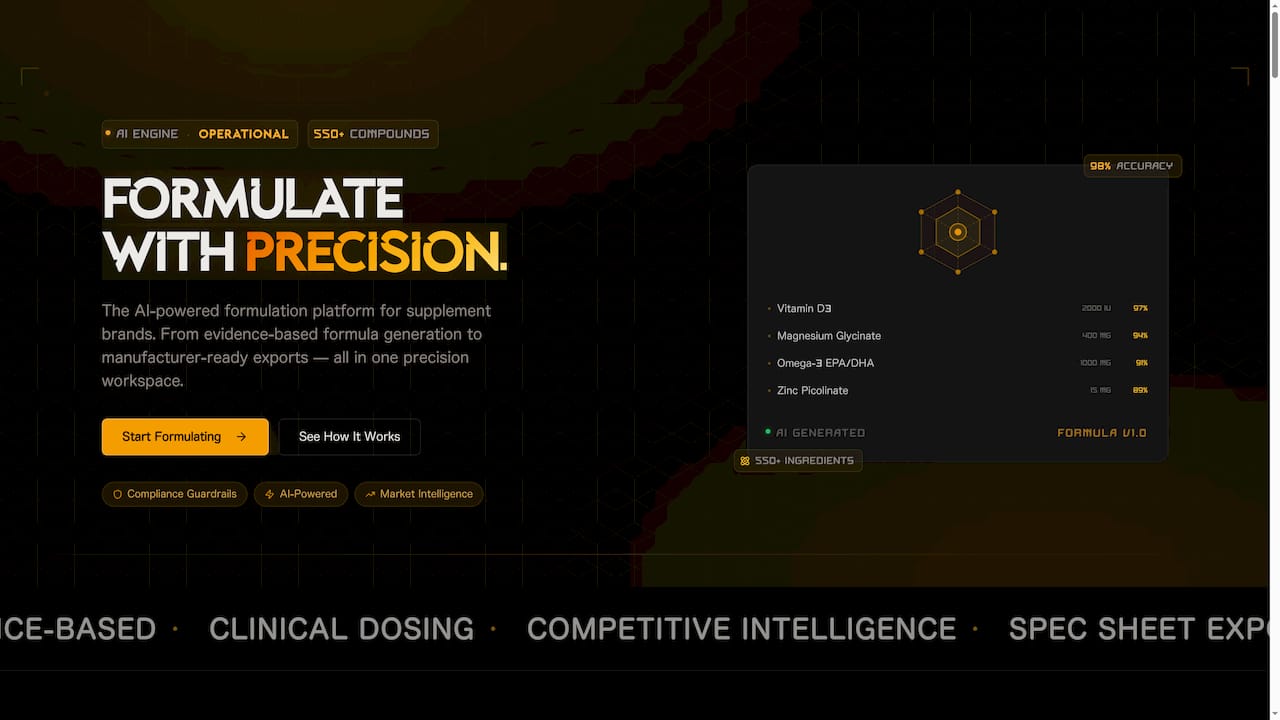
If you've been evaluating AI formulation tools and keep running into enterprise platforms with six-month onboarding timelines and opaque pricing, Formlypro is the direct answer to that problem. It's a subscription SaaS platform built specifically for supplement and wellness brands, with FDA/DSHEA compliance guidance, an 8-phase product development workflow, ingredient intelligence, market analytics, and an AI mockup packaging designer all under one roof.
You don't need a data engineering team or a multi-year contract. You need a platform that helps you go from concept to manufacturer-ready formula in weeks, with compliance built in from day one. Formlypro's subscription tiers let you start at the right level for your brand and add paid reports and advanced analytics as your product line grows. Start your formulation workflow today or request a demo to see the 8-phase plan in action.