

TL;DR:
- AI accelerates formulation development by reducing time-to-market through automated ingredient screening and predictive modeling. It significantly cuts material costs and improves product consistency by forecasting stability and compatibility early. Adoption challenges like data quality and interpretability are solvable with proper infrastructure and expertise.
AI in formulation is defined as the application of machine learning, predictive modeling, and data-driven decision support to design, test, and refine product formulas faster and with less waste. The benefits of AI in formulation are measurable and significant. Digital formulators paired with automated data systems can cut development time by 60% and reduce active pharmaceutical ingredient (API) material use by 65%. For formulators and product developers, that is not a marginal improvement. It changes what is possible within a single product cycle. This article breaks down the top advantages, the real limitations, and what comes next for AI-driven formulation techniques.
1. How AI accelerates formulation development timelines
AI in product development compresses the time between concept and finished formula. AI-assisted predictive engineering reduces product development time-to-market by 20–40%. That range reflects differences in how early teams integrate AI into their workflow.
The core mechanism is automation of formulation decisions that previously required sequential lab experiments. Machine learning models screen ingredient combinations, flag incompatibilities, and rank candidate formulas before a single physical batch is made. Teams that previously spent weeks on early screening can compress that phase to days.
Predictive modeling also reduces the number of design-of-experiment iterations needed. Instead of running a full factorial study across five variables, an AI model narrows the search space to the two or three combinations most likely to succeed. That focus saves both time and materials.
Pro Tip: Embed AI tools at the concept stage, not after your first prototype fails. Early AI integration aligns performance, cost, and manufacturability goals from day one, which is far harder to retrofit later.
Key timeline benefits include:
- Automated ingredient screening before physical testing begins
- Predictive narrowing of design-of-experiment variables
- Faster iteration cycles between formula versions
- Earlier identification of stability and compatibility issues
2. Reducing experimental workload and material costs
AI cuts the number of physical experiments a team needs to run. Predictive modeling and optimized experiment design reduce physical testing needs by up to 50%. That reduction directly translates to lower material costs, less lab time, and fewer analyst hours per project.

The savings on API materials are especially significant in pharmaceutical and nutraceutical formulation. APIs are expensive. When a digital formulator can simulate how a compound behaves across different excipient combinations, teams avoid wasting high-cost ingredients on experiments that a model already predicts will fail. The 65% reduction in API material use reported with integrated digital formulation systems reflects exactly this dynamic.
Simulated experiments also generate structured data that feeds back into the model. Each virtual run improves prediction accuracy for the next project. Over time, the system gets better at narrowing the experimental space, which compounds the cost savings across a product portfolio.
Practical areas where AI reduces experimental load:
- Excipient screening: Models predict compatibility before physical mixing
- Dissolution prediction: AI estimates release profiles without running full dissolution studies
- Stability forecasting: Algorithms flag degradation risks based on molecular and environmental data
- Batch size optimization: Simulations identify the minimum viable batch for meaningful data
For teams looking at formulation cost reduction strategies, AI-driven experiment reduction is one of the highest-leverage places to start.
3. Improving formulation quality and reproducibility
AI improves product consistency by removing subjective judgment from critical formulation decisions. AI models predict excipient compatibility, dissolution profiles, and stability with a level of consistency no manual review process matches at scale. That predictive capability directly supports Quality by Design (QbD) principles, which require developers to understand and control sources of variability from the start.
Data-driven optimization also catches formulation problems earlier. A model trained on historical batch data can identify patterns that precede a stability failure or a dissolution deviation. Human reviewers working from batch records alone often miss those patterns until a failure occurs in late-stage testing or, worse, post-launch.
Pro Tip: Use AI decision-support tools to build your formulation design space before you enter formal development. Defining acceptable ranges for critical quality attributes early reduces the risk of costly reformulation later.
Numbered steps where AI strengthens quality control:
- Predict critical quality attributes (CQAs) from raw material properties
- Map the design space for acceptable ingredient ratios
- Flag excipient interactions before they appear in physical testing
- Monitor batch consistency using real-time process data
- Generate reproducible documentation for regulatory submissions
AI acts as a decision-support layer here, not an autonomous system. Expert validation remains necessary, particularly when working from sparse or proprietary datasets. The combination of AI prediction and formulator judgment produces better outcomes than either alone.
4. Supporting compliance and regulatory documentation
Regulatory submissions require structured, traceable evidence that a formulation was developed with scientific rigor. AI in formulation processes generates that evidence automatically. Every model run, prediction, and experimental decision is logged, timestamped, and linked to the data that drove it. That audit trail is exactly what regulatory bodies expect under QbD frameworks.
AI tools also help formulators stay current with ingredient compliance requirements across markets. Ingredient status, permitted use levels, and labeling requirements change frequently across the FDA, EU, and other regulatory bodies. Automated compliance checks reduce the risk of submitting a formula that fails on a technicality discovered late in the review process.
For teams building market-ready formulations, the documentation advantage alone justifies AI integration. Reformulating after a regulatory rejection is expensive and delays launch by months.
5. Common challenges in adopting AI for formulation
The advantages of AI formulation are real, but adoption is not frictionless. Data scarcity, model interpretability challenges, and regulatory uncertainty are the three most cited barriers to widespread use. Each one requires a deliberate response, not a workaround.
Data scarcity is the most fundamental problem. AI models need large, structured, high-quality datasets to make reliable predictions. Most formulation teams have years of experimental data locked in lab notebooks, disconnected spreadsheets, or legacy LIMS systems. That data is rarely in a format an AI model can use without significant cleaning and structuring. Reliable AI requires structured data governance from project start. Retrofitting data processes after a model is already in use is difficult and often produces unreliable outputs.
Model interpretability is the second major barrier. Many high-performing AI models, particularly deep learning architectures, do not explain their predictions in terms a formulator or regulator can evaluate. That "black box" problem creates hesitation in regulated industries where every decision must be defensible.
Additional adoption challenges include:
- Workforce competence: Employee AI skills significantly amplify the innovation benefits from AI investment. Teams without AI literacy underuse the tools they buy.
- Integration complexity: Connecting AI tools to existing ERP, LIMS, and quality management systems requires IT resources most formulation teams do not have in-house.
- Regulatory uncertainty: Agencies are still developing guidance on AI-generated evidence in submissions. That uncertainty slows adoption in highly regulated categories.
None of these challenges are permanent. They are solvable with the right data infrastructure, training investment, and regulatory engagement.
6. Where AI delivers the greatest impact in the product lifecycle
AI is not equally useful at every stage of formulation development. AI impact is highest during early concept development and early screening, with diminishing returns in later stages where physical testing and complex regulatory decisions dominate. That stage-dependent reality shapes how teams should allocate AI resources.
Early-stage screening is where AI replaces the most manual work. Generating and ranking hundreds of candidate formulas, predicting which combinations are worth testing, and identifying stability risks before any physical work begins are all tasks AI handles faster and more consistently than human teams. The formulation analytics advantage is most visible here.
Late-stage development still requires human expertise. Scale-up decisions, manufacturing process validation, and regulatory strategy involve judgment calls that current AI tools cannot make reliably. Treating AI as a replacement for experienced formulators in those stages leads to errors that are expensive to fix.
"The teams getting the most from AI in formulation are not replacing scientists. They are giving scientists better information, faster, so human judgment is applied to the decisions that actually require it."
7. Future trends shaping AI-driven formulation
Generative AI, quantum machine learning, and federated learning are the three technologies most likely to reshape formulation development in the next five years. Each addresses a current limitation in a meaningful way.
Generative AI can propose novel ingredient combinations and delivery system architectures that fall outside the range of existing experimental data. That capability is particularly valuable in personalized medicine, where formulations need to be tailored to individual patient profiles at a scale traditional methods cannot support.
Federated learning allows multiple organizations to train shared AI models without sharing proprietary data. That approach directly addresses the data scarcity problem by pooling knowledge across companies while protecting competitive information. For an industry where formulation data is a core asset, federated learning changes the economics of AI model development.
Quantum machine learning remains earlier-stage, but its potential to process molecular interaction data at speeds classical computers cannot match makes it relevant for complex formulation problems involving large molecules or multi-component systems.
Teams that invest in data governance and AI literacy now will be positioned to adopt these technologies as they mature. The 2026 product development landscape rewards teams that build the infrastructure for AI before the tools demand it.
Key takeaways
AI in formulation delivers the greatest value when integrated early, supported by structured data, and combined with expert human judgment at every critical decision point.
| Point | Details |
|---|---|
| Timeline compression | AI reduces development time by 20–60% depending on how early it is integrated. |
| Material savings | Predictive modeling cuts physical testing needs by up to 50% and API use by up to 65%. |
| Quality improvement | AI predicts excipient compatibility, dissolution, and stability before physical testing begins. |
| Adoption barriers | Data quality, model interpretability, and workforce AI skills are the three main obstacles. |
| Stage-dependent value | AI delivers the most impact in early concept and screening stages, not late-stage validation. |
What I've learned about AI and formulation after years in the field
The conversation around AI in formulation often splits into two camps. One side treats it as a near-magical accelerant. The other dismisses it as overhyped software that does not understand chemistry. Both are wrong, and both miss the point.
What I have seen work consistently is this: teams that treat AI as a decision-support tool, not an autonomous formulator, get results. They use it to generate options faster, flag risks earlier, and document decisions more thoroughly. Then they apply formulator expertise to evaluate those outputs critically.
The teams that struggle are the ones who either expect AI to replace scientific judgment or who resist it entirely because the outputs are not always explainable. The black box problem is real, but it is manageable. You validate AI predictions against physical data. You build confidence in the model incrementally. You do not hand over critical decisions to a system you do not yet trust.
The near-term benefit is speed and cost reduction. The long-term benefit is the structured dataset your team builds while using AI. That dataset becomes a competitive asset. It trains better models, supports faster future projects, and gives you a defensible evidence base for regulatory submissions. Start building it now.
— Ben
Formlypro puts these AI advantages into one platform
Formulators who want to apply these AI benefits without building infrastructure from scratch have a direct path forward with Formlypro.
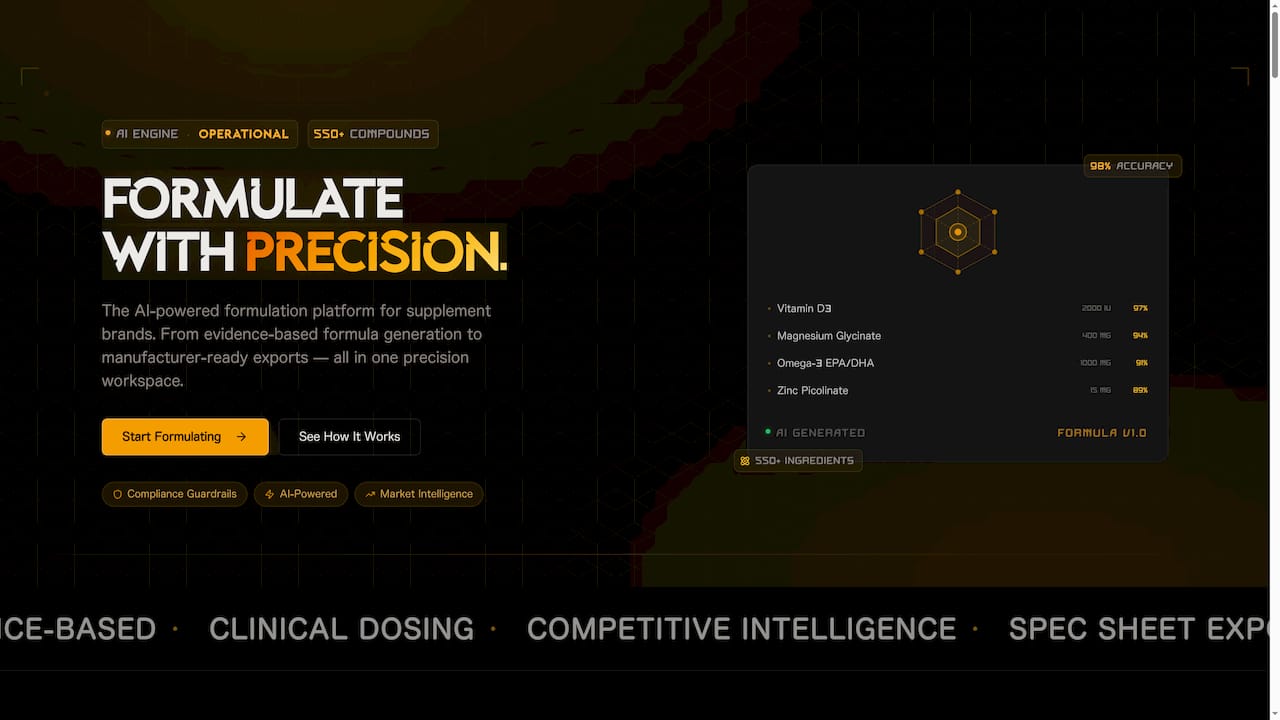
Formlypro is an AI-powered supplement formulation platform that covers the full product lifecycle, from ideation through compliance and production. The platform includes market research, competitor analysis, an 8-phase development plan, compliance guidance, and a packaging section with an integrated AI mockup designer. Every feature is built to give product developers the data and structure they need to move faster and make better formulation decisions. If you are building a new product and want AI working for you at every stage, Formlypro is where that starts.
FAQ
What are the main benefits of AI in formulation?
AI in formulation reduces development time by 20–60%, cuts physical testing needs by up to 50%, and improves formulation quality by predicting excipient compatibility and stability before lab work begins.
How does AI reduce formulation costs?
AI reduces costs by replacing physical experiments with predictive models, which lowers material use, analyst hours, and the number of failed batches that reach late-stage testing.
What are the biggest challenges in adopting AI for formulation?
Data scarcity, model interpretability, and regulatory uncertainty are the three primary barriers. Workforce AI competence also determines how much value a team extracts from its AI investment.
Is AI replacing formulators?
AI acts as a decision-support system, not a replacement for expert formulators. Current tools require human validation, particularly when working from limited or proprietary datasets.
When in the product lifecycle does AI deliver the most value?
AI delivers the highest impact during early concept development and ingredient screening. Its value decreases in later stages where physical testing and regulatory judgment dominate.